TL;DR: Automated QA can score every live chat against the same quality framework you use for voice when you change what you measure. Chat needs line items for written accuracy, policy wording, response gaps, concurrency, and bot-to-agent handovers, because chat has no audio cues. One quality framework can cover voice and chat when you add chat-specific line items and weightings. Human review still matters for high-risk interactions, while automation handles 100% of routine scoring.
QA programs built for voice often assume a conversation has audio, tone, and one customer at a time. Live chat adds failures those criteria may not catch: wrong answers buried in text, compliance wording that drifts from policy, and handovers that lose context.
How AI scores chat for compliance and outcomes
Automated QA scores live chat by reading the transcript against your scorecard, just as it does with voice. The AI looks for written accuracy, required disclosures word-for-word, response gaps, and bot-to-human handovers that lose context.
The Context Engine grounds every score in your own procedures. You upload your knowledge base and policy documents, and the AI checks whether the agent gave the right answer and followed your approved wording. A written record can make accuracy easier to verify than in voice.
Measuring accuracy in live chat
Accuracy in chat means checking whether the agent provided the correct information according to your knowledge base, in approved wording. The Context Engine gives the AI your uploaded documentation, and the automated line items compare each response against it, flagging conflicts with the evidence passage highlighted.
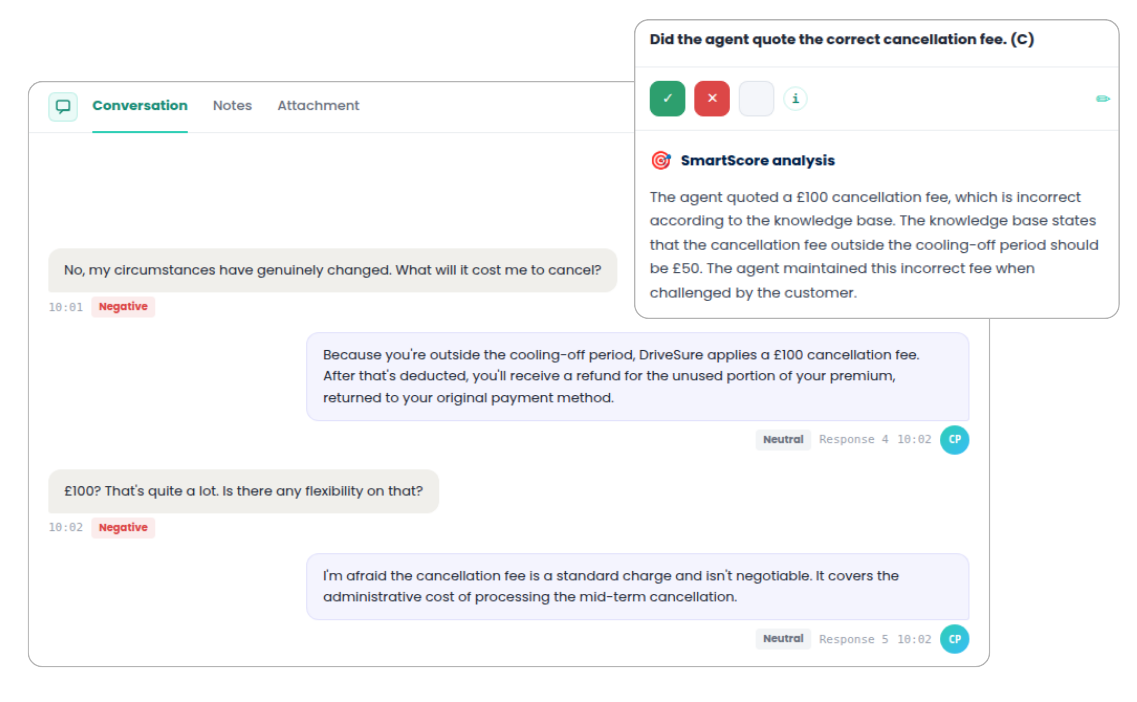 Alt text: SmartScore analysis checking whether an agent quoted the correct cancellation fee against the knowledge base, with pass or fail controls.
You define "correct" by writing guidelines that describe good performance. The AI then checks for those specific elements in every conversation.
Detecting chat response delays
Response time in chat is the gap between a customer message and the agent's reply. Chat transcripts carry a timestamp on every message, so you can score response gaps as part of your evaluation and coach on the conversations where customers were left waiting. Some chat platforms, such as Zendesk Chat, also send first, average, and maximum response times into evaluagent as fields you can filter and report on.
Standardizing responses for chat QA
Standardization in chat focuses on consistent policy language and approved templates. The AI checks that agents use your exact compliance wording for regulated products and deploy canned responses appropriately. Line Item Builder translates your plain-language requirements into automated checks, drafting the line item and testing it against real transcripts.
Auditing bot escalations
When a chatbot hands a conversation to a human agent, the handover can create a quality risk. The bot might have collected information incorrectly, misunderstood the intent, or failed to pass context. AI Agent Observability evaluates the entire journey, grading the bot's responses against your knowledge base and checking whether the human agent got what they needed.
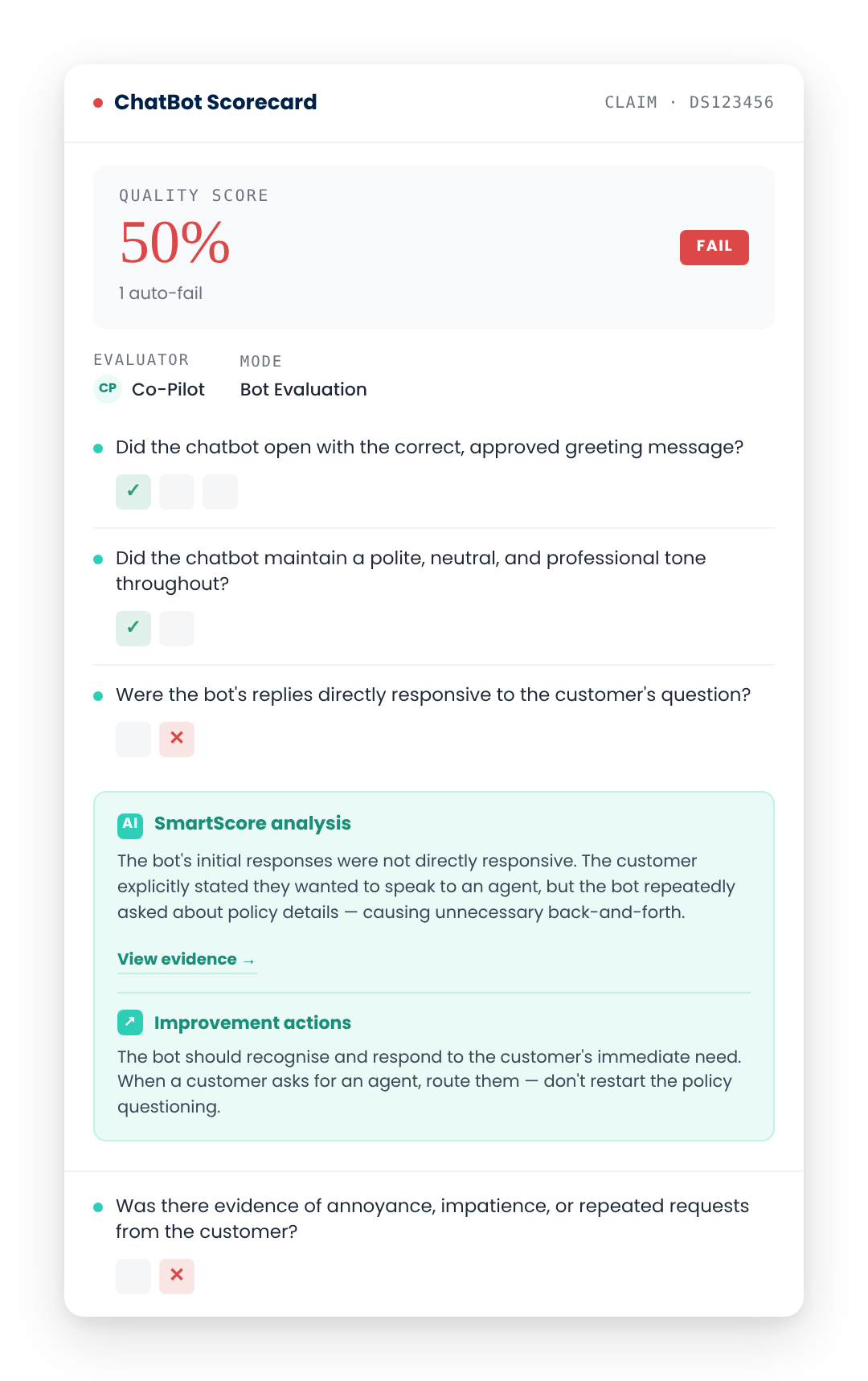 Alt text: Chatbot evaluation scorecard showing an overall quality score, pass or fail results for each line item, and a SmartScore analysis explaining where the bot failed.
Escalation precision (whether transferred conversations genuinely required a person) and missed escalation rate (conversations that should have transferred but didn't) together create an audit trail of where the bot failed and how the human recovered.
Evaluating chat QA vs voice QA requirements
Chat QA differs from voice QA because audio cues disappear, concurrency enters the picture, written text becomes the record, and bots may handle the conversation before a human does. Voice QA typically measures empathy through audio cues such as tone of voice. Chat QA typically infers sentiment from text signals such as word choice, while also managing simultaneous threads.
| Scoring dimension | Voice QA | Chat QA | What changes |
|---|---|---|---|
| Tone and empathy | Typically analyzes audio cues such as tone and pace | Typically infers sentiment from text patterns such as word choice and emoji use | Chat lacks audio cues, so the AI reads sentiment from text |
| Accuracy checking | Typically checks spoken answers against a knowledge base | Typically checks written answers against a knowledge base | Chat leaves a written record that customers can hold you to |
| Concurrency | One live agent per call, with many calls evaluated concurrently | Multiple simultaneous chats per agent | Chat requires measuring focus and context retention across threads |
| Bot involvement | IVR or voice bots may handle parts of the call | Bots can handle the initial query before handing over | Chat must score bot-to-human handovers |
| Compliance wording | Verbal disclosures | Written disclosures with exact wording | Chat requires precise text matching for regulatory language |
Analyzing chat data without audio
Without audio, you can't measure tone of voice, but you can measure written empathy and clarity. Sentiment analysis classifies customer mood from their messages, and the AI detects frustration cues in the customer's text, such as repeated questions or capitalization, which can indicate a service failure.
Standardizing language for QA
Where a disclosure has prescribed wording, the agent must match it verbatim or within a tight phrase window, on voice and chat alike. Automated QA checks that the required phrases appear. Vulnerable customer detection looks for signs of vulnerability in typed responses, such as confusion about simple processes, and checks whether the agent followed your protocol.
Measuring the impact of concurrent chats
Agents handling several chats at once can split their attention, and the cracks show up in the transcript: a customer called by the wrong name, details carried over from another conversation, or a question left unanswered. You can build line items that check for these signs on every chat, so concurrency problems surface in your scores rather than in complaints.
Identifying root causes of chat gaps
In chat, an unresolved ending can mean the customer stopped typing or the agent didn't close out the conversation. Reason for Contact analysis identifies why customers started the chat, and xResolution predicts whether it was actually resolved. Together, they show where unresolved chats cluster around particular intents, which often points to a process problem rather than agent performance.
When to trigger manual review for chat quality
Trigger human review for high-risk customer interactions, disputed AI scores, bot-to-agent handovers with context loss, and statistical outliers. Automated QA handles 100% of routine scoring, while Auto Work Queues route the conversations most likely to carry risk to human reviewers.
Flagging high-risk customer interactions
High-risk interactions in chat include conversations with vulnerable customers, complaints about financial loss, regulatory topics, and threats to escalate to social media. The AI flags these and routes them to a QA lead for manual review.
Auto Work Queues route high-risk conversations to human review, so QA leads see them first. Compliance checking can identify these high-risk conversations automatically.
Improving chat accuracy with human oversight
Calibration with human reviewers can build trust in AI scores. Run AI scores hidden while QA leads review a sample of the same chats, and adjust the scorecard before agents see the scores. The SmartScore report compares AI scores against human reviews, tracking agreement rates and showing the evidence passage behind every score, so you can refine the line item until it matches your standard.
Defining when to escalate chats
Escalation in chat can mean transferring to a supervisor or moving from a bot to a human. Automated QA scores whether the receiving agent had the context they needed. The handoff success rate can show whether a human reached the customer, and a manual sample of escalations can show whether conversation quality survived the transfer.
Refining automated scores for edge cases
Edge cases in chat include sarcasm, technical jargon, language mixing, and very short conversations. AI might misread "Great, just great" as positive sentiment when the customer is being sarcastic, so human reviewers can catch these cases during calibration. When an edge case scores incorrectly, the Line Item Builder rewrites the automated check based on your feedback, without writing prompts or code.
Standardizing QA across voice and chat channels
You can hold voice and chat to the same standard without forcing them onto the same scorecard. The core quality framework stays consistent (accuracy, compliance, resolution, empathy), while each channel gets the line items that reflect how it actually works. Whether that ends up as one scorecard or several depends on your operation, but the definition of good shouldn't change between channels.
evaluagent's AutoQM & Improvement scores every conversation against your framework, with AI-scored line items for the criteria that matter in each channel.
Unified scoring for voice and chat QA
Unified scoring works when you separate universal criteria from channel-specific ones. Universal items, such as "agent verified customer identity," apply to every channel. Channel-specific items reflect what each channel can show you: "agent avoided talking over the customer" only makes sense in voice, while "agent used clear formatting and correct grammar" belongs to chat.
Both channels can be scored against the same knowledge base, so calls and chats are held to the same answers and the same approved wording.
Tailoring QA for chat nuances
Chat brings risks that voice QA doesn't need to cover. One is written accuracy, because customers can screenshot it. Others are gaps between replies, details mixed up when agents juggle several conversations, and the quality of bot-to-agent handovers. You might weight these more heavily in chat, and weight empathy more heavily in voice, where tone is available to score.
Applying weighting to chat QA scores
Weighting reflects your business priorities. A sales-focused operation might weight conversion behaviors heavily, while a compliance-heavy one gives exact policy wording the largest share. Chat-specific risks, such as mixed-up customer details or long gaps between replies, need enough weight to trigger coaching when they fail. Auto-fail items can differ too: in chat, a missing written disclosure or incorrect regulatory information is a strong candidate, because the customer has it in writing.
Standardizing data for board review
Board reporting requires consistent metrics across channels. One quality framework lets you compare voice and chat quality directly.
SmartView dashboards display side-by-side comparisons of bot and human performance, giving the board one consistent quality view.
Evaluating vendors for automated chat QA
When selecting software for monitoring live chat quality, prioritize platforms that score 100% of conversations, offer explainable AI, integrate with your existing chat platform, and evaluate bots alongside humans. Look for vendors that don't sell contact center as a service (CCaaS) or AI agents, so they have no stake in grading their own homework.
Software for monitoring live chat quality should provide one view across every channel, which matters if you run voice, chat, and bots on different platforms.
Evaluating chat quality at scale
Check that a platform can score your full chat volume. AutoQA scores 100% of conversations, versus the small manual sample many teams review.
Look for platforms that score chats after they end, so coaching is based on recent conversations.
Integrating chat QA with your CRM
Chat QA must integrate with your helpdesk or CRM to pull transcripts and push scores back. evaluagent integrates with platforms such as Zendesk, Intercom, Freshdesk, and Salesforce. The platform should also pull metadata like wait time, queue, and agent ID.
Configuring human audit for chat QA
Human review configuration lets you set the percentage of chats that go to manual QA. Start with a small percentage and adjust it to your risk profile. Auto Work Queues point human reviewers at the conversations most likely to carry risk, such as vulnerable-customer or compliance failures.
Audit trail and compliance reporting
In regulated sectors, every automated score should show the evidence passage and the rule it mapped to, and you can export that data for compliance reviews.
Every AutoQA score shows the evidence and rationale behind it. In compliance reviews, you can show the scorecard and the human oversight process.
Aligning AI and human agent quality metrics
If you use chatbots alongside human agents, your QA platform must evaluate both to the same standard. AI Agent Observability grades bots against the same knowledge base as humans, flagging fabricated content, off-policy advice, and poor handovers, so you can compare bot and human performance fairly.
Connecting quality scores to cost and revenue
You can test whether chat QA pays for itself by tracking how chat quality correlates with first contact resolution, customer satisfaction, and cost to serve.
With evaluagent, Capital on Tap increased interaction coverage to 95%. Broader coverage gives you more chats to analyze for repeat contacts and first-time resolution.
Addressing root causes of repeat chats
Repeat chats occur when the first interaction didn't resolve the issue. Conversation Intelligence tracks xRepeats (predicted repeat contacts) and xResolution (predicted resolution) on every chat, so high repeat rates on specific intents can point to a process fix rather than individual coaching.
Automating regulatory oversight
Regulatory oversight in chat often involves checking that agents follow scripts exactly. Automated QA checks every chat for required disclosures, vulnerability triggers, and complaint handling procedures. With evaluagent, 1st Central cut QA planning time by 95%.
Lowering cost to serve with AutoQA
Chat's cost to serve depends on whether it resolves issues without creating repeat contacts. Automated QA can help identify which chat behaviors drive resolution, so you can coach agents on those behaviors.
AutoQA & Improvement starts at $35 per user per month. AutoQA & Improvement with Conversation Intelligence starts at $65 per user per month.
Quantifying chat impact for stakeholders
Predicted metrics like xCSAT and xNPS on every chat estimate satisfaction without relying on survey responses. You can use them to report on chat's effect on customer experience.
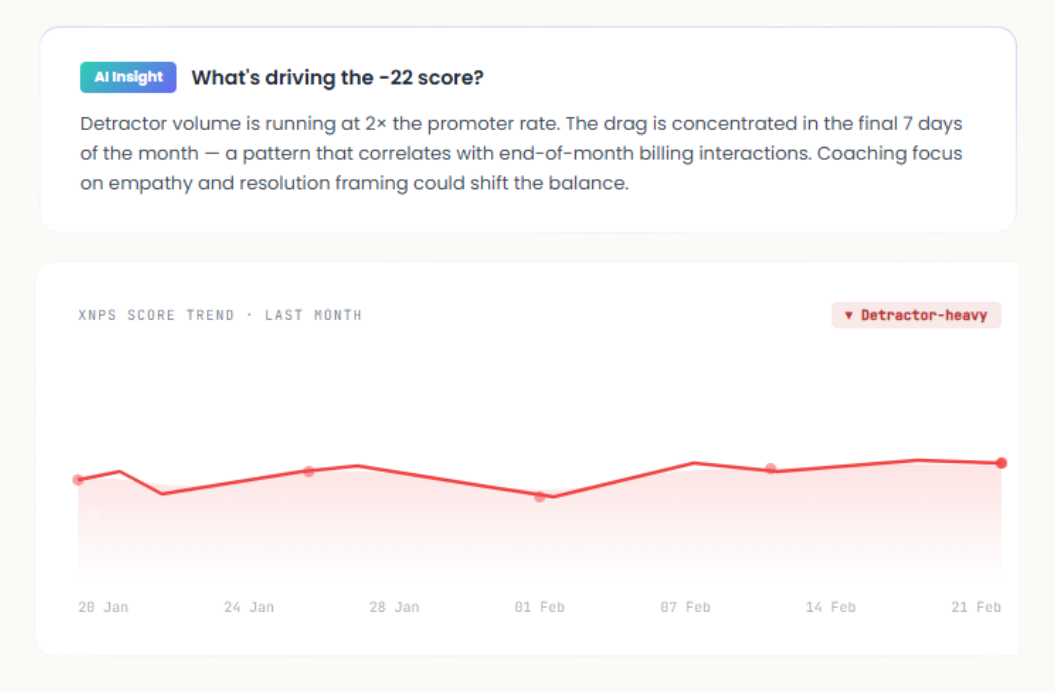 Alt text: AI-powered xNPS insight panel showing the drivers behind a low predicted score, with a trend chart and coaching recommendations for stakeholders.
evaluagent has 440+ reviews on G2 (October 2026).
The bottom line
Live chat quality assurance works when you measure what goes wrong in text-based, concurrent, bot-assisted conversations. Automated QA scores every chat against your definition of good, flags high-risk interactions for human review, and connects quality scores to the metrics your board tracks. One standard across every channel, for human and AI agents alike, gives you evidence you can show to regulators.
Book a personalized demo and see AutoQA working on your own conversations.
FAQs
Can automated QA score chat as reliably as voice?
Reliability depends on adapting the scoring criteria: chat needs line items for written accuracy, response time, concurrency, and bot handovers, while voice relies on tone analysis. Calibration against human reviews shows how closely AI scores match your standard.
Do I need separate scorecards for chat and voice?
Not necessarily. What matters is one consistent quality framework. Keep universal criteria like accuracy and compliance consistent across both channels, then add chat-specific line items for response gaps and written communication. Whether that means one scorecard or several depends on your operation.
How does chat QA handle concurrent conversations?
Concurrency problems show up in the transcript, such as a customer called by the wrong name, details mixed up between conversations, or long gaps between replies. You can build line items that check for these signs, so they're scored on every chat.
How much human review is needed for automated chat QA?
Human review is configurable, so you can set it to a small sample of chats focused on high-risk interactions. The AI scores 100% of conversations and routes risky ones to human reviewers.
Key terms glossary
AutoQA: evaluagent's automated quality assurance platform that scores 100% of customer conversations using AI against the business's own quality framework.
Context Engine: evaluagent's feature that grounds AI scoring in the customer's own knowledge base and procedures, checking whether agents gave the right answer rather than just whether they sounded polite.
Line Item Builder: An in-platform tool that drafts automated scorecard criteria from plain-language descriptions, testing them against real conversations before deployment.
AI Agent Observability: evaluagent's capability for evaluating chatbots and AI agents under the same quality framework used for human agents, ensuring comparable standards across automated and human service.
Conversation Intelligence: evaluagent's analytics suite (part of the AutoQA platform) that provides predicted metrics like xCSAT and xResolution on every interaction, plus root-cause analysis of contact drivers.
SmartScore report: An evaluagent report that compares AI scores against human reviews, tracking agreement and revision rates so teams can see where line items need refining.
Concurrency: The number of chats an agent handles at the same time. High concurrency can lead to context errors and slower replies, which chat QA can catch through line items for accuracy and response gaps.
Bot-to-agent handover: The point where a bot transfers a conversation to a human agent. QA scores whether the handover happened at the right moment and whether context survived the transfer.
xMetrics: Predicted customer outcome scores (xNPS, xCSAT, xCES, xRepeats, xResolution, xVulnerability) generated on every interaction without requiring survey responses.