Today, Quality Managers embracing AutoQA find themselves doing a job they didn't sign up for: becoming an amateur prompt engineer.
Whichever AI tool is in front of them – a general-purpose assistant or a platform's own automation – writing a good scoring prompt takes real technical skill.
Testing it, tweaking the wording, testing it again.
Most quality teams were never trained for that work, and it isn't why they were hired.
Seven or eight rounds of manual edits on a single line item isn’t unheard of. Pasting call transcripts back and forth into a general AI tool, watching it fixate on one scenario instead of generalizing, and still not landing on wording that scores reliably is all part of the ‘fun’.
Of course, it doesn’t have to be.
Prompts are important – but so is everything else
AI is supposed to lighten the load on quality teams.
Too often, without the right tooling, it does the opposite: it adds a new responsibility, asking already stretched Quality Managers to become part-time prompt engineers.
Time spent wrestling with prompt wording is time that could go toward other parts of the job that move the needle in other meaningful ways.
Free that time up, and it naturally flows toward three areas that also matter to the business:
- Evaluation deep-dives: exploring the calls flagged as high-risk, or poor sentiment, to discover what’s really going wrong at a root-level.
- Customer journey analysis: looking across interactions to spot patterns that a single scorecard, viewed in isolation, will never show you.
- Coaching: turning what the data shows into a conversation that actually changes how an agent handles the next call, which is the entire point of quality assurance.
That trade-off shows up everywhere quality teams are lean (which is a lot of them!).
It’s not that the prompt work isn’t important – it’s absolutely vital to your AutoQA accuracy. But it can be so much simpler.
Judgment first, technology second
Good AI tooling lets someone with deep knowledge of what good looks like on a call translate that knowledge directly into an accurate scoring model, without needing a parallel skill in prompt engineering to get there.
That's the thinking behind features like evaluagent's Line Item Builder. it puts a Quality Manager's expertise directly to work, translating what they already know into a tested, accurate line item without a detour through prompt engineering. The judgment stays human; the technical heavy lifting is handled for them.
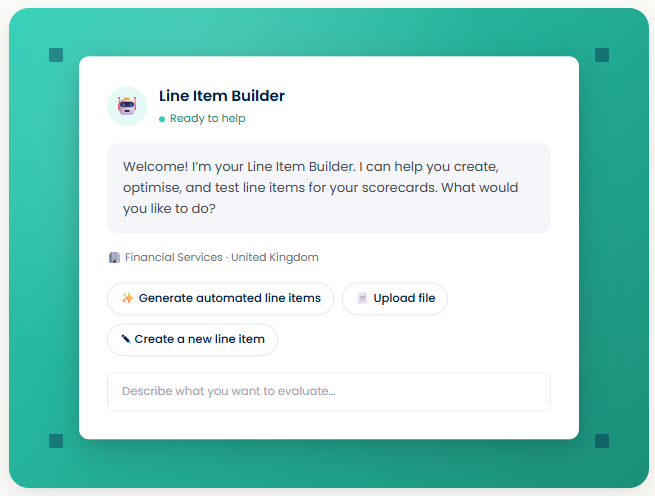
It’s a feature that enables Quality Managers to spend their time on evaluation, coaching, and making the case for what the data means for the business. The technical heavy lifting just happens in the background.
Line Item Builder by evaluagent represents AI at its best: solving a real problem, and giving your team time back to focus on the parts of the job that benefit from human insight and collaboration.
