Contact center leaders are increasingly getting more comfortable with the idea of AI scoring customer conversations, but the gap between embracing efficiency and risk mitigation is still wide.
Some AI QA tools work like a compliance rubber stamp: a number comes out, but the reasoning behind it stays hidden. McKinsey’s 2026 State of AI Trust report lists ‘Regulatory Compliance, ‘Inaccuracy’, and ‘Explainability’ as key facets of responsible AI – but in every instance, work to mitigate those risks is lagging behind awareness of them.
Yet contact centers face rising demand, and manual QA that covers a small sample size of conversations just isn’t viable for decision-making or compliance.
AI it is: but how do you reduce risk?
The black-box problem
When a score can't be explained, it can't be challenged either — a team can only accept it, or turn the feature off.
That's a difficult position in compliance-heavy industries like financial services or insurance, where a scoring decision might need to be defended months later, and it matters just as much for a Quality Manager whose own credibility with their team depends on being able to explain a result.
For AutoQA to be successful, it must be able to match the trust that businesses have in their own human QA teams. Without rationale, it’s neither defensible or trustworthy.
A defensible design bar
The standard worth building to is simple to state, but hard to deliver: the AI shows its reasoning clearly enough that a human can catch it when it's wrong.
Inside evaluagent, that standard shows up in more than one place.
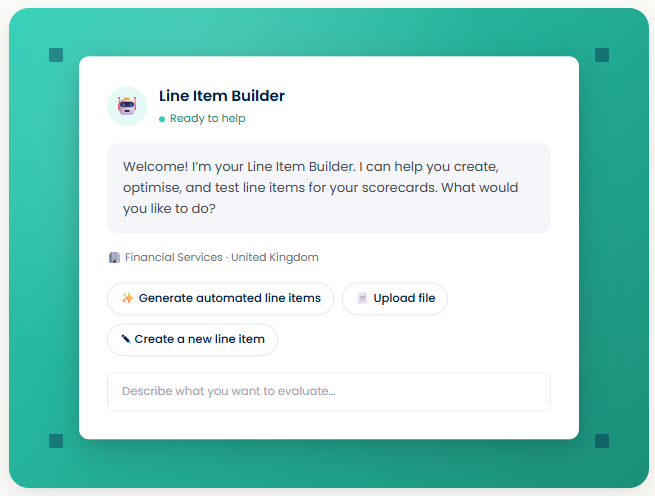
Line Item Builder is one of the clearest examples: when you test a line item against real conversations, you get the reasoning behind every score, not just the number. If you disagree, you say so — select the correct answer, explain what you saw in the transcript that the AI missed, and the builder rewrites the line item based on that feedback. Nothing goes live until a human has reviewed it and had the chance to push back.
SmartScore rationales work to the same standard, just at the point of evaluation. Alongside every AI-suggested score sits a detailed rationale explaining what the AI identified in the conversation and why it scored the way it did, so evaluators can choose to accept, revise, or challenge the score before it's ever published.
Explainability shows up as a design principle throughout evaluagent. It’s applied everywhere the AI makes a judgment call, not bolted on as an afterthought.
Explainable AutoQA, built-in
Explainability is what makes automation usable, at scale, in a function where the stakes are too high to run on blind trust. That's what complete visibility across every interaction means to us — every score comes with the reasoning behind it.
The contact centers getting real value from AI-assisted QA are the ones that build trust in from the start — giving evaluators (and agents!) the reasoning behind every score and the ability to challenge it, so confidence in the system grows with every evaluation, rather than being taken on faith.
