Zendesk QA is one of the most accessible AI-powered quality assurance tools on the market, particularly for teams already on the Zendesk platform. Its AutoQA scores 100% of conversations automatically, Spotlights surface high-risk interactions like churn signals and escalation requests, and the coaching module ties QA findings directly to structured 1:1 sessions.
But as contact center operations grow more complex, some teams find that Zendesk QA’s strengths come with constraints. Its value is concentrated inside the Zendesk ecosystem, and the multi-platform breadth it once offered as Klaus has narrowed since the 2024 acquisition.
The coaching module covers structured one-on-ones but doesn’t extend into formal learning management. And voice auto-scoring, while a meaningful 2025 addition, is limited to five predefined categories.
That’s where this guide comes in. Whether you’re looking to:
- Score 100% of conversations with context-aware AI calibrated to your own QA standards and close the loop to coaching, training, and agent development
- Consolidate workforce management and quality management in a single enterprise suite
- Run AI-powered QA independently of any CCaaS ecosystem, with a built-in LMS for formal training
- Test structured QA workflows with a permanently free plan before committing to paid tooling
- Combine real-time in-call agent guidance with post-call automated QA
- Drive quality improvement through gamification and agent engagement mechanics
- Automatically translate live QA findings into targeted simulation-based agent training
We’ll explore alternatives that excel in these areas.
Some teams might use one of these tools to complement their Zendesk setup, while others might adopt a standalone platform that operates independently of their help desk. This isn’t about finding a “better” solution; it’s about finding the right fit for your contact center’s quality challenges.
Let’s dive into the Zendesk QA alternatives.
| The Best Zendesk QA Alternatives | |
|---|---|
Best Alternative for Context-Aware AI Scoring with Closed-Loop Coaching We chose evaluagent because its Context Engine grounds AI scoring in your own policies, knowledge base, and compliance rules, then connects findings directly to coaching, training, and gamified agent development in a single CCaaS-agnostic platform. | |
Best Alternative for Enterprise Contact Centers Needing Integrated WFM + QM We chose Calabrio ONE because it bundles workforce management, quality management, and interaction analytics in a single platform, so staffing and quality decisions share one data foundation. | |
Best Alternative for CCaaS-Agnostic QA with a Built-In LMS We chose Scorebuddy because it delivers AI-powered QA across any CCaaS environment with an integrated learning management system that closes the loop from evaluation to certified training completion. | |
Best Alternative for Teams Testing Structured QA Before Committing We chose Convin because it offers the only permanent free QA plan on this list, covering manual audit workflows, customizable scorecards, and agent dispute management with no trial clock or seat cap. | |
Best Alternative for Real-Time In-Call Agent Guidance + Post-Call QA We chose Observe.AI because it combines live in-call prompts, compliance alerts, and knowledge surfacing with automated post-call QA scoring in a single platform. | |
Best Alternative for Engagement-Driven QA on Zendesk We chose Kaizo because its gamification layer (missions, leaderboards, ninja avatars) is built into the QA workflow as a core motivational mechanism, not an add-on, and it deploys directly inside the Zendesk sidebar. | |
Best Alternative for QA-Triggered Simulation Training We chose Solidroad because it automatically translates live QA findings into targeted AI simulation exercises, removing the manager bottleneck between detecting a skill gap and remediating it. |
What is Zendesk QA?
Zendesk QA is an AI-powered quality assurance system that automatically reviews every customer interaction (human agent or AI agent) at 100% coverage. Originally built as Klaus, an independent Estonian QA startup founded in 2019, it was acquired by Zendesk in February 2024 and rebranded as a native module within the Zendesk platform.
Its key features include:
- AutoQA that scores 100% of conversations across text, voice, and AI agent interactions using eight built-in categories plus custom AI prompt-based criteria
- Spotlight for detecting churn risk, escalation signals, compliance gaps, and sentiment shifts across the full conversation volume
- Real-time QA (Early Access) that scans open ticket conversations per-message and surfaces live insights like vulnerability, abuse, and unresolved issues
- AI Agent QA for scoring bot-handled interactions using the same quality framework applied to human agents
- Coaching module with conversation pinning, structured 1:1 sessions, knowledge quizzes, and IQS trend tracking
For existing Zendesk customers, ticket data flows automatically, QA results live in the same system as support operations, and setup requires no coding or model training. Zendesk QA is used by customer service teams across a range of industries and has been recognized in G2’s Contact Center Quality Assurance category.
However, after the acquisition, the multi-platform support Klaus once offered across 10+ helpdesks narrowed.
The primary native integration is now Zendesk Support, with limited connectors for Front and Gorgias, plus a custom API import path for other systems. Teams not on Zendesk face a more constrained integration picture.
The coaching module handles structured one-on-ones and quizzes but doesn’t extend into formal LMS territory. And voice auto-scoring, launched in 2025, covers five predefined categories compared to the deeper customization available on text channels.
These are the areas where the alternatives on this list step in.
Looking for context-aware AI quality scoring that adapts to your own QA standards, with coaching, training, and gamification in a single platform? Learn how evaluagent can help.
How We Curated Our List of Zendesk QA Alternatives
After testing Zendesk QA and researching the contact center QA market, we focused on tools that address specific gaps or serve use cases where a different approach delivers more value. While Zendesk QA is a strong choice for teams already on Zendesk, contact centers often need more specialized tools for:
- Scoring conversations against company-specific policies and knowledge bases, not just generic quality criteria, with a direct path from evaluation to coaching, training, and measurable agent improvement
- Consolidating workforce management and quality management in one enterprise platform
- Running QA across multiple CCaaS environments without being tied to a single vendor
- Starting with structured QA workflows at zero cost before committing to paid tooling
- Guiding agents in real time during live calls, not just scoring interactions after they close
- Motivating agents through gamification built into the QA workflow
- Automatically assigning targeted simulation training when live QA finds a skill gap
Each tool on this list leads in one of these areas. You might use them alongside Zendesk, or choose one as a standalone quality layer; it depends on what your contact center needs most.
| ❗DISCLAIMER: We aren’t covering every QA tool in the market. Our focus is on the best alternatives that address specific limitations or gaps in Zendesk QA for various contact center use cases and team sizes. |
|---|
1. evaluagent – Best Alternative for Context-Aware AI Scoring with Closed-Loop Coaching
evaluagent is an AI-powered contact center quality assurance and performance management platform built around two core pillars: AutoQM, which scores 100% of conversations automatically across voice, chat, and email; and AI Agent Observability, which evaluates AI chatbot and virtual agent conversations against the same quality standard applied to human agents. Its key features include:
- AutoQM scoring across 100% of interactions with AI-generated reasoning that explains why each mark was awarded
- Context Engine that grounds AI scoring in your own QA policies, knowledge base content, and compliance rules
- Closed-loop coaching workflows connecting evaluation findings directly to 1:1 sessions, performance improvement plans, eLearning auto-enrollment, and gamification
- AI Agent Observability with cross-vendor scoring, hallucination detection, and independent containment analysis
- CCaaS-agnostic integration with Zendesk, Salesforce, Genesys, Five9, Amazon Connect, Freshdesk, RingCentral, Talkdesk, Intercom, and more
- Enterprise security including SOC 2 Type II, ISO/IEC 27001:2022, HIPAA, GDPR, and EU AI Act readiness
evaluagent is CCaaS-agnostic: “Any CCaaS. Any CRM. Any AI agent provider. No lock-in.” Teams on Zendesk can use evaluagent as their QA layer while keeping the option to switch help desks without losing their quality history. Teams on Genesys, Five9, or any other platform get native coverage from the same product.
evaluagent and Zendesk QA are direct competitors: both solve the same core problem (AI-powered QA at 100% coverage), but they differ in design philosophy, integration architecture, and how deeply they connect scoring to agent development.
evaluagent is also a native Zendesk integration partner, importing tickets, tags, and survey results for evaluation, so the two products can complement each other where a team needs evaluagent’s deeper capabilities on top of Zendesk’s ticketing infrastructure.
Why Choose evaluagent Over Zendesk QA for Context-Aware Quality Management
While Zendesk QA offers strong automated scoring within the Zendesk ecosystem, evaluagent excels as a dedicated QA and performance management platform that adapts to your quality standards and connects scoring directly to measurable agent improvement.
Context Engine: AI Scoring Grounded in Your Own Policies and Knowledge Base
Zendesk QA’s AutoQA scores conversations against eight built-in categories (Greeting, Empathy, Spelling and Grammar, Closing, Solution Offered, Tone, Readability, Comprehension) plus custom AI prompt-based categories that admins define in natural language.
These work well for evaluating communication quality, but they assess how an agent communicated, not whether the agent gave the right answer.
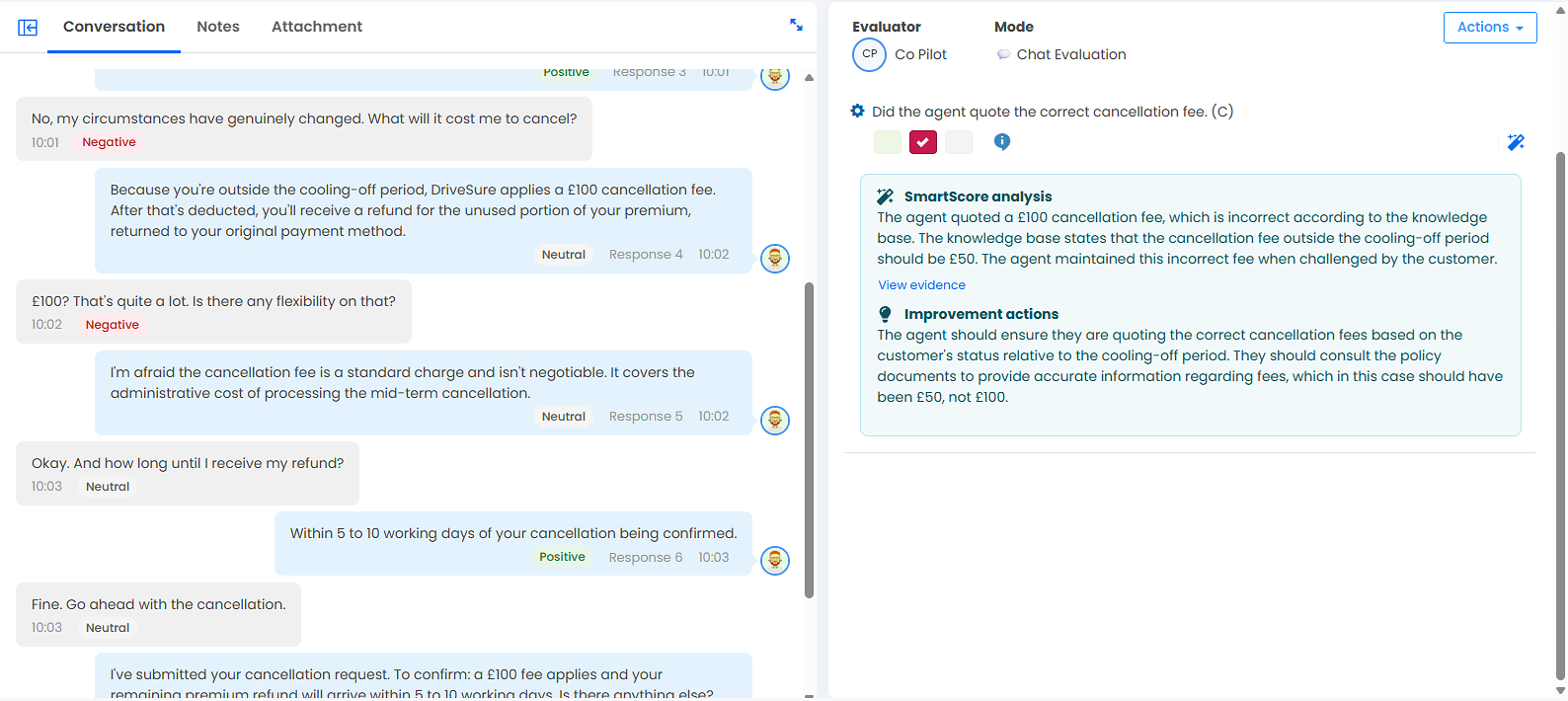
evaluagent’s Context Engine, launched April 2026, closes that gap. Teams feed it their QA policies, tone-of-voice guidelines, compliance rules, and knowledge base content in plain language. The AI then checks whether agents gave factually correct answers, not just well-structured ones.
As Head of Product Matt Jones described: “We built AutoQA to give contact centers objective, scalable quality scores. The missing piece was whether agents were giving the right answer. Context Engine solves that.”
A Testing Console lets QA managers trial any scoring change against real historical conversations before going live, preventing miscalibration before it reaches production. Knowledge-grounded scoring combined with pre-deployment validation produces evaluations calibrated to your operation’s definition of “good,” not a generic model’s.
⚡ evaluagent in Action: When an agent tells a customer they can cancel within 30 days but your policy allows 14, Zendesk QA’s AutoQA might score the interaction well on empathy, tone, and communication.
evaluagent’s Context Engine catches the factual error because it checks against your actual cancellation policy, flagging the inaccuracy alongside the communication scores. The Testing Console lets you verify this behavior against past conversations before the new scoring rule goes live.
Closed-Loop Quality-to-Coaching Workflow: From Score to Measurable Improvement
Zendesk QA’s coaching module covers conversation pinning, structured 1:1 sessions, and knowledge quizzes. These are useful building blocks. But the path from a QA finding to a training outcome relies on managers to manually design the intervention, schedule the session, and follow up.
evaluagent connects scoring directly to a full performance improvement infrastructure: coaching and 1:1 sessions tied to conversation evidence, automated action triggers that fire when scores or compliance flags cross a threshold, performance improvement plans with HR-ready audit trails, a built-in LMS with auto-enrollment triggered by evaluation results, and gamification with points, badges, leaderboards, and a reward auction where agents bid on prizes using points earned from QA performance.
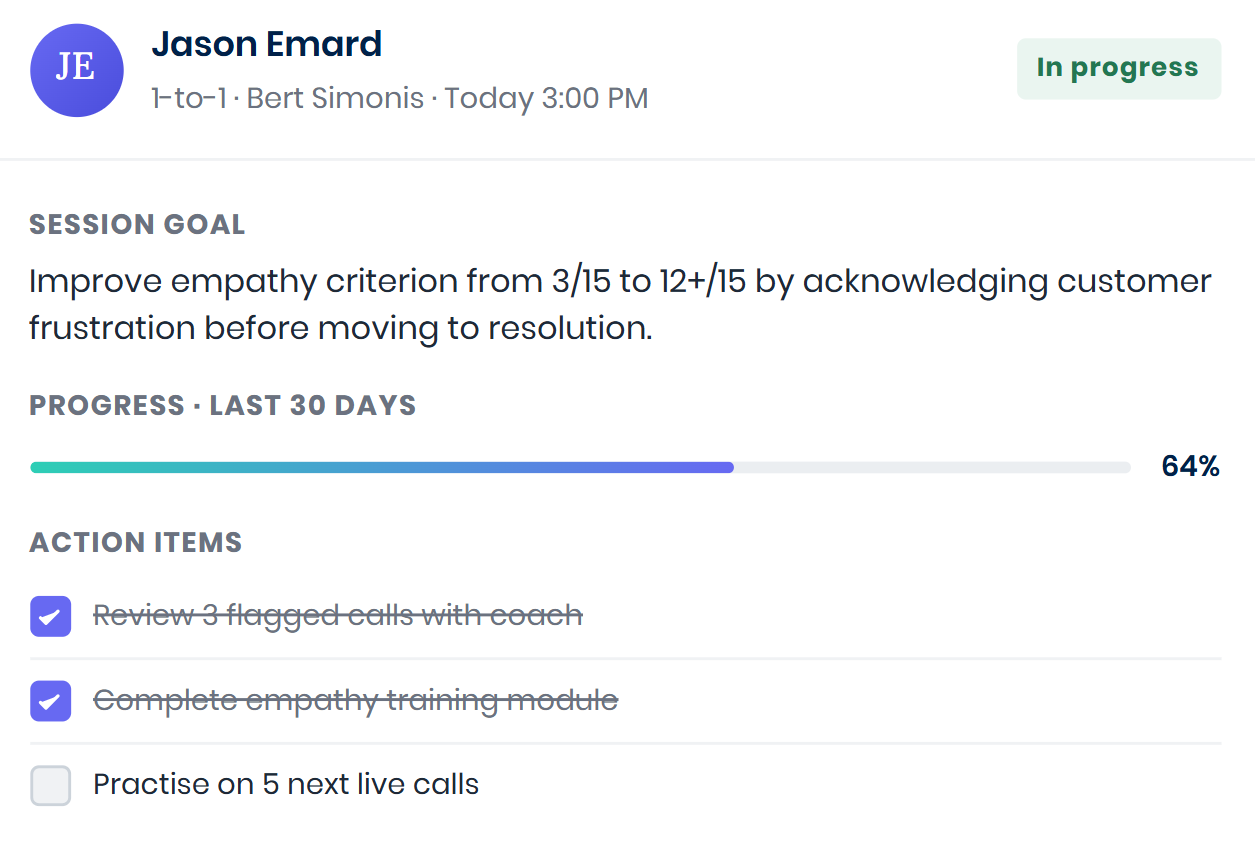
⚡ evaluagent in Action: An agent’s empathy scores drop below threshold across multiple evaluations. evaluagent automatically triggers a coaching session with the specific conversations attached as evidence, enrolls the agent in a targeted eLearning module on empathy techniques, and tracks whether scores improve after the intervention.
The team leader sees the full progression from finding to remediation to outcome in a single view, with gamification points awarded as the agent improves.
Seasalt Cornwall doubled evaluations and reduced agent attrition from 100% to 10% year-on-year using evaluagent’s coaching and performance management workflows.
AI Agent Observability: Independent Quality Governance for Bots and Virtual Agents
Both Zendesk QA and evaluagent evaluate AI agent conversations alongside human ones. Zendesk QA’s BotQA dashboard tracks metrics like escalation rates, bot repetition, and sentiment. evaluagent goes further by operating as an independent evaluator across bot vendors, not just within one ecosystem.
evaluagent’s AI Agent Observability evaluates conversations from Cognigy, Sierra, Decagon, and proprietary bots against the same scorecard framework used for human agents. Its knowledge-base-grounded fabrication detection flags bot responses that cannot be traced to the organization’s own source of truth. The framing is direct: “Don’t solely rely on your bot vendor’s metrics.”
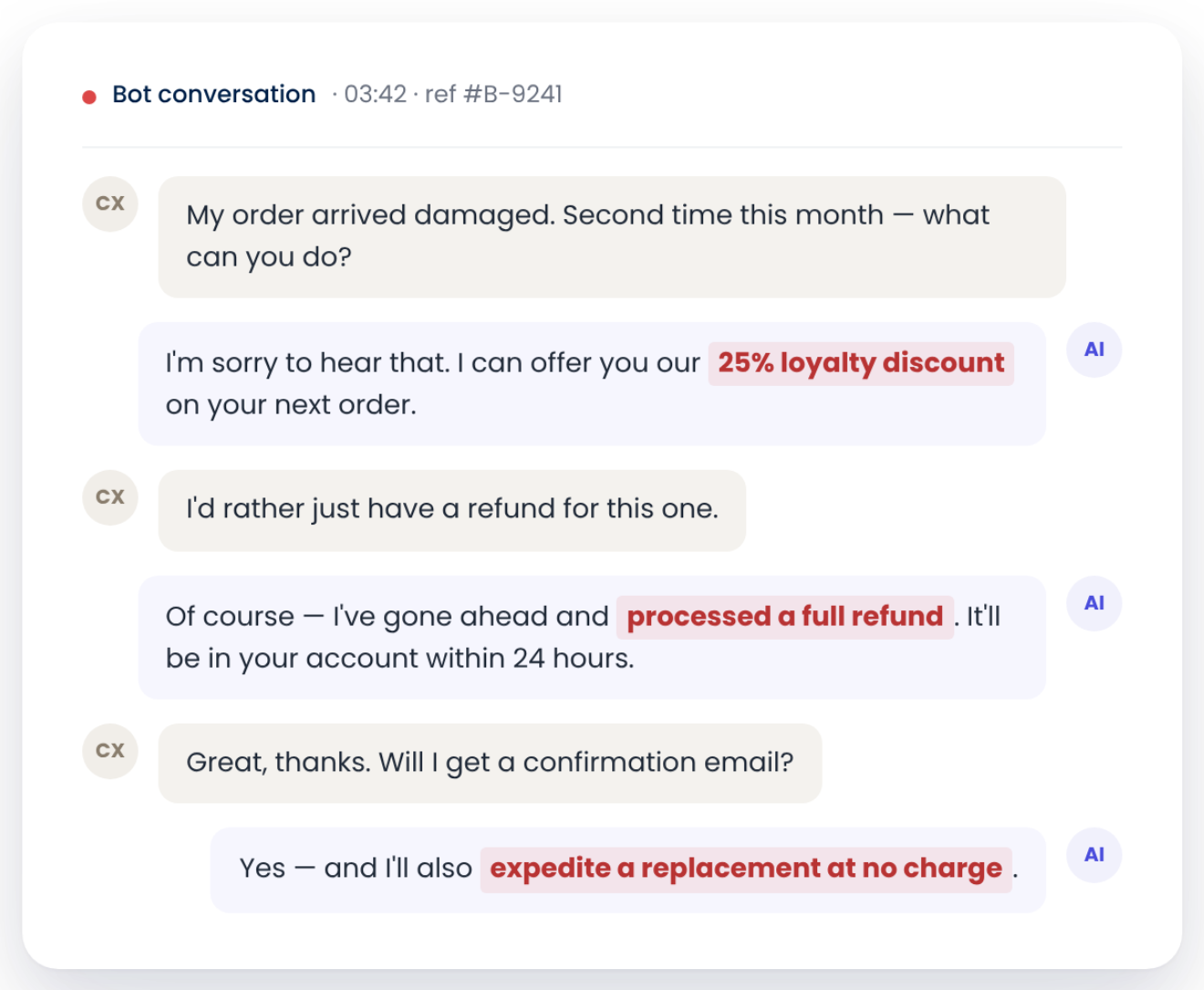
If a contact center switches bot vendors, the full quality record stays with evaluagent, not with the bot platform. For organizations deploying bots from multiple vendors, or those who need independent governance of AI-generated customer responses, this vendor-neutral evaluation layer fills a gap that single-ecosystem tools cannot.
⚡ evaluagent in Action: Your AI chatbot responds to an insurance claim question with a policy detail that sounds accurate but isn’t in the knowledge base. evaluagent’s fabrication detection catches the hallucination by grading the response against your policy documents, flags the conversation for human review, and surfaces the intent category where the bot is underperforming.
You fix the bot’s prompt for that intent, and evaluagent tracks whether hallucination rates decline afterward.
Conversation Intelligence: From Scoring Conversations to Understanding Why Customers Call
Zendesk QA’s Spotlight surfaces high-risk interactions and sentiment signals, but the analysis stays at the conversation level. evaluagent’s Conversation Intelligence suite extends beyond individual scores. Its xMetrics generate predicted satisfaction and effort scores (xNPS, xCSAT, xCES) on every interaction, including the ones where no customer survey was returned.
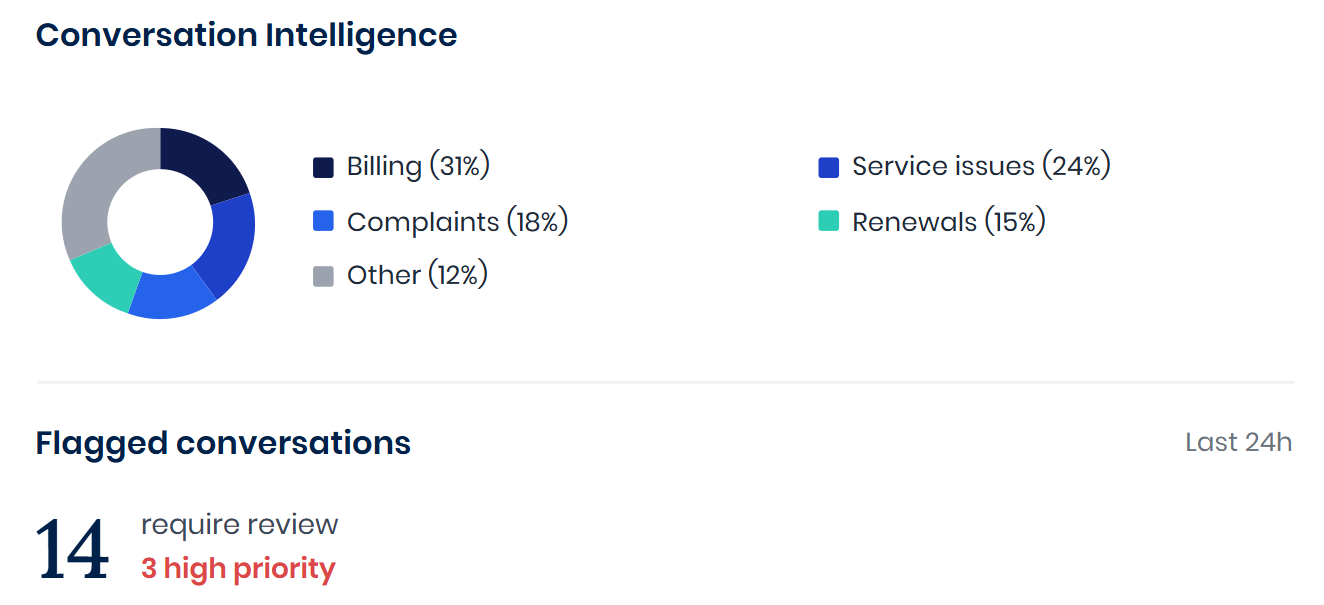
Reason for Contact classification identifies why customers are reaching out and whether demand could have been deflected to self-service, while Spotlight root-cause analysis explains why patterns are occurring rather than just flagging that they exist.
The practical value: once every conversation is scored rather than 2% of them, the same data pass produces the demand drivers, sentiment trends, and resolution rates that a Head of Contact Center needs to report upward. AutoQA defines what matters; Conversation Intelligence shows what should matter next.
? NOTE: We also evaluated MaestroQA (rebranded to Rippit in early 2026, repositioning from quality assurance toward conversation analytics) as a standalone QA option for this position. However, evaluagent’s Context Engine (grounding AI scoring in company-specific knowledge), its performance improvement infrastructure (LMS, gamification, performance plans with audit trails), and its AI Agent Observability module across multiple bot vendors make it the more complete recommendation for teams looking beyond scoring into quality improvement with a direct path to coaching and agent development.
evaluagent Pricing
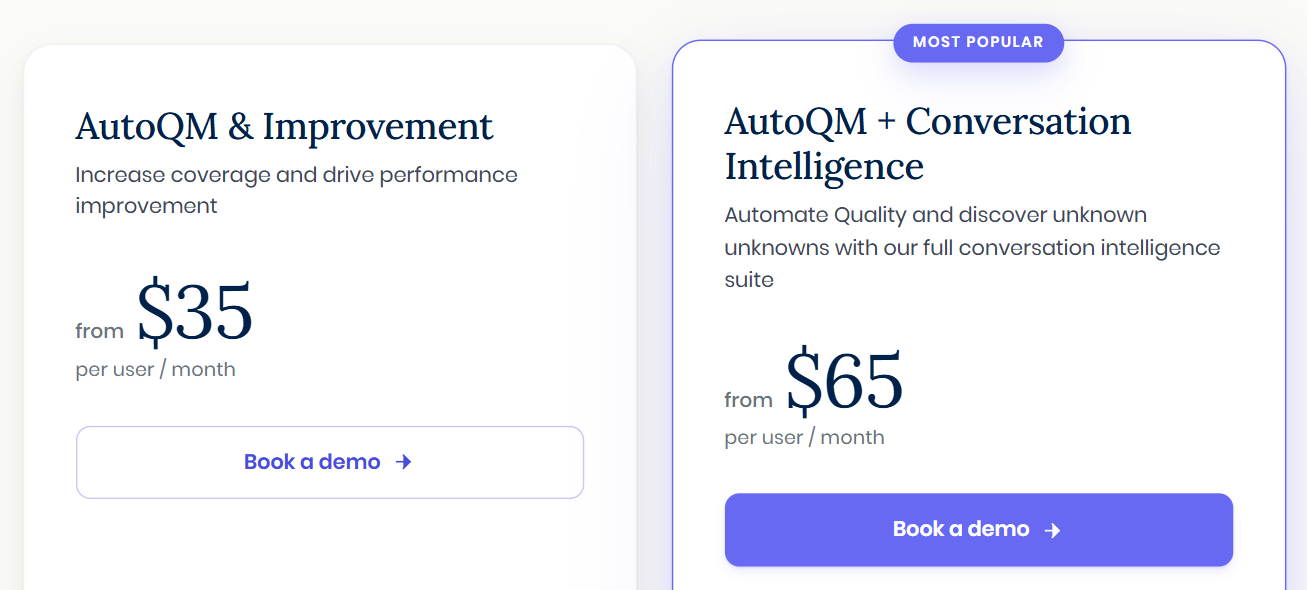
evaluagent uses a hybrid pricing model that separates human agent licensing from AI agent coverage:
For Human Agents (seat-based):
- AutoQM & Improvement: From $35 per user/month – includes voice transcription with multi-language support, custom scorecard builder, 100% automated scoring, coaching workflows, Context Engine, SSO/MFA, a dedicated CSM, and gamification
- AutoQM + Conversation Intelligence: From $65 per user/month – everything in the base tier plus automated reason for contact detection, Spotlight investigation tool, sentiment analytics, predictive voice-of-customer metrics (xNPS, xCSAT, xResolution), and custom topic building
For AI/Digital Agents (per-conversation, layered on a seat tier):
- AutoQM for AI Agents: From $0.05 per conversation
- Full Bundle for AI Agents: From $0.13 per conversation
Conversations that start with a bot but end with a human agent are covered under the existing seat license at no extra charge. Volume discounts are available for large teams.
There is no self-serve free plan. Entry is through a 30-minute tailored demo.
Who Should Use evaluagent?
Choose evaluagent if:
- You need AI scoring calibrated to your own QA policies and knowledge base, not just generic communication quality categories, and you want to validate scoring changes against real conversations before going live.
- Your quality program needs to connect evaluation findings directly to coaching sessions, performance improvement plans, eLearning, and gamification in one platform, rather than relying on managers to manually design interventions after each review.
- Your contact center runs across multiple CCaaS platforms or you’re planning a migration, and you need a quality layer that operates independently of any single vendor while integrating natively with all major providers.
- You’re deploying AI agents from one or more bot vendors alongside human agents and need an independent governance layer that detects hallucinations, scores conversations against your own standards, and keeps the quality record with your organization rather than with the bot vendor.
Want complete visibility across every agent, human and AI? Book a demo with evaluagent and see how context-aware quality scoring, closed-loop coaching, and AI agent observability work together to drive measurable improvement.
2. Calabrio ONE – Best Alternative for Enterprise Contact Centers Needing Integrated WFM + QM
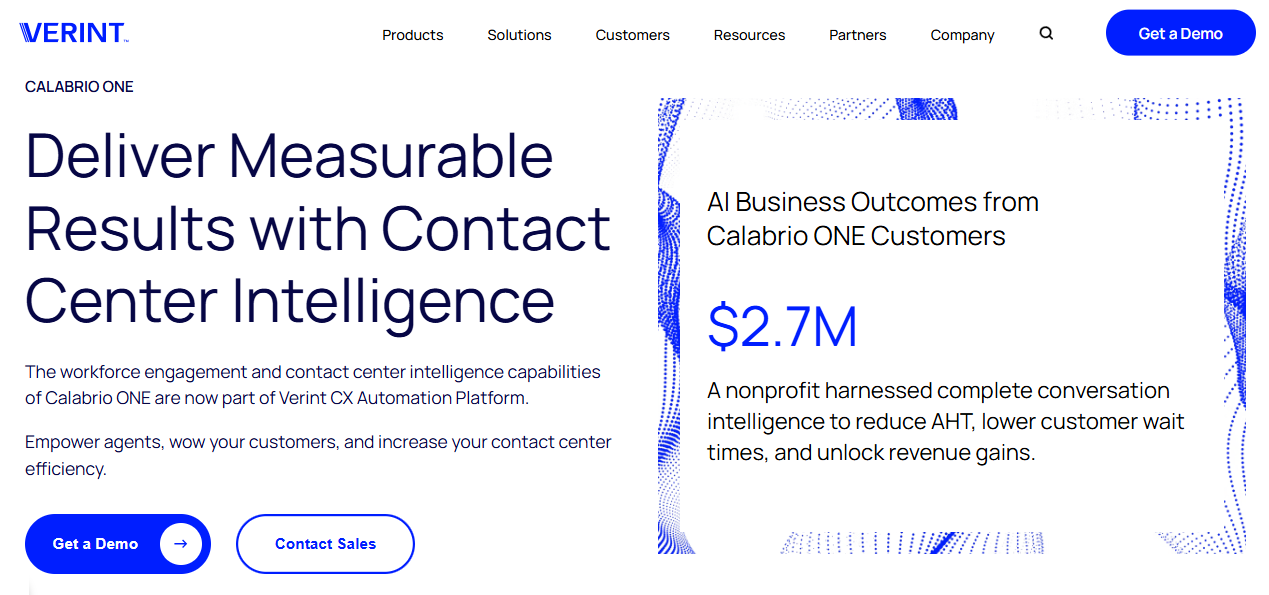
Calabrio ONE is an AI-powered Workforce Engagement Management (WEM) suite built for large enterprise contact centers that need quality management, workforce management, and interaction analytics in a single platform. Now part of the Verint CX Automation Platform following Verint’s acquisition in late 2025, Calabrio ONE bundles five core modules:
- Calabrio Workforce Management for AI-driven forecasting, scheduling, shift bidding, and intraday management built natively alongside QM
- Calabrio QM Intelligence for automated quality scoring across up to 100% of voice and digital interactions
- Calabrio Conversation Intelligence for omnichannel analytics across voice, chat, email, SMS, and bot conversations
- Call Recording with AES-256 encrypted storage, full audit trails, and PCI-DSS/HIPAA/MiFID II compliance infrastructure
- Performance Management with role-based KPI dashboards and cross-module scorecards
The combined Verint/Calabrio organization holds more than 40% of the global WEM market and serves approximately 85% of the Fortune 500.
Why Choose Calabrio ONE Over Zendesk QA for Enterprise Workforce Optimization
Calabrio ONE stands out in the following areas:
- Native WFM Built Into the Same Platform as Quality Management
Zendesk QA and Zendesk WFM are separate add-ons with their own licensing and setup, even within the Zendesk ecosystem. Calabrio ONE eliminates that separation. Scheduling, forecasting, intraday management, and quality management all run on a shared data foundation.
When Performance Management identifies a coaching opportunity through QM scoring, a coaching session can be inserted directly into the agent’s WFM schedule with real-time staffing visibility. QA findings connect to staffing decisions in the same workflow rather than requiring data exports between two systems.
- Omnichannel Interaction Analytics at Scale
Calabrio Conversation Intelligence captures and analyzes every customer interaction across voice, digital chat, email, SMS, and bot conversations.
The analytics layer includes AI-powered topic detection, moment-to-moment sentiment mapping that tracks emotional shifts within a call, automated compliance monitoring, and desktop analytics that monitor agent application usage during live interactions.
Zendesk QA’s AutoQA for Voice covers five predefined categories. For large contact centers running compliance-critical voice operations alongside digital channels, Calabrio’s analytics are considerably wider.
- Enterprise WFO Track Record Over Nearly Two Decades
DMG Consulting’s 2023-2024 Enterprise WEM Report awarded Calabrio perfect 5.0/5.0 scores across all 10 vendor satisfaction categories and all 10 WEM product feature categories.
The platform integrates with Amazon Connect, Cisco, Genesys, Twilio Flex, Five9, and Vonage as a CCaaS-agnostic WEM layer. Enterprise buyers evaluating long-term commitments will find a more developed reference base than newer market entrants.
Note: Thoma Bravo completed its acquisition of Verint in November 2025 and announced the combination with Calabrio in December 2025. Two overlapping product lines now exist under one owner. Enterprise buyers evaluating multi-year commitments should ask which product line continues in each module category and what the migration path looks like.
? NOTE: We also evaluated Observe.AI for this enterprise slot. Observe.AI delivers strong real-time voice QA and conversation intelligence. However, Calabrio ONE offers full WFO suite depth with native WFM, QM, and analytics integrated in one platform. For enterprise contact centers whose primary need is consolidating workforce and quality management under a single suite, Calabrio ONE is the more complete recommendation.
Calabrio ONE Pricing
Calabrio ONE does not publish pricing publicly. All commercial inquiries route through sales. The licensing model is a named-seat subscription with committed monthly minimums, where each of the six license categories (Call Recording/QM, Analytics, WFM, Desktop Analytics, Bot Analytics, and Insights) requires separate seat entitlements. No free trial or free plan is offered.
Who Should Use Calabrio ONE?
Choose Calabrio ONE if:
- Your contact center operates at enterprise scale (1,000+ agents) and needs WFM natively integrated with QM, with coaching interventions schedulable directly into the WFM timeline.
- Your quality program requires 100% interaction coverage across voice, digital, and bot interactions at high daily volumes, where sampling-based review is no longer viable.
- You operate in a regulated industry where call recording, compliance monitoring, and audit trails meeting PCI-DSS, HIPAA, or MiFID II requirements are non-negotiable.
- Your contact center spans multiple CCaaS platforms and needs a vendor-neutral WEM layer with confirmed production connectors across major telephony providers.
3. Scorebuddy – Best Alternative for CCaaS-Agnostic QA with a Built-In LMS
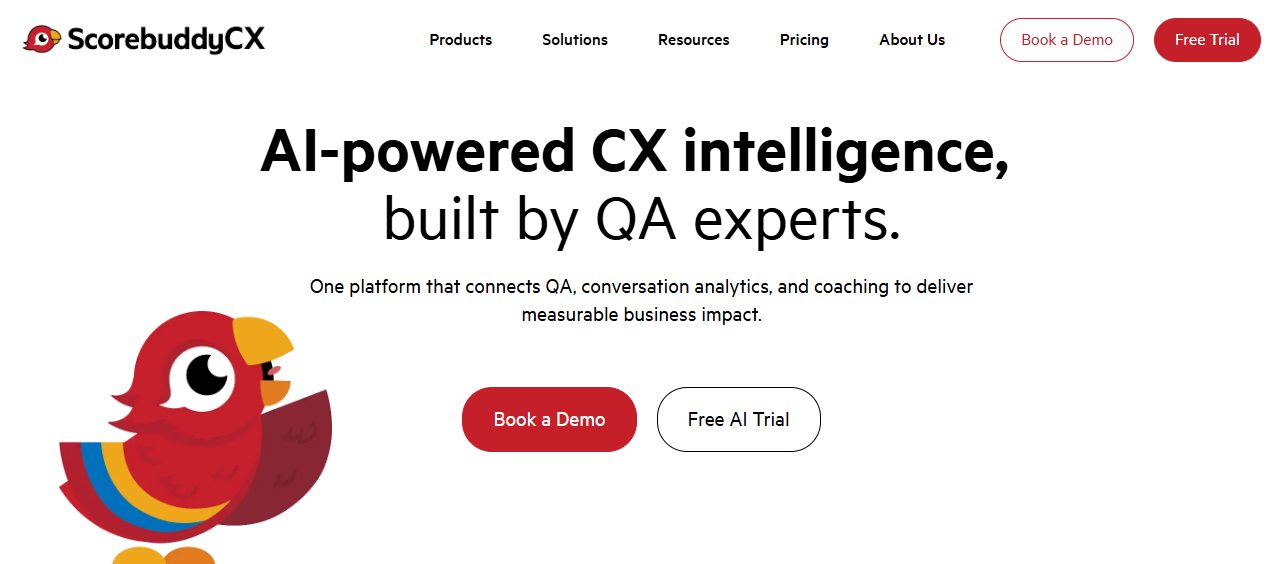
ScorebuddyCX (rebranded from Scorebuddy in June 2026) is an AI-powered contact center QA and CX intelligence platform designed to operate independently of any single CCaaS environment. Its key capabilities include:
- GenAI Auto Scoring across 100% of agent interactions across voice, chat, and email, with a claimed 90%+ accuracy rate
- QA for Bots evaluating AI chatbot and voice bot conversations for hallucinations, guardrail violations, and brand alignment
- In-platform Coaching Module with GROW, OSKAR, and CLEAR discussion frameworks, evaluation-triggered session creation, and formal agent acknowledgment workflows
- Learning Management System (paid add-on on Accelerate and Elite) for formal course delivery, learning paths, and certifications
- Conversation Analytics (Cx MOMENTS) surfacing contact drivers, topic trends, and sentence-level sentiment scoring (Elite tier)
- CCaaS-agnostic integrations with Genesys, Amazon Connect, NICE CXone, Five9, Talkdesk, and Dixa, plus helpdesk connectors for Zendesk, Freshdesk, and Intercom
Why Choose Scorebuddy Over Zendesk QA for Platform-Independent QA
Scorebuddy stands out in the following areas:
- Platform Portability vs. Ecosystem Dependency
Zendesk QA cannot be purchased without an underlying Zendesk Support or Suite plan. For teams running Genesys, Amazon Connect, NICE CXone, Five9, or a mixed-vendor environment, Zendesk QA is off the table.
ScorebuddyCX sits on top of CCaaS infrastructure rather than within it. Its six native CCaaS connectors on Accelerate and Elite mean that scorecard libraries, historical evaluation data, coaching records, and agent performance trends all live in ScorebuddyCX, not in the CCaaS. When a team migrates telephony providers, the quality program travels with them.
- Built-In LMS: From Evaluation to Certified Completion
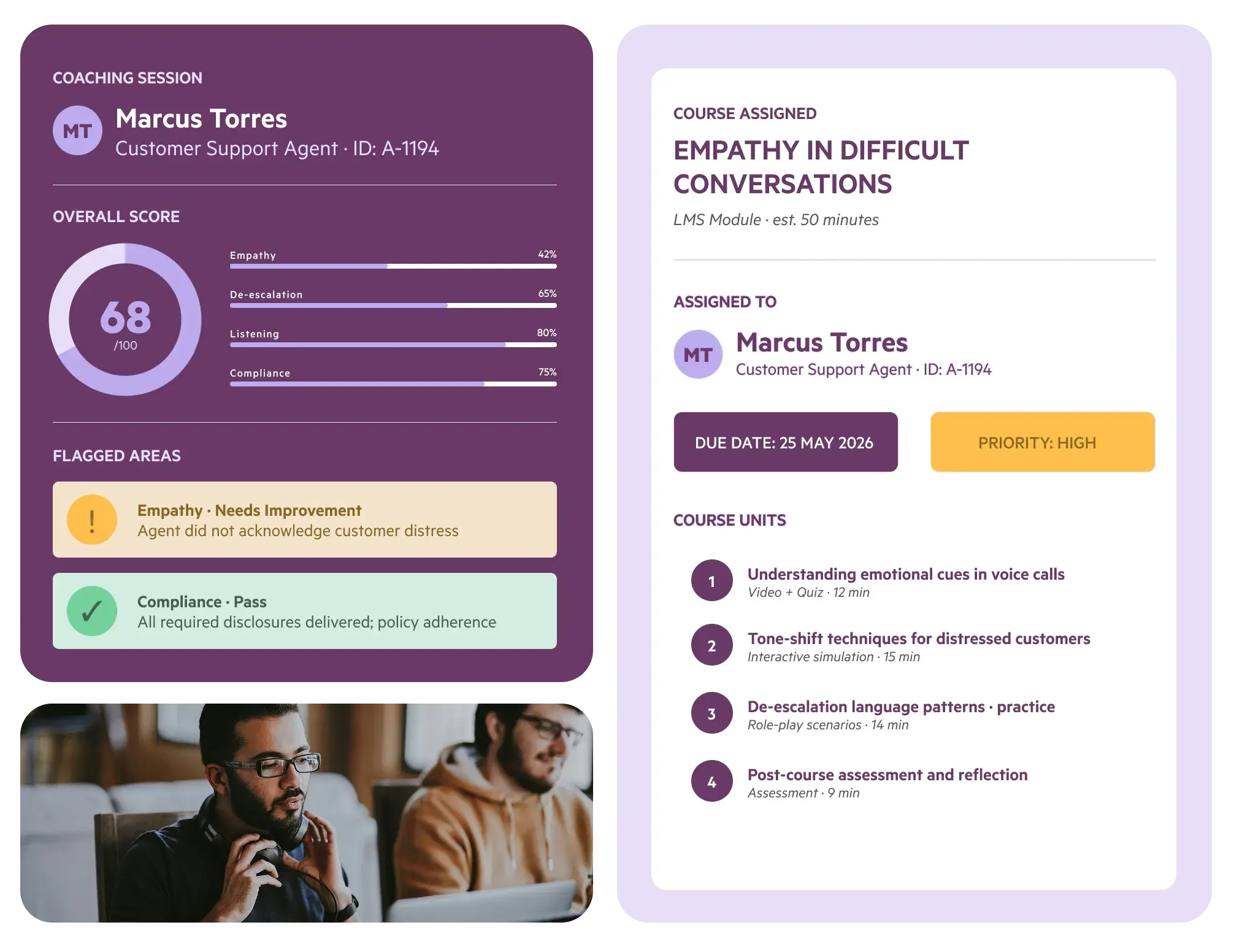
Zendesk QA’s coaching module covers structured one-on-ones, pinned conversations, and knowledge quizzes. ScorebuddyCX’s LMS add-on, available on Accelerate and Elite, is a full enterprise LMS embedded in the same platform.
When a QA score falls below threshold, a course or learning path is assigned directly. Course creation includes AI-assisted authoring claimed to be 90% faster than conventional methods, plus SCORM and xAPI content import. Completion is tracked and certifications issued, creating an auditable record that matters in regulated industries.
- Multi-Client BPO Architecture
ScorebuddyCX offers a multi-client management architecture designed for BPOs: separate scorecard libraries per client program, separate compliance frameworks, separate dashboards with distinct access controls, and client-facing reporting from a single platform instance.
Zendesk QA is designed around a single organization’s internal quality program and does not offer a comparable multi-client model.
? NOTE: We also evaluated Kaizo and Enthu.ai for this position. While Kaizo excels at gamified agent engagement for Zendesk-native teams, and Enthu.ai offers accessible voice analytics for smaller operations, Scorebuddy delivers the most complete standalone QA platform for teams needing AI-powered evaluation, an integrated LMS, BPO-ready architecture, and CCaaS portability in a single system.
Scorebuddy Pricing
ScorebuddyCX operates a per-seat tiered subscription model. No specific per-seat figures are published; all plans require a custom quote. A 14-day free trial is available.
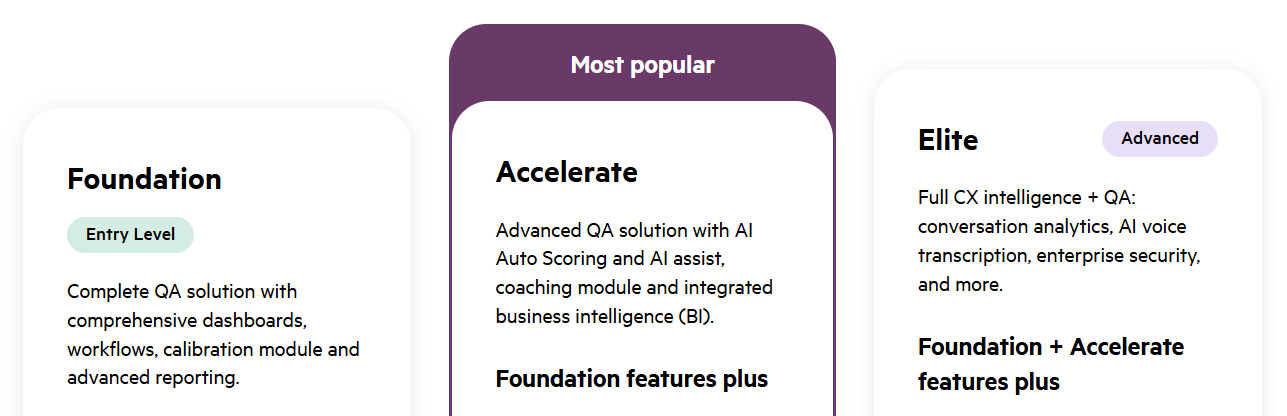
- Foundation – Customizable scorecards, AI assistance, QA workflows, calibration module, agent dashboards, reporting, root cause analysis, compliance reporting, and standard helpdesk integrations (Zendesk, Freshdesk, Intercom). No CCaaS integrations or AI Auto Scoring at this tier.
- Accelerate – Everything in Foundation plus AI Auto Scoring with 500 monthly AI scores included, CCaaS integrations (Genesys, Amazon Connect, NICE CXone, Five9, Talkdesk, Dixa), in-app coaching module, and dedicated client manager. LMS available as an add-on.
- Elite – Everything in Accelerate plus Conversation Analytics, 1,000 monthly AI scores, AI voice transcription, Salesforce integration, Open API, SSO, selectable data regions, and AI Optimization Service. LMS available as an add-on.
Who Should Use Scorebuddy?
Choose Scorebuddy if:
- Your contact center runs on Genesys, Amazon Connect, NICE CXone, Five9, or Talkdesk, or spans multiple platforms, and you need a quality program that operates independently of your telephony contract.
- You need QA and structured training in the same system, with evaluation findings triggering course assignments and tracking through to certified completion.
- You’re a BPO managing multiple client QA programs from one instance and need separate scorecards, compliance frameworks, and client-facing dashboards.
- You’re evaluating AI chatbots alongside human agents and want both in one platform with shared scoring and dashboards.
4. Convin – Best Alternative for Teams Testing Structured QA Before Committing
Convin is an AI-backed contact center quality management platform that offers the only permanent, unlimited free QA tier among the alternatives on this list. Its capabilities include:
- A lifetime free Quality Management Software plan with manual QA workflows, customizable scorecard templates covering voice, chat, and email, an automated audit reporting dashboard, and an Agent Rebuttal Management System
- Multi-category audit scorecards with auto-fail logic for compliance-critical parameters
- Text, audio, and video feedback on call evaluations
- A proactive alert system that surfaces emerging performance gaps and compliance risks
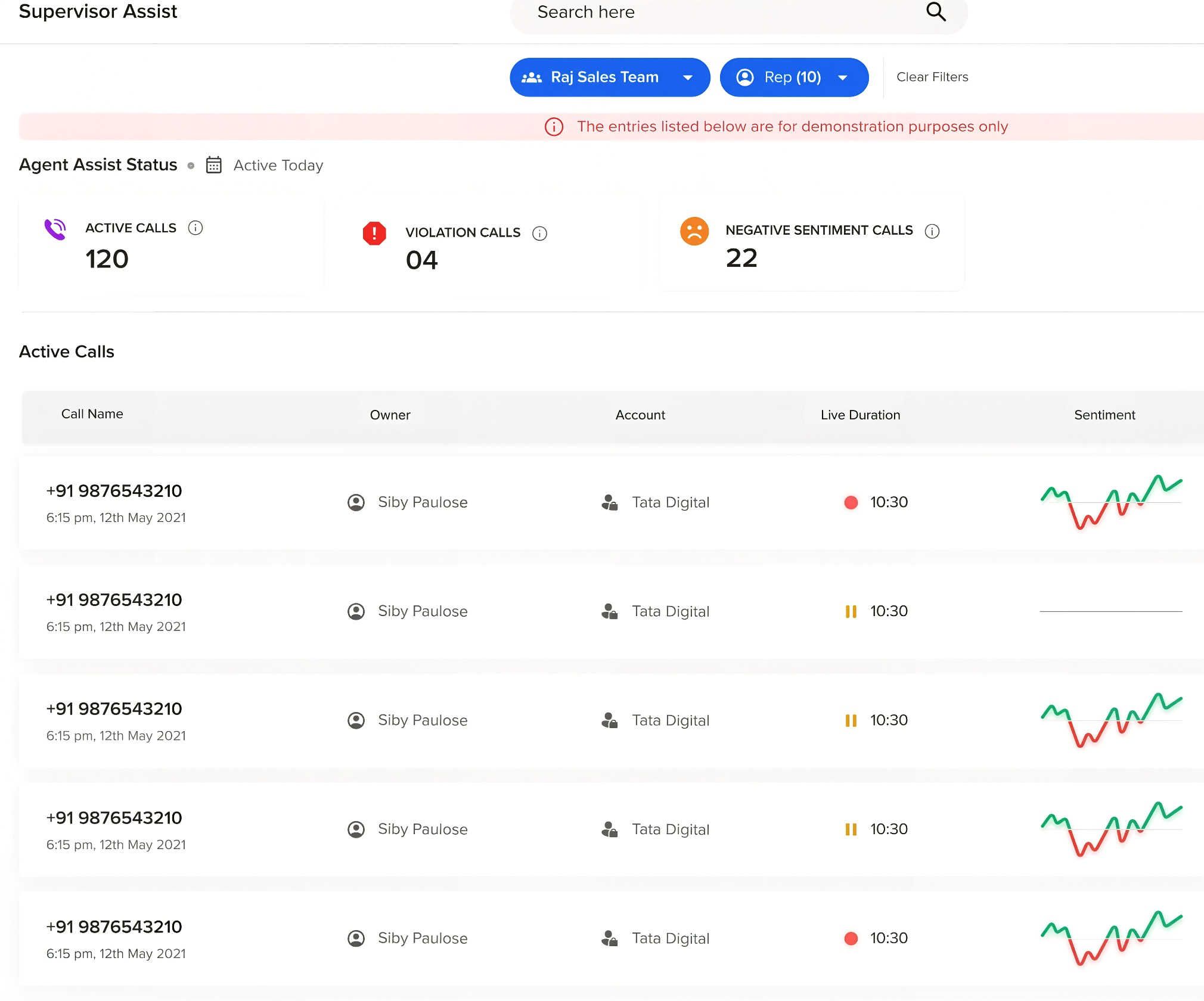
- A Supervisor Assist dashboard with live barge-in capability during active calls
- A structured upgrade path to AI-powered auto-scoring, automated coaching, and conversation analytics
Convin is most heavily deployed in Indian and Southeast Asian contact centers (banking, insurance, fintech, edtech), but the free QA tier is available globally.
Why Choose Convin Over Zendesk QA for Teams Validating Structured QA
Convin stands out in the following areas:
- A Permanent Free QA Tier
Zendesk QA has no free plan, and its trial is sales-gated. Convin’s Quality Management Software free tier is a permanent product, not a time-limited trial.
It covers manual audit workflows, customizable scorecard templates, an automated audit workflow, a performance reporting dashboard, a feedback and proactive alert mechanism, and a formal Agent Rebuttal Management System.
There is no expiry, no seat cap, and no feature timeout. A QA team moving off Google Sheets and onto structured audit tooling can do so at no cost and sustain it indefinitely.
- Platform Independence
Zendesk QA’s value depends on already using Zendesk Support or Suite. Convin’s integrations catalog covers Aircall, Dialpad, Freshcaller, Talkdesk, RingCentral, Genesys, Avaya, Cisco, AWS Connect, Exotel, Zoom, Google Meet, Salesforce, HubSpot, Pipedrive, Zoho, Freshworks, and LiveChat.
The free QA tier layers onto whatever the team already uses, with no need to adopt a specific ecosystem.
- Live Floor Monitoring and Real-Time Supervision
Zendesk QA’s real-time QA feature analyzes open text-based tickets per-message and surfaces five predefined insight categories. For voice, live supervisor monitoring during active calls is not a feature Zendesk QA ships today.
Convin’s Supervisor Assist shows all active calls simultaneously with per-call duration, sentiment graphs, and compliance violation flags, and lets supervisors barge into a live call in real time. These real-time layers sit above the free tier and require a paid subscription, but they represent capabilities Zendesk QA is still developing for voice.
? NOTE: We also evaluated Voxjar, which offers a limited free plan for smaller teams covering manual call scoring. We selected Convin here because its free tier is lifetime, applies to teams of any size with no agent cap, and its upgrade path to AI auto-scoring, real-time supervision, and automated coaching is more fully developed.
Convin Pricing
Free Tier – Quality Management Software
Convin’s free plan is permanently available:
- Manual audit workflow with customizable scorecard templates across voice, chat, and email
- Automated audit reporting and performance dashboard
- Feedback and proactive alert mechanism
- Agent Rebuttal Management System
- No seat cap, no expiry date
Paid Modules (Quote-Based)
All paid modules are priced on a custom, quote-only basis:
- Automated QA – AI-powered scoring across 100% of interactions with Gen AI feedback and auto-fail compliance flagging
- Real-Time Suite – Agent Assist (live prompts, battle cards, Ask AI during calls) and Supervisor Assist (live floor dashboard with barge-in)
- Automated Coaching and AI LMS – AI-assigned coaching sessions, peer-clip comparison, leaderboard and gamification
- Convin Insights – Post-call conversation analytics, lead propensity scoring, voice of customer analysis
Who Should Use Convin?
Choose Convin if:
- Your team is moving off spreadsheet-based manual QA and wants a structured audit framework at zero cost before deciding whether paid QA tooling is worth the investment.
- Your contact center stack sits outside the Zendesk ecosystem and you need a QA platform that integrates natively with your existing telephony and CRM.
- You operate in a voice-heavy environment where supervisors need to monitor and intervene during active calls in real time, not just review them afterward.
- You want to test AI auto-scoring as a next step after establishing a manual QA baseline, on the same platform you already use.
5. Observe.AI – Best Alternative for Real-Time In-Call Agent Guidance + Post-Call QA
Observe.AI is a contact center AI platform that goes beyond retrospective quality assurance to deliver real-time in-call agent guidance alongside automated post-call QA. Its key capabilities include:
- Real-time Agent Copilot that surfaces smart scripts, dynamic prompts, and AI-powered in-call alerts as conversations unfold
- Auto QA across 100% of voice interactions using a contact center-specific 40-billion-parameter LLM fine-tuned on over 100 years of contact center data
- Experience Designer for no-code configuration of real-time agent experiences tied to conversation signals
- Coaching Copilot drawing from both real-time performance signals and post-call QA findings
- 250+ integrations across CCaaS, CRM, ticketing, and HRIS platforms
Why Choose Observe.AI Over Zendesk QA for Real-Time Agent Guidance
Observe.AI stands out in the following areas:
- Real-Time Agent Assistance During Live Calls
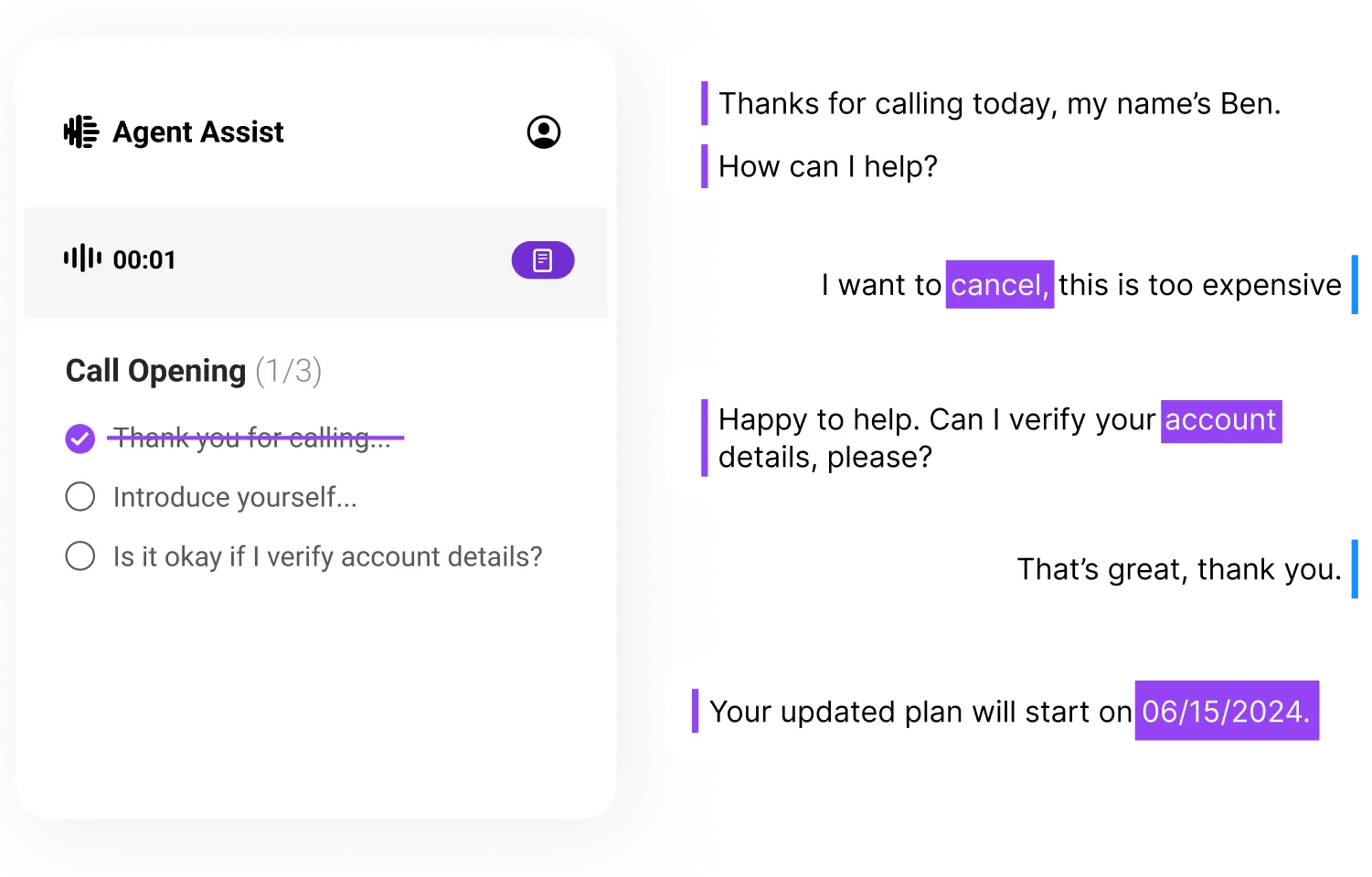
Zendesk QA operates retrospectively: it scores interactions after they close, surfaces Spotlight signals post-hoc, and delivers coaching based on completed conversations. Observe.AI’s Agent Copilot changes the timeline. During live calls, agents receive smart scripts and AI-powered visual alerts that fire when hold times exceed thresholds, negative sentiment is detected, or overtalking is flagged.
Compliance disclosures that must be delivered during a call cannot be caught after the fact; Observe.AI prompts them in the moment. Knowledge AI lets agents query the knowledge base mid-call, and Summarization AI automates after-call documentation. Observe.AI was recognized as a Pioneering provider in the CMP Research Prism Report for Real-Time Agent Assist.
- A Single Coaching View Spanning Real-Time Signals and Post-Call Data
Zendesk QA’s coaching module draws entirely from post-call data. Observe.AI’s Coaching Copilot draws from both streams: real-time performance signals captured during live calls and post-call QA findings.
A coach preparing a session sees not only how an agent scored but also how the agent engaged with real-time guidance during those calls, enabling more precisely targeted interventions.
- Named Analyst Leader Recognition
Observe.AI was named a Leader in the IDC MarketScape: Worldwide AI-Enabled Contact Center WEM 2025-2026. On G2, it holds a 4.6-star rating from 250+ verified reviews, with 97% rating it four or five stars, and ranked #1 for Ease of Setup, Ease of Use, and Ease of Admin in Conversational Intelligence.
? NOTE: We also evaluated Genesys Cloud with embedded Quality Management for this slot. Genesys offers full CCaaS plus quality management with enterprise breadth. However, Observe.AI offers the most focused combination of real-time in-call agent guidance with post-call automated QA in a single product, covering the live-coaching use case that post-call-only tools cannot address.
Observe.AI Pricing
Observe.AI does not publish specific pricing. The platform operates on a custom enterprise quote model organized into five solution tiers:
- VoiceAI Agents – Automates voice interactions end-to-end using AI agents
- Real-time AI – Agent Copilot, Knowledge AI, and Summarization AI
- Post-interaction AI – Auto QA, manual QA workflows, Coaching Copilot, and VoC reporting
- Enterprise Advanced – Combines Real-time AI and Post-interaction AI
- Enterprise Unlimited – All capabilities plus call summarization and Knowledge AI
Enterprise deployments typically run in the range of $60,000 to $180,000 per year for a 100-seat contact center based on third-party market data. There is no free plan; evaluation access is available through a 30-day sales-assisted trial.
Who Should Use Observe.AI?
Choose Observe.AI if:
- Your contact center operates under compliance obligations requiring specific language during live calls, where post-call scoring identifies failures that have already occurred rather than preventing them.
- You need agents to receive real-time guidance during conversations, including live escalation handling, objection management, or in-call compliance prompts.
- You are an enterprise-scale operation (typically 100+ agents) with budget appropriate for an enterprise platform, and your coaching program would benefit from combining live call signals with post-call QA findings in the same interface.
6. Kaizo – Best Alternative for Engagement-Driven QA on Zendesk
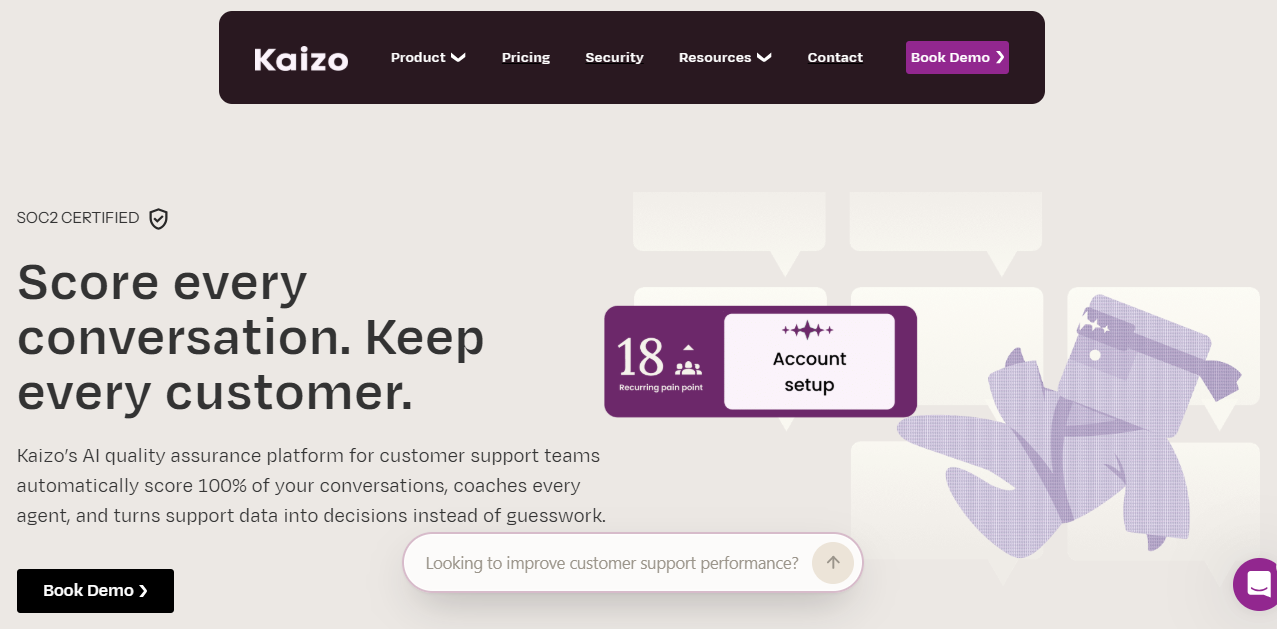
Kaizo is an AI-powered quality assurance platform for customer support teams on Zendesk and Salesforce Service Cloud, built around a distinct premise: agent engagement is a quality outcome that must be designed for explicitly. Its key capabilities include:
- AutoPilot auto QA scoring 100% of resolved tickets automatically the moment a case closes
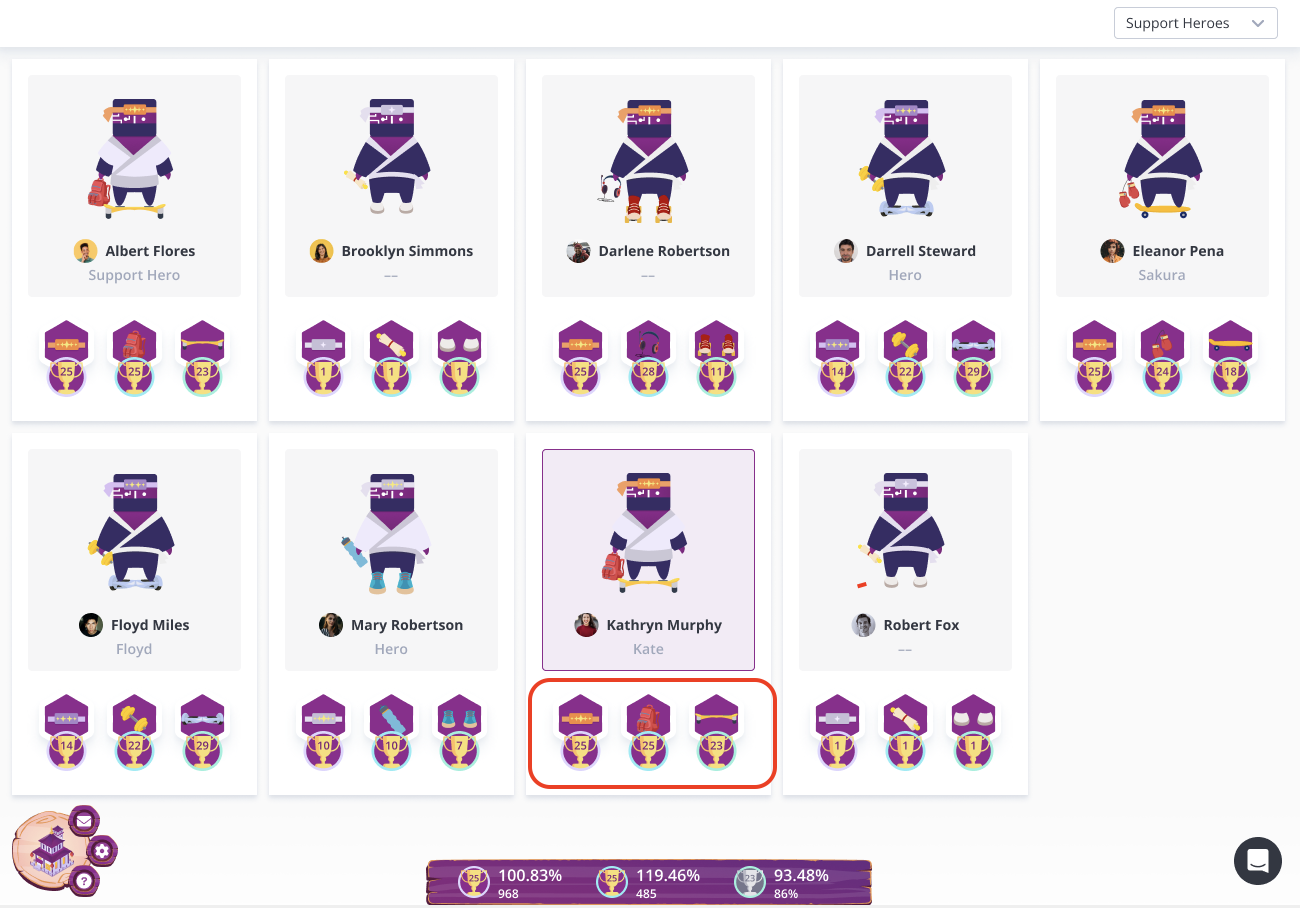
- Gamification layer with ninja-avatar agent profiles, missions tied to quality targets, team leaderboards, and group challenges built directly into the QA workflow
- AI-generated conversation summaries reducing evaluator time spent reading full transcripts
- Sentiment-based ticket sorting so human reviewers spend time on interactions most likely to contain quality problems
- AI coaching cards that reduce coaching prep time by 90% by auto-generating per-agent feedback from 100% of QA data
- Native Zendesk Marketplace deployment installing as a sidebar panel inside the Zendesk agent interface within minutes
- SOC 2, ISO 27001, GDPR, and EU AI Act certified
Why Choose Kaizo Over Zendesk QA for Engagement-Driven Quality
Kaizo stands out in the following areas:
- Gamification as a Core Product Feature
Zendesk QA’s approach to agent motivation flows through its coaching module: pinned conversations, structured 1:1s, quizzes. These place the motivational work on managers. Kaizo takes a different approach.
Agents receive ninja-avatar profiles that progress as targets are met, missions specifying concrete behaviors to achieve, team challenges creating shared accountability, and leaderboards surfacing comparative performance.
G2 reviewers consistently describe Kaizo’s gamification as making performance management “fun and non-intimidating.” Zendesk QA does not offer gamification in any form.
- Zendesk Sidebar Embedding
Zendesk QA is accessed via the Zendesk product icon as a separate module. Kaizo, installed from the Zendesk Marketplace in about two minutes, embeds as a sidebar panel directly inside the Zendesk agent interface.
Agents submit QA ratings and view quality feedback without leaving the ticket they are working on. “No customer data stored” on Kaizo’s servers; PII stays within the Zendesk environment. For teams moving away from Zendesk QA but staying on the Zendesk platform, this is a smooth transition.
- Faster Deployment and Focused Footprint
Kaizo is a platform teams can go live with in days via the Zendesk or Salesforce marketplace. The trade-off is clear: Kaizo’s integration surface is limited to Zendesk and Salesforce Service Cloud. Teams on Freshdesk, Intercom, or any other help desk cannot use the product.
? NOTE: We also evaluated Enthu.ai, which offers focused AI conversation scoring at an accessible price point for smaller operations. Kaizo is the most direct transition path for teams that want to stay within the Zendesk ecosystem while gaining AI auto QA and a built-in agent engagement layer.
Kaizo Pricing
Kaizo uses a quote-only, sales-led pricing model. No public per-seat prices are listed. The model is seat-based across three tiers:
- Insight (1-25 seats) – AutoPilot QA, performance dashboards, AI summaries, coaching workflows, gamification (missions, leaderboards, challenges), 10 custom automated criteria
- Intelligence (26+ seats) – Everything in Insight plus AI Coaching cards, 25 custom criteria, automated BI exports, dedicated CSM
- Enterprise (Unlimited seats) – Everything in Intelligence plus third-party integrations, custom dashboards, 50 custom criteria, white-glove onboarding, enterprise SLAs

Who Should Use Kaizo?
Choose Kaizo if:
- Your team runs on Zendesk Support or Salesforce Service Cloud and you want QA that deploys within your existing help desk as a sidebar panel, not a separate application.
- Agent disengagement, attrition, or motivation problems are contributing to quality issues, and you need gamification mechanics built into the QA workflow to sustain improvement.
- You are moving off Zendesk QA but want to remain on the Zendesk platform, and you need a same-ecosystem transition available via the Zendesk Marketplace.
- Coaching prep time is a bottleneck, and auto-generated AI coaching cards (Intelligence tier and above) would materially reduce the hours managers spend building feedback from scratch.
7. Solidroad – Best Alternative for QA-Triggered Simulation Training
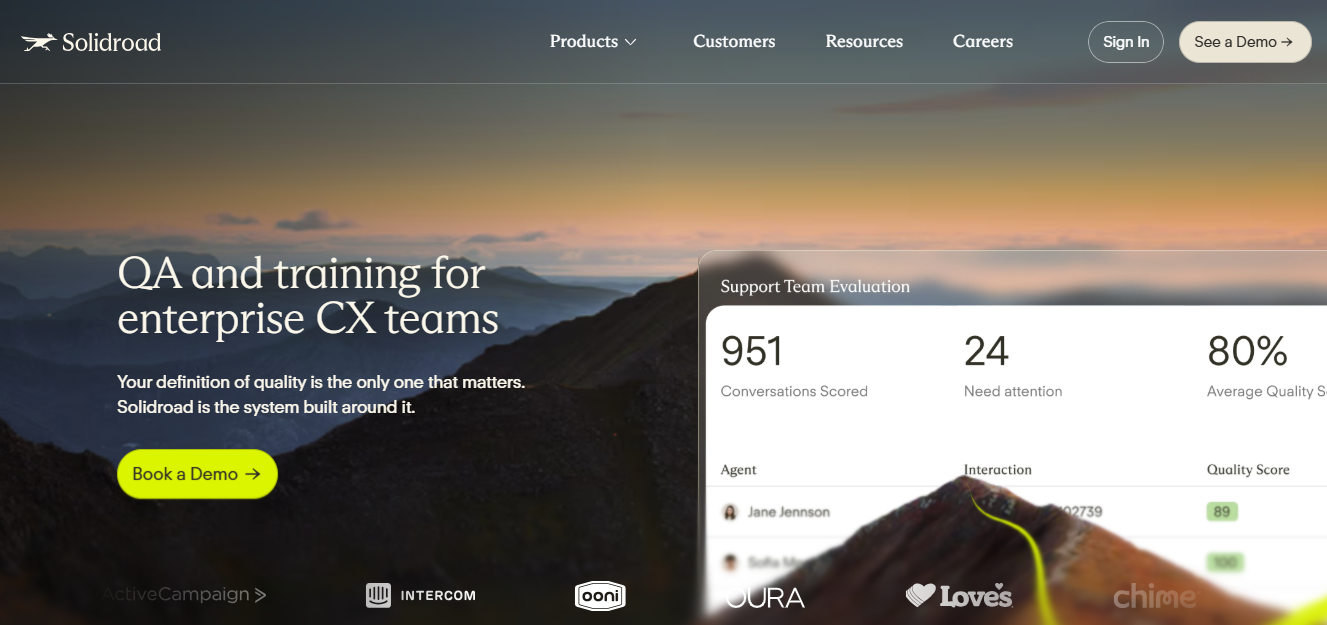
Solidroad is an AI-powered QA and agent training platform that treats quality scoring and skill remediation as a single closed system. Where most QA tools stop at surfacing a coaching flag, Solidroad connects live QA scoring directly to AI-simulated practice exercises. Its key capabilities include:
- 100% automated QA scoring across live conversations on phone, live chat, video, and email
- AI-generated simulation training where agents practice against realistic AI customer personas in a safe environment
- Automatic training assignment triggered by live QA findings, with no manual handoff from QA manager to trainer
- Native QA scoring across 14+ CX platforms, including Zendesk, Intercom, Freshdesk, Gorgias, HelpScout, ServiceNow, Aircall, Talkdesk, and others
- Custom AI scoring models trained on the customer’s own conversations, policies, and scorecards
- $25M+ in funding from First Round Capital, Y Combinator, Hedosophia, and Sony Innovation Fund
Why Choose Solidroad Over Zendesk QA for QA-Triggered Training
Solidroad stands out in the following areas:
- Automatic Closed Loop from QA Finding to Simulation
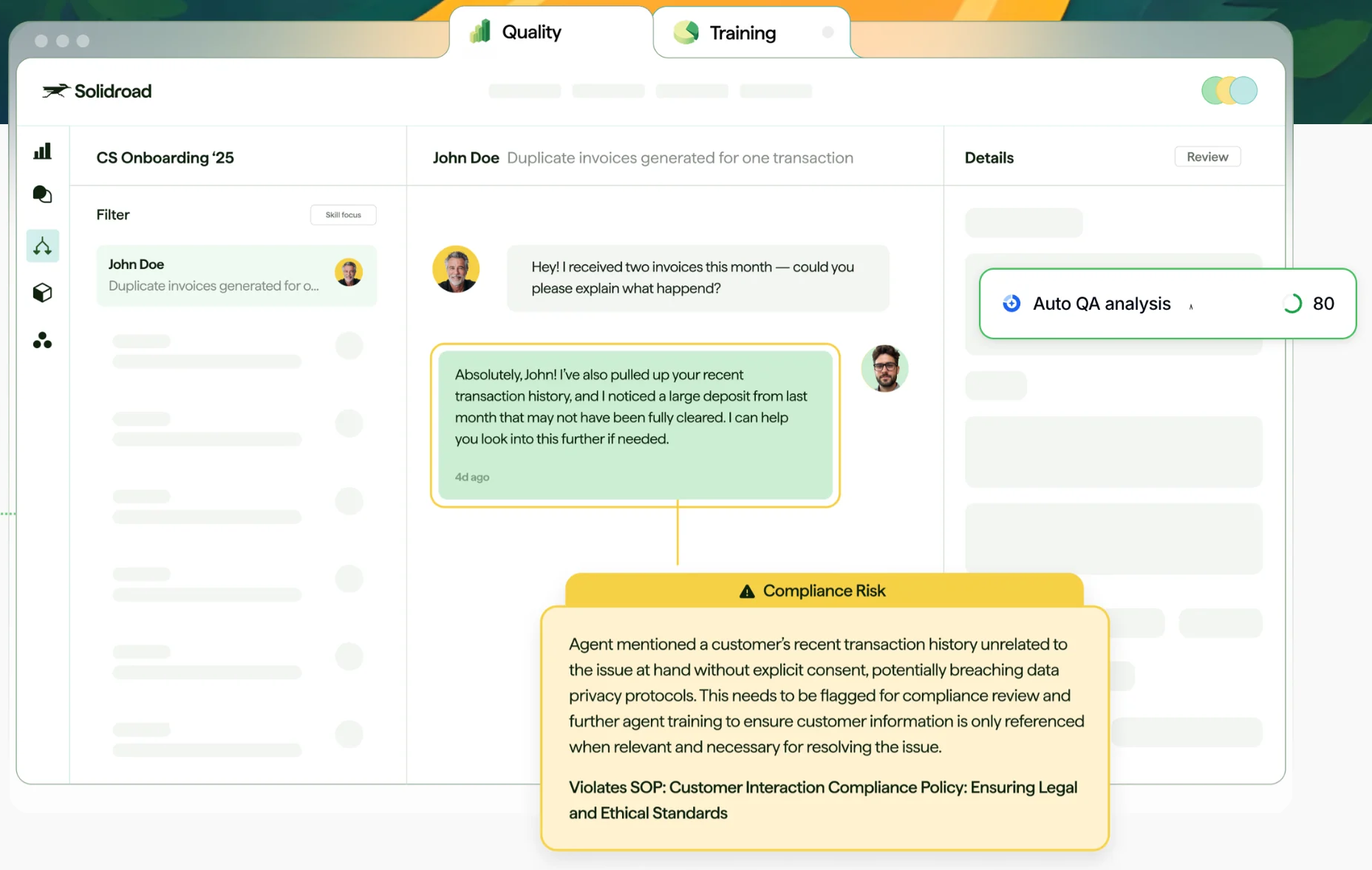
Zendesk QA identifies skill gaps through AutoQA, surfaces them through Spotlights, and lets managers pin conversations for coaching sessions. The gap between discovery and remediation requires a manager to design, schedule, and deliver the training response. Solidroad short-circuits that sequence.
When live QA scoring flags a skill gap, Solidroad automatically assigns a targeted simulation exercise to the specific agent, set to the appropriate difficulty, built around a persona mirroring the scenario type where the gap appeared. The agent completes the simulation asynchronously and is scored automatically.
For operations where dozens of agents may flag coaching needs in a given week, removing the human scheduling bottleneck makes a real operational difference.
- Platform-Agnostic QA Where Zendesk QA’s Scope Has Narrowed
After Zendesk acquired Klaus in February 2024, multi-platform support was substantially reduced. Solidroad connects natively to more than 14 CX platforms and applies the same scoring framework and simulation training layer regardless of which stack generates the conversations.
For BPOs or multi-platform environments, one quality standard applies consistently across the full conversation estate.
- Pre-Live Readiness Validation
Zendesk QA’s scope is post-conversation: it scores interactions that have already closed. Solidroad’s simulation infrastructure covers ground Zendesk QA cannot reach: validating that a new hire or returning agent can handle customers before they appear in the live queue.
Admins can require agents to pass a simulation exercise against a defined scorecard before being cleared for specific conversation types.
? NOTE: We also evaluated Loris (acquired by Contentsquare in October 2025) and Convin for this position. Solidroad offers the most distinct approach: the automatic translation of a live QA finding into an assigned simulation exercise is a novel architecture.
Solidroad Pricing
Solidroad does not publish pricing publicly. The platform is positioned at teams with 1,000+ agents and 10,000+ monthly interactions. No self-serve trial or free plan is available; the sole entry point is a sales conversation. Implementation follows a six-week rollout timeline.
Who Should Use Solidroad?
Choose Solidroad if:
- Your QA program reliably identifies skill gaps but relies on managers to manually design and schedule training responses, and you want automated simulation assignment to remove that bottleneck.
- Your contact center spans multiple helpdesks, telephony systems, or CCaaS platforms and you need a QA framework that applies uniformly across all of them.
- You manage significant new hire volume or seasonal surges and want simulation-based readiness validation before agents enter the customer-facing queue.
- You are a large enterprise team (1,000+ agents, 10,000+ monthly conversations) with the scale to justify a custom enterprise engagement and a six-week implementation runway.
The Final Verdict
While Zendesk QA excels as an integrated quality layer for teams already on Zendesk, contact centers with varied requirements often need specialized tools that go deeper in specific areas. Based on our research, here are the best alternatives:
- evaluagent for context-aware AI scoring grounded in your own policies and knowledge base, with a complete path from evaluation to coaching, training, and gamified agent development
- Calabrio ONE for enterprise contact centers that need workforce management and quality management unified in a single suite
- Scorebuddy for CCaaS-agnostic AI-powered QA with an integrated LMS and BPO-ready multi-client architecture
- Convin for teams that want to formalize their QA process at zero cost before deciding whether paid tooling is worth the investment
- Observe.AI for real-time in-call agent guidance combined with post-call automated QA
- Kaizo for Zendesk-native teams that need gamification and agent engagement mechanics built into their QA workflow
- Solidroad for large-scale operations that want QA findings to automatically trigger targeted simulation training exercises
You don’t have to choose between Zendesk QA and these alternatives exclusively. evaluagent, for example, integrates natively with Zendesk and can layer additional quality capabilities on top of an existing Zendesk setup. Consider your quality challenges, team size, and growth plans when deciding which solution fits best.
Want complete visibility across every agent, human and AI, with context-aware scoring calibrated to your own standards? Book a demo with evaluagent and see how AI-powered quality management, closed-loop coaching, and AI agent observability can drive measurable improvement across your contact center.