Most team leaders want to coach well. They know what a good session looks like and they have the credibility to make feedback land. What they’re rarely given is the time, data access, or infrastructure to make it happen consistently.
That’s the gap. It’s a structural one, and it is solvable.
The promotion problem
The people who become team leaders are promoted because they were excellent agents. Sound logic, but what it doesn’t account for is that performing a role and developing other people in it are different skills.
Somewhat ironically, team leaders often aren’t coached themselves when they make the step up. And the system they inherit makes it genuinely difficult to coach their agents.
A newly promoted TL takes on a team of 10, 15, sometimes 20 agents. Regular 1:1s, meaningful feedback, goals that stick, progress tracked over time — all the expectations are clear. The support structure to meet them usually isn’t.
What the role actually allows
A team leader’s day is built around immediacy. Escalations, queue metrics, rota gaps, real-time performance issues. By the time a coaching session appears in the calendar, it’s competing with everything else that happened that morning.
Preparation gets squeezed. In practice, that means a scan of recent evaluations if there’s time — or a mental note from last week if there isn’t. The session happens, something useful is said, and both people leave knowing it could have gone better, more in-depth.
The problem is time and access, not motivation.
What preparation actually requires
A coaching conversation that changes behavior is specific. It’s built around particular calls, patterns, and moments, rather than general impressions carried in from memory.
It works best when it’s cumulative; building on what was discussed last time. And it’s evidenced, so the agent can see exactly what the feedback is based on.
Getting there manually can take 30 to 45 minutes per agent, per session. Pulling evaluations, identifying themes across multiple calls, cross-referencing sentiment data, recalling what was covered in the previous session. For a TL with a team of 15 and a monthly cadence, that’s a substantial block of time alongside everything else the role demands.
So preparation gets cut, or it gets shallow, and the data that could have made the session transformational stays buried in the platform.
The cost
Under-coached agents develop more slowly and are more likely to disengage. And why should they value the sessions? Particularly when feedback is vague or inconsistent, agents stop expecting their 1-2-1s to deliver anything meaningful. That shows up in performance first, and in attrition not long after.
The frustrating part is that most contact centers already have everything they need. AutoQA scores every interaction. Sentiment analysis runs across hundreds of calls. The insight exists, but the gap is between that insight and the coaching room.
What changes when preparation isn’t the bottleneck
When team leaders can walk into every session armed with the right data, the conversation changes dramatically.
Feedback is specific and evidenced, not anecdotal. There’s room for praise as well as constructive critique. That means they can focus on the part that humans do exceptionally well: listening, responding, and building the kind of trust that makes development stick.
The capability is already there. What’s been missing is the system to support it.
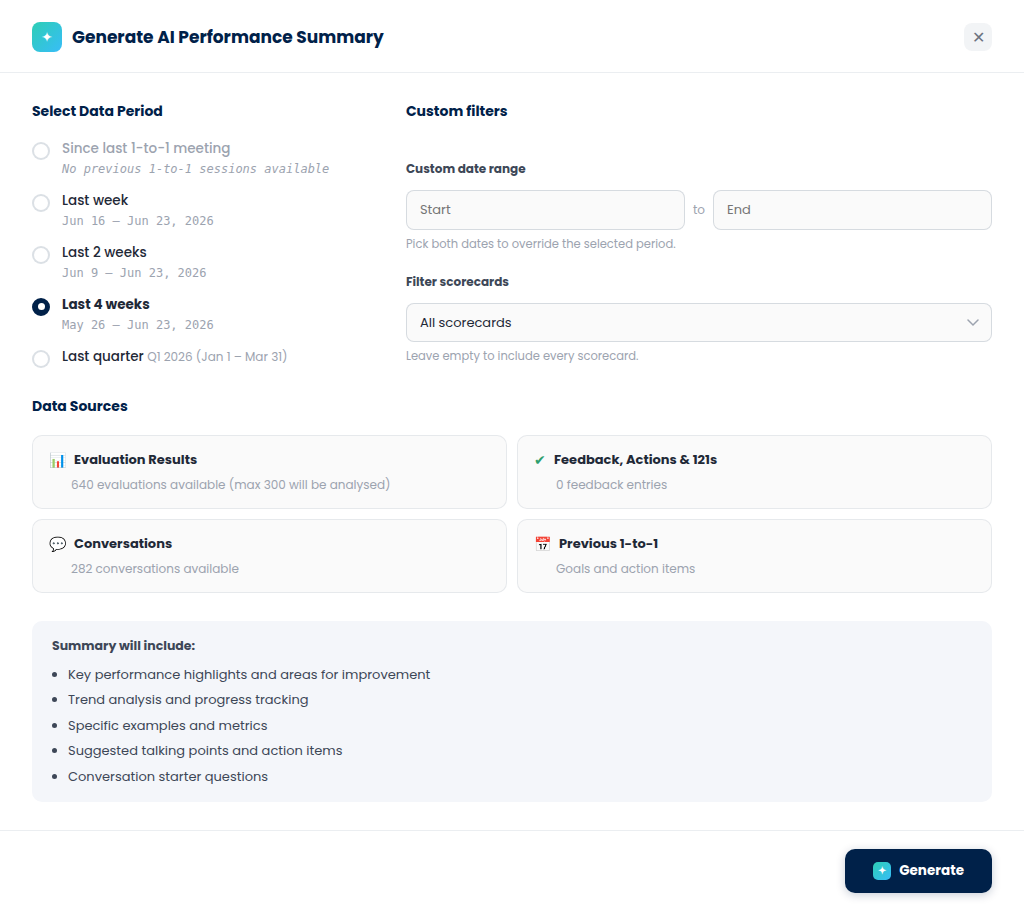
AI Coaching by evaluagent is that system. It turns your platform data into a ready-to-use coaching brief before every session. Simply pick the date range and data sources, and at the click of a button, you’ll have a structured performance summary. Minimal prep time, but huge impact.
See AI Coaching in action
See how automation features like AI Coaching can bring efficiency and performance to your contact center. Book a demo with the team today.
