A call gets scored, behaviors are assessed against a framework, a number is produced. Do all that at scale and you have consistent, auditable, defensible visibility. It’s genuinely valuable, and the contact centers that have it are in a better position than those that don’t.
But there’s a version of QA maturity that stops there. Evaluation becomes the output rather than the input. Scores accumulate, dashboards update, and agent behavior changes... slowly, partially, or not at all.
The evaluation was never meant to be the end of the process. It was meant to be the start of real, proven improvements.
What QA was designed to do
Consistent evaluation across a high volume of interactions gives you something most contact centers have historically lacked: a consistent, structured picture of how your agents are performing against the behaviors that matter.
It creates accountability, supports compliance, and gives leadership the data they need to make informed decisions about training, resource and process.
What it can’t do on its own is change how individual agents perform on calls. That requires a specific, structured coaching conversation. QA creates the conditions for that conversation to be useful – but often the conversation doesn’t happen the way it should.
The handoff problem
Between an evaluation and a behavior change, there are several steps, and each one is a place where the chain can break.
- The evaluation produces a score and some line item data
- At some point, a team leader reviews it, forms a view of the agent’s performance, and carries that view into a coaching session
- In the session, feedback is given. The agent responds to it, takes something away, and either applies it or doesn’t.
At every stage, something gets lost. A single evaluation captures one call, not a pattern. A rushed review captures recent memory, but not trends over time. A coaching session without preparation captures general impressions, not specific, evidenced feedback.
By the time the insight from a well-run QA program reaches the agent in a form they can act on, it’s often been diluted beyond the point of usefulness.
It’s a structural problem, not a people one. Team Leaders often want to spend more time with agents, giving them quality feedback – but time pressures and other responsibilities get in the way.
What gets lost between the score and the conversation
The things that most reliably change behavior in a coaching session are also the things that are hardest to carry through a manual process.
Recurring themes
A single evaluation might flag that an agent struggled with objection handling on a particular call. Ten evaluations across a month might reveal that this happens consistently in calls over a certain length, or in specific product categories, or always in the second half of a shift. Or even, that the initial evaluation was a one-off.
You can’t coach meaningfully based on that. But what’s the alternative? Extracting that pattern manually, across multiple scorecards, multiple calls, multiple weeks, requires time that most team leaders don’t have.
Sentiment trends
How an agent is feeling across their interactions, and how customers are responding to them, changes over time and can signal things that scores alone don’t capture.
A technically compliant call where the agent sounds disengaged is a different coaching conversation from the same score with genuine warmth behind it.
Continuity
A coaching conversation that builds on the last one, knowing what was being worked on and whether it’s moved, is qualitatively different from one that starts from scratch every time. Without a record of previous sessions and their outcomes, coaching tends to reset rather than compound.
The sessions that actually change behavior have:
- Specificity: Feedback tied to real examples is more likely to be accepted and acted on than general assessments.
- Frequency: Regular, short sessions outperform long, infrequent long ones.
- Continuity: Development that builds over time outperforms episodic interventions.
Most coaching programs score poorly on all three, because the preparation required to do them well is simply too demanding within the constraints of the role.
The team leader who wants to be specific doesn’t have the time to go back through 20 calls to find the right example. The team leader who wants to build continuity doesn’t have a structured record of what the last conversation covered.
The gap between QA data and coaching quality is more often than not about access, rather than intent — getting the right information into the room at the right moment, in a format that a team leader can actually use.
How to close the coaching loop
A mature QA program shouldn’t just tell you what’s happening across your contact center. It should be the foundation for conversations that change what happens next. The evaluation and the coaching sessions are two halves of the same loop, which only works if information can move cleanly from one to the other.
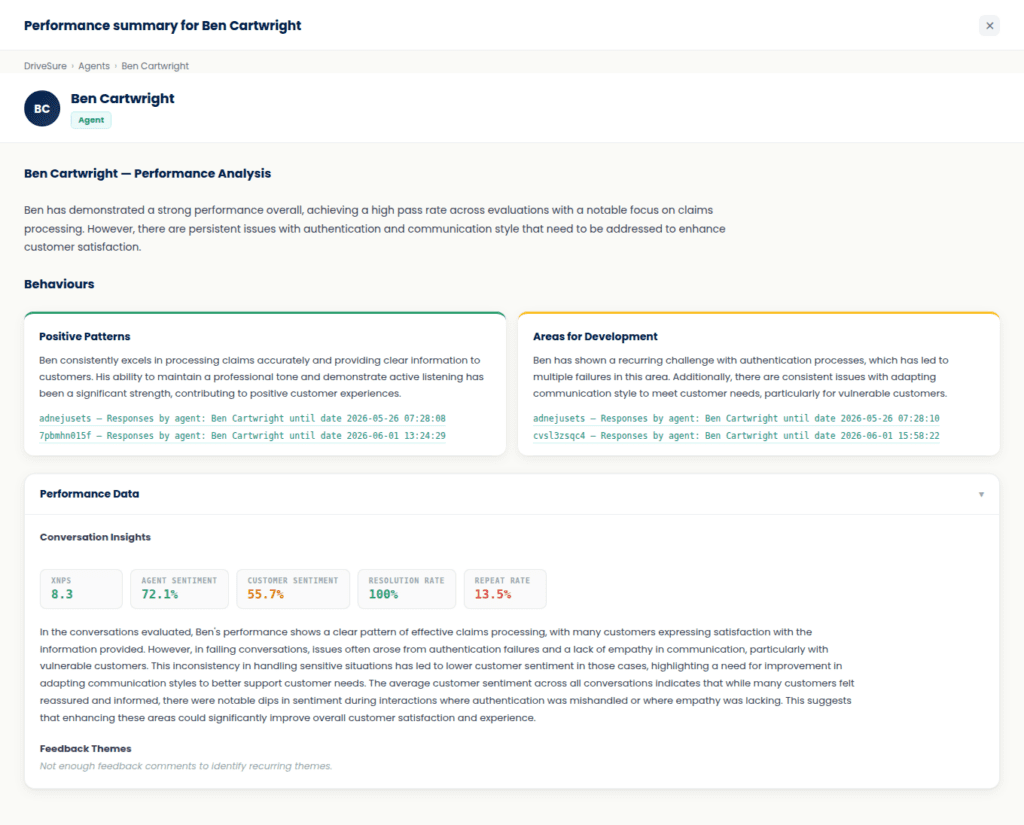
We launched AI Coaching to address this exact issue. Now, Team Leaders and Quality Managers can turn evaluation data into structured, ready-to-use coaching briefs before every session. Select a date range, identify patterns and unlock the ability to consistently coach across a representative sample of interactions.
See AI Coaching in action
See how automation features like AI Coaching can bring efficiency and performance to your contact center. Book a demo with the team today.
