If you’re comparing Five9 vs RingCentral, the first thing to understand is that you’re not comparing two versions of the same product. Five9 is a dedicated contact center platform. RingCentral is a unified communications company that added a contact center. This distinction shapes everything: feature depth, pricing, integration philosophy, and where each platform invests its engineering resources.
The real questions you should be asking:
- Do you need a dedicated contact center platform with CCaaS capabilities, or do you want unified communications and contact center from a single vendor?
- Is outbound dialing (predictive, progressive, power) central to your daily operation?
- Are you comfortable with quality management as one module inside your CCaaS, or do you need independent QA that scores every conversation?
- Can you justify $119+ per seat per month for enterprise features, or does a $65 per seat starting point better match your budget?
- How important is it that your quality data travels with you if you switch contact center vendors?
In short, here’s what we recommend:
Five9 is built for enterprise contact centers that need a dedicated platform across inbound, outbound, and blended operations. Named a Gartner Magic Quadrant Leader for CCaaS eight years running, Five9 brings its Genius AI platform for agentic self-service, an outbound dialer with four distinct modes, and native CRM integrations with Salesforce, ServiceNow, and Zendesk.
The platform scales to environments with more than 10,000 agents and has crossed $1.1 billion in annual revenue. The trade-off: pricing starts at $119 per seat per month, implementation requires professional services, and reviewers consistently flag call stability issues and platform complexity.
RingCentral serves organizations that want unified communications and contact center from a single vendor. A Gartner Magic Quadrant Leader for UCaaS eleven consecutive years, RingCentral combines its RingEX business communications platform (phone, messaging, video) with RingCX, an AI-first contact center that starts at $65 per seat per month.
The platform offers 500+ integrations, 99.999% uptime, and operates in 100+ countries. However, RingCX launched in 2023, making it younger than Five9’s contact center, and its CCaaS feature depth is still maturing.
Both platforms include quality management modules that score interactions with AI. But quality management inside a CCaaS platform is one feature among dozens, built to complement routing and telephony rather than to drive agent performance improvement. When contact centers grow beyond sample-based QA, the difference between a built-in module and a dedicated quality platform becomes the difference between generating scores and actually changing agent behavior.
evaluagent is the independent quality assurance and performance management platform that integrates natively with both Five9 and RingCentral (along with Genesys, Amazon Connect, Talkdesk, Zendesk, Salesforce, and others). Instead of replacing your contact center, evaluagent sits on top of it, scoring 100% of conversations with AI and connecting those scores to coaching sessions, performance plans, and agent development.
Its Context Engine grounds scoring in your own policies and knowledge base, so AI evaluates not just how agents communicate but whether they gave the right answer. Its AI Agent Observability module monitors AI chatbots for hallucinations and off-policy responses, using your company’s source of truth rather than the bot vendor’s self-reported metrics.
For contact centers that treat quality assurance as a competitive advantage rather than a compliance checkbox, evaluagent provides the depth that built-in modules cannot.
If independent quality assurance across your entire contact center sounds like the missing piece, see how evaluagent works with your existing platform.
Five9 vs RingCentral vs evaluagent at a glance
| Five9 | RingCentral | evaluagent | |
|---|---|---|---|
| Core focus | Dedicated contact center platform | Unified communications + contact center | QA & performance improvement |
| AI capabilities | Genius AI with agentic orchestration, Agent Assist, AI Knowledge | AI Receptionist, AVA Agent Assist, AI Quality Management | AutoQA, Context Engine, AI Agent Observability |
| Quality management | Agentic QM (built-in module) | AI Quality Management (built-in module) | Full-coverage AutoQA with closed-loop coaching |
| Outbound dialing | Predictive, progressive, preview, power | Manual, preview, progressive, predictive | N/A (QA layer) |
| UCaaS included | No (integrates with Teams, Zoom, RingCentral) | Yes (RingEX) | N/A |
| Integration ecosystem | CRM adapters + CX Marketplace | 500+ pre-built integrations | Native CCaaS, helpdesk, and WFM integrations |
| Starting price | $119/seat/month | $65/seat/month (RingCX) | $35/user/month |
| Best for | Enterprise contact centers needing dedicated CCaaS depth and outbound capabilities | Organizations wanting unified comms and contact center from one vendor | Contact centers needing independent QA that scores 100% of conversations |
Dedicated contact center vs unified communications platform
This is the foundational choice between Five9 and RingCentral, and it’s worth getting right before comparing individual features.
Five9 does one thing. It runs contact centers. Every product decision, every engineering investment, every acquisition has served that single mission since 2001.
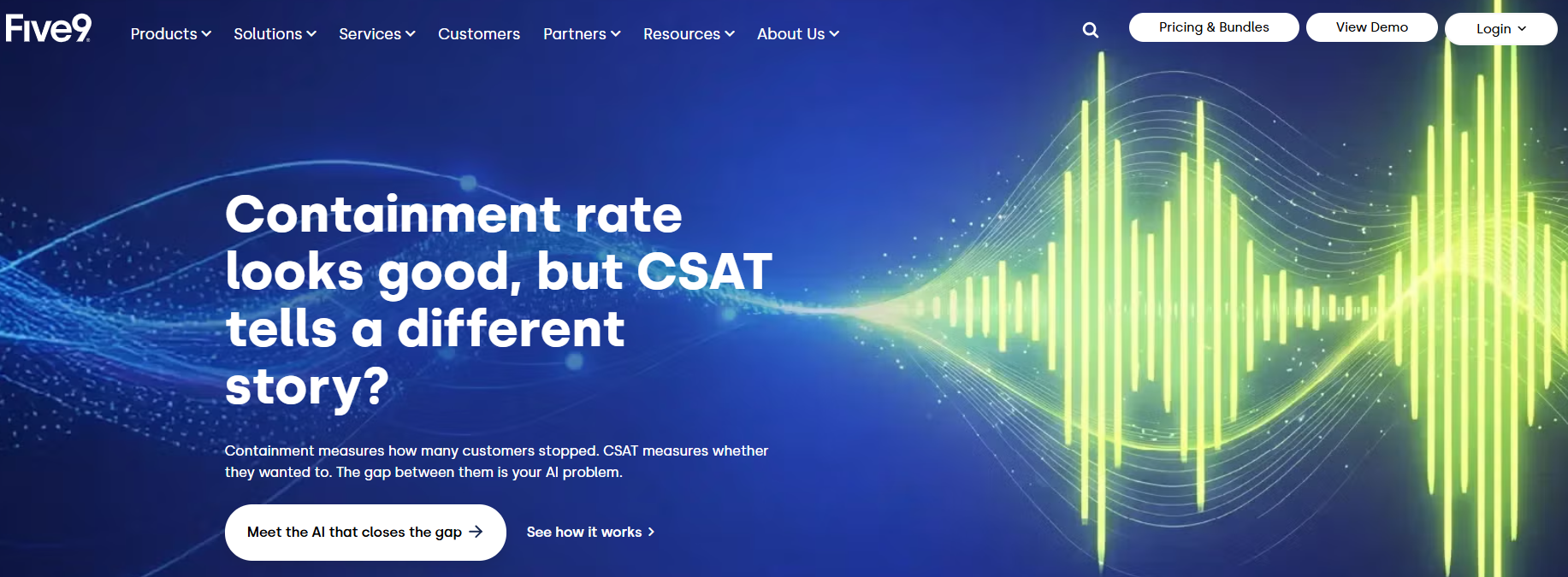
The result is a platform with 25 years of dedicated contact center architecture: ACD, IVR, predictive dialing, workforce management, quality monitoring, and AI, all designed to work together inside a contact center workflow.
Five9 doesn’t sell business phone systems, team messaging, or video conferencing. If you need those, Five9 integrates with Microsoft Teams, Zoom, and RingCentral, but the integration is a bridge between two separate platforms.
RingCentral does many things. It started as a cloud business phone system in 1999 and expanded into team messaging, video, webinars, events, and contact center over the following decades.
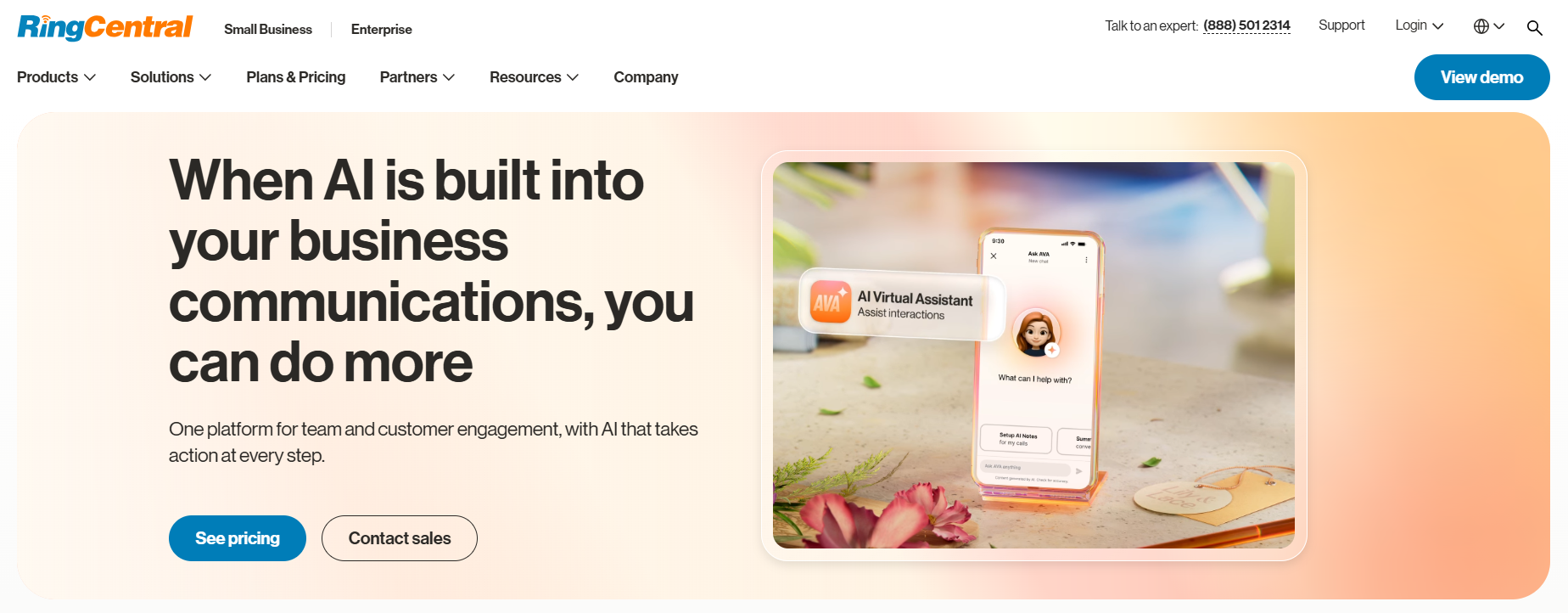
RingCX launched in 2023, bringing contact center capabilities under the same vendor as RingEX. For organizations already using RingCentral for business communications, adding RingCX means one vendor, one bill, and agents who can handle customer calls and internal collaboration from the same application.
The practical difference shows up in depth versus breadth.
Five9’s outbound dialer has four distinct modes, each configurable per campaign, with Advanced Campaign Manager adding AI-driven segmentation and built-in TCPA compliance controls.
RingCX offers manual, preview, progressive, and predictive dialing with call blending, but the outbound engine is younger and lacks the same campaign management depth.
RingCentral, on the other hand, gives you something Five9 cannot: a unified communications platform alongside the contact center. Business phone, team chat, video meetings, webinars, and AI-powered call transcription all live inside RingEX with a personal AI assistant included at no additional cost.
Five9 users need a separate UCaaS subscription from another vendor.
For contact centers where inbound and outbound calling is the core operation, Five9’s depth matters. For businesses where the contact center is one piece of a larger communications strategy, RingCentral’s breadth saves the cost and complexity of managing multiple vendors.
AI capabilities take different approaches
Five9 and RingCentral have both invested heavily in AI, but their architectures reflect different priorities.
Five9’s Genius AI uses an agentic architecture where an AI orchestrator listens to a caller, reasons about intent, and recruits specialized sub-agents to execute each step of a resolution.
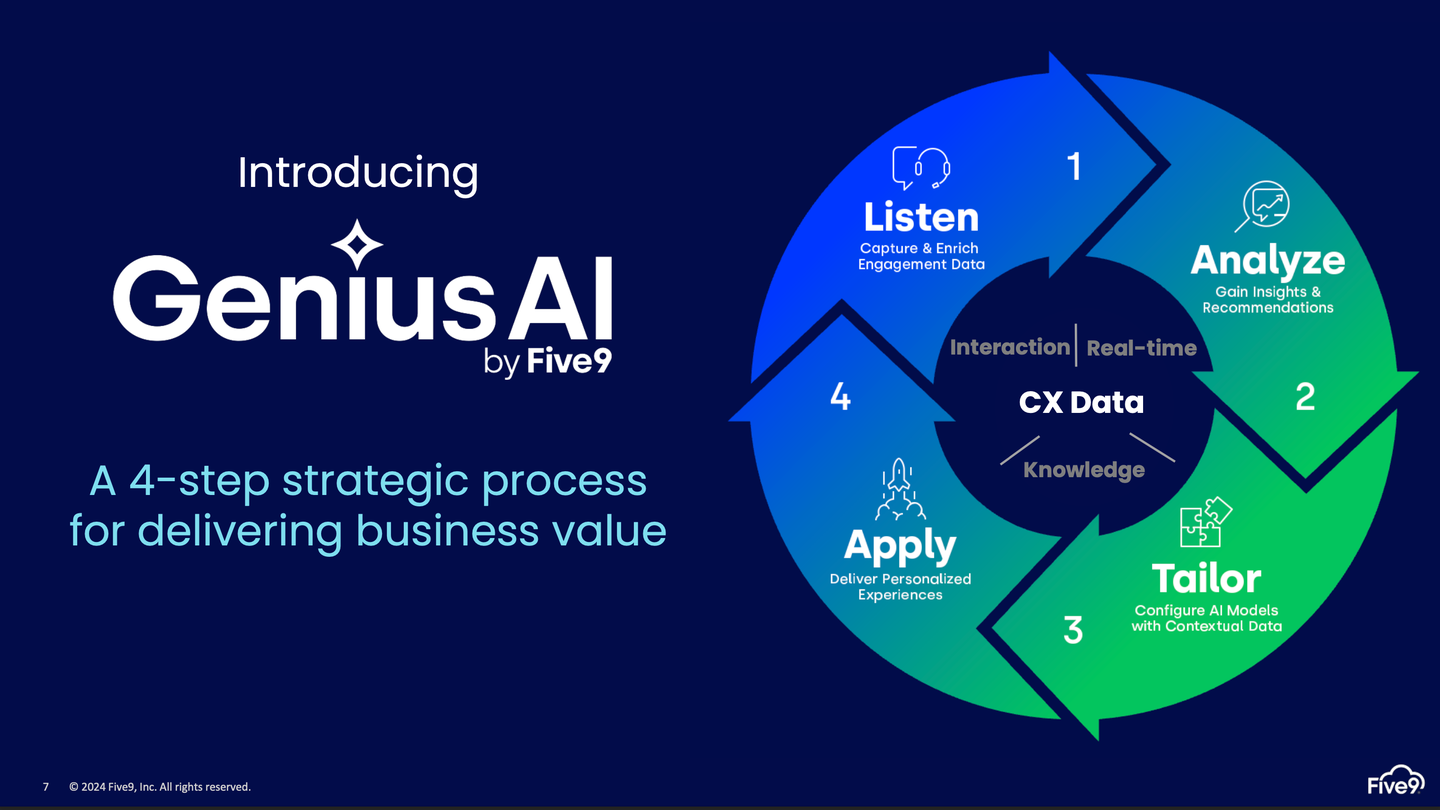
The June 2026 Voice AI Agents release added multi-agent orchestration for complex customer journeys, secure tool calling for authentication and transactions, and LLM-blinding to keep sensitive data out of language models.
Five9 frames its AI around a specific problem: high containment rates that mask poor customer satisfaction. The company’s own homepage argues that containment measures whether customers stopped, not whether they wanted to.
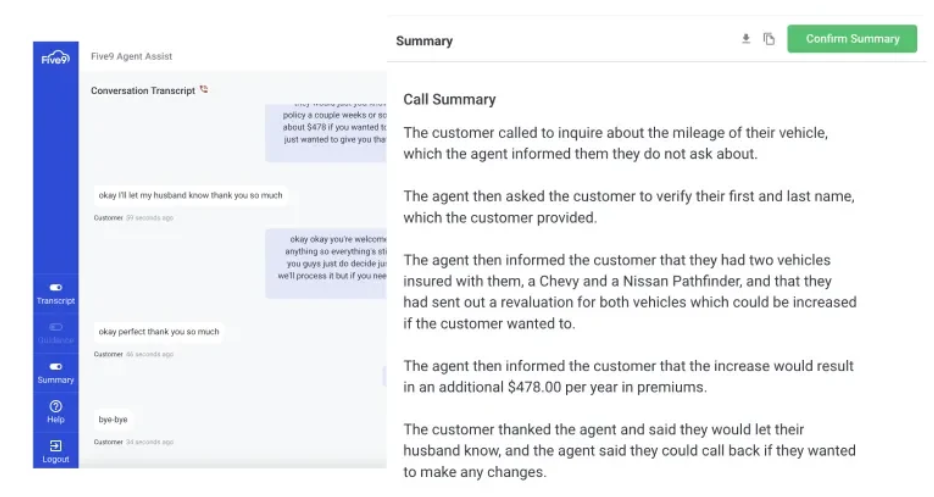
Beyond self-service, AI Agent Assist provides real-time transcription and guidance cards during live calls.
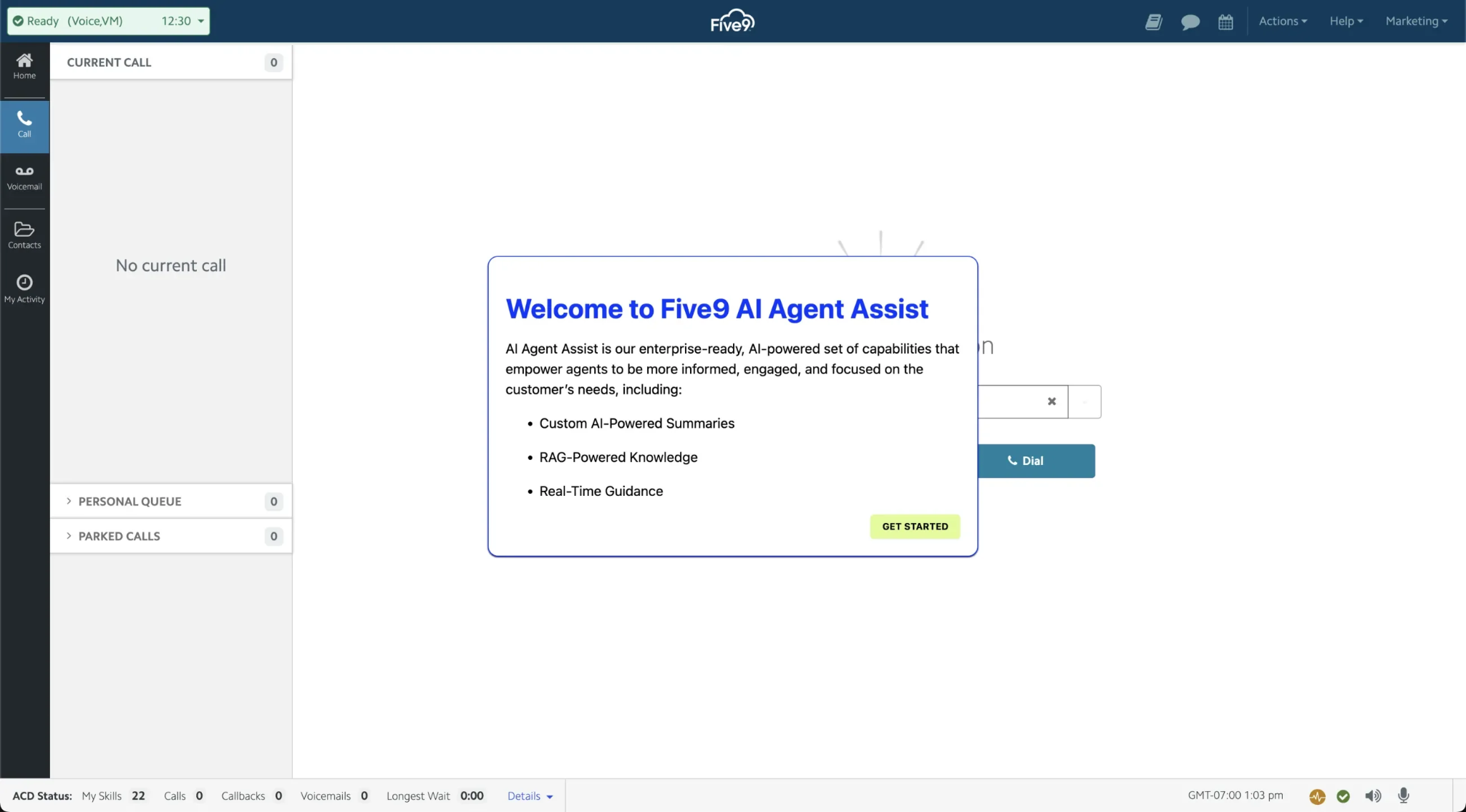
AI Summaries auto-generates after-call notes, reportedly reclaiming up to 40% of after-call work time.
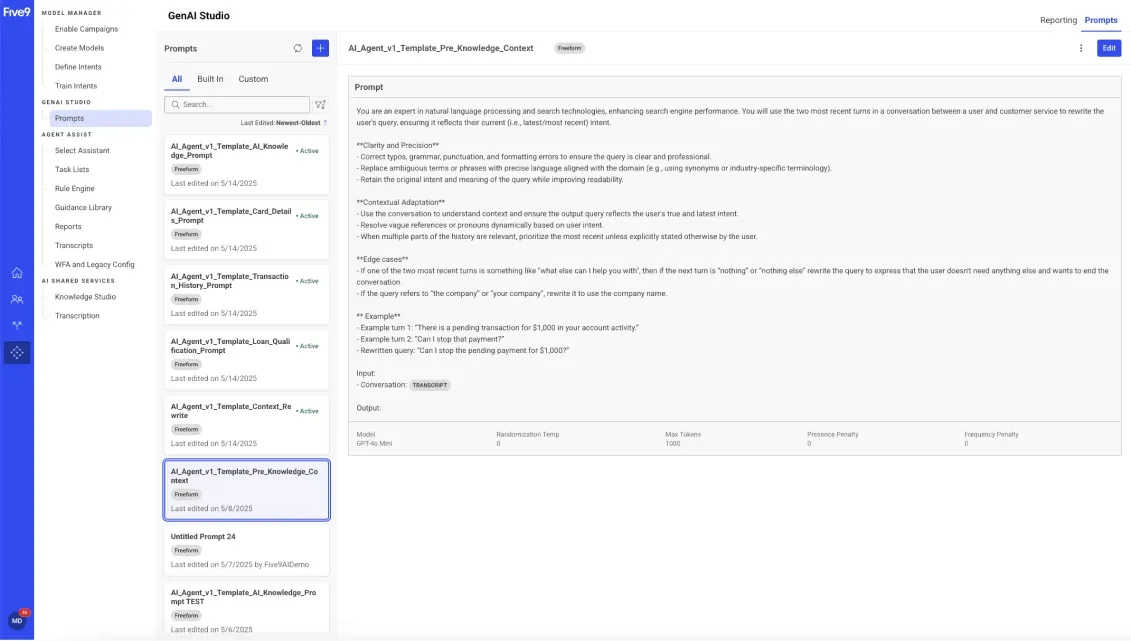
GenAI Studio lets administrators choose between multiple LLM providers, craft custom prompts, and test outputs against real call recordings without engineering involvement.
AI Trust & Governance adds hallucination monitoring and prompt injection threat detection from a single admin interface.
RingCentral’s AI strategy spans its entire product portfolio, not just the contact center. AI Receptionist (AIR) handles inbound calls autonomously, now serving more than 8,000 customers with 44% sequential growth.

AIR Pro extends this with a no-code studio for building custom AI agents.

Inside RingCX, AVA Agent Assist surfaces answers from web pages, FAQ guides, and CRMs during live calls, while AVA Supervisor Assist delivers real-time AI alerts and call summaries.
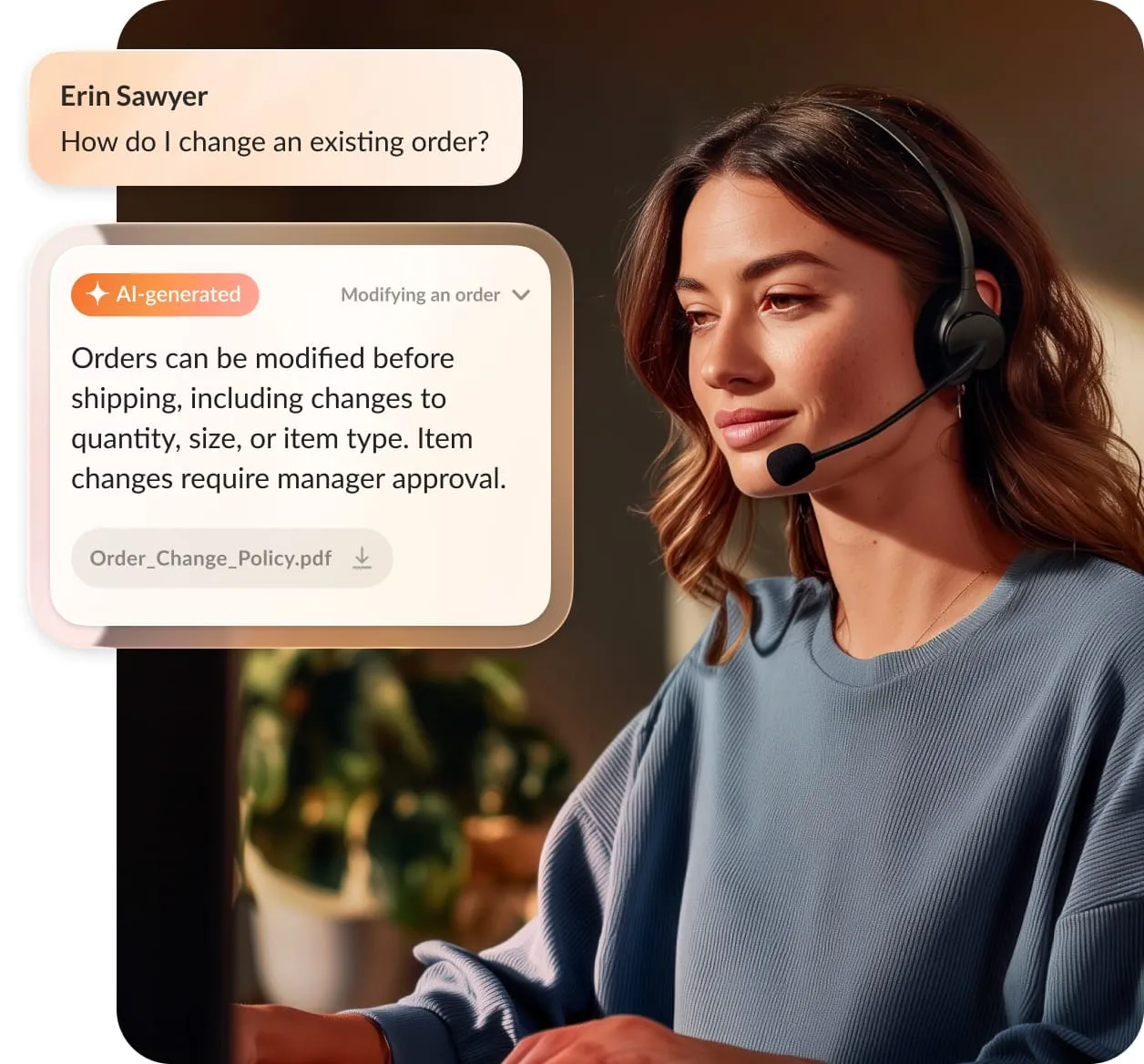
RingCentral’s partnership with OpenAI integrates frontier models into the platform.
evaluagent’s AI serves a different purpose. Rather than routing calls or assisting agents in real time, evaluagent’s AutoQA evaluates every conversation after the fact against the organization’s own quality standards.
The Context Engine (launched April 2026) goes beyond behavioral scoring to check whether agents gave factually correct answers, grounding AI evaluation against uploaded company policies and knowledge base content.
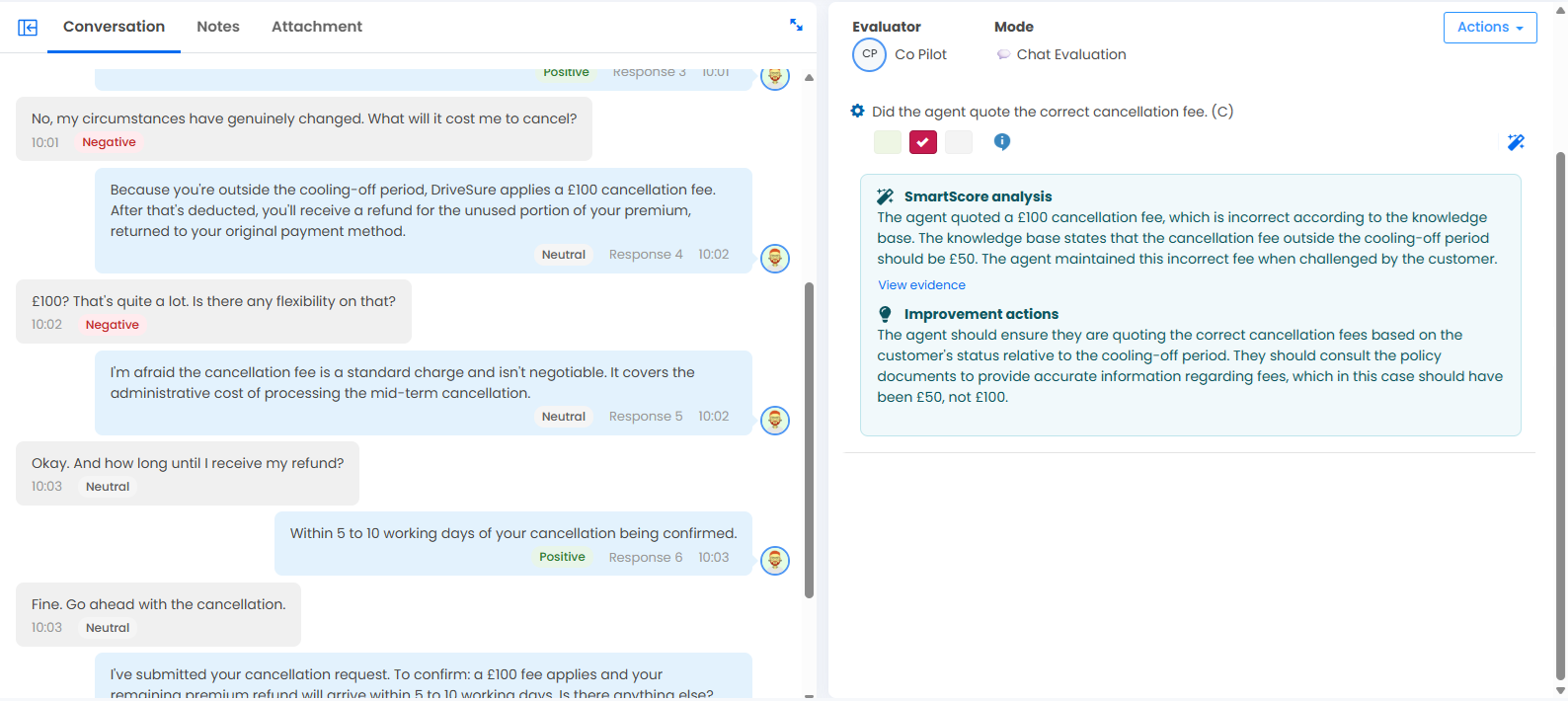
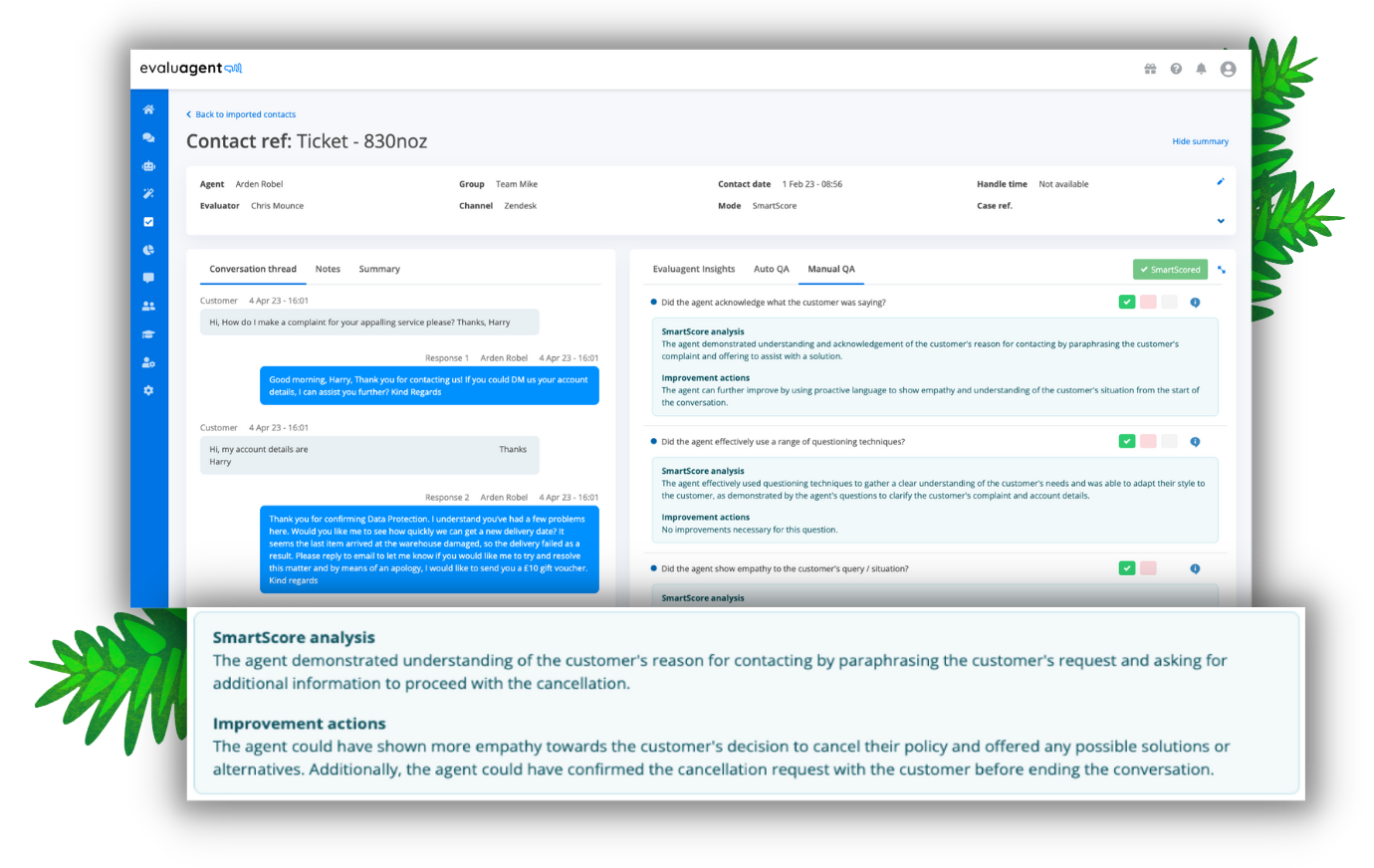
SmartScore provides AI-generated reasoning for each mark, explaining why it was awarded rather than returning a number.
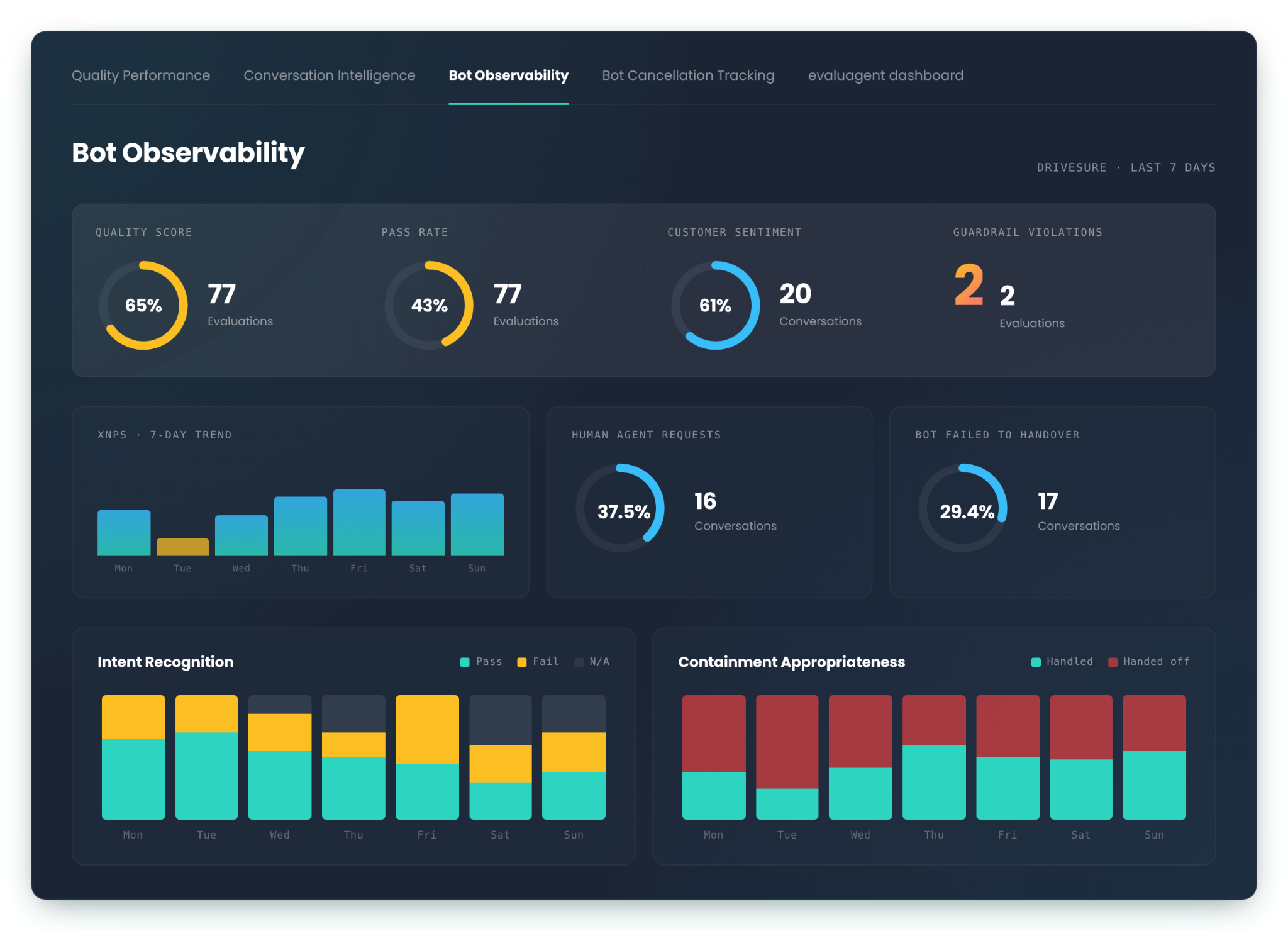
AI Agent Observability monitors AI chatbots for hallucinations and off-policy responses, using the organization’s own source of truth rather than the bot vendor’s self-reported metrics.
The distinction matters. Five9 and RingCentral use AI to make the contact center run. evaluagent uses AI to tell you whether it’s running well.
Quality management: built-in modules vs dedicated QA
Both Five9 and RingCentral have added AI-powered quality management to their platforms. Both now claim to evaluate 100% of interactions. But the depth and purpose of these tools differ from a platform built specifically for quality assurance.
Five9’s Agentic Quality Management (GA in Q1 2026) analyzes up to 100% of interactions, identifies knowledge gaps by benchmarking against top performers, and feeds competency data back into routing decisions. It’s a capable module that makes the contact center smarter over time, but it lives inside the Five9 ecosystem and serves Five9’s broader platform strategy.
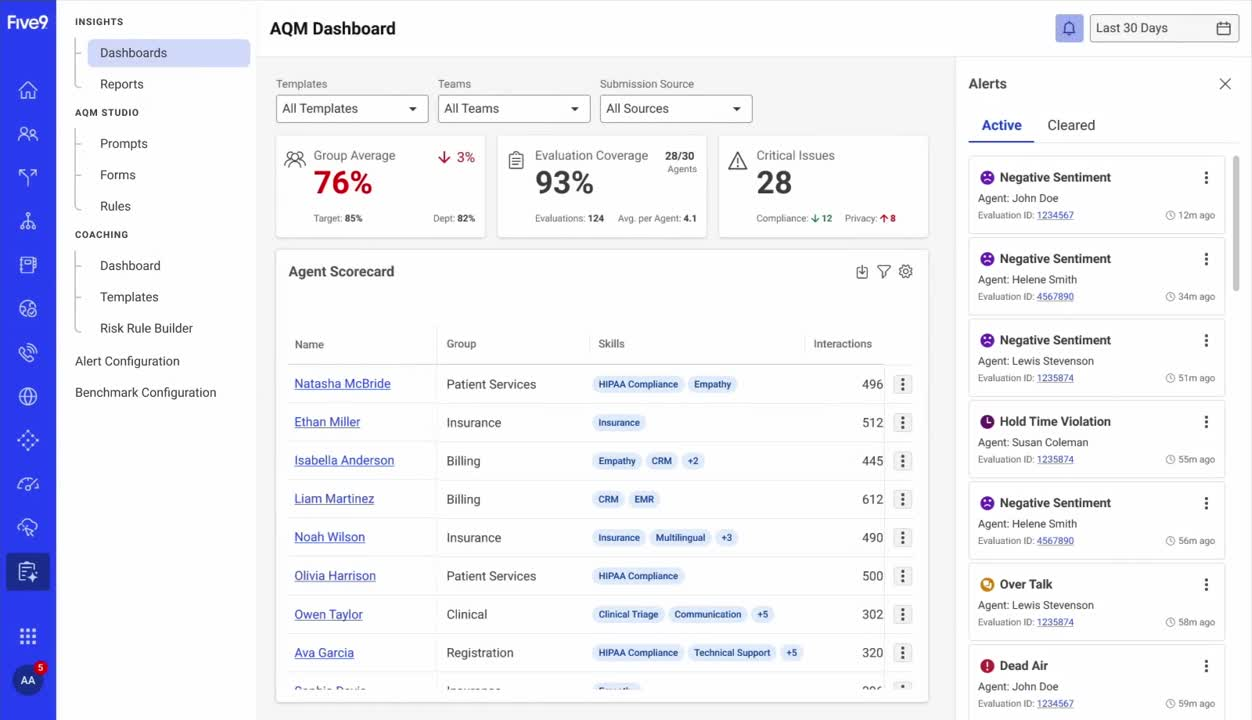
RingCentral’s AI Quality Management scores every customer interaction with AI, moving from the typical 1-2% manual review to full coverage. It integrates with RingCX’s supervisor tools and interaction analytics. Like Five9’s AQM, it’s a module within a larger platform.
evaluagent approaches quality differently. It’s not a module inside something else. It’s the entire product.
What that means in practice: evaluagent’s Blended Scorecards let some criteria be scored by AI and others reserved for human evaluators on the same scorecard.
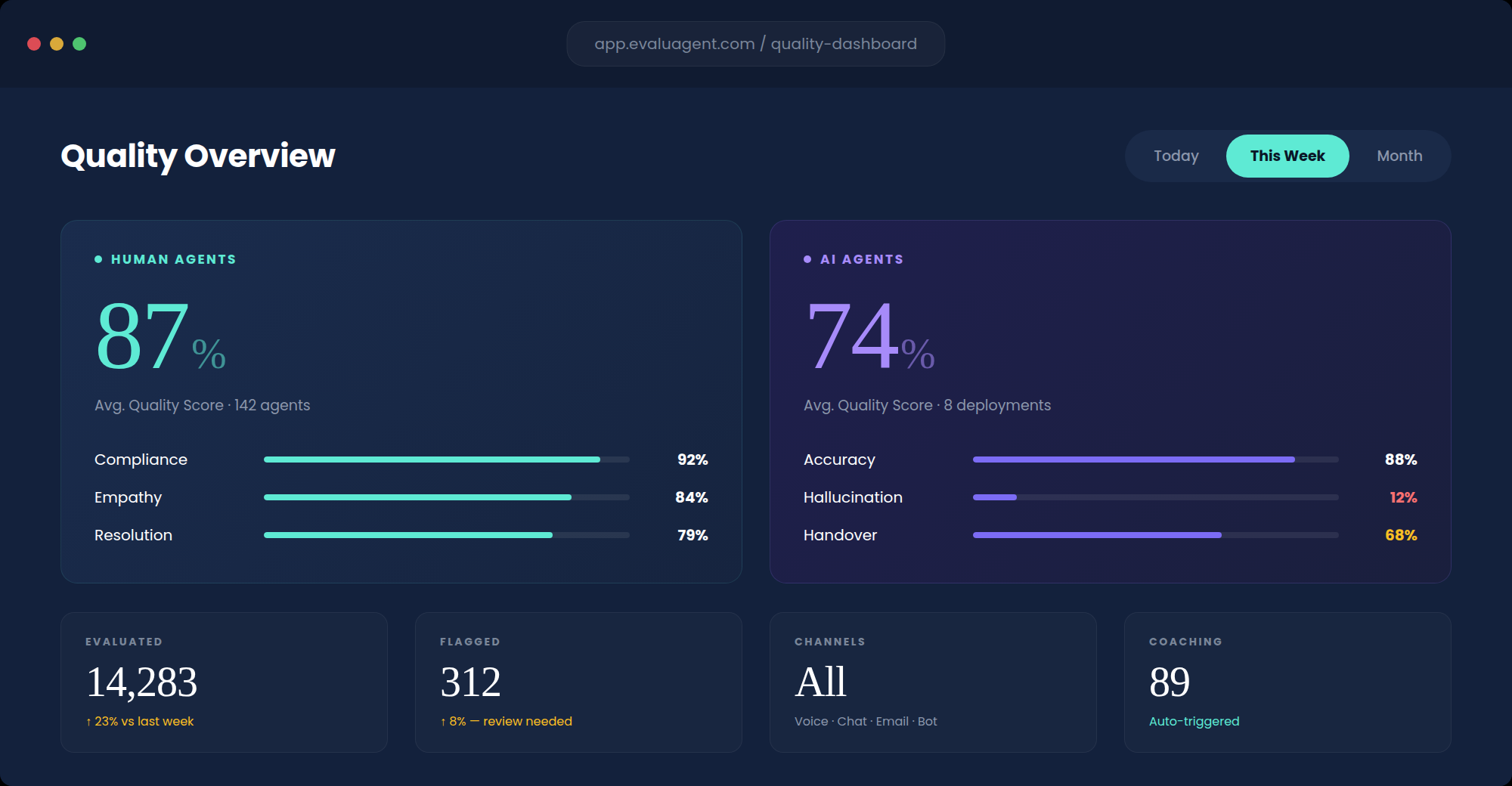
Calibration sessions align human and AI scoring to keep definitions consistent over time.
Agents can file formal disputes on scores they disagree with, feeding corrections back into the model.
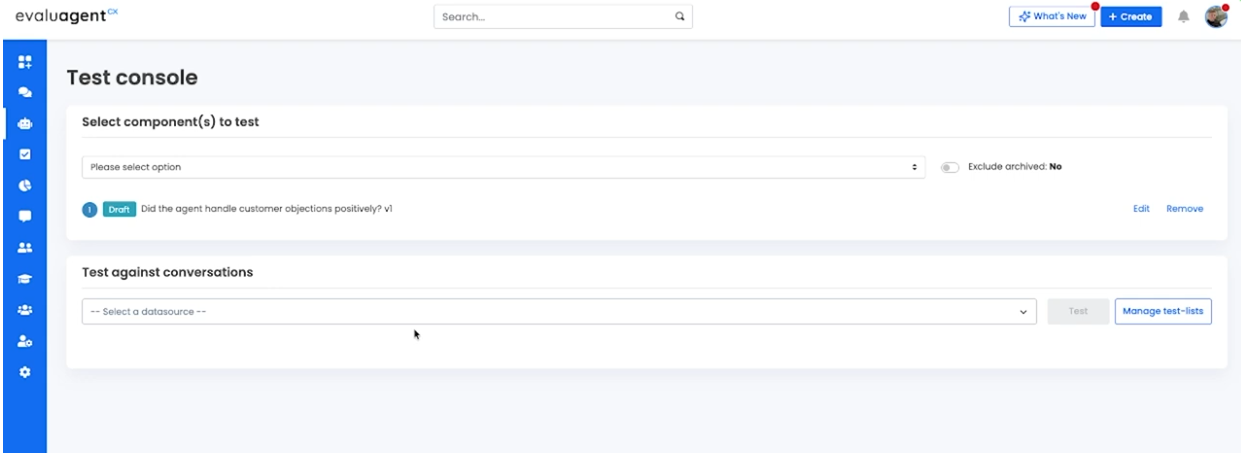
A Testing Console lets QA managers trial any scoring change against real historical conversations before deploying it to production.
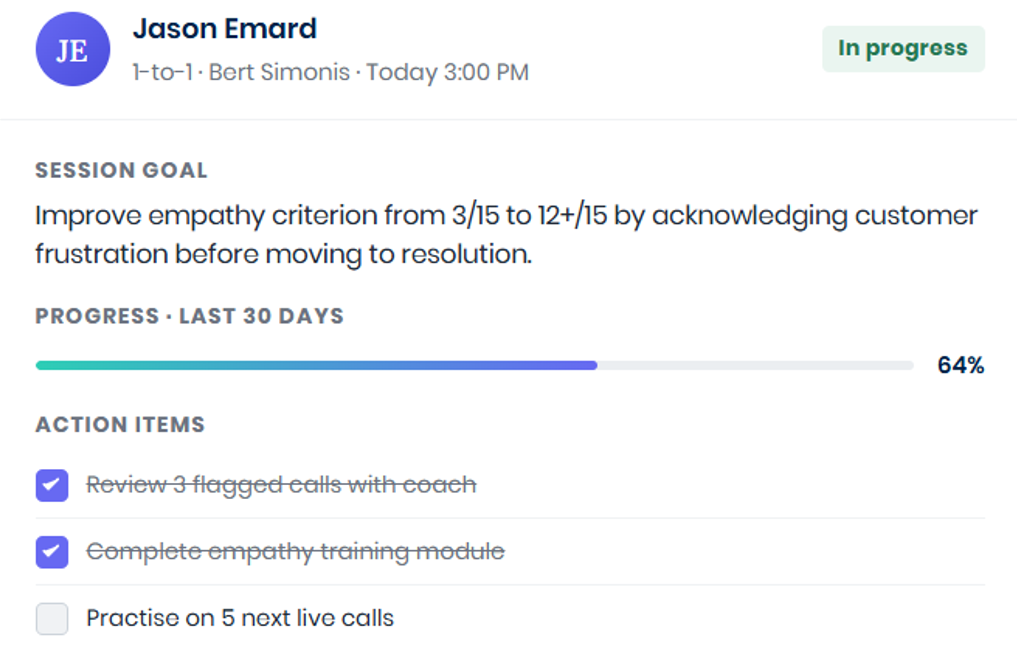
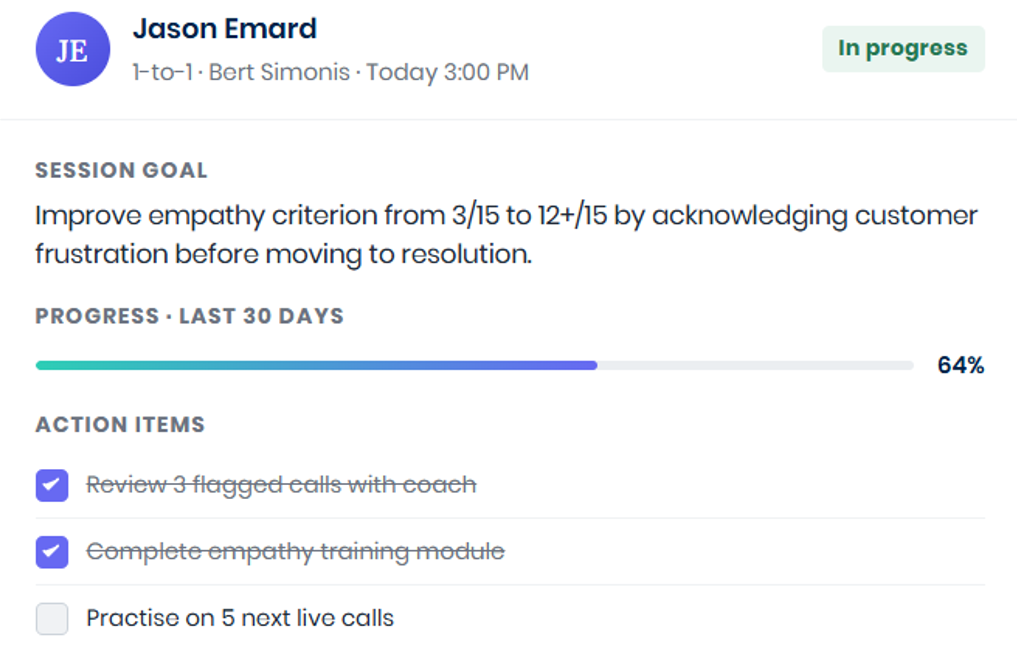
The closed loop between scoring and improvement is where evaluagent’s specialization shows most clearly. Evaluation findings connect to coaching sessions, 1-to-1s, performance improvement plans, and eLearning auto-enrollment without switching systems.
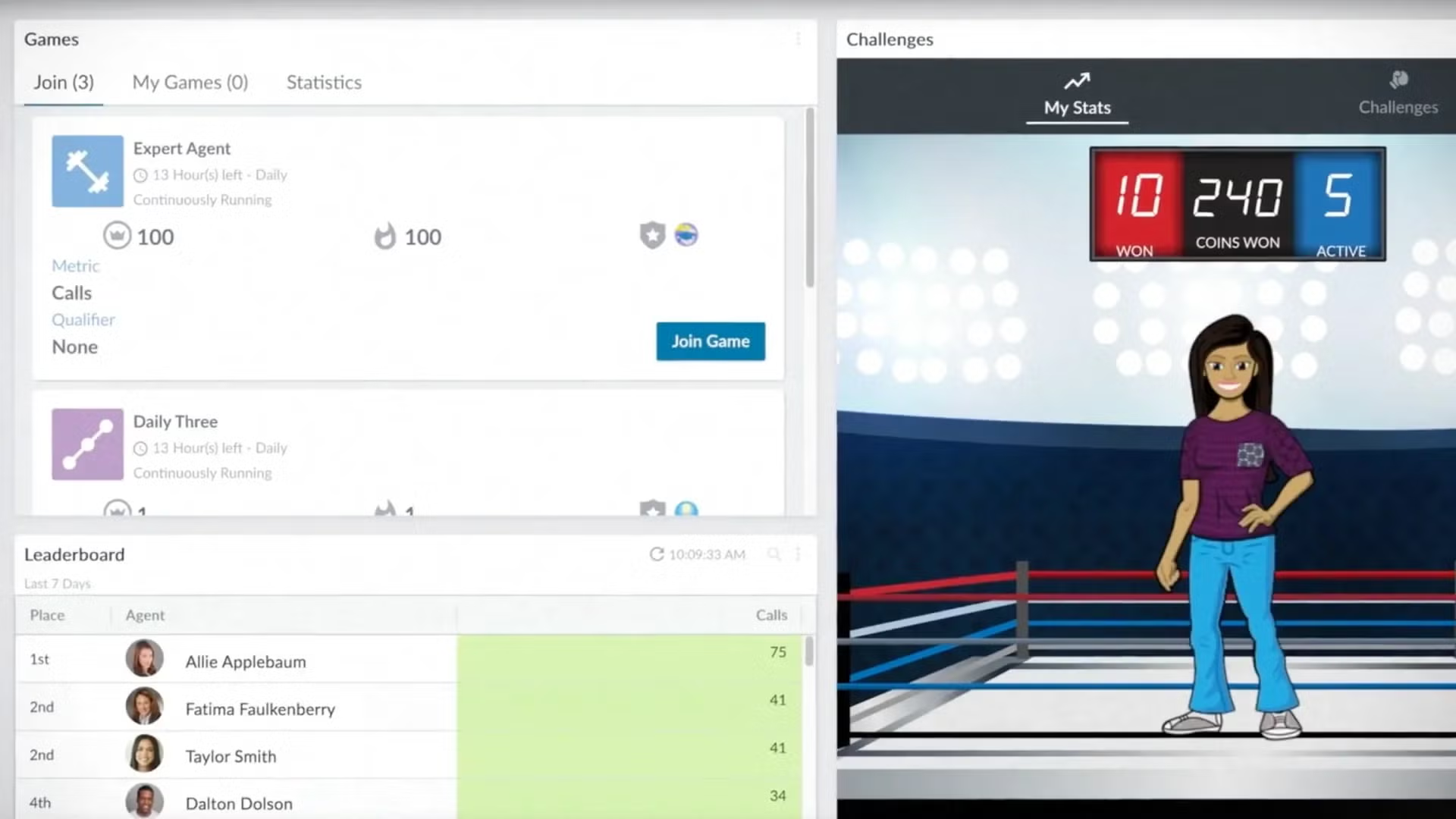
Gamification adds points, badges, leaderboards, and an auction-style reward system tied to QA results. Five9 offers gamification within its WEM suite, and RingCentral provides performance dashboards, but neither connects QA scores to structured coaching and development as tightly within a single workflow.
The independence factor matters too. evaluagent is CCaaS-agnostic: it integrates with Five9, RingCentral, Genesys, Amazon Connect, Talkdesk, and others. Your quality data lives in evaluagent, not in your contact center platform. If you switch from Five9 to RingCentral (or vice versa), your quality history, coaching records, and trend data carry over.
Capital on Tap scaled from 900 to 6,000 BDM quality checks per month immediately after going live with evaluagent, without adding QA headcount. (Capital on Tap Case Study)
Coaching and agent development
Scoring conversations is only useful if scores lead to better performance. This is where the three platforms diverge most sharply.
Five9 feeds quality data into its Performance Management dashboards, giving supervisors visibility into agent KPIs.Its Gamification module lets supervisors model game outcomes against historical data before launching challenges.
But the coaching workflow (connecting a poor score to a structured development plan to measurable improvement) relies on supervisors taking manual action from dashboard insights.
RingCentral provides AI Interaction Analytics that calculates predictive customer satisfaction across all calls, and AI Conversation Expert that captures and analyzes phone calls, video meetings, and emails for coaching insights. These tools surface information, but the path from insight to agent improvement is loosely structured.
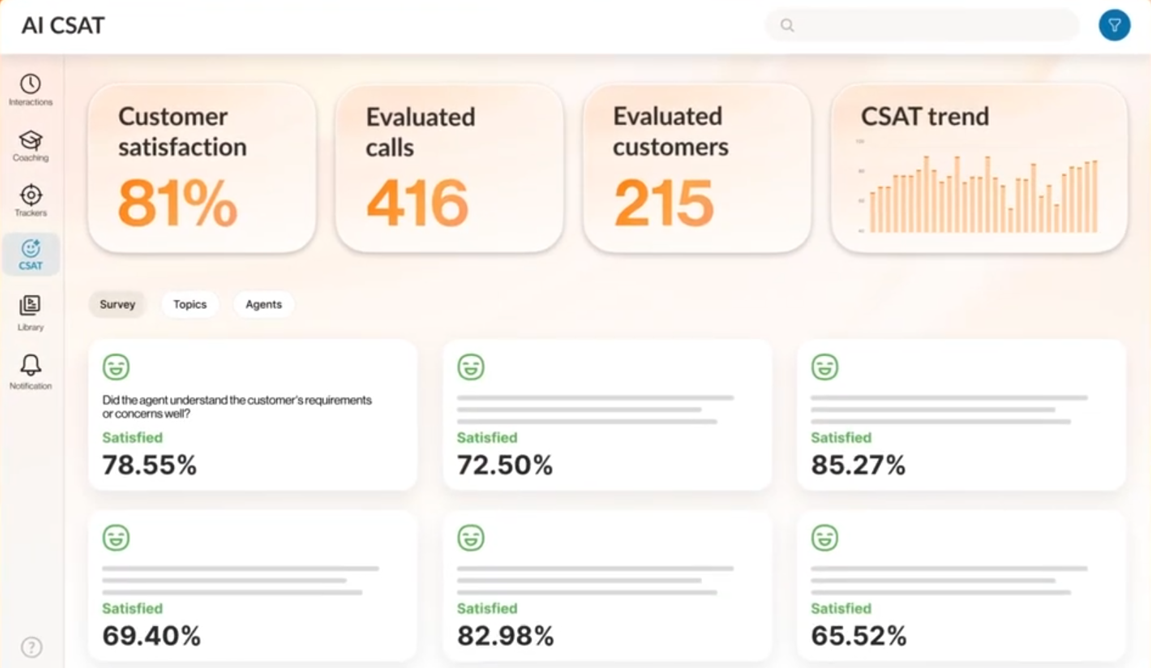
evaluagent treats the insight-to-improvement pathway as a core product, not a supervisor’s manual responsibility. When a score publishes, agents receive feedback promptly, while the conversation is still fresh.
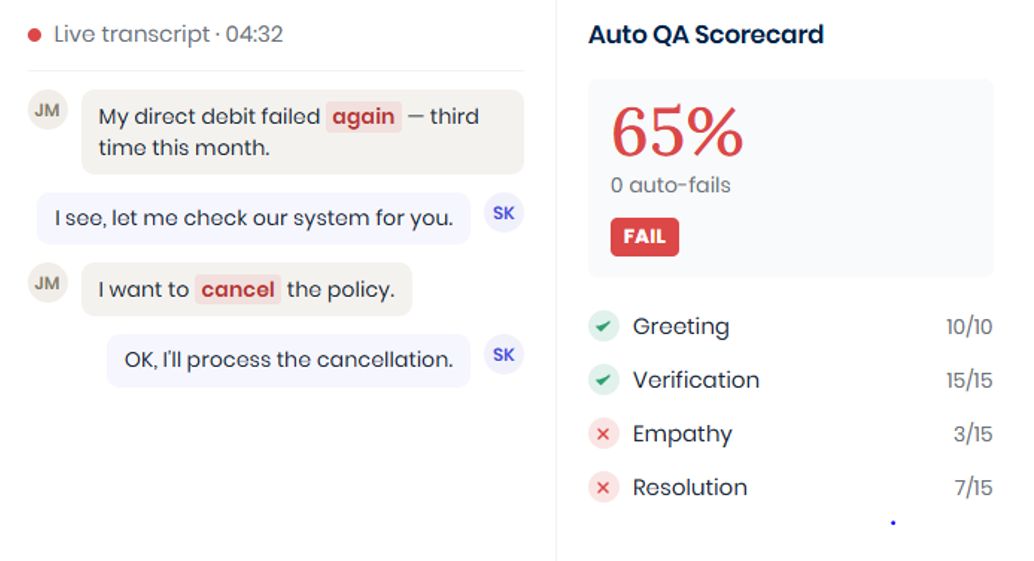
Automated Actions fire when scores, sentiment shifts, or compliance flags meet configured thresholds, triggering coaching sessions, escalations, or eLearning enrollment without manual intervention.
Performance Plans link 1-to-1 sessions, coaching actions, and training courses into an HR-ready record with a built-in audit trail.
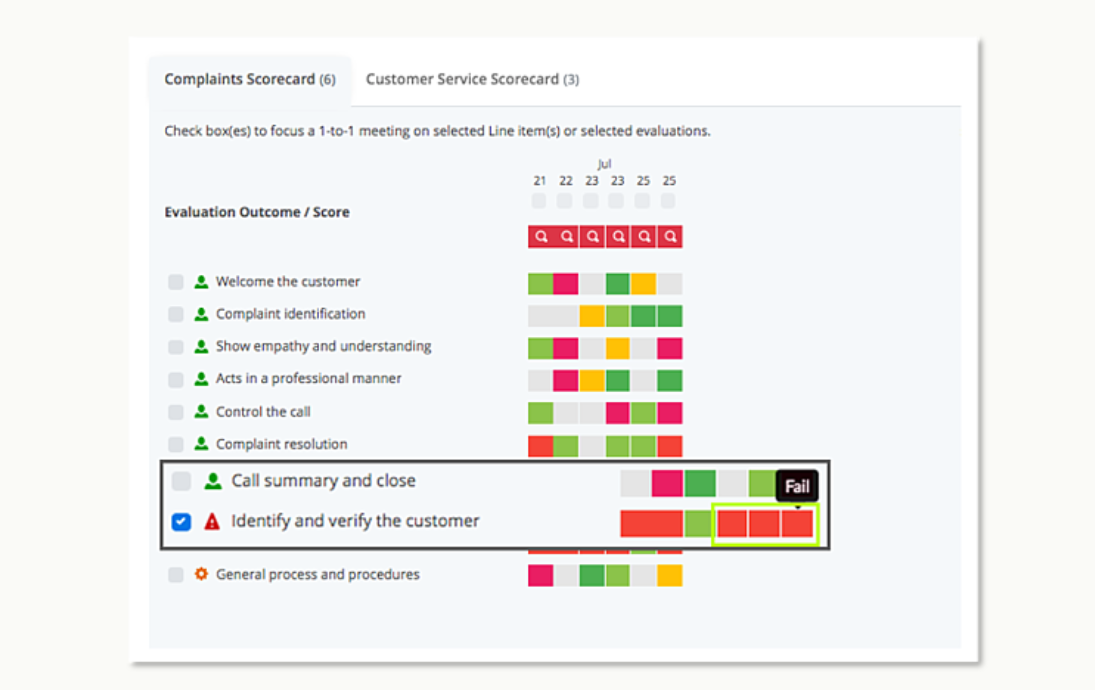
The platform includes a built-in LMS with interactive lessons, quizzes, and learning paths triggered automatically by performance metrics.
evaluagent’s Conversation Intelligence suite adds another dimension to coaching decisions: predicted satisfaction, effort, and resolution scores (xNPS, xCSAT, xCES, xResolution) generated on every interaction, including those where no survey was returned.
Spotlight surfaces root causes behind emerging performance patterns, helping QA leaders direct coaching where it will matter most rather than reacting to scorecard averages.
For contact centers where agent retention is a priority, this structured development workflow has measurable impact.
Seasalt Cornwall doubled evaluations completed and reduced annual agent attrition from 100% to 10% after implementing evaluagent’s coaching and transparency features. (Seasalt Cornwall Case Study)
Outbound capabilities and omnichannel coverage
If outbound calling is a significant part of your operation, this section may settle the Five9 vs RingCentral decision on its own.
Five9 built its reputation partly on outbound dialing. Four dialing modes (predictive, progressive, preview, and power) are each configurable per campaign. Advanced Campaign Manager adds AI-driven lead prioritization, omnichannel campaign orchestration across voice, SMS, and email, and no-code compliance controls for TCPA, FDCPA, and GDPR.
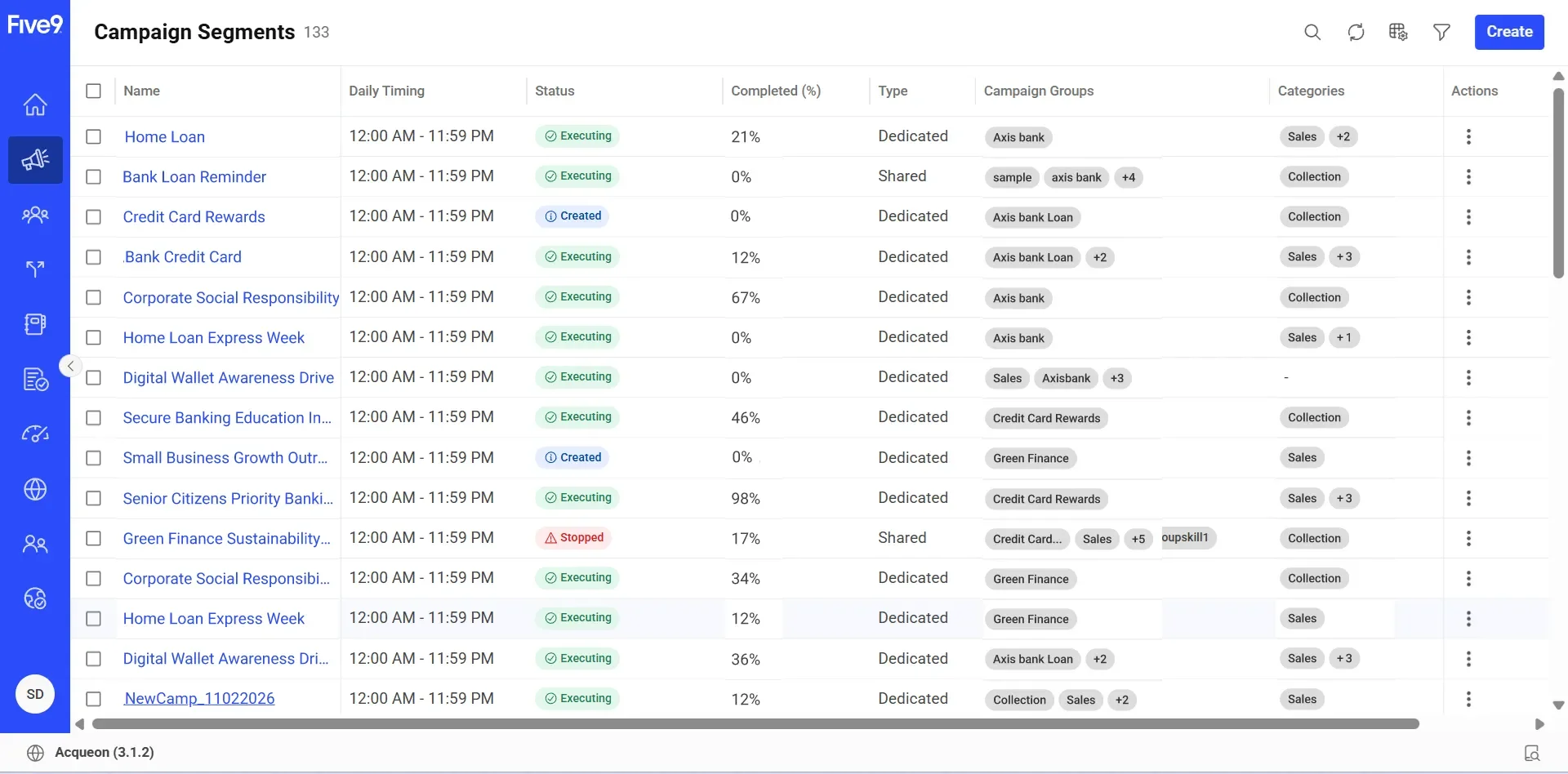
Active Blending shifts agents between inbound queues and outbound lists based on real-time traffic automatically, with no manual log-in or log-out required. G2 reviewers consistently cite the predictive dialer as a standout feature.
RingCentral offers outbound dialing with manual, preview, progressive, and predictive modes and call blending. The capability works, but it lacks Five9’s depth in campaign management, lead scoring, and compliance automation.

For organizations with modest outbound needs, RingCX’s outbound tools are sufficient. For high-volume outbound operations (collections, telemarketing, appointment setting), Five9 is the stronger platform.
On omnichannel coverage, both platforms handle the core channels. Five9 supports voice, email, chat, SMS, social messaging, and video, with a direct Meta BSP partnership for WhatsApp and video with agent annotation where agents can mark up a customer’s live camera feed.
RingCentral’s RingCX covers voice and 20+ digital channels, with Intelligent Virtual Agents for 24/7 self-service across those channels.
evaluagent evaluates conversations from whichever channels your CCaaS ingests. It doesn’t handle routing or delivery. Instead, it scores voice, chat, and email conversations imported through its native integrations or API, applying the same quality standards regardless of channel.
Pricing reflects different positioning
The pricing structures reveal how each company thinks about its market.
Five9 prices by seat with five bundles. The two published tiers are Digital at $119 per seat per month (digital channels only, voice available with separate usage charges) and Core at $159 per seat per month (all channels plus AI). Plus, Pro, and Enterprise tiers require a sales conversation.
AI capabilities are bundled at 3,000 minutes per seat, with additional consumption billed on usage. WEM (workforce management, quality, analytics) is available at Pro and Enterprise tiers or through Five9’s partnerships with Verint and Calabrio.
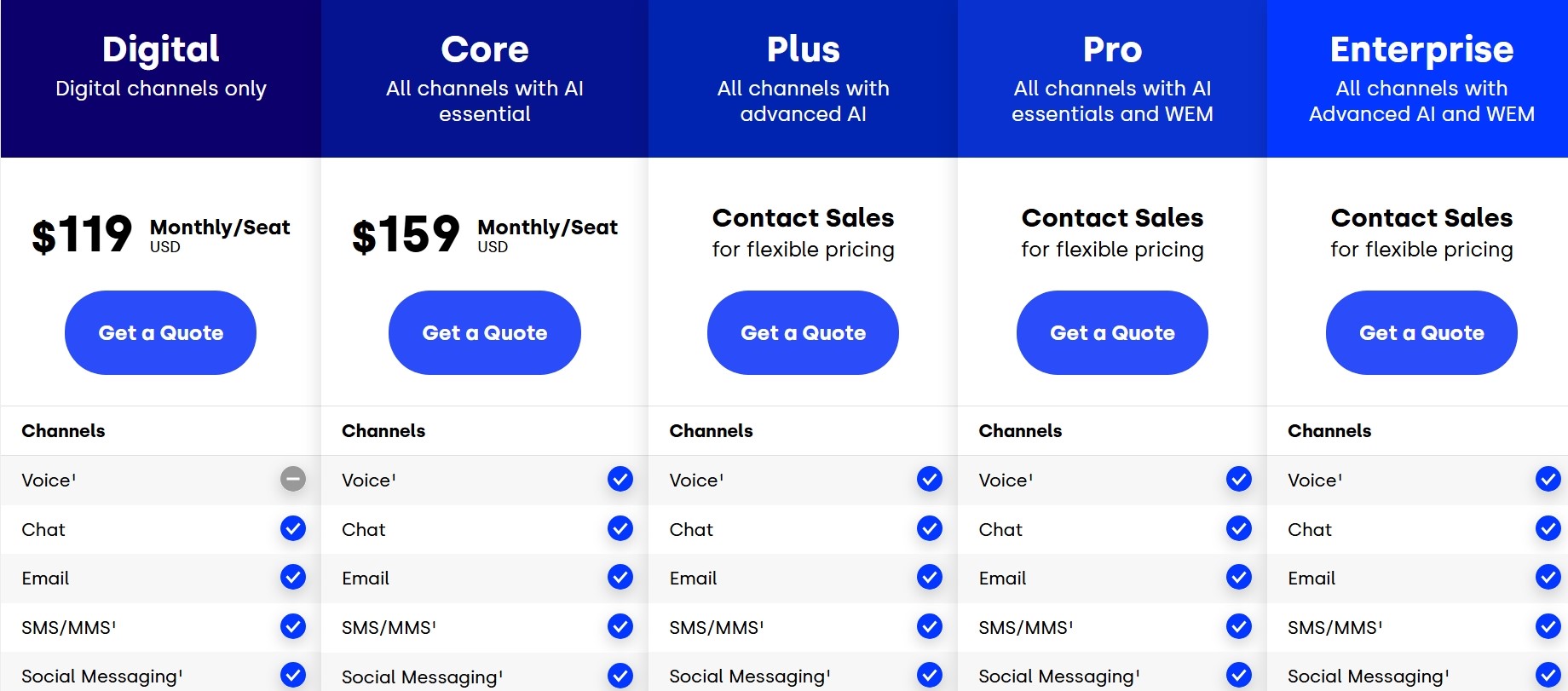
Add-ons include Secure Pay, IVR with Speech Recognition, a Technical Account Manager, and additional storage.
The total cost of running Five9 frequently exceeds the published per-seat rate. G2 reviewers note that add-on costs for advanced capabilities can increase the total spend at scale, and implementation typically requires professional services engagement.
RingCentral prices RingCX with four tiers: Standard at $65 per seat per month (annual billing), Professional at $95, Elite at $145, and Enterprise at custom pricing. RingEX (the unified communications platform) is priced separately.
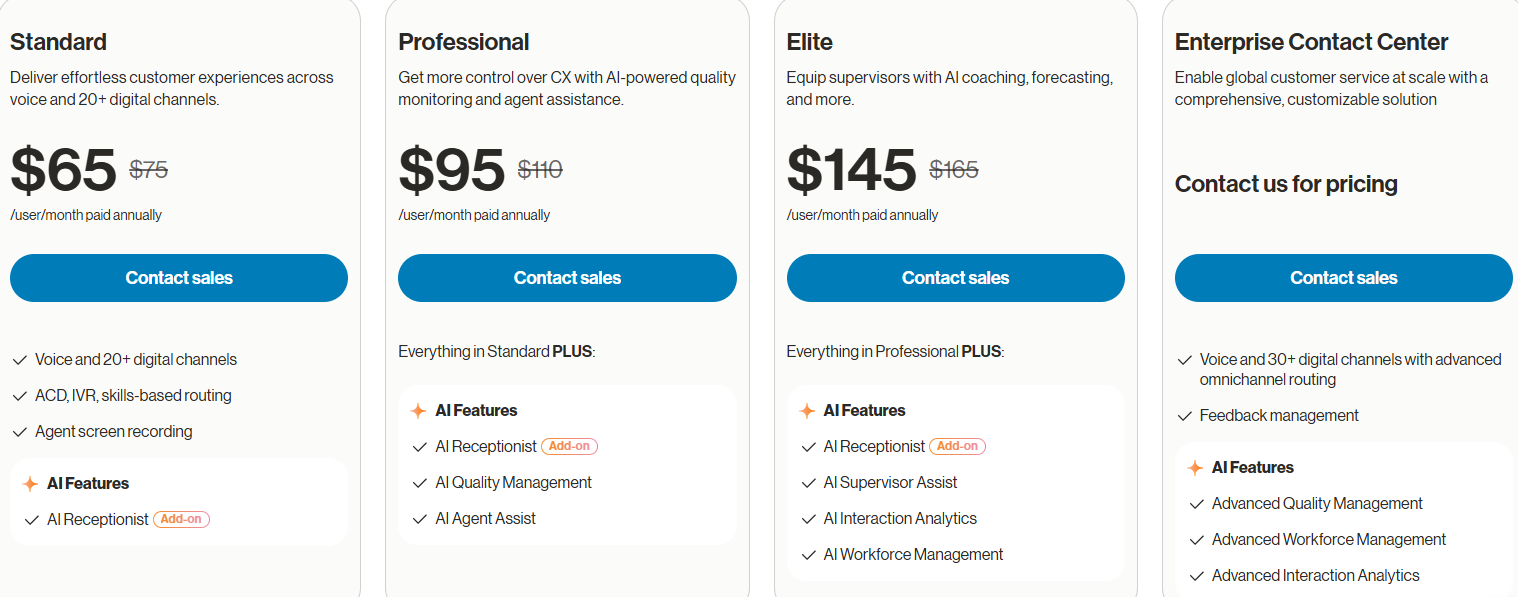
Organizations that want both UCaaS and CCaaS from RingCentral will carry two subscriptions, though the combined cost for RingEX plus RingCX can still undercut Five9’s standalone CCaaS pricing. A 14-day free trial is available for RingEX, though SMS is not available during the trial.
evaluagent prices from $35 per user per month for AutoQA & Improvement, or $65 per user per month for the full bundle including Conversation Intelligence (sentiment analytics, predictive VoC metrics, Spotlight AI analyst, and custom topics). Volume discounts are available for large teams.
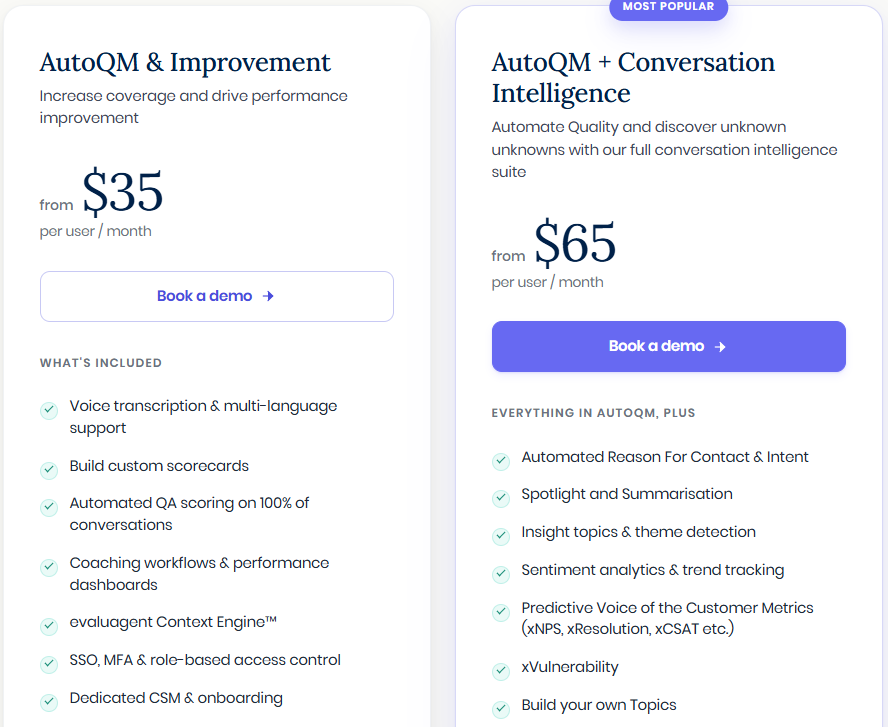
Because evaluagent is a QA layer rather than a contact center, its cost is additive to your CCaaS subscription. But the math often works out: it costs less than hiring additional QA analysts to achieve the same coverage.
The Share Centre cut evaluation time from 24 minutes to 6 minutes per interaction after implementing evaluagent, a 285% increase in QA productivity, while pass rates rose from 73% to 85%. (The Share Centre Case Study)
AI agent governance: a growing gap
As contact centers deploy AI chatbots and virtual agents, a new problem emerges: who watches the bots?
Five9 addresses this with AI Trust & Governance, which provides hallucination monitoring, prompt injection threat detection, and custom data redaction across its AI platform. These controls govern Five9’s own AI products from a single administrative interface.
RingCentral is investing in agentic AI and has launched AIR Pro for building custom AI agents. Quality management within RingCX can evaluate AI-handled interactions, but governance tooling for third-party bots is not a primary focus.
evaluagent treats AI agent governance as a dedicated product line. The module evaluates every AI agent conversation against the same quality standard applied to human agents, with fabrication detection grounded in the organization’s own knowledge base, off-policy response flagging, containment analysis, and handover quality tracking.
It works across bot vendors (Cognigy, Sierra, Decagon, and proprietary builds), providing cross-vendor scoring against a single quality definition.
The architectural distinction matters: Five9’s and RingCentral’s AI governance monitors their own AI. evaluagent monitors any AI, from any vendor, against your standards rather than the vendor’s. For organizations deploying bots from multiple providers, or for those who need an independent evidence base for regulators, that independence is the point.
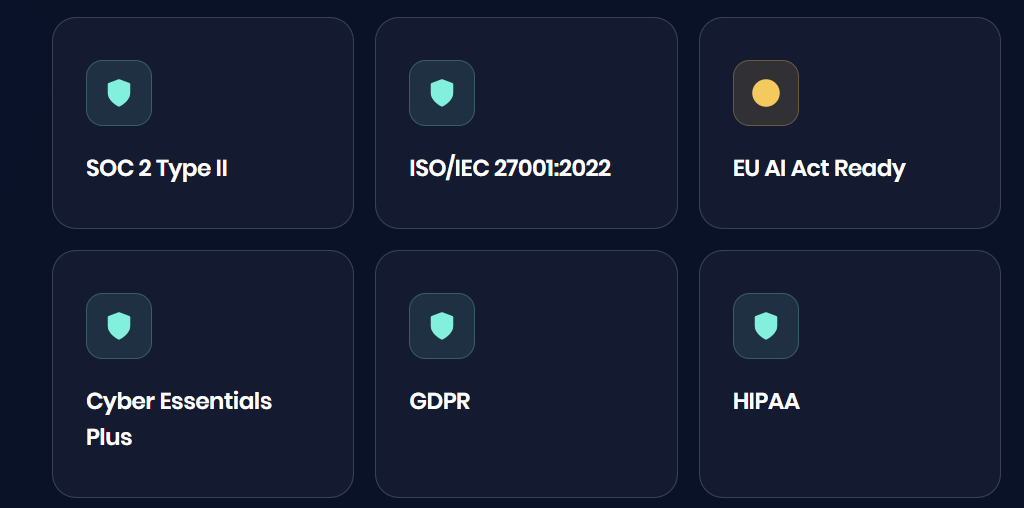
evaluagent holds SOC 2 Type II, ISO/IEC 27001:2022, and Cyber Essentials Plus certifications, is HIPAA-aligned and GDPR-compliant, and offers selectable data residency across UK/EU, US, and Australia.
Five9 vs RingCentral vs evaluagent: Which should you choose?
The choice between Five9 and RingCentral depends on what your contact center needs most. The decision to add evaluagent depends on how seriously you take quality.
Choose Five9 if:
- You run a dedicated contact center where CCaaS depth matters more than unified communications
- Outbound dialing (predictive, progressive, power) is a significant part of your workflow
- You need Salesforce integration with native CTI capabilities
- Your organization has the budget and IT resources for an enterprise platform
- You want a contact center vendor with eight consecutive Gartner Magic Quadrant Leader recognitions
Choose RingCentral if:
- You want unified communications (phone, messaging, video) and contact center from a single vendor
- Your contact center operation is primarily inbound or lightly blended
- A lower CCaaS entry point ($65 per seat per month) better fits your budget
- Your team already uses or plans to use RingEX for business communications
- Faster deployment matters more than feature depth
Add evaluagent to either if:
- You want to score 100% of conversations independently from your CCaaS vendor
- Closing the loop between QA scores and structured coaching is a priority
- You need your quality data to be portable, not locked inside your contact center platform
- You’re deploying AI agents and need independent governance with hallucination detection
- You want a QA platform that works whether you use Five9, RingCentral, or something else entirely
See how evaluagent works with your existing platform.
Five9 and RingCentral both run good contact centers. They route calls, manage agents, and deliver AI-powered automation at scale. But the contact center is only as good as the quality of its conversations. An independent QA platform like evaluagent ensures that quality is measured consistently, coached systematically, and improved continuously, regardless of which contact center technology sits underneath.