Balto does something most contact center AI competitors don’t: it coaches agents while they’re still on the call. Instead of analyzing conversations after the fact, Balto listens in real time, surfacing scripts, compliance reminders, and objection-handling prompts the moment an agent needs them. For contact centers where what an agent says on a live call has revenue and regulatory consequences, that distinction matters.
To write this Balto review, we analyzed the platform in depth. We believe it’s the right choice if:
- You run outbound or blended contact centers where live call performance drives revenue
- Real-time compliance monitoring is a regulatory requirement in your industry
- You need to close the gap between top performers and new hires during live conversations
- You want AI that guides agents in the moment, not just evaluates them afterward
- Your primary channel is voice, with most interactions happening over the phone
However, Balto might not be the best choice if:
- You need a full quality management system with structured coaching workflows and performance improvement plans
- Your contact center handles significant volume across chat, email, and SMS alongside voice
- You want AI scoring calibrated to your own QA policies, knowledge base, and compliance documents
- You need independent quality oversight of AI chatbots and virtual agents alongside human agents
- Transparent, published pricing matters to your procurement process
In this case, you should consider evaluagent: a QA and performance management platform that scores 100% of conversations automatically across voice, chat, and email, then connects those scores directly to structured coaching sessions, performance improvement plans, and gamified agent development. Where Balto intervenes during calls, evaluagent ensures every interaction is evaluated afterward and that evaluation leads to measurable improvement.
We’ve included a detailed look at evaluagent at the end of this review as the strongest alternative for contact centers that need quality management beyond real-time guidance. If you’re ready to explore it, you can book a demo here.
What is Balto?
Balto is a contact center AI platform founded in 2017 in St. Louis, Missouri by Marc Bernstein and Chris Kontes.
The two were working in telesales when they noticed a familiar problem: agents forgot their training the moment a real objection came up on a live call. Bernstein built a rudimentary Excel macro to pull up pre-written responses during calls, Kontes saw the commercial potential, and they coined the term “real-time guidance” to describe what became Balto’s founding product.
The company has raised approximately $52 million in funding, including a $37.5 million Series B led by Stripes in 2021 with participation from RingCentral Ventures. Balto reports having guided over 500 million calls and delivered more than one billion real-time recommendations. The platform holds SOC II, HIPAA, and PCI certifications and supports over 20 languages.
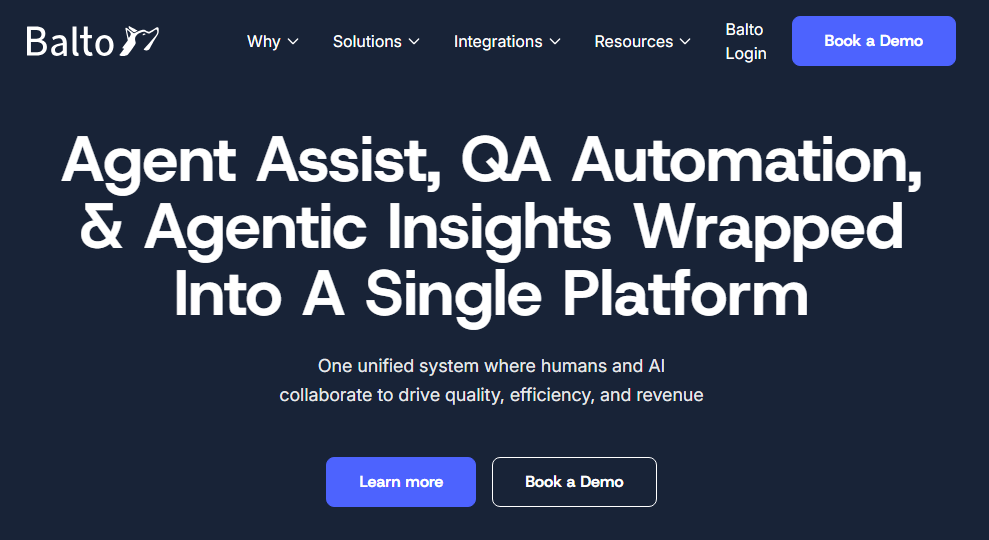
Today, Balto’s product suite spans nine modules: Agent Assist (live in-call guidance), Quality (automated QA scoring), Compliance (real-time regulatory monitoring), Coaching (performance development), Insights (conversation intelligence), Notes (automated call summaries), Voice AI Agents (Togo, for automatable interactions), Omnichannel AI, and Generative AI (BaltoGPT).
Named customers include Humana, Empire Today, Staples Canada, GEHA, and AmTrust. The platform targets mid-to-enterprise contact centers in regulated verticals: health insurance, healthcare, P&C insurance, banking, collections, home improvement, and BPO.
Balto Pros & Cons
| Pros | Cons |
|---|---|
| Real-time, in-call guidance surfaces answers during live conversations | Speech recognition can miss fast or nuanced dialogue |
| Proven compliance improvements (scores above 90% in documented cases) | Real-time suggestions can overwhelm agents during high-tempo calls |
| Automated QA scores 100% of calls, replacing spot-check sampling | Initial playbook setup is time-consuming for managers |
| Fast time-to-value (customers report ROI within 45 days) | CRM reporting integration is not always automatic |
| Integrates with 50+ contact center platforms | Pricing is not published; requires sales engagement |
| 4.8 G2 rating with over 500 reviews | Omnichannel capabilities are newer and less proven than voice |
| Automated call notes with CRM sync | Single-monitor widget behavior can be disruptive |
Balto Review: How It Works & Key Features
Real-Time Agent Assist: Balto listens to live calls and surfaces guidance the moment agents need it.
Balto’s Real-Time Agent Assist is the platform’s defining feature. It plugs into the contact center’s existing phone system, listens to both the agent and customer during a live call, and triggers relevant scripts, objection responses, and compliance reminders without requiring the agent to search for information or put the customer on hold.
The system pulls answers from multiple sources at once: the organization’s knowledge base, CRM, the web, and responses from top-performing agents. When an agent verbally completes a required disclosure or onboarding step, Agent Assist checks it off automatically, removing the manual tracking burden. Managers can tag top performers and have Balto identify their response patterns, then spread those behaviors to the rest of the team.
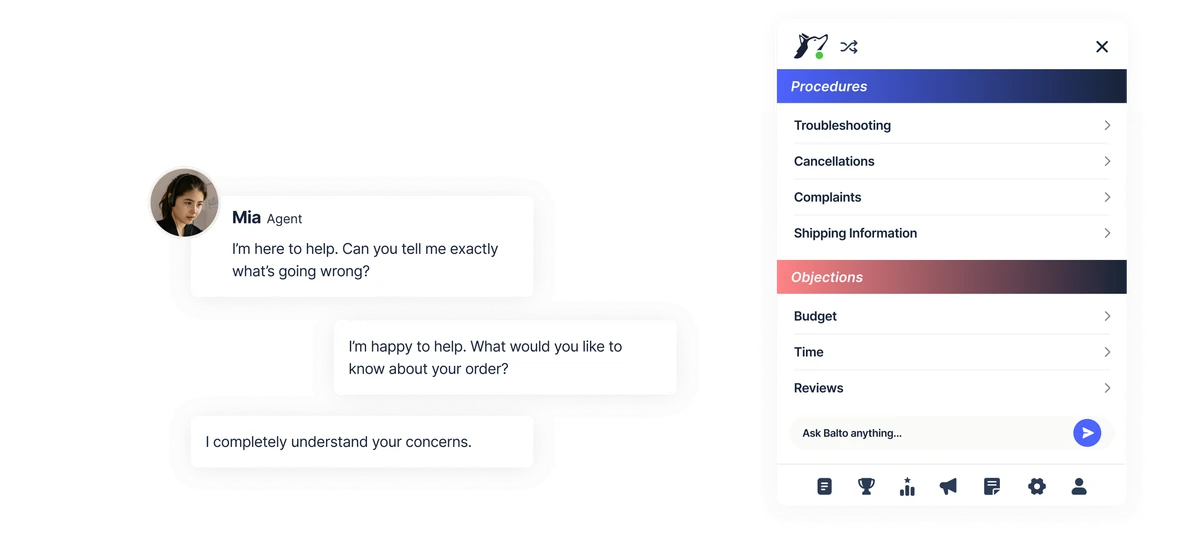
Real-time supervisor alerts fire during live calls the moment something goes off-script or requires attention. Supervisors can listen in with a single click and message agents via two-way chat without disrupting the customer conversation.
The platform also includes built-in leaderboards for performance competitions and supports over 50 contact center platform integrations, including RingCentral, Five9, Genesys Cloud, NICE inContact, and Zoom Phone.
Automated Quality Assurance: Balto scores every call with AI, replacing random sampling with full coverage.
Balto’s QA software auto-scores every conversation immediately after it ends, replacing the standard practice of manually reviewing a small fraction of calls. Scorecards are written in natural language (the way a manager would describe criteria to a new hire) with no rigid templates or technical configuration required. Each scored call includes an AI-generated explanation of why it received its score, so supervisors and agents understand the reasoning.
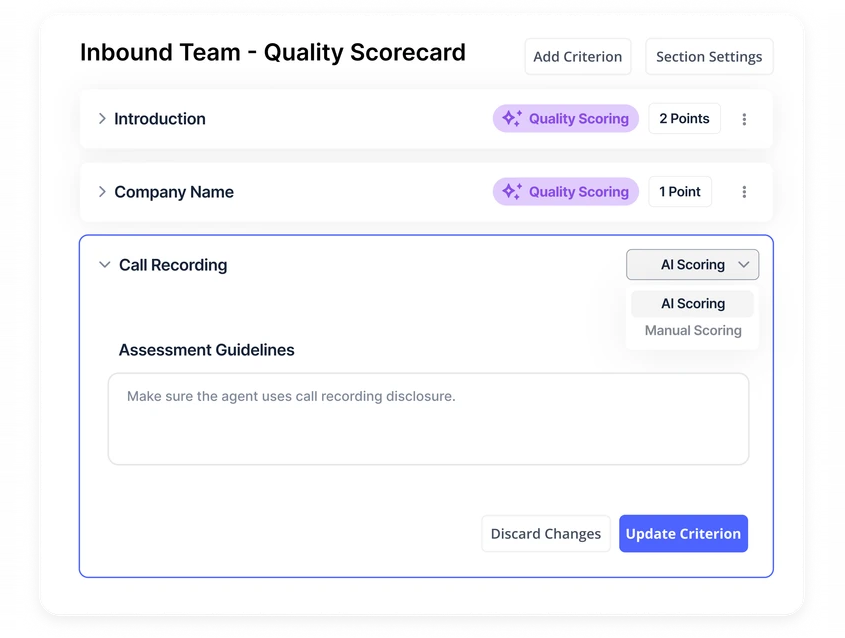
A blended scoring model lets auto QA and manual review coexist in the same workflow. A “Rapid-Fire Reviews” inbox lets managers accept, escalate, or dismiss quality issues one by one. The platform also captures call and screen recording simultaneously, giving investigators full context.
Agents see their scores the moment a call ends, so they can self-correct immediately rather than waiting days for feedback. The platform reports having scored over 2 million calls across customer deployments.
Compliance Monitoring: Balto catches regulatory risks during live calls, not after.
Balto’s Compliance module scans 100% of interactions for regulatory risk, both in real time and post-call. During a call, the AI listens for compliance triggers (forbidden language, missing required disclosures, protocol deviations) and surfaces alerts so agents can course-correct before the call ends.
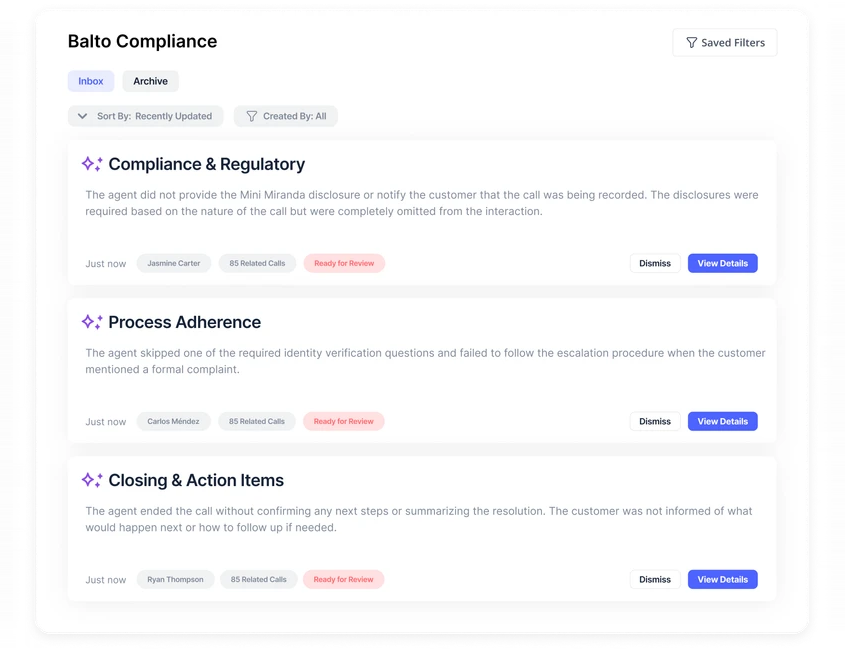
After the call, flagged issues route to a unified inbox where reviewers work through them using the Rapid-Fire Reviews workflow. An Anchor Points feature captures rare or edge-case moments that fall outside standard rules and marks them for human review. Automatic redaction masks sensitive data in call audio, transcripts, and screen recordings to comply with HIPAA, PCI, and similar privacy regulations.
Screen Capture records agents’ full desktop workflows synchronized with audio, giving compliance investigators complete visibility into what happened during a flagged interaction.
Conversation Intelligence and BaltoGPT: Balto turns call data into answers managers can query in plain language.
Balto Insights analyzes every customer interaction and surfaces patterns, trends, and issues through three layers. Weekly Insights deliver a refreshed pulse on performance without manual report building. GPT Trends track directional questions over time, showing how issues evolve week over week.
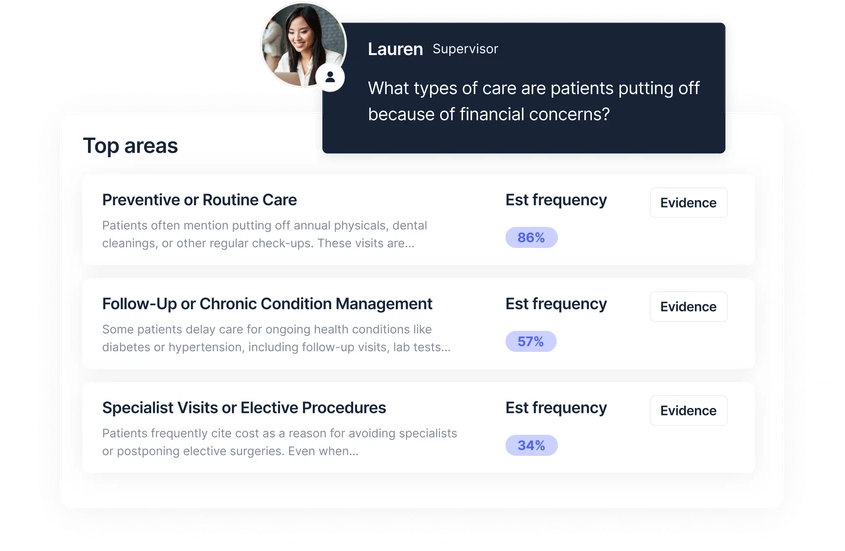
BaltoGPT is the generative AI layer that accepts natural-language questions against any set of conversations. A director can ask “How are conversions doing this quarter compared to last quarter?” and get a data-backed answer without waiting for an analyst. Balto positions this engine against legacy speech analytics tools that “had a nasty habit of getting things wrong, picking up false signals”.
Voice AI Agents (Togo): Balto automates routine calls using AI trained on your own top performers.
Togo is Balto’s autonomous voice AI agent, designed to handle high-volume, repeatable call types (scheduling, order status, account verification) so human agents can focus on complex interactions. Togo is trained on recordings from the contact center’s own top performers, reflecting proven standards rather than generic defaults.
Before deployment, the platform provides an automation readiness score for every conversation topic based on call volume, complexity, required API connections, and handoff triggers. When Togo reaches the boundary of what it should handle, it passes the conversation to a human agent with full context on what was said, what was attempted, and what the customer needs next. All Togo calls are monitored in real time through Balto’s QA and compliance framework.
Notes and After-Call Summaries: Balto eliminates manual note-taking with AI-generated call summaries.
Balto’s Notes captures and structures conversation summaries within seconds of each call completing, then syncs them to the CRM. Administrators configure which topics the AI should extract (call purpose, outcome, customer sentiment, key questions), making output tailored to each organization’s workflow rather than a generic transcript.
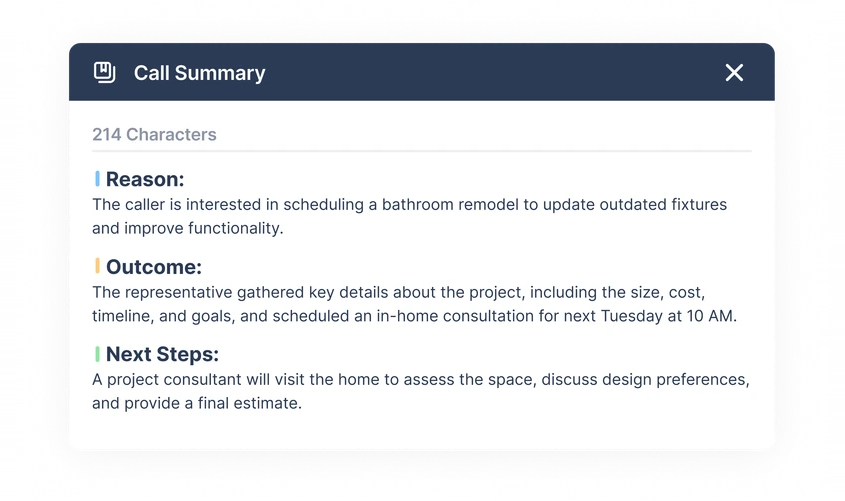
Notes include automatic PCI and PHI redaction, so regulated industries get compliant summaries without a separate scrubbing step.
Pricing: Balto does not publish pricing; all quotes require a sales conversation.
Balto does not publish pricing on its website. No tiers, per-seat rates, or plan structures are disclosed. The sole call-to-action is “Book a Demo”, the required entry point for any pricing information. There is no free trial, free plan, or self-serve evaluation option.
Given the platform’s architecture (a per-agent, real-time AI layer deployed in contact centers), the pricing model is consistent with per-seat SaaS pricing common in the category, but Balto does not confirm this publicly. Contract terms, implementation fees, and add-on costs are handled through the sales process.
Where Balto Falls Short
Balto optimized for real-time, voice-first intervention. Those choices create trade-offs that surface depending on what a contact center actually needs.
Voice-first design limits omnichannel depth.
Balto built its reputation on voice. The Omnichannel AI module extending coverage to chat, email, and SMS is a newer addition. For contact centers where written channels carry significant volume, the omnichannel capabilities may lack the maturity of Balto’s voice infrastructure. Real-time guidance (Balto’s defining advantage) currently applies only to voice; written channels receive automated QA scoring and compliance monitoring, but not live in-conversation prompts.
Real-time prompts can compete with agents’ attention.
G2 reviewers note that “the suggestions can be a bit overwhelming, especially during really fast calls.” When an agent is handling a rapid objection or an escalated caller, a prompting UI panel can become a distraction rather than a help. The single-monitor widget compounds this for agents without dual-screen setups.
Coaching stays close to the call, not the improvement plan.
Balto’s coaching module identifies coachable moments and delivers AI-generated coaching packets. But it does not offer the structured performance improvement infrastructure (formal performance plans with audit trails, eLearning auto-enrollment, gamified reward systems, dispute mechanisms) that dedicated QA platforms provide. Coaching in Balto is call-centric: it surfaces what happened but leaves the structured development path to other tools.
Playbook setup demands significant upfront work.
Multiple users report that setting up playbooks “can be tedious” and that they “initially had difficulty setting up the playbooks.” Mapping conversation flows, tuning AI triggers, and configuring compliance checklists require substantial manager time before agents see value. The “45 days to results” promise assumes teams can dedicate that time.
No scoring calibration against your own knowledge base.
Balto’s QA scores calls using natural-language scorecards, but the platform offers no way to ground AI scoring against company-specific policies, product documentation, or compliance rules. It can tell you whether an agent followed the script. It cannot verify whether the agent gave the factually correct answer based on your own source of truth.
Opaque pricing adds friction to evaluation.
With no published pricing, no free trial, and no self-serve demo, buyers must commit to a sales conversation before learning whether Balto fits their budget. For teams evaluating multiple vendors at once, this adds procurement overhead that competitors with transparent pricing avoid.
Top Balto Alternative: evaluagent
evaluagent addresses Balto’s quality management gaps with a platform built around a different premise: the most valuable AI in a contact center doesn’t guide agents during calls. It ensures every interaction is evaluated afterward and that evaluation drives measurable improvement.
Founded in 2012 by Jaime Scott, Michelle Dinsmore, and Alex Richards (three operators who spent their careers running contact centers and managing quality teams), evaluagent serves customers including Samsung, Jet2, Capital on Tap, and ManyPets. The company has reported nearly 500% revenue growth over the three years preceding July 2025 and is backed by a $20 million growth investment from PeakSpan Capital.
AutoQA: evaluagent scores 100% of conversations and calibrates AI to your own quality standard.
evaluagent’s AutoQA scores every interaction across voice, chat, and email without increasing QA headcount. But the differentiator isn’t coverage alone; it’s calibration.
The Context Engine grounds AI scoring in each customer’s QA policies, tone-of-voice guidelines, compliance rules, and knowledge base content. The AI doesn’t just evaluate whether an agent was polite; it verifies whether the agent gave the factually correct answer based on the organization’s own source of truth.
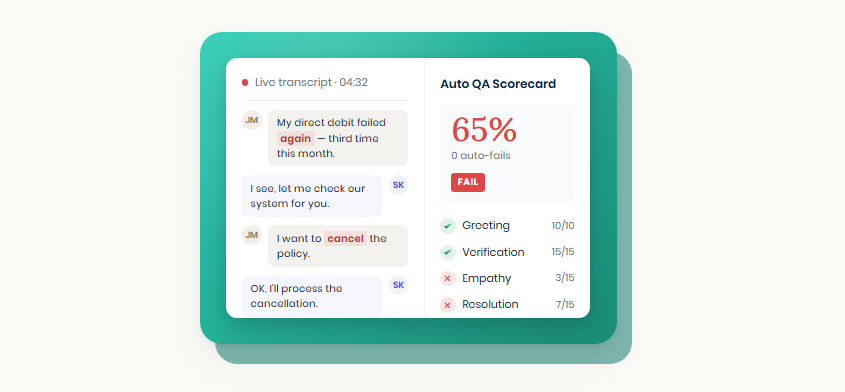
A Testing Console lets QA managers trial any scoring change against real historical conversations before it goes live, preventing miscalibration from reaching production. SmartScore provides AI-generated reasoning for qualitative line items, explaining why a score was awarded rather than simply reporting a number. Blended Scorecards let AI handle repetitive rule-based checks while human evaluators retain nuanced assessments on the same scorecard.
Capital on Tap scaled from 900 to 6,000 BDM checks per month immediately after go-live without adding headcount. (Capital on Tap Case Study)
Closed-Loop Performance Improvement: evaluagent connects QA scores directly to coaching, development plans, and agent engagement.
Where Balto surfaces coachable moments, evaluagent builds the full improvement infrastructure around them. Evaluation findings connect directly to structured coaching sessions and 1-to-1s tied to conversation evidence, with progress tracked against session-specific goals. Performance Plans link coaching sessions, training modules, and improvement targets into an HR-ready record with a complete audit trail.
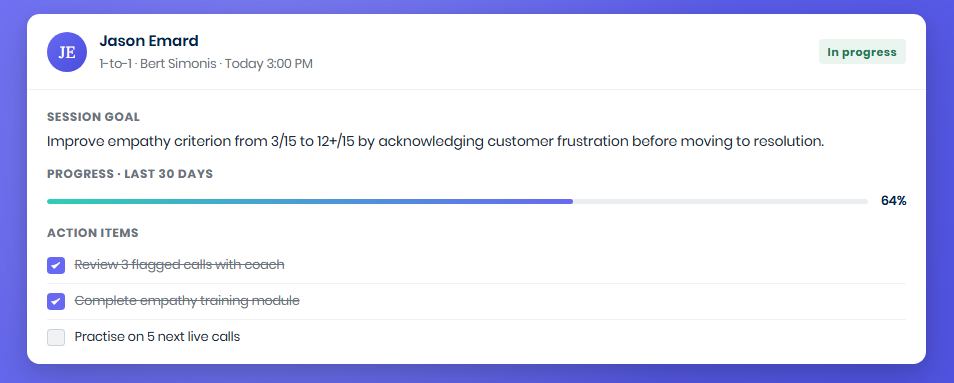
Automated actions fire when a score, sentiment shift, or compliance flag meets a configured threshold, triggering a coaching session, escalation, or eLearning enrollment without manual intervention. A built-in LMS offers interactive learning paths, quizzes, and certificates, with auto-enrollment driven by performance metrics. Gamification adds points, badges, leaderboards, and a reward auction where agents use earned points to bid on prizes.
Agents can file formal disputes on scores they disagree with, feeding corrections back into the model. This two-way mechanism builds trust in the QA process rather than imposing scores from above.
Seasalt Cornwall doubled evaluations and reduced agent attrition from 100% to 10% year-on-year after deploying evaluagent’s coaching and quality workflows. (Seasalt Case Study)
Conversation Intelligence: evaluagent surfaces what customers are saying and predicts satisfaction across every interaction.
evaluagent’s Conversation Intelligence module goes beyond call scoring to deliver structured business intelligence. Reason for Contact detection auto-classifies every interaction with no manual tagging. Predictive metrics including xNPS, xCSAT, xResolution, and xVulnerability are derived from conversation signals across 100% of contacts rather than relying on post-call survey response rates.
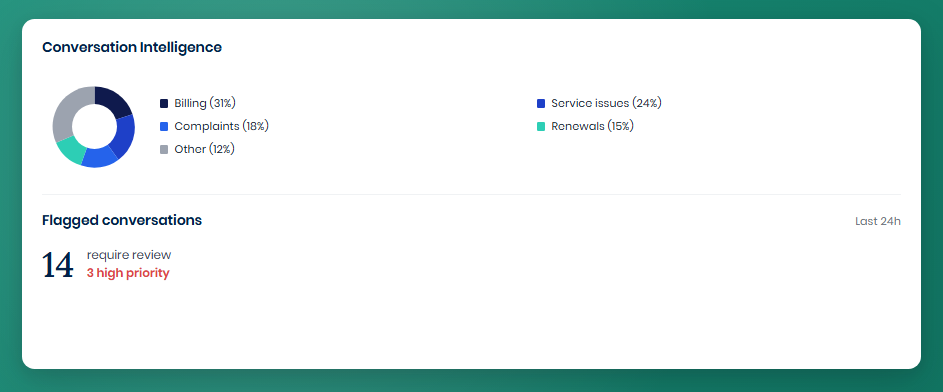
The Spotlight tool acts as an on-demand AI analyst: filter a set of conversations, run Spotlight, and it analyzes up to 1,000 interactions in the background, returning themes organized into Critical Issues, Monitor Closely, and Performing Well, each with supporting conversation excerpts.
AI Agent Observability: evaluagent evaluates AI chatbots against the same standard as human agents.
As contact centers deploy AI chatbots, a governance gap opens. Bot vendors report containment metrics using their own definitions of “resolved,” but cannot independently verify whether the answers were correct. evaluagent’s AI Agent Observability module fills this gap by evaluating every AI agent conversation against the same QA framework applied to human agents.
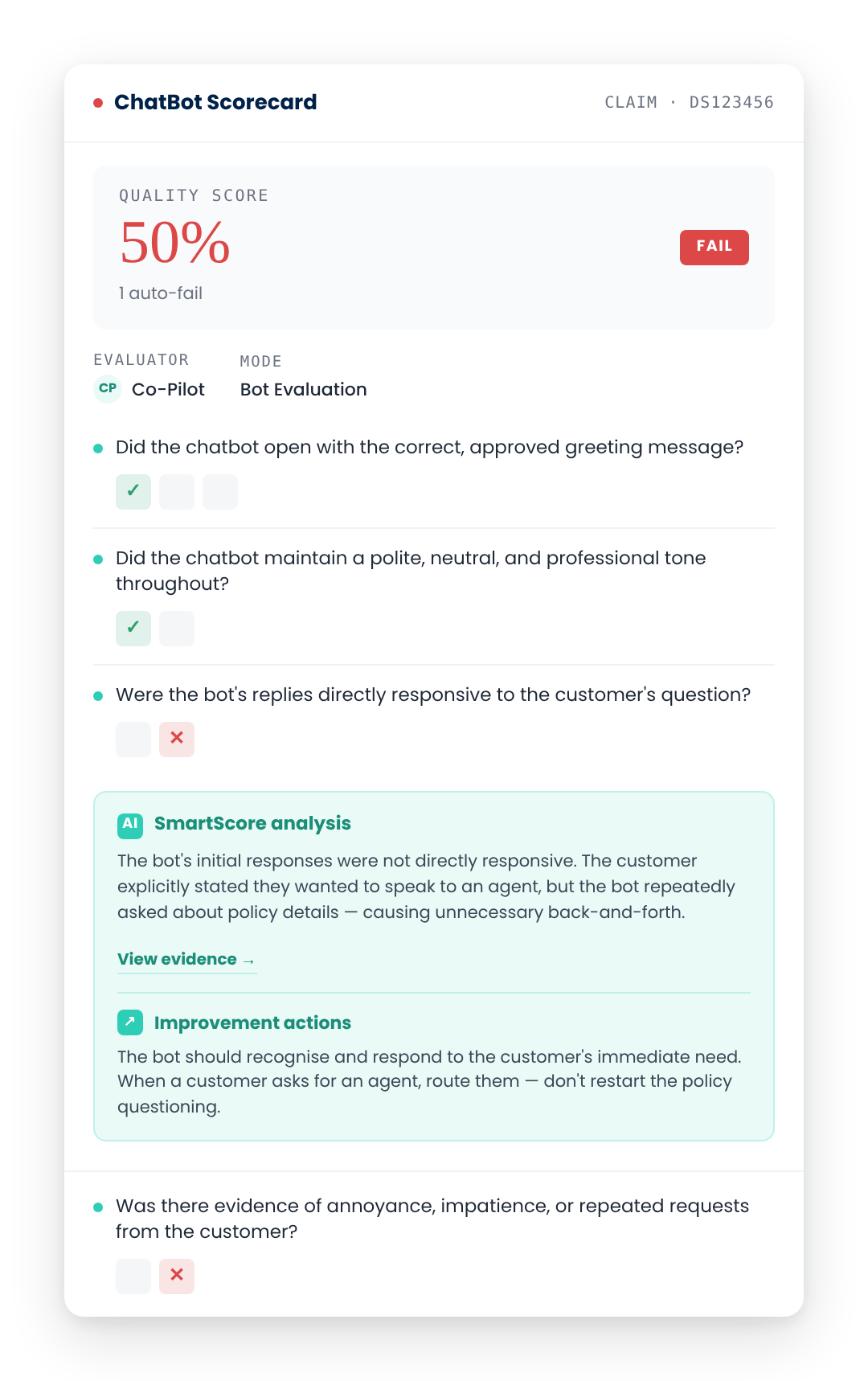
The module includes fabrication detection that flags when a bot invents information, grounded in the organization’s own knowledge base. It tracks containment quality (not just containment counts), identifies handover failures where human agents inherit damaged conversations, and provides intent-level performance reporting showing which query types the bot handles cleanly and which generate frustration.
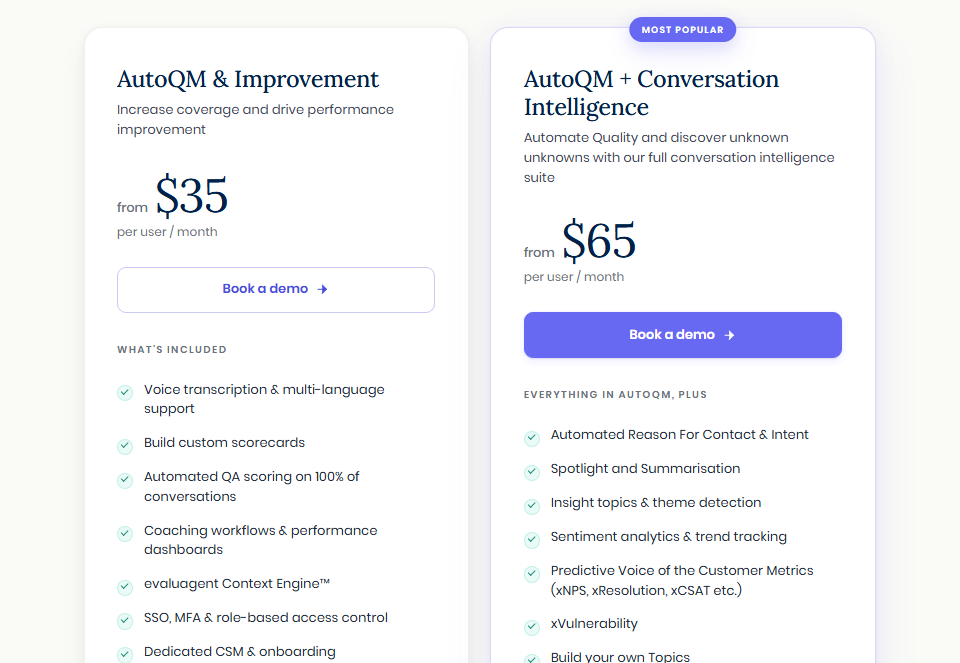
Transparent Pricing: evaluagent publishes its pricing model with two clear tiers.
evaluagent’s pricing is published and structured around two tiers for human agents:
AutoQA & Improvement (from $35/user/month):
- 100% automated conversation scoring across voice, chat, and email
- Context Engine with Testing Console
- Custom scorecards with auto-fail logic
- Coaching workflows, 1-to-1s, and performance plans
- Gamification and agent engagement tools
- SSO/MFA/role-based access control
- Dedicated CSM and onboarding
AutoQA + Conversation Intelligence (from $65/user/month):
- Everything in the first tier
- Automated reason for contact and intent detection
- Spotlight AI analyst and conversation summarization
- Sentiment analytics and trend tracking
- Predictive voice of customer metrics (xNPS, xCSAT, xResolution)
- Custom topic builder with testing console
Balto or evaluagent: Comparison Summary
| Balto | evaluagent | |
|---|---|---|
| Core approach | Real-time in-call guidance and coaching | Post-interaction AI scoring with closed-loop improvement |
| Primary channel strength | Voice (omnichannel is newer) | Voice, chat, and email from the same engine |
| QA coverage | 100% automated call scoring | 100% automated scoring across all channels |
| Knowledge-grounded scoring | Natural language scorecards without knowledge base validation | Context Engine validates answers against company policies and knowledge base |
| Coaching workflow | AI-generated coaching packets and real-time alerts | Structured 1-to-1s, performance plans, eLearning, gamification, and dispute mechanism |
| AI agent governance | Togo (Balto’s own voice AI agent) monitored via same QA | Independent observability for any AI agent vendor with fabrication detection |
| Integrations | 50+ CCaaS platforms; Salesforce, HubSpot, Close, NetSuite | Zendesk, Salesforce, Genesys, Five9, Amazon Connect, Intercom, and others |
| Security certifications | SOC II, HIPAA, PCI | SOC 2 Type II, ISO 27001, HIPAA, Cyber Essentials Plus, GDPR |
| Pricing transparency | Not published; demo required | Published ($35–$65/user/month) |
| Free trial | Not available | Available on request (case-by-case) |
| G2 rating | 4.8 (500+ reviews) | Leader in Contact Center QA (G2 Summer 2026) |
| Best for | Voice-first contact centers needing real-time in-call intervention | Omnichannel contact centers needing quality management and agent development |
Final Verdict
The choice between Balto and evaluagent depends on where your contact center’s biggest gap lies: during the call, or after it.
Choose Balto if your contact center lives and dies by what agents say on live calls.
It’s the right platform for outbound sales teams, collections operations, and compliance-heavy environments where real-time intervention prevents mistakes and lifts conversion rates on the spot. Balto’s strength is speed: guidance fires while the conversation is still happening, and integration with 50+ CCaaS platforms means it layers onto existing infrastructure without replacing it. If your primary channel is voice and your biggest problem is agents forgetting their training under pressure, Balto solves that directly.
Choose evaluagent if you need a quality management system that goes beyond scoring calls to actually developing agents.
It’s the stronger choice for contact centers handling significant volume across voice, chat, and email, where consistent quality standards must apply across every channel. The Context Engine’s ability to validate answers against your own knowledge base, the structured coaching-to-improvement pipeline, and the AI Agent Observability module for governing chatbots give evaluagent a depth of quality management that real-time guidance tools don’t provide.
For QA leaders who want to move from sampling 2% of interactions to scoring 100% and turning those scores into measurable improvement, evaluagent closes that loop in a single platform.
Book a demo with evaluagent here.
Both platforms share the conviction that AI should make contact centers better. Balto acts in the moment. evaluagent builds the system that makes every moment count.