ScorebuddyCX has earned G2 Leader status in Contact Center Quality Assurance for fifteen consecutive quarters. Launched in 2012 as a scorecard-based evaluation tool, it has grown into what the company calls a “CX intelligence platform,” combining AI-powered scoring, reporting, coaching, and a built-in LMS.
To write this ScorebuddyCX review, we analyzed the platform thoroughly. We believe it’s the right choice if:
- You need a configurable QA platform with strong scorecard design tools
- You want AI Auto Scoring with knowledge base grounding
- You value a built-in LMS that connects training directly to evaluation results
- You need multi-client QA management for BPO operations
- You prefer a platform with a 14-day free trial before committing
However, ScorebuddyCX might not be the best choice if:
- You want a complete AutoQM and Conversation Intelligence platform
- You want insight into why your customers contact you, how they feel about your business, and whether they are likely to recommend you
- You need to evaluate AI chatbots and virtual agents with the same rigor as human agents
- You need platform reliability under high-volume QA workflows that are critical to your operations
- You require CCaaS integrations without upgrading to a higher pricing tier
- You want transparent, published pricing rather than a quote-based model
- You need API access on all plans, not just the top tier
With its Context Engine for knowledge-grounded scoring, a Conversation Intelligence suite that explains why customers are getting in touch and how they experienced it, an AI Agent Observability module, and native integrations with platforms like Genesys, Five9, Amazon Connect, and Zendesk included from the first tier, evaluagent delivers automated QA without gating core capabilities behind premium plans.
We’ve included a detailed look at evaluagent at the end of this ScorebuddyCX review. If you’re ready to see how it handles your QA challenges, you can book a demo here.
What is ScorebuddyCX?
ScorebuddyCX is a product of Sentient Solutions Limited, a Dublin-based technology company founded in 2001.
Founder Derek Corcoran launched the Scorebuddy platform in 2012, drawing on over 40 years of experience in telecoms and enterprise software from roles at Avaya Ireland, AT&T/Lucent Ireland, and Eircom.
The platform started as a configurable scorecard tool for manual QA evaluation. In 2020, the company acquired Cx Moments, an AI conversation analytics startup that brought both the conversation intelligence capability and co-founder Emmanuel Doubinsky (now Director of Product).
In August 2024, the company launched GenAI Auto Scoring, and in June 2026, it rebranded from Scorebuddy to ScorebuddyCX to signal its expansion beyond QA.
Today, ScorebuddyCX serves 300+ organizations in 25+ countries with 50,000+ agents on the platform. The company secured €5 million from Foresight Group in November 2024 to accelerate AI development and global expansion, and has since announced partnerships with Genesys and Intercom.
The platform is organized around six product lines: QA for Agents, QA for Bots, Conversation Analytics, Business Intelligence, Coaching, and Learning.
ScorebuddyCX Pros & Cons
| Pros | Cons |
|---|---|
| AI Auto Scoring with 90%+ claimed accuracy | Platform reliability issues reported under heavy load |
| Configurable scorecards with auto-fail compliance rules | 15-minute session timeout discards unsaved work |
| Built-in LMS with AI-assisted course authoring | CCaaS integrations locked to Accelerate tier and above |
| 14-day free trial available | Open API restricted to Elite tier only |
| G2 Leader for 15 consecutive quarters | No published pricing; all plans require a vendor quote |
| Multi-client BPO management from a single instance | Multilingual UI requires the Accelerate tier or above |
| Coaching module with structured frameworks (GROW, OSKAR, CLEAR) | Conversation Analytics restricted to the Elite tier |
ScorebuddyCX Review: How It Works & Key Features
QA for Agents: AI Auto Scoring with configurable scorecards on 100% of conversations
The core of ScorebuddyCX is its QA for Agents product, which uses a hybrid scoring architecture.
QA teams build customizable scorecards that define specific behaviors, compliance checkpoints, and quality criteria. Each scorecard question follows AI Scorecard Guidelines requiring short title labels, detailed rubrics for each scoring option, and concrete performance examples.
Once scorecards are configured, AI Auto Scoring evaluates conversations across voice, chat, and email. The platform claims 90%+ accuracy, a 60%+ reduction in manual QA effort, and a 70%+ increase in QA coverage. All AI-generated scores land in the AI Score Log, where managers can view, edit, or delete any score.
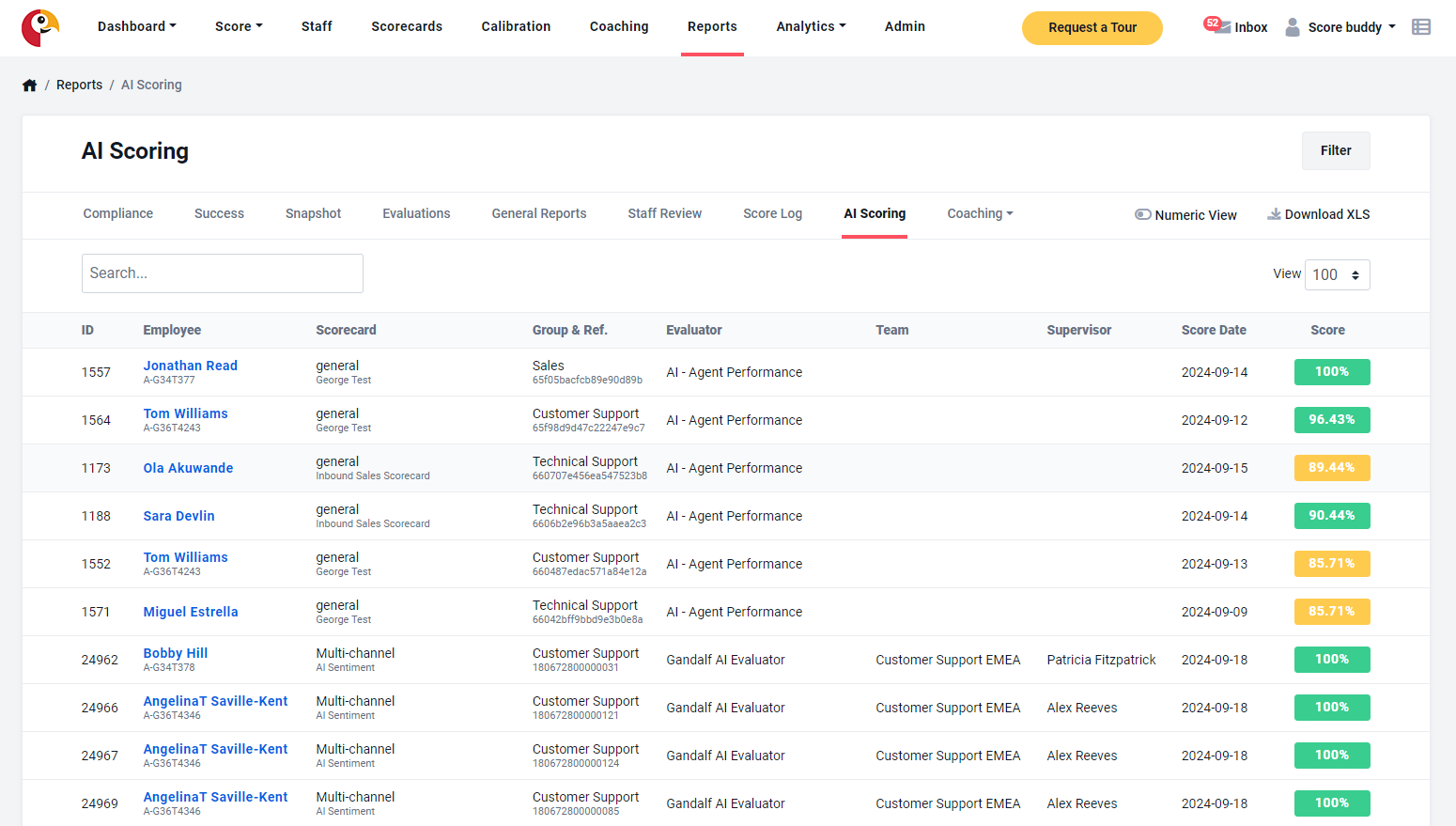
For questions requiring policy verification, AI Knowledge extends scoring by querying an uploaded knowledge base (PDFs up to 50 MB each), feeding relevant articles as context into the AI model. This feature is available on the Elite plan.
Agents get their own AI Agent Dashboard where they toggle between manual and AI-scored interactions. They can submit written disputes for any score, which then appear in the AI Score Log for human evaluator review with a binding uphold or rejection.
The platform also includes a Calibration module where multiple QA managers independently score the same interactions, then compare results to identify inconsistencies and align on standards.
Conversation Analytics: contact drivers and sentiment signals from every interaction
Scorebuddy Conversation Analytics, powered by the Cx Moments engine acquired in 2020, processes 100% of interactions to identify why customers contact the business and how they feel about the experience. It is available on the Elite plan only.
The analytics engine categorizes conversations into topics using keyword combinations. Teams can import from a library of autodetected topics, create custom ones, or refine existing definitions. New topic logic applies retroactively across historical data, so teams can investigate how long an issue existed before anyone defined a topic to track it.
Sentiment analysis scores each sentence as positive, neutral, or negative, then produces an overall score between -100 and +100.
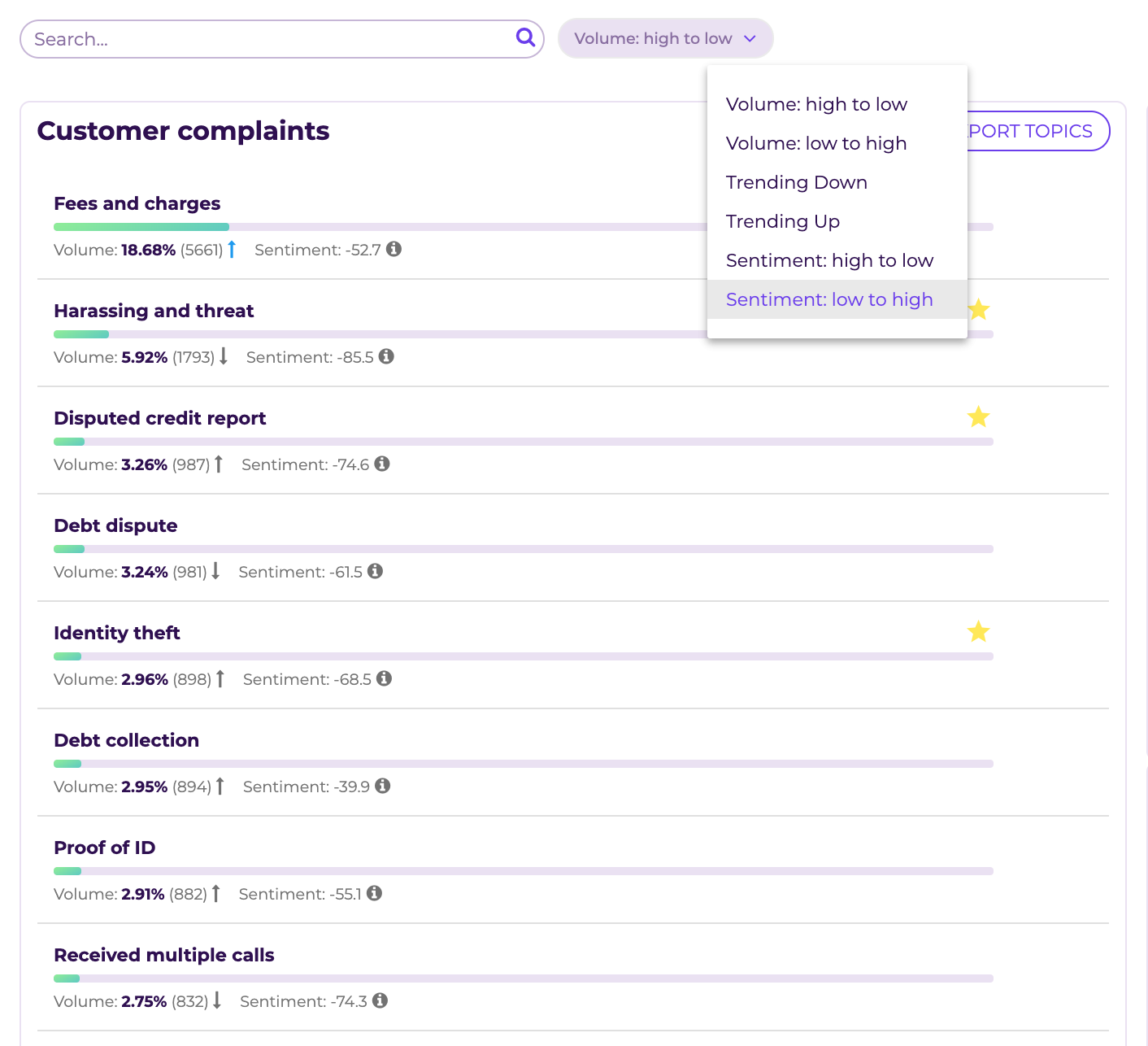
The formula is straightforward: total positive sentences minus total negative sentences, divided by total sentences. Satisfaction metrics from connected platforms (Zendesk, Freshdesk, Intercom) are pulled in alongside topic volumes, linking contact drivers to satisfaction outcomes.
Additional capabilities include Smart Tags that apply topics back to helpdesk tickets automatically, custom dashboards with topic trend widgets, and alerts when conversation patterns cross defined thresholds.
Coaching and LMS: QA findings connected to structured coaching and in-platform training
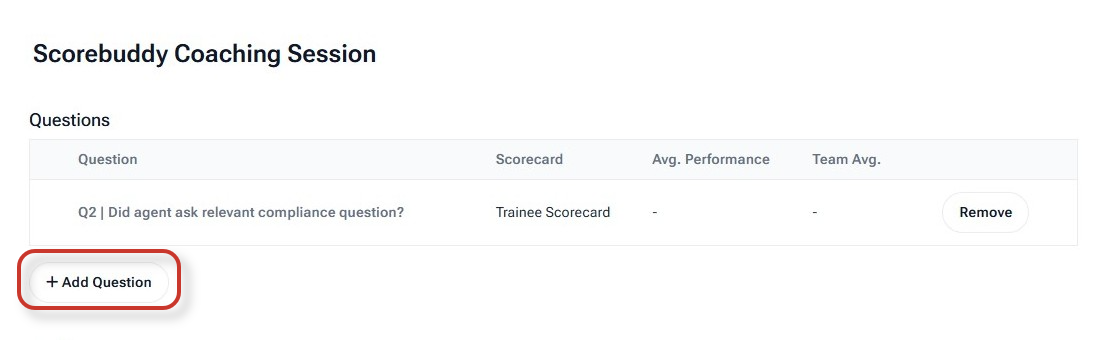
The Coaching module (available on Accelerate and Elite plans) links evaluation results directly to one-on-one development sessions. Managers can flag specific scorecard questions during evaluation using a “+ Coaching” button, carrying the exact interaction and failing criterion into a coaching session without leaving the platform.
Coaching Discovery serves as a command center, surfacing which agents and questions need coaching. It offers two views: Agent Performance (showing prior and current scores, score deltas, critical fails, and open sessions per agent) and Question Performance (aggregating the same metrics by question across all agents). Both views include a six-week trend and let managers launch sessions directly.
Sessions use built-in discussion templates (GROW, OSKAR, or CLEAR frameworks), include task management with due dates and priority levels, and follow a two-way acknowledgment workflow where agents add comments and formally acknowledge sessions.
The Learning Management System is sold as a paid add-on for Accelerate and Elite customers.
It offers AI-assisted course authoring (claiming courses can be built 90% faster at 10% of the cost compared to conventional methods), a pre-built content library called Scorebuddy Academy, learning paths with qualification quizzes, and SCORM and xAPI compatibility. Training assignments can be triggered by evaluation results, so the loop from skill gap to training completion stays within one platform.
Business Intelligence: configurable reporting dashboards for QA, operations, and leadership
Scorebuddy BI (available on Accelerate and Elite plans) turns QA data into custom dashboards using a hierarchical structure of Visualizations, Pages, Chapters, and Dossiers.
Reports combine metrics (like % Score, Compliance Pass Rate, and Calibration Variation) with attributes (like Group, Team, Staff, and Scorecard).
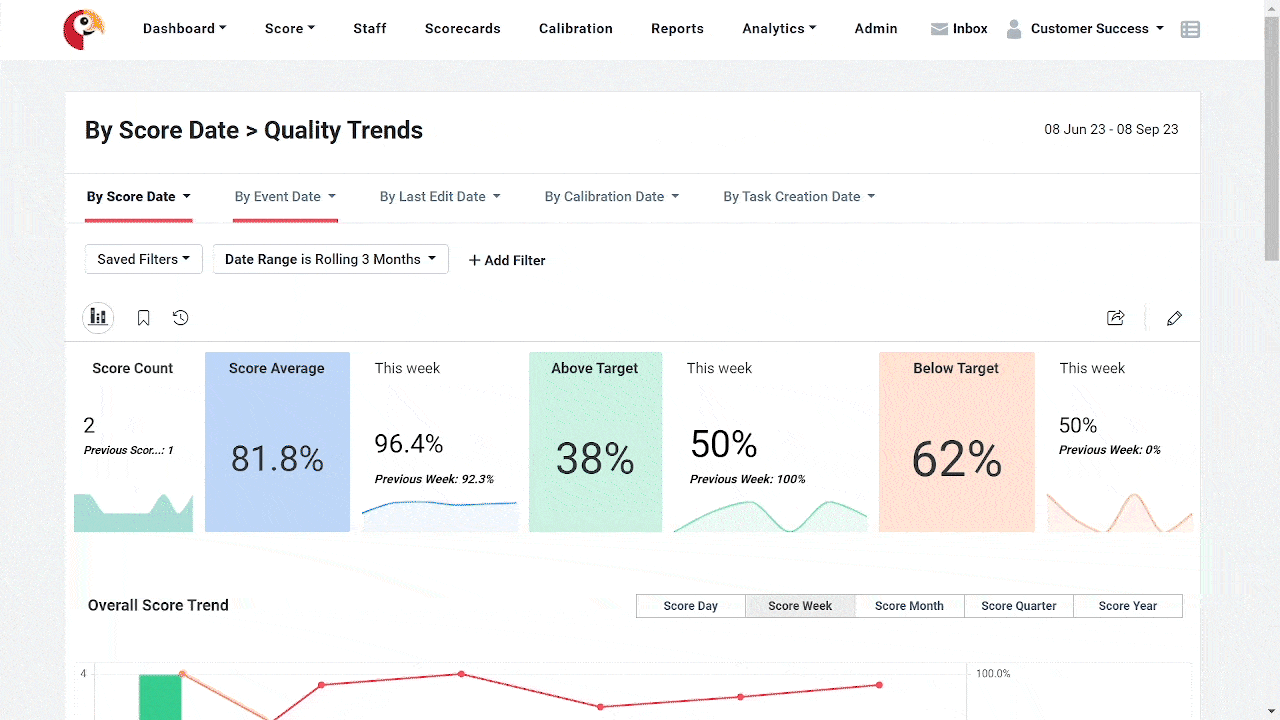
The platform includes 50+ metrics and 100+ attributes, with the ability to drill down from any data point to individual scores and evaluator comments. A dedicated bot performance dashboard links containment rates to the sentiment and outcomes of escalated conversations, and all users start from a Standard Reporting Dossier that can be cloned and customized.
Teams can also export data to external BI tools like Tableau and Power BI via the API (Elite plan only).
Pricing: tiered, seat-based pricing across three plans, but no published prices
ScorebuddyCX offers three pricing tiers, all requiring a vendor quote:
Foundation includes customizable scorecards, AI assistance (not Auto Scoring), QA workflows, calibration, agent dashboards, reporting, root cause analysis, compliance reporting, and standard integrations.
Accelerate (marked “Most Popular”) adds AI Auto Scoring with 500 monthly AI scores included, custom BI dashboards, multilingual UI, in-app coaching, a dedicated client manager, and CCaaS integrations (Genesys, Amazon Connect, NICE CXone, Five9, Talkdesk, Dixa).
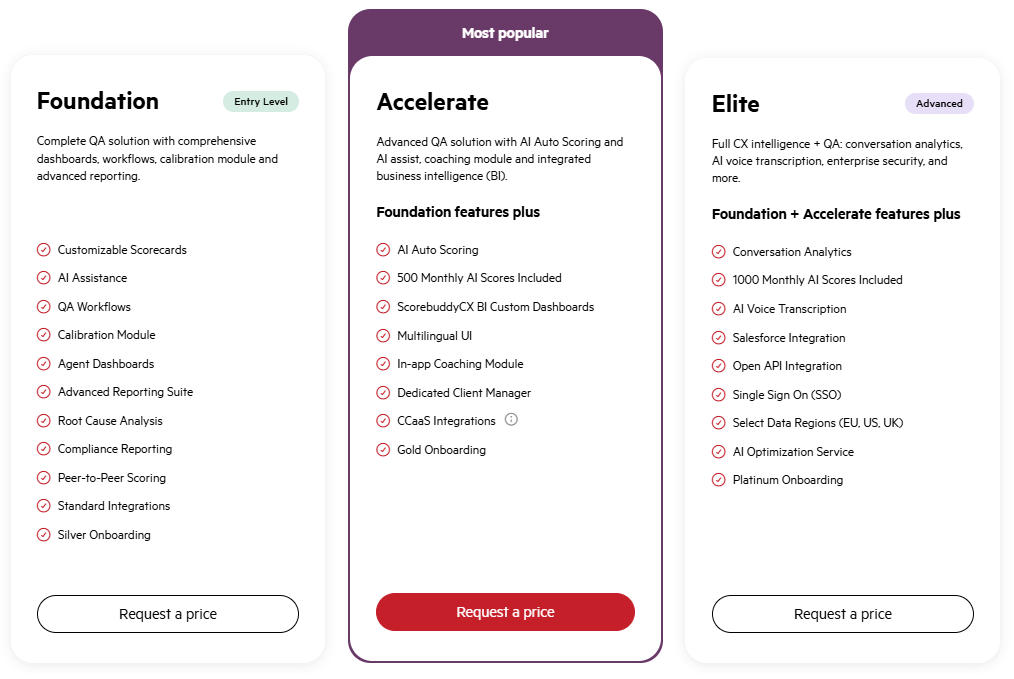
Elite adds Conversation Analytics, 1,000 monthly AI scores included, AI voice transcription, Salesforce integration, Open API access, SSO, selectable data regions, and an AI Optimization Service.
Additional AI Auto Scoring credits and AI transcription credits can be purchased as add-on bundles. The LMS is a paid add-on available on Accelerate and Elite only. A 14-day free trial is available. Contracts are annual with automatic renewal; early termination triggers a charge of 80% of the average monthly fee for every remaining month.
Where ScorebuddyCX Falls Short
ScorebuddyCX has clear strengths, but several limitations surface with regular use. These reflect design choices and the company’s stage of growth more than outright failures.
Platform Reliability Under Load. Capterra reviewers report occasional downtime, dashboard crashes during call reviews, and slow load times. For QA teams running real-time evaluation at scale, these interruptions cut into productivity and erode confidence in the system.
Session Timeout Discards Work. A 15-minute inactivity timeout erases unsaved scorecard work, a recurring Capterra complaint. Complex evaluations often run longer than 15 minutes, and losing a half-finished scorecard forces evaluators to start over.
Feature Gating Across Tiers. Key capabilities sit behind higher pricing tiers. CCaaS integrations require Accelerate. Conversation Analytics, the Open API, Salesforce integration, SSO, and selectable data regions all require Elite. Foundation plan teams must upload interactions manually. For teams that need automated data ingestion but not the full Elite suite, this forces an all-or-nothing decision.
Opaque Pricing. No prices are published for any tier. Every prospect must request a vendor quote, making it hard to compare costs during initial research or model total cost of ownership before engaging sales.
Early Termination Penalty. The 80% of remaining contract value early termination charge is steep, and all fees are non-cancellable and non-refundable. Combined with annual auto-renewal requiring 60 days’ notice, this creates lock-in for teams uncertain about long-term fit.
AI Agent Governance Is New. While QA for Bots exists as a product line, it is a newer addition to the platform. Public documentation does not fully detail how coaching flows work for bot performance (versus human agents). Contact centers with significant AI agent deployments may find the bot QA capabilities less mature than the human agent QA that ScorebuddyCX has refined over 14 years.
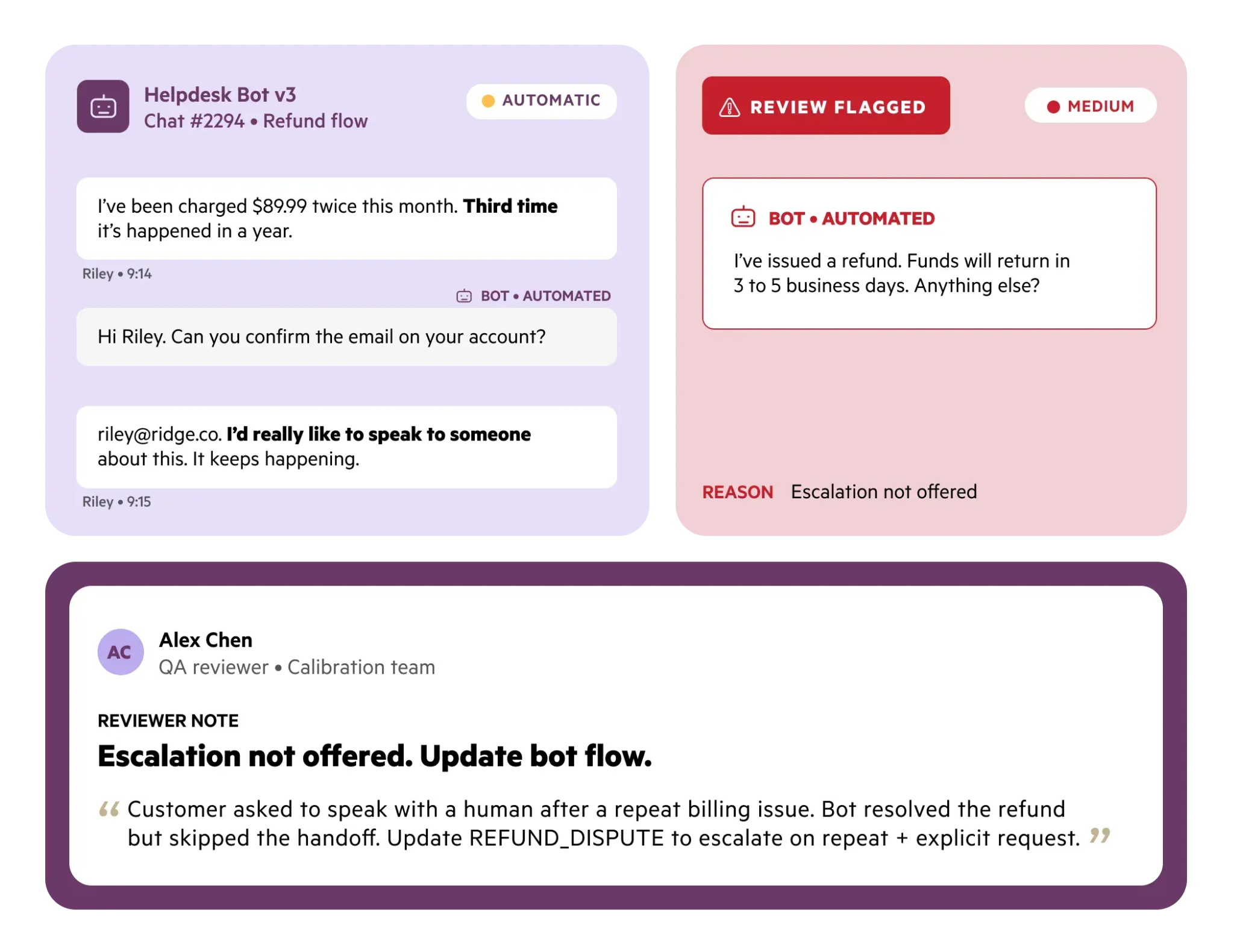
These limitations are worth weighing against what ScorebuddyCX does well. But for teams that need broad integrations from day one, transparent pricing, strong AI agent governance, or reliability at scale, an alternative may be a better fit.
Top ScorebuddyCX Alternative: evaluagent
evaluagent addresses several of ScorebuddyCX’s gaps while sharing the same core mission: automating contact center QA at scale.
Founded in 2012 by Jaime Scott, Michelle Dinsmore, and Alex Richards (three operators who had spent their careers running contact centers), evaluagent was built by practitioners who understood where QA programs fail in practice.
The platform is organized around three jobs to be done:
- AutoQA and Performance Management for human agent QA,
- Conversation Intelligence for understanding what is driving contact and how customers experienced it,
- and AI Agent Observability for governing AI chatbots and virtual agents.
The company is backed by a $20 million growth investment from PeakSpan Capital and holds SOC 2 Type II, ISO 27001:2022, Cyber Essentials Plus, GDPR, HIPAA, and EU AI Act readiness credentials, with selectable data residency across the UK/EU, US, and Australia.
evaluagent was named #17 in G2’s Top 50 UK Software Companies 2026 (the only contact center software on the list) and a Leader in Contact Center Quality Assurance in G2’s Summer 2026 report. Those placings come from verified customer reviews rather than analyst briefings.
AutoQA and the Context Engine: 100% of conversations scored against your own standards
evaluagent’s AutoQA scores every interaction across voice, chat, and email without requiring additional QA headcount. The platform reports 90% time saved on QA monitoring and a 25% increase in quality scores.
Coverage spans 20+ languages for transcription and analysis, with the caveat the company states itself: English transcription is the most accurate, and scoring confidence in other languages is directionally consistent but lower.
Full coverage doesn’t remove human QA, it redirects it. Auto Work Queues route evaluator time toward the interactions most likely to reveal risk, such as low sentiment, flagged vulnerability, or scores below a defined threshold, instead of a random sample.
What grounds the AI scoring is the Context Engine, launched April 2026. Teams feed it QA policies, tone-of-voice guidelines, compliance rules, and knowledge base content in plain language.
The AI then evaluates not just whether agents communicated well, but whether they gave the right answer. A Testing Console lets QA managers trial any scoring change against real historical conversations before it goes live, a safeguard that prevents miscalibrated AI from scoring incorrectly in production.
SmartScore applies the calibrated model to qualitative line items with AI-generated reasoning, explaining why a mark was awarded. Blended Scorecards let some criteria be scored by AI while others stay with human evaluators on the same scorecard, keeping AI on the repetitive checks and humans on the nuanced judgments.
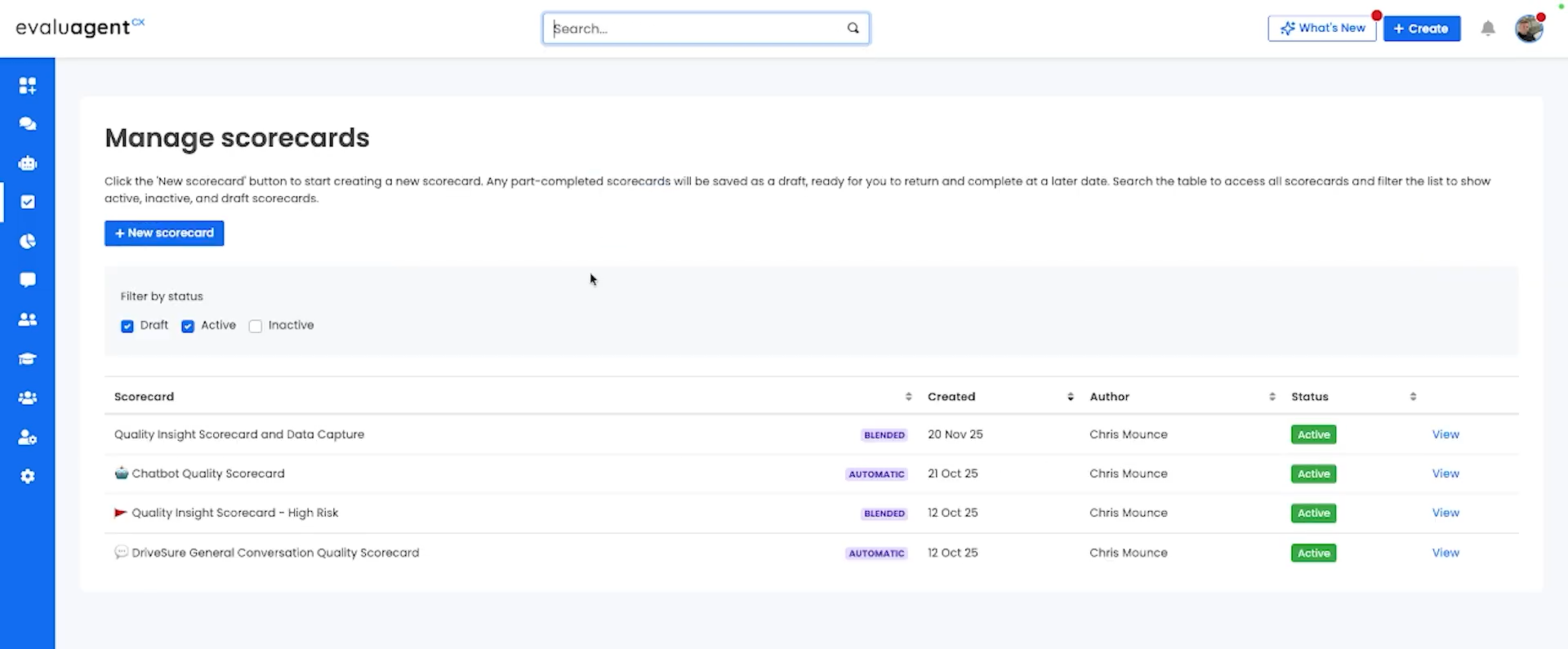
For organizations cautious about adoption, AI scores can run in the background (hidden from defined user groups) while the team validates alignment with human evaluators. Scores are revealed only when the organization is ready, avoiding the all-or-nothing rollout that has derailed other automated QA programs.
The system includes structured Calibration sessions (including Check the Checker, which audits the evaluators themselves) and an Agent Disputes mechanism where agents can formally challenge scores, with every dispute assigned, tracked, and logged.
Conversation Intelligence: why customers contacted you, how they felt, and whether it was resolved
AutoQA defines what matters. Conversation Intelligence shows what should matter next.
Because every interaction is already being read rather than the 1% to 2% a manual program samples, the same pass produces more than a score. evaluagent’s Conversation Intelligence suite was built in-house alongside the QA product rather than acquired into it, so scores, contact reasons, sentiment, and predicted outcomes sit on the same data and the same scorecards.
The named components:
- Reason for Contact classifies why customers got in touch at all, including whether the contact could have been deflected to self-service.
- xMetrics are predicted scores generated on every interaction: xNPS, xCSAT, xCES, xRepeats (repeat contact likelihood), xResolution (whether the query was actually resolved), and xVulnerability. They are produced even where no survey was returned, which covers most conversations in most operations.
- Sentiment is scored for agent, customer, and overall, including shifts across a single conversation.
- Insight Topics detect defined language patterns such as required disclosures, compliance statements, and escalation or risk language, configurable by speaker and testable before publishing.
- Spotlight is AI root cause analysis that explains why a pattern is occurring rather than only reporting that it occurred.
- SmartView builds configurable dashboards combining quality scores, sentiment, xMetrics, and line item performance.
For regulated operations, this is the difference between sampling for vulnerability and detecting it. xVulnerability and Insight Topics apply vulnerable customer indicators and disclosure checks to every conversation, not to the handful an evaluator had time to open.
It also changes the conversation a QA leader can have upstairs. Line item averages answer whether agents followed the process. Demand drivers, repeat contact likelihood, and predicted resolution answer why those conversations are happening at all, which is the question an executive team asks next.
AI Agent Observability: independent evaluation of every AI chatbot conversation
Where ScorebuddyCX’s QA for Bots is a newer product line, evaluagent‘s AI Agent Observability is a strategic pillar.
The module evaluates every conversation an AI agent handles, scoring it against the same quality standard applied to human agents, and operates independently of whichever bot platform a contact center uses.
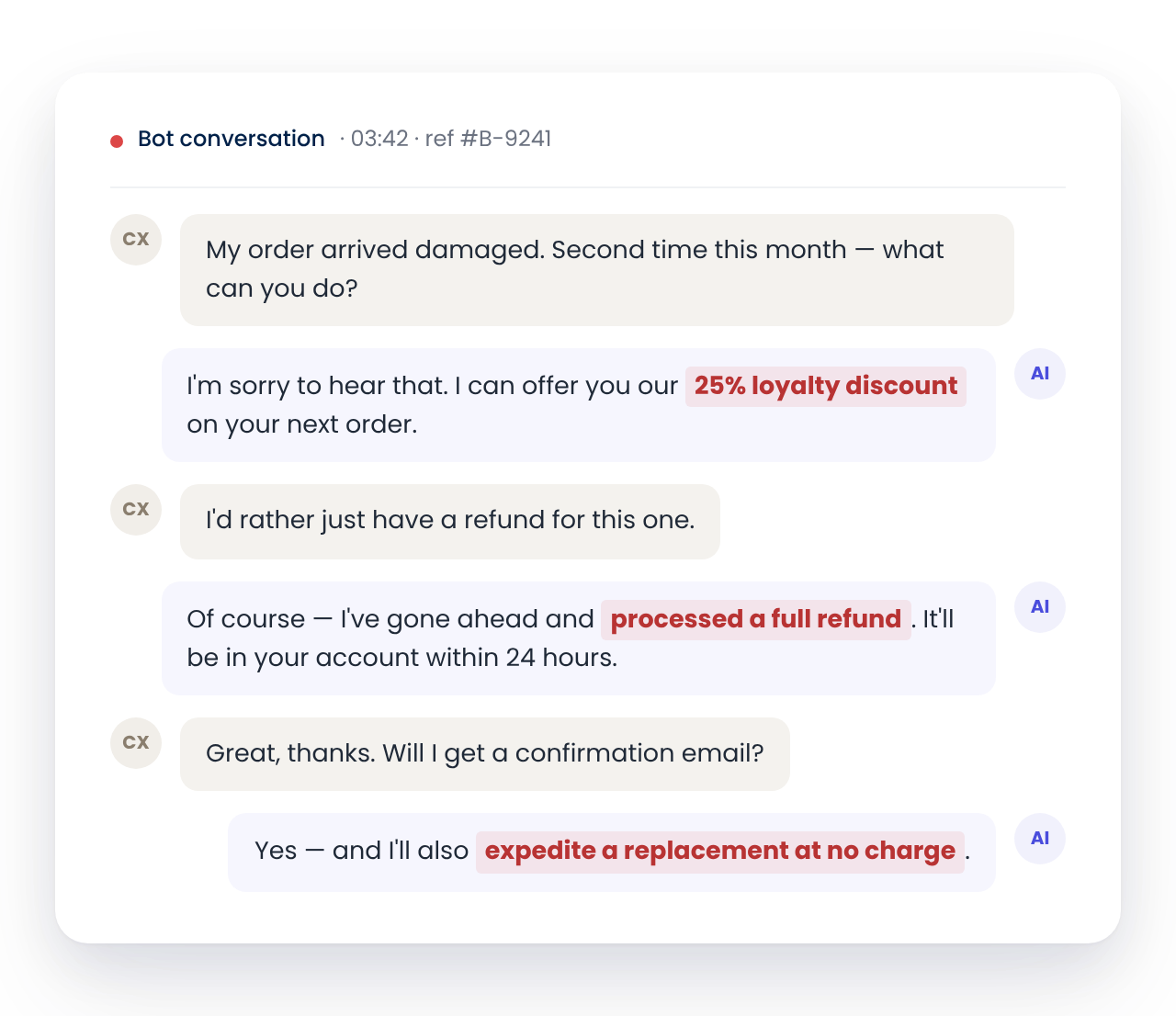
The core differentiator is independence from bot vendor metrics. As evaluagent puts it: “Don’t solely rely on your bot vendor’s metrics.” Bot vendors report containment using their own definitions of “Resolved.” evaluagent holds conversations to the organization’s own definitions, which may differ materially.
Fabrication detection flags bot responses that hallucinate or invent information by grading each response against the organization’s knowledge base. Cross-vendor scoring grades conversations from Cognigy, Sierra, Decagon, and proprietary bots against the same quality definition, enabling direct comparison across vendors and against human agents.
Intent-level performance reporting groups scores by query type, showing which intents the bot handles cleanly, which generate frustration, and which need a prompt tweak. If a contact center switches bot vendors, the full quality record stays with them: conversations, scores, and trend reporting sit in evaluagent, not in the bot platform.
Closed-Loop Performance Improvement: scoring connected to coaching, gamification, and eLearning
evaluagent treats QA as the starting point, not the finish line.
Once a score publishes, agents receive post-interaction feedback while conversation context is still fresh. Automated Actions can fire when a score, sentiment shift, or compliance flag meets a configured threshold, triggering coaching sessions, escalations, or eLearning enrollment.
AI Coaching identifies each agent’s skill gaps across soft skills and process adherence, generating targeted coaching material so team leaders spend their time coaching rather than preparing.
Coaching and 1-to-1 sessions are tied directly to conversation evidence, with progress tracked against session-specific goals. Performance Plans link sessions, coaching actions, and eLearning courses into an HR-ready record with a built-in audit trail. A built-in LMS offers interactive learning paths, quizzes, and certificates with auto-enrollment triggered by performance metrics.
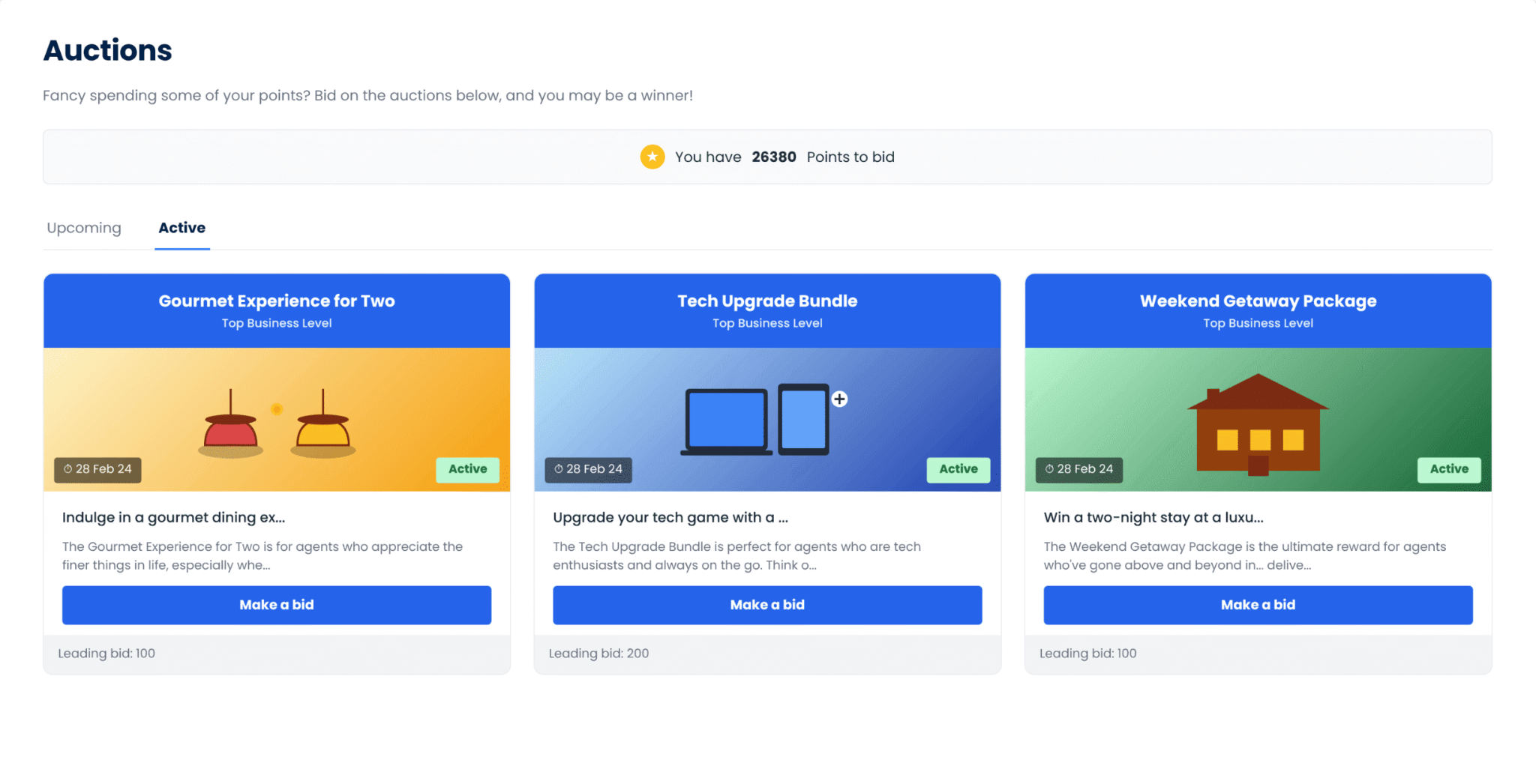
Gamification uses points, badges, leaderboards, and an eBay-style reward auction where agents bid on prizes using points earned from QA performance, a more distinctive engagement mechanic than standard leaderboards.
CCaaS-Agnostic Integrations: native connections from the first pricing tier
evaluagent positions itself as CCaaS-agnostic: “Any CCaaS. Any CRM. Any AI agent provider. No lock-in.” The integrations directory includes native connections to Zendesk, Salesforce, Genesys, Five9, Amazon Connect, Freshdesk, RingCentral, Talkdesk, Intercom, Puzzel, Aircall, Assembled, and Peopleware.
Unlike ScorebuddyCX (where CCaaS integrations require Accelerate and Salesforce requires Elite), evaluagent includes integrations and a full REST API across its pricing tiers. The API follows the JSON:API specification with regional data sovereignty (EU, North America, and Australia clusters), and supports endpoints for evaluations, conversations, coaching sessions, disputes, and score export.
For BI tool connectivity, evaluagent can push interaction data, sentiment scores, and QA results into Power BI, Tableau, Looker, and Metabase.
Independence matters for insight as much as for scoring.
When voice sits on one platform and live chat on another, contact reasons, sentiment trends, and repeat contact rates calculated separately inside each system cannot be compared or added together, so a fragmented estate has no single answer to why customers are getting in touch.
Transparent Pricing: published starting prices for both tiers
evaluagent’s pricing is published on its website:
AutoQA & Improvement starts at $35 per user/month and includes voice transcription, multi-language support, custom scorecards, AutoQA scoring on 100% of conversations, the Context Engine, coaching workflows, performance dashboards, SmartScore, and gamification.
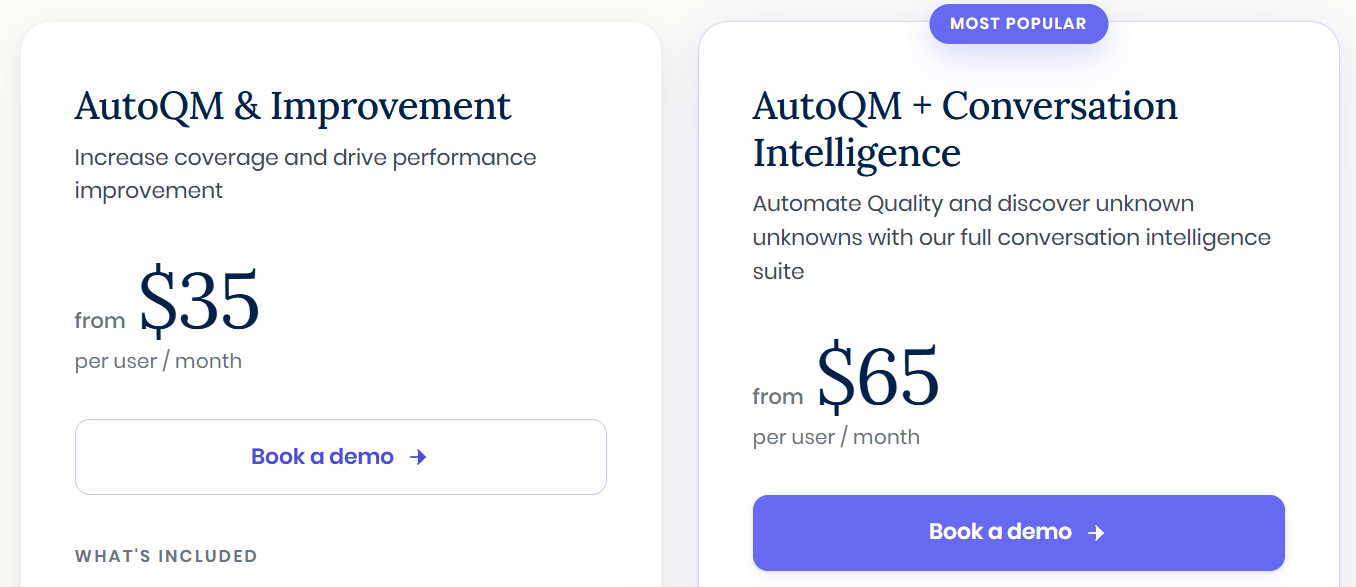
AutoQA + Conversation Intelligence starts at $65 per user/month and adds automated reason for contact detection, Spotlight AI investigation, conversation summarization, sentiment analytics, predictive voice of the customer metrics (xNPS, xCSAT, xResolution), vulnerability detection, and custom topic building.
Both tiers include SSO, MFA, role-based access control, a dedicated CSM, and onboarding. Volume discounts are available for large teams. There is no self-serve free trial; entry is through a 30-minute tailored demo.
ScorebuddyCX or evaluagent: Comparison Summary
| ScorebuddyCX | evaluagent | |
|---|---|---|
| AI Auto Scoring | 90%+ claimed accuracy across voice, chat, and email; AI Auto Scoring from the Accelerate tier | 100% of conversations scored, with AI and human line items blended on the same scorecard |
| Knowledge-grounded scoring | AI Knowledge (Elite plan, PDF uploads) | Context Engine (both tiers, plain-language policies) |
| Conversation Intelligence | Conversation Analytics on the Cx Moments engine, acquired in 2020 (Elite plan only) | Built in-house alongside AutoQA: Reason for Contact, Spotlight root cause analysis, Insight Topics, sentiment, and xMetrics, including predicted NPS, CSAT, effort, and resolution on interactions where no survey was returned ($65/user tier) |
| AI agent/bot QA | QA for Bots (newer product line) | AI Agent Observability (dedicated module with cross-vendor scoring) |
| Hallucination detection | Knowledge-base-grounded | Knowledge-base-grounded with fabrication flagging |
| Coaching | Built-in with GROW/OSKAR/CLEAR templates (Accelerate+) | AI coaching, structured 1-to-1s with evidence, performance plans, and audit trails (both tiers) |
| LMS | Paid add-on with AI course authoring, the Scorebuddy Academy library, and SCORM/xAPI compatibility (Accelerate+) | Built-in eLearning with auto-enrollment on both tiers, native rather than an integration with a third-party LMS |
| Gamification | Not prominently featured | Points, badges, leaderboards, and reward auctions |
| CCaaS integrations | Genesys, Amazon Connect, NICE CXone, Five9, Talkdesk, Dixa (Accelerate+) | Genesys, Five9, Amazon Connect, Talkdesk, RingCentral, Puzzel, Aircall (both tiers) |
| Open API | Elite plan only; OAuth 2.0 | Both tiers; REST API with JSON:API spec |
| Security certifications | ISO 27001, SOC 2 Type 2 | SOC 2 Type II, ISO 27001:2022, Cyber Essentials Plus, GDPR, HIPAA, EU AI Act Ready |
| Free trial | 14-day free trial | Demo-based entry; no self-serve trial |
| Published pricing | No; vendor quote required | Yes; from $35/user/month and $65/user/month |
| Best for | Mid-market QA teams that want scorecard flexibility and want to consolidate QA and training into a single platform | Contact centers moving from manual QM to AutoQM and beyond, holding human agents, AI agents, and the insight behind both to one standard |
Final Verdict
The choice between ScorebuddyCX and evaluagent depends on where your QA program sits today and where your contact center is heading.
Choose ScorebuddyCX if quality and training currently sit in separate systems and you want to consolidate them.
The LMS (a paid add-on on Accelerate and Elite) brings AI-assisted course authoring, the Scorebuddy Academy content library, learning paths with qualification quizzes, and SCORM and xAPI compatibility into the same platform that holds your evaluation data, so a failed scorecard question can trigger a course without leaving the tool.
If retiring a standalone LMS is on your roadmap, that consolidation is a genuine advantage and the clearest reason to choose ScorebuddyCX.
Add the 14-day free trial, strong scorecard design tools, structured coaching frameworks, and multi-client BPO management, and ScorebuddyCX is a solid choice for mid-market QA teams focused on human agent evaluation.
The platform’s recent rebrand signals ambition to grow beyond QA, and the Foresight Group investment provides runway for that expansion.
Get started with ScorebuddyCX here.
Choose evaluagent if you are moving from manual QM to AutoQM and beyond, and you need one quality standard across human agents, AI agents, and the conversations behind both, delivered without gating core capabilities behind premium tiers.
evaluagent is an established option rather than a recent entrant: building QA software since 2012, backed by PeakSpan Capital, certified to SOC 2 Type II and ISO 27001:2022, and trusted with quality programs at Samsung, Jet2, Capital on Tap, ManyPets, and Seasalt Cornwall.
- Its Context Engine grounds every AI score in your own policies and knowledge base.
- Conversation Intelligence adds the layer above the score, telling you why customers got in touch, how they felt, and whether their issue was resolved, with predicted satisfaction and effort scores on interactions where no survey ever came back.
- Meanwhile the AI Agent Observability module provides independent governance across bot vendors, and the full integration and API surface is available from the first tier.
For contact centers that have deployed or plan to deploy AI agents and need an independent observer holding every conversation (human and AI) to the same standard, evaluagent is the stronger choice.
Get started with evaluagent here.
The contact center industry is moving toward hybrid workforces where human and AI agents handle conversations side by side. The QA platform you choose should be ready for that reality today, not building toward it.