CallMiner has spent more than two decades building a conversation intelligence platform. Founded in 2002 as a speech analytics company, it has expanded into a CX automation suite that captures, analyzes, coaches, and automates across voice, chat, and digital channels. For large contact centers with strict compliance requirements and experienced analytics teams, it remains a strong option.
To write this CallMiner review, we analyzed the platform extensively. We believe it’s the right choice if:
- You operate a large enterprise contact center with 60+ agents and need omnichannel conversation intelligence
- Regulatory compliance monitoring (FDCPA, TCPA, HIPAA) is a primary business requirement
- You want real-time agent guidance and next-best-action prompts during live calls
- You need virtual agent automation and analytics under one roof
- You have dedicated analysts who can invest months in platform configuration
However, CallMiner might not be the best choice if:
- You need to go live quickly without a multi-month implementation
- Your QA team can’t build and maintain complex category models
- You want a focused quality assurance platform that connects directly to coaching and agent development
- You’re a mid-market team that needs transparent, published pricing
- You want independent AI agent governance that works across any bot vendor without platform lock-in
In this case, you should consider evaluagent: a QA and performance improvement platform that scores 100% of conversations automatically, then connects those scores directly to structured coaching, performance plans, and gamification, all with published pricing starting at $35/user/month and go-live timelines measured in weeks rather than months.
We’ve included a detailed look at evaluagent at the end of this CallMiner review as the best alternative for contact centers that want full QA coverage without the complexity overhead. If you’re ready to explore it, you can book a demo with evaluagent here.
What is CallMiner?
CallMiner was founded in 2002 in Cape Coral, Florida by Jeff Gallino.
The company started with a clear mission: make sense of contact center call recordings by mining speech for business intelligence, compliance insights, and performance data.
Today, CallMiner is headquartered in Waltham, Massachusetts and serves more than 550 customers globally with nearly 300 employees. The platform has evolved from speech analytics into what it calls the Eureka Platform, a CX automation suite organized into four pillars: Capture, Intelligence, Augmentation, and Automation.
Across these pillars, more than 12 products handle everything from call recording and transcription to AI-driven coaching, real-time agent guidance, and virtual agent automation.
The company secured a $75 million investment from Goldman Sachs in 2019 and has attracted backing from In-Q-Tel, NewSpring Capital, and other institutional investors. In June 2025, CallMiner acquired VOCALLS, a conversational AI provider, extending the platform into virtual agent automation with the product now branded OmniAgent.
CallMiner targets enterprise organizations with mature contact center operations. The platform requires a minimum of 60+ agents and uses custom contract pricing, placing it in the mid-market-to-enterprise range. Key verticals include financial services, healthcare, telecommunications, BPO, and retail.
CallMiner Pros & Cons
| Pros | Cons |
|---|---|
| Analyzes 100% of omnichannel interactions without sampling | Steep learning curve; users report needing up to 6 months to get established |
| Strong analyst recognition (Forrester Wave Leader, SPARK Matrix Leader) | No published pricing; requires sales engagement for any cost information |
| AI Assist natural language interface reduces technical barriers | Legacy architecture perceived as slower to adopt generative AI |
| Real-time agent guidance during live calls | 60+ agent minimum makes it inaccessible for smaller teams |
| Broad integration ecosystem across CCaaS, CRM, and speech-to-text providers | Session and UI timeouts disrupt multi-tab analyst workflows |
| Automated PII redaction across audio and text | Reporting and category builder UX cited as inflexible |
| Virtual agent automation via OmniAgent acquisition | Professional services for implementation likely add significant cost |
CallMiner Review: How It Works & Key Features
Conversation Capture: CallMiner records, screens, and redacts across the full interaction lifecycle.
The Capture layer sits at the foundation of the Eureka Platform.
Record captures 100% of voice contacts using dual-channel stereo audio with the Opus codec, separating agent and customer voice streams into distinct channels. This stereo approach improves transcription accuracy compared to mixed mono audio. Recordings are indexed automatically and available for search and playback during or immediately after a call.
Screen Record captures agent desktop activity during calls, filling the gap that audio alone cannot explain. It triggers automatically when an agent connects to a call and uses a delta-capture method that records only changes in screen activity rather than continuous full-frame video, reducing storage. Screen recordings synchronize with corresponding audio for side-by-side review.
Redact identifies and removes sensitive data from both audio recordings and transcripts automatically. It covers over 50 entity types out of the box and supports custom configurations through aliases, specific phrases, and regular expressions.
Each redacted item is labeled in the transcript with its entity type, so compliance teams can see what was removed without seeing the underlying data. This replaces the error-prone “pause-and-resume” recording practices many contact centers still use for PCI, HIPAA, and PII compliance.
Analytics and AI: CallMiner applies AI-driven analysis across the full volume of interactions.
Analyze is the core intelligence engine.
It ingests omnichannel interactions and applies AI across the pipeline: transcribing voice-to-text from hundreds of languages, running sentiment analysis across voice and text (including emojis), and categorizing, scoring, and summarizing interactions automatically. Unsupervised machine learning surfaces unexpected topics and trends that rule-based systems would miss.
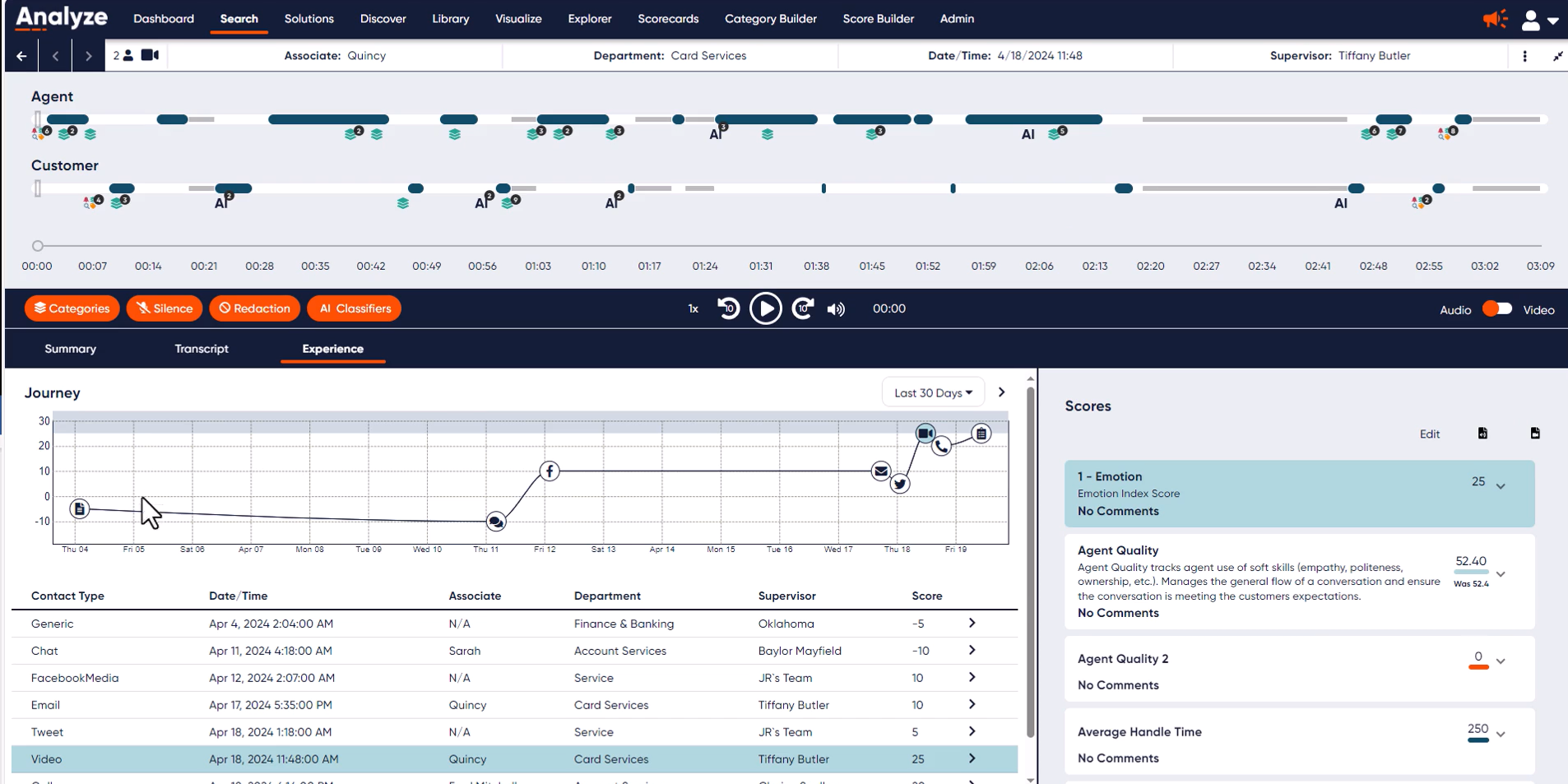
The platform includes contact summarization to reduce agent after-call work and supports predictive models for NPS, churn anticipation, and likelihood to buy. Alerting pushes critical feedback to stakeholders across the organization through APIs and configurable dashboards.
Visualize, powered by Tableau, handles reporting. Users can build drag-and-drop charts, graphs, and dashboards from conversation analytics data, with pre-built report templates. The Tableau foundation connects BI capabilities directly to conversation data.
The Advanced AI layer adds generative and agentic capabilities. AI Assist uses a multi-agent architecture where research agents answer natural language questions and supervisor agents coordinate complex workflows. AI classifiers are custom-trained to each organization’s terminology rather than generic taxonomies.
Semantic search v2 enables natural language queries across languages, reducing the need for product expertise to extract insights.
Agent Coaching and Real-Time Guidance: CallMiner improves agent performance through post-call coaching and in-call intervention.
Coach draws on 100% of voice and text-based interactions to drive evidence-based performance improvement.
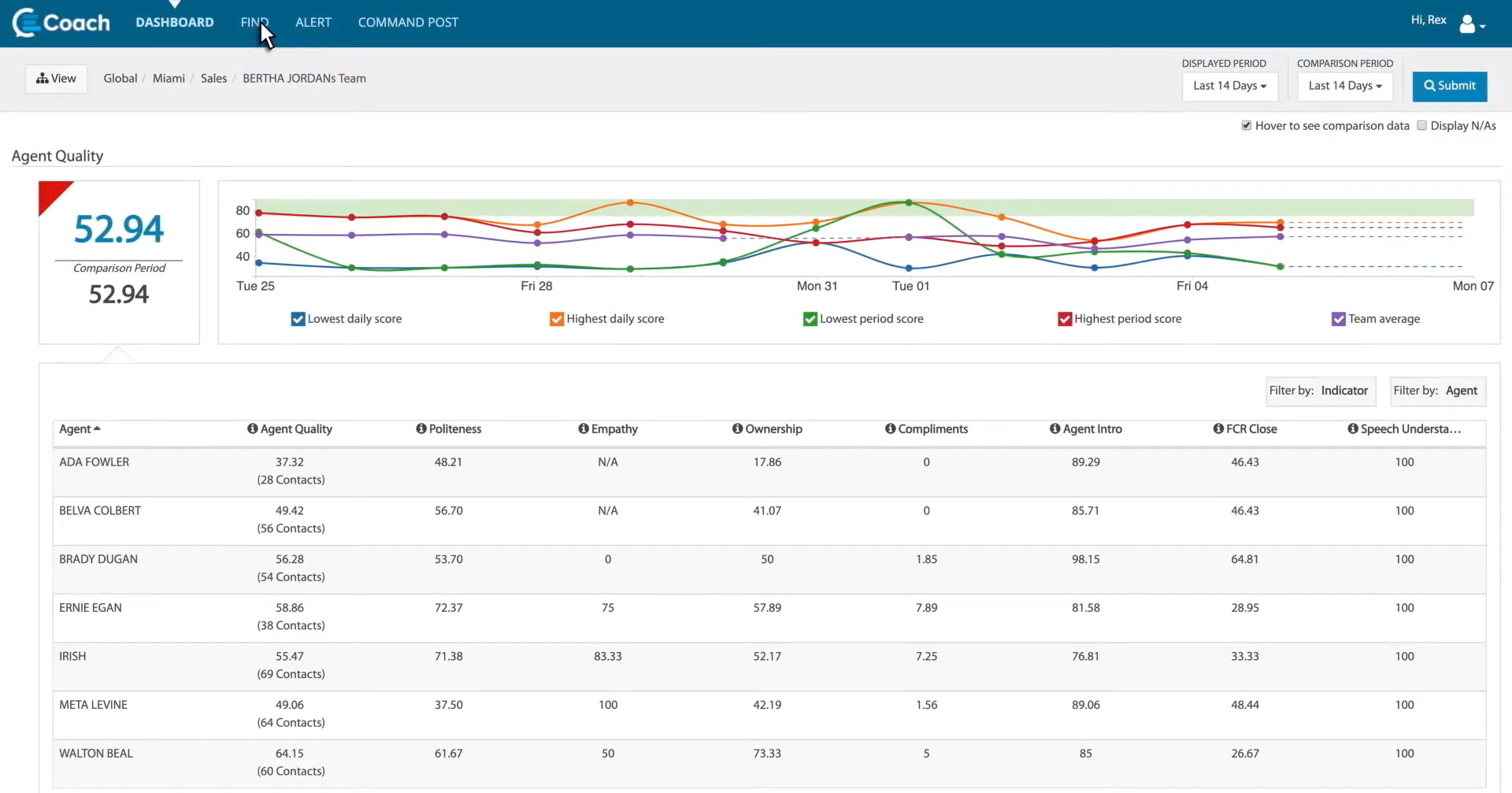
Organizations configure it to auto-score every interaction against custom criteria (empathy, script compliance, sentiment, silence detection) or blend automated and manual evaluations. Supervisors use the call finder and viewer to locate specific interactions, filter by keywords and performance scores, and attach audio or screen recording snippets to coaching notifications.
The coaching workflow supports two-way communication: agents can acknowledge feedback, respond, and flag challenges outside their control. Agent self-coaching dashboards display performance scores in readable formats, and peer visibility shares positive examples from high performers across the team.
RealTime enables intervention during live conversations. It triggers automated notifications when predefined indicators appear, surfacing guidance, compliance alerts, or retention prompts on the agent’s desktop.
Alert thresholds are customizable by category without IT involvement. Supervisors can listen to live conversations, and agents can invoke a call-for-help signal when they need support. The system scales to 100,000+ simultaneous multichannel interactions without storage requirements.
Automation: CallMiner extends from analytics into virtual agents, outreach, and real-time translation.
OmniAgent is CallMiner’s voice-optimized virtual agent, built on technology acquired from VOCALLS in June 2025.
It handles routine to complex customer inquiries across voice, chat, and email using speech recognition and NLP. Organizations use a visual designer to map and build dialogue flows, and the system connects with CRM and CCaaS platforms to personalize interactions in real time. When escalation is needed, OmniAgent transfers the call with full context preserved.
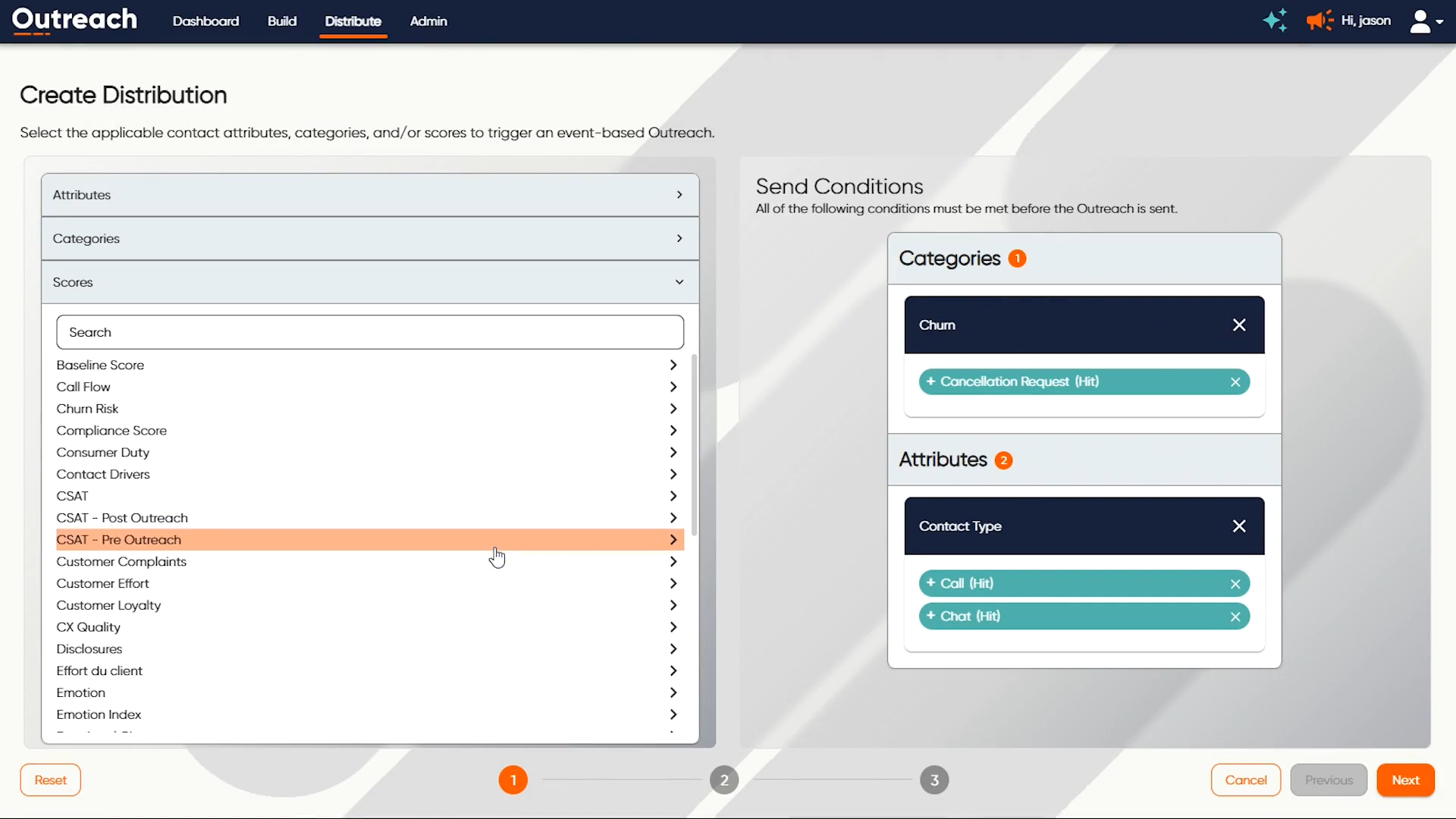
Outreach triggers feedback requests via email or SMS based on actual customer interaction content, replacing generic post-call surveys with relevant follow-ups. AI generates personalized summaries of each customer’s interaction and tailors messages to the customer’s preferred channel.
LiveTranslate provides real-time in-call translation so agents and customers can speak in their native languages without human interpreters. It includes custom grammar and dictionaries for brand and industry terms, and asks customers to repeat themselves when background noise or unclear speech is detected. All translated conversations feed into the conversation intelligence engine for analysis.
Pricing: CallMiner uses custom enterprise pricing with no published rates.
CallMiner does not publish pricing. The company’s FAQ describes the model: “CallMiner offers multiple bundled pricing packages, based on either user count or interaction volume.”
Key details:
- Subscription-based with bundled packages for common use cases
- Two pricing levers: user count and interaction volume
- Minimum size: 60+ agents, scaling to global enterprise
- AI included: all packages include AI capabilities at no extra cost
- No free plan: pilot programs available “in certain cases” through a sales-led process
- Professional services: seven packages available separately for platform setup, analytics configuration, and training
The company states that most customers go live within weeks, with a 90-day value realization target. However, third-party review data points to a more realistic 6-month maturity curve for extracting full value.
Where CallMiner Falls Short
CallMiner is a capable platform for enterprise-scale conversation intelligence, but several limitations shape who should and shouldn’t adopt it.
Steep Learning Curve and Long Time-to-Value: G2 reviewers describe a steep learning curve, noting that average users struggle to build searches without extensive training. Some report needing up to six months to feel established on the platform. For organizations expecting rapid ROI, this creates a gap between purchase and productive use.
Legacy Architecture Constraints: Multiple G2 reviewers characterize the platform’s core architecture as legacy rather than AI-native, noting that this foundation has slowed its adoption of generative AI. The custom classifier and AI Assist investments in 2025 aim to close this gap, but the perception remains a concern for buyers evaluating cloud-native alternatives.
Opaque Pricing: With no published pricing page, prospective buyers cannot evaluate cost without engaging a sales team. This makes it hard to compare CallMiner against alternatives or budget for deployment. The modular structure (recording, analytics, coaching, automation) and separate professional services packages can add up in ways that are hard to predict before contract negotiation.
Reporting and UX Friction: G2 reviewers cite reporting inflexibility, including the inability to bundle multiple categories into a single report, and note workflow disruptions in the category builder caused by unnecessary page navigation. Session timeouts that affect all open browser tabs at once frustrate power users who rely on multi-tab workflows.
Transcription Accuracy in Difficult Conditions: Capterra reviewers report that speaker separation degrades when third-party voices or hold music are present, particularly during call transfers. G2 reviewers flag occasional accuracy gaps in noisy audio environments, leading to misinterpretations that affect downstream analytics.
Coaching Gap Between Insight and Action: CallMiner’s Coach product offers two-way feedback and performance tracking, but the platform does not natively include structured performance improvement plans with audit trails, built-in learning management, or gamification. The emphasis is on surfacing insights to supervisors rather than building a complete loop from score to measurable skill improvement.
These limitations reflect a platform built for analytical depth at enterprise scale. But they create a clear opening for teams that prioritize speed to value, transparent pricing, and a tighter connection between QA scores and agent development.
Top CallMiner Alternative: evaluagent
evaluagent addresses CallMiner’s complexity and time-to-value challenges with a platform designed around one principle: score every conversation, then make those scores drive measurable agent improvement.
Founded in 2012 by Jaime Scott, Michelle Dinsmore, and Alex Richards (three operators who had spent their careers running contact centers and quality teams), evaluagent grew from practitioner experience rather than technology-first design.
The company serves customers including Samsung, Jet2, Capital on Tap, 1st Central, Atos, and ManyPets, with nearly 500% revenue growth over the three years preceding July 2025.
evaluagent was named #17 in G2’s Top 50 UK Software Companies 2026 and #22 in Top Customer Service Products 2026, the only contact center software on the UK list for a third consecutive year.
In G2’s Summer 2026 report, evaluagent earned Leader and Momentum Leader in Contact Center Quality Assurance and High Performer in Conversation Intelligence, rankings driven by verified customer reviews rather than analyst briefings.
AutoQA and Performance Management: evaluagent scores 100% of conversations and connects results directly to coaching, learning, and gamification.
evaluagent’s AutoQA replaces the industry norm of evaluating just 2% of interactions with full-coverage AI scoring across voice, chat, and email.
The scoring is calibrated to each organization’s standards through the Context Engine, which grounds AI evaluations in uploaded QA policies, tone-of-voice guidelines, compliance rules, and knowledge base content. A Testing Console lets QA managers validate any scoring change against real historical conversations before it goes live.
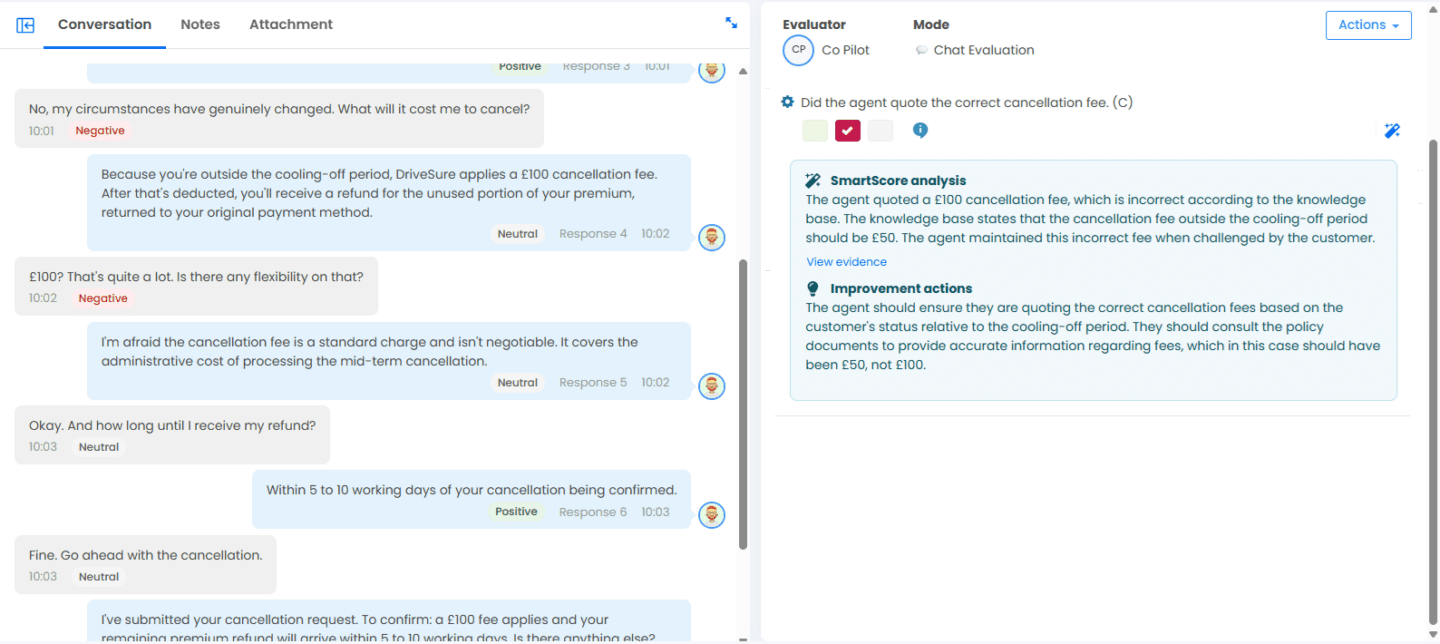
What sets the platform apart is what happens after scoring. Blended Scorecards let AI handle repetitive rule-based checks while human evaluators keep nuanced assessments on the same scorecard.
Scores flow directly into structured Coaching and 1-to-1 sessions tied to conversation evidence, Performance Plans with full audit trails, and gamification that uses points, badges, leaderboards, and an eBay-style reward auction to keep agents engaged.
Automated lesson assignment enrolls agents in e-learning when a defined event occurs, such as a failed evaluation or a low score on a specific line item.
Agents can file formal Agent Disputes on scores they disagree with, creating a feedback loop that improves AI accuracy over time. Calibration sessions keep human and AI scoring aligned across evaluators, solving the inter-rater reliability problem that plagues manual QA programs.
Capital on Tap scaled from 900 to 6,000 BDM checks per month immediately after go-live without adding headcount. (Capital on Tap Case Study)
Conversation Intelligence: evaluagent surfaces what customers are saying, why they’re calling, and what it means for the business.
The Conversation Intelligence module sits alongside AutoQA as the analytics layer.
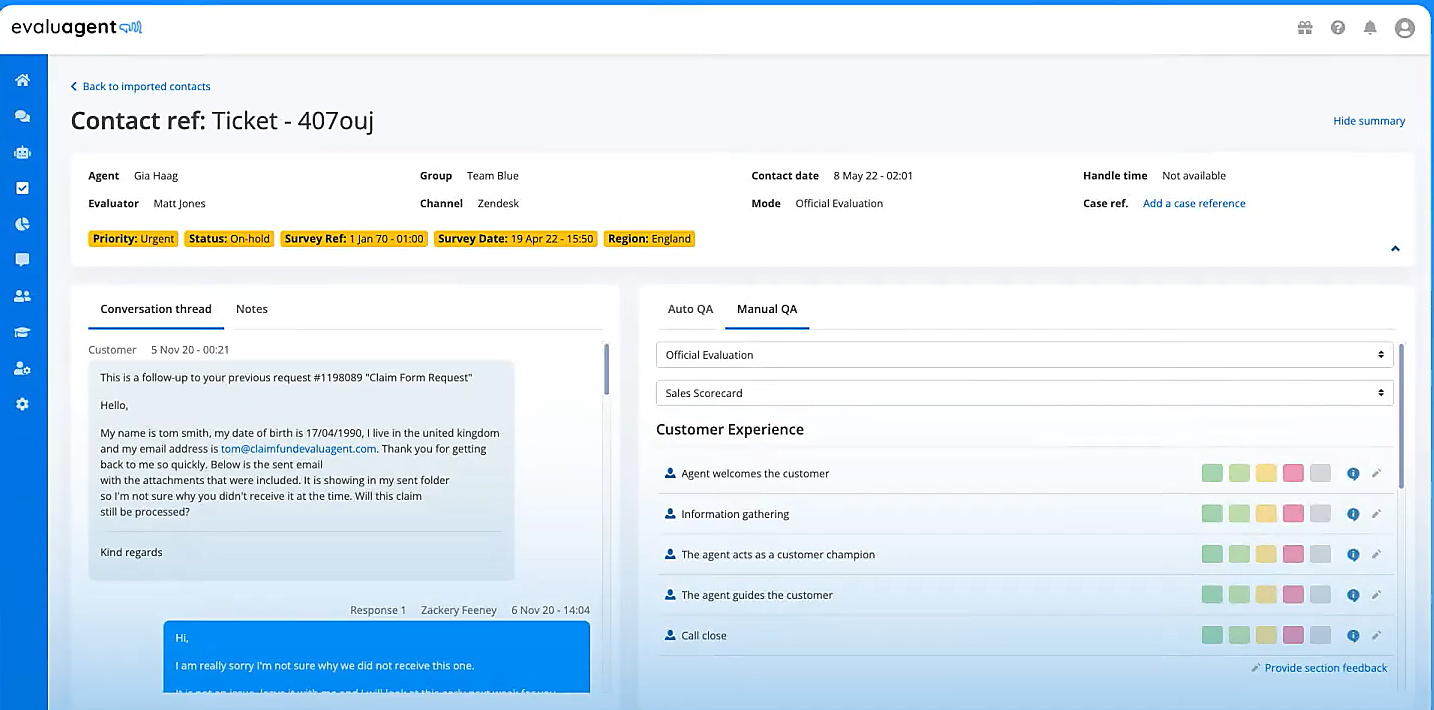
It classifies reason for contact across every interaction without manual tagging, tracks sentiment at the conversation level, and derives predictive metrics including xNPS, xCSAT, xResolution, and xVulnerability from conversation signals rather than post-call survey responses.
The Spotlight tool acts as an on-demand AI analyst. Users filter a set of conversations, run Spotlight, and it analyzes up to 1,000 conversations in the background, returning themes organized into Critical Issues, Monitor Closely, and Performing Well, each with supporting excerpts and clickable transcript links.
Every insight is traceable to the specific conversation moment that produced it, and admins can override AI-derived outcomes at any time, with corrections feeding back into the model. Custom Insight Topics are built through a no-code interface with a testing console, accessible without data science expertise.
AI Agent Observability: evaluagent independently governs AI chatbots and virtual agents using the same quality standard as human agents.
AI Agent Observability addresses a growing gap: contact centers deploying AI agents without independent quality oversight.
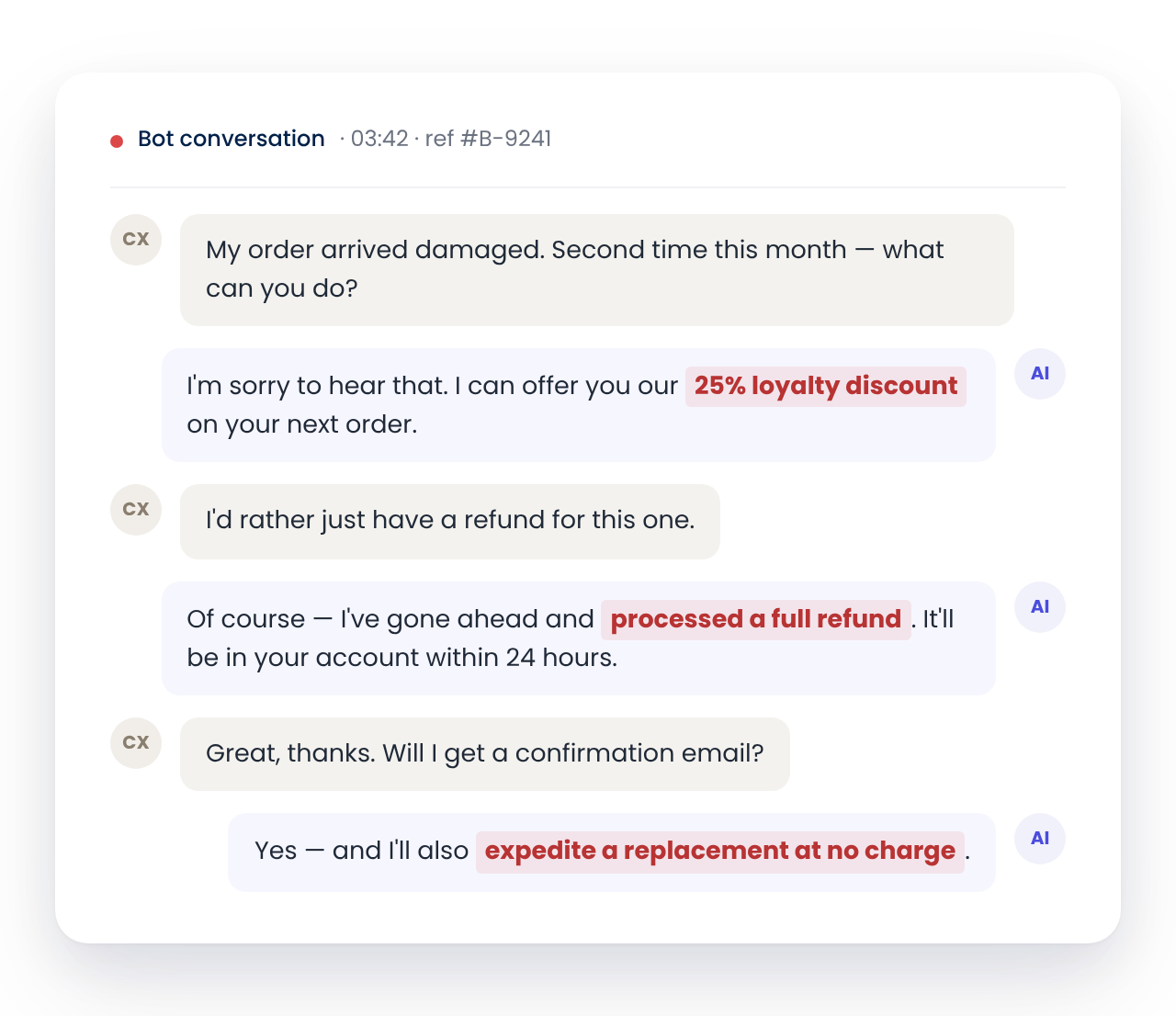
evaluagent evaluates every AI agent conversation against the same scorecard applied to human agents, with fabrication detection grounded in the organization’s own knowledge base, off-policy response flagging, containment analysis, and handover quality tracking.
The module works across bot vendors (Cognigy, Sierra, Decagon, and proprietary builds) so teams can compare performance across platforms and against human agents using the same definitions. Conversations, scores, and reporting sit in evaluagent rather than the bot platform, so switching vendors doesn’t mean losing the quality record.
Transparent Pricing and Fast Go-Live: evaluagent publishes pricing and gets teams live in weeks, not months.
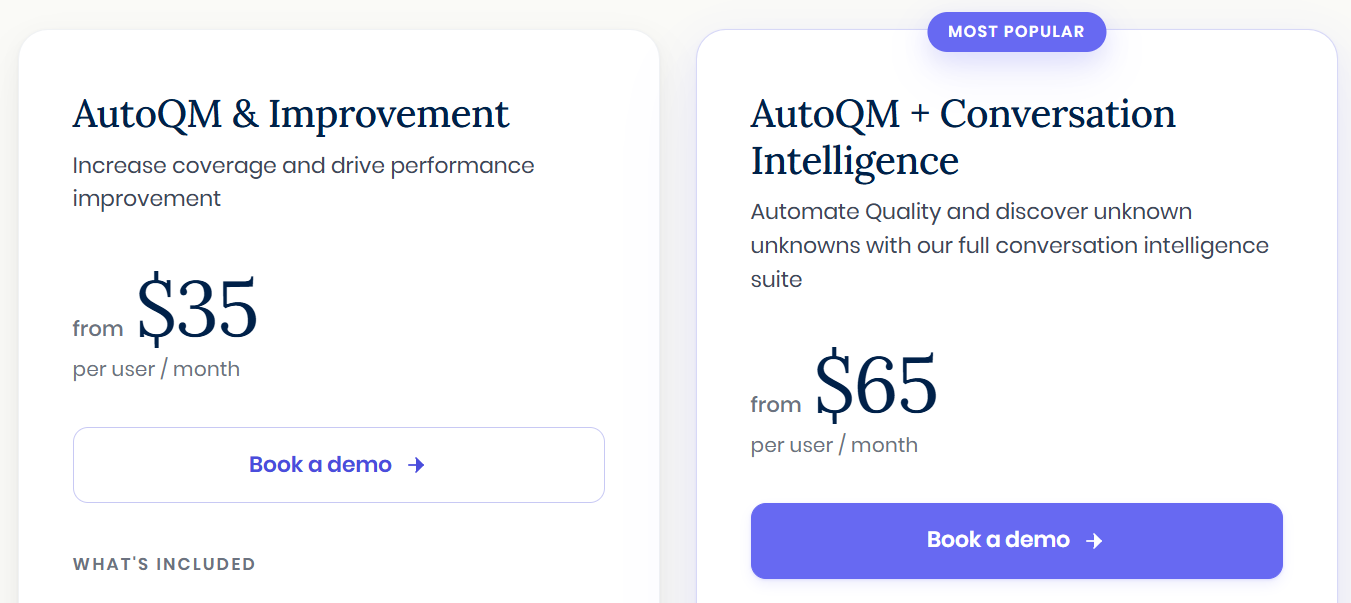
evaluagent publishes its pricing directly on its website:
AutoQA & Improvement (from $35/user/month):
- Voice transcription with speaker diarization and multi-language support
- 100% automated conversation scoring across voice, chat, and email
- Custom scorecard builder with auto-fail logic
- SmartScore AI line items with transparent reasoning
- Context Engine for knowledge-grounded scoring
- Coaching workflows, performance plans, and gamification
- Fabrication detection, calibration sessions, and agent disputes
- SSO, MFA, and role-based access control
- Dedicated CSM and onboarding
AutoQA + Conversation Intelligence (from $65/user/month):
- Everything in the AutoQA tier
- Automated reason for contact and intent detection
- Spotlight AI analyst and conversation summarization
- Sentiment analytics and trend tracking
- Predictive xNPS, xCSAT, xResolution, xVulnerability
- Custom insight topic builder
evaluagent reports that most organizations go live in a few weeks, with dedicated CSM onboarding included at both tiers rather than gated behind enterprise contracts. The platform integrates natively with Zendesk, Salesforce, Genesys, Five9, Amazon Connect, Freshdesk, RingCentral, Talkdesk, Intercom, Puzzel, Aircall, Assembled, and Peopleware and stays CCaaS-agnostic.
Security certifications include SOC 2 Type II, ISO/IEC 27001:2022, Cyber Essentials Plus, GDPR, HIPAA-aligned, and EU AI Act readiness, with data hosted on AWS in regional data centers.
Seasalt Cornwall doubled evaluations and reduced agent attrition from 100% to 10% year-on-year after implementing evaluagent’s coaching and QA workflows. (Seasalt Cornwall Case Study)
CallMiner or evaluagent: Comparison Summary
| CallMiner | evaluagent | |
|---|---|---|
| Primary focus | Full CX automation (capture, analytics, coaching, virtual agents) | Automated quality management, conversation intelligence, and AI agent observability |
| Interaction coverage | 100% of omnichannel interactions | 100% of voice, chat, and email interactions |
| Scoring calibration | Custom AI classifiers trained per business | Context Engine grounded in company policies and knowledge base |
| Real-time agent guidance | Yes (RealTime product with live alerts and next-best-action) | No real-time in-call intervention |
| Coaching loop | Two-way feedback with call clips attached | Structured 1-to-1s, performance plans, gamification, automated lesson assignment |
| Virtual agent automation | OmniAgent (voice, chat, email) | Not offered |
| AI agent governance | Analytics on OmniAgent conversations | Independent cross-vendor bot QA with fabrication detection |
| Learning curve | Steep; reportedly 6 months to full maturity | Go-live in weeks; practitioner-oriented design |
| Integrations | 30+ CCaaS, CRM, speech-to-text, and experience management partners | Native integrations across CCaaS, CRM, helpdesk, and WFM platforms, plus open API |
| Security certifications | SOC 2 Type II, ISO 27001, FISMA, HITRUST, PCI DSS | SOC 2 Type II, ISO 27001, Cyber Essentials Plus, HIPAA-aligned, EU AI Act Ready |
| Pricing transparency | Custom quotes only; 60+ agent minimum | Published from $35/user/month; volume discounts available |
| Free trial | Pilot programs in certain cases | Demo-based; trials available on a case-by-case basis |
| Best for | Large enterprises needing full CX automation and advanced analytics | Mid-market to enterprise teams wanting fast, focused QA with a direct path to agent improvement |
Final Verdict
The choice between CallMiner and evaluagent depends on what your contact center needs most: analytical depth and full CX automation, or focused quality assurance with a direct line to agent development.
Choose CallMiner if you run a large enterprise contact center with 60+ agents, need real-time in-call intervention, want virtual agent automation alongside your analytics, and have the resources and timeline to invest in a platform that takes months to configure.
CallMiner’s compliance monitoring depth, broad integrations, and consistent analyst recognition make it a strong fit for organizations with mature CX programs ready to consolidate conversation intelligence and automation into one platform.
Choose evaluagent if you want to replace sampled manual QA with full-coverage AI scoring and ensure those scores drive agent improvement through structured coaching, performance plans, and gamification.
evaluagent is built for teams that value speed to value, pricing transparency, and a tight connection between quality data and frontline development. Its independent AI agent governance and CCaaS-agnostic design make it strong for organizations managing multiple platforms or deploying AI agents that need oversight the bot vendor cannot credibly provide.
Get started with evaluagent here.
The core difference is scope versus focus. CallMiner is a broad CX automation platform that includes QA among many capabilities. evaluagent is a QA and performance improvement platform that does that one job completely, closing the loop from every scored conversation to a measurable coaching outcome.