If you’ve clicked through Hamming AI’s pricing page, where every tier says “Contact us,” and realized that test case allocations, concurrency limits, and compliance details surface only after a sales call, you know that evaluating voice agent QA pricing can feel like a black box.
Hamming AI sells voice agent testing and monitoring: automated test call simulation, production call analytics, and security red-teaming. The platform connects to voice agent frameworks like Vapi, Retell, and LiveKit, runs concurrent test calls, and evaluates results against 50+ built-in metrics. But its pricing is opaque. No published rates, no self-serve signup, and no way to estimate costs without booking a 25-minute sales call.
We analyzed Hamming’s tier structure, feature gating, and customer evidence. It’s a good fit if:
- You’re building or deploying AI voice agents and need pre-launch testing at scale
- Your voice agents operate in regulated environments requiring HIPAA or SOC 2 compliance
- You need to run thousands of concurrent simulated test calls before shipping
- Your engineering team wants CI/CD integration to gate releases on quality thresholds
- You need security red-teaming for prompt injection and PII leakage
Hamming might not be the right fit if:
- You need published pricing to plan your budget before a sales conversation
- Your quality assurance needs extend to human agents, not just AI bots
- You want a system that connects QA scores to agent coaching and performance improvement
- Your contact center runs across multiple channels (voice, chat, email) with human and AI agents
- You need vendor-agnostic QA across your CCaaS ecosystem, not just your voice agent framework
In that case, consider evaluagent: a contact center QA and performance management platform that scores 100% of conversations (human and AI) automatically, connects findings to coaching workflows and performance plans, and integrates with any CCaaS or helpdesk, starting from a published $35 per user per month.
We’ve included a pricing comparison with evaluagent for teams that need transparent pricing and quality management across human and AI agents.
Hamming Pricing Summary
| Hamming AI | evaluagent | |
|---|---|---|
| Free Trial | No self-serve trial; personalized demo and onboarding required | No self-serve trial; 30-minute tailored demo via booking form |
| Entry Plan | Startup: Contact us; test volume and concurrency set during onboarding; 7-days-a-week support | AutoQM & Improvement: From $35/user/month; 100% automated scoring, coaching workflows, Context Engine |
| Mid-Tier | Agency: Contact us; multi-client management, priority support | AutoQM + Conversation Intelligence: From $65/user/month; analytics suite, predictive VoC metrics, Spotlight |
| Enterprise | Enterprise: Contact us; SOC 2 & HIPAA, support SLAs, dedicated engineer, 50K+ concurrent calls | Volume discounts available; SOC 2 Type II, ISO 27001, HIPAA, EU AI Act Ready |
| Pricing model | Volume-based (test calls); no per-seat fees | Per-seat; published rates on the pricing page |
| Best For | Engineering teams testing and monitoring AI voice agents in regulated environments before and after deployment | Contact center teams needing QA and performance improvement across human and AI agent interactions |
Hamming Pricing: In-Depth Overview
Hamming charges by test call volume rather than per seat.
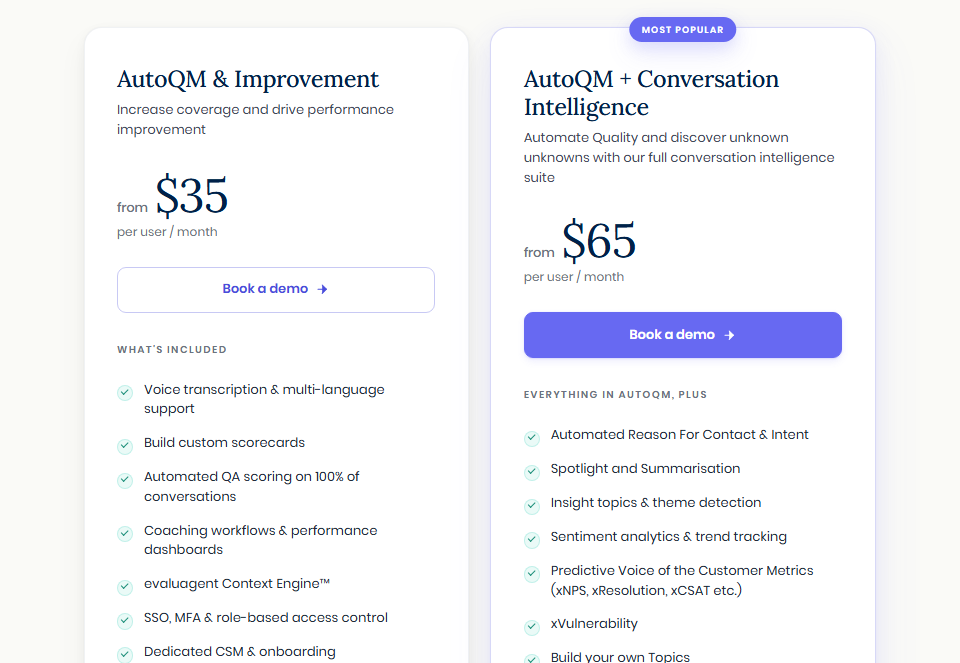
Teams can add engineers and QA staff without per-user fees, but cost depends on how many test and production calls they process. The platform offers three tiers (Startup, Agency, Enterprise), all listed as “Contact us” with no published rates. Buyers must book a 25-minute sales call to learn what they would pay. Monthly test case limits range from hundreds for startup teams to thousands for enterprise customers, with specifics disclosed only during onboarding.
Hamming Startup Plan: Contact Us
| Feature | Details |
|---|---|
| Price | Not published; contact sales |
| Test Volume | Hundreds of test cases per month |
| Parallel Calls | 50 default, configurable to 100+ |
| Support | 7-days-a-week; direct access to founders |
| Compliance | Not included (no SOC 2 or HIPAA) |
The Startup plan targets early-stage teams building voice agents who need automated testing without enterprise overhead. It includes automated voice agent testing, call analytics, trust and safety reports, and custom scoring templates. YC companies receive a special deal, though the specifics aren’t published. Direct founder access for support reflects the company’s seed-stage size.
| Startup Plan Pros | Startup Plan Cons |
|---|---|
| – No per-seat fees for the team | – No published pricing |
| – Direct founder access for support | – No SOC 2 or HIPAA compliance |
| – 7-days-a-week support included | – Test volume capped (hundreds/month) |
| – Fast time to first test (under 10 minutes) | – No multi-client management |
Hamming Agency Plan: Contact Us
| Feature | Details |
|---|---|
| Price | Not published; contact sales |
| Multi-Client Management | Included |
| Support | Priority support |
| Compliance | Not specified |
| Additional Features | All Startup features plus client management |
The Agency plan adds multi-client management for teams building voice agents for multiple customers. Priority support replaces the founder-direct model. The Agency tier does not list 7-days-a-week support or SOC 2/HIPAA compliance in its feature comparison, creating an odd gap between Startup and Enterprise.
| Agency Plan Pros | Agency Plan Cons |
|---|---|
| – Multi-client project management | – No published pricing |
| – Priority support for faster response | – Compliance features not specified |
| – No per-seat fees | – 7-days-a-week support not listed |
| – Scales across client projects | – Test volume limits undisclosed |
Hamming Enterprise Plan: Contact Us
| Feature | Details |
|---|---|
| Price | Not published; custom terms |
| Concurrent Calls | 50,000+ |
| Compliance | SOC 2 Type II, HIPAA with BAA |
| Support | Dedicated engineer, SLAs, 24/7 |
| Data Residency | US, EU, UK options |
| Deployment | Single-tenant and on-premise available |
The Enterprise plan unlocks Hamming’s full feature set: SOC 2 Type II and HIPAA compliance, support SLAs with less than 4-hour response for critical issues, dedicated support engineering, and infrastructure options including single-tenant deployment and customer-managed encryption keys. The 50,000+ concurrent test call capacity enables production-scale load testing.
| Enterprise Plan Pros | Enterprise Plan Cons |
|---|---|
| – SOC 2 Type II and HIPAA BAA | – Price requires negotiation |
| – 50K+ concurrent test calls | – Contract terms undisclosed |
| – Dedicated support engineer with SLAs | – Long sales cycle for procurement |
| – Single-tenant and on-premise options | – Compliance features locked to this tier |
Hamming Hidden Costs and Considerations
Beyond the opaque base pricing, several factors affect the true cost of running Hamming:
Usage Limits Disclosed Only at Onboarding
- Hamming shares monthly test case allocations during onboarding based on your team’s needs, not in advance
- Overage rates and scaling costs are custom per customer
- No self-serve upgrade path; changes require sales conversations
Compliance Is Tier-Gated
- SOC 2 Type II and HIPAA BAA are Enterprise-only
- Startup and Agency customers operate without these certifications
- Teams in regulated industries have no lower-cost entry point
No Self-Serve Evaluation
- Hamming restricts documentation at docs.hamming.ai to paying customers
- No free trial; every evaluation requires a personalized demo
- Developers cannot assess API depth or integration quality before committing
Where Hamming Falls Short
Hamming excels at pre-deployment voice agent testing and production monitoring, but its narrow focus and opaque pricing create challenges for teams with broader QA needs:
Opaque Pricing
- Every tier says “Contact us” with no published rates, no rate cards, and no documentation of test volume allocations
- Budget planning requires a sales call, creating friction for teams that need procurement approval before engaging vendors
- No self-serve signup means even a basic evaluation requires scheduling time with the founding team
Voice-First Focus Leaves Other Channels Behind
- All customer case studies and positioning anchor to voice/telephone agents
- Teams running chat, email, or SMS agents alongside voice agents will find thinner support for non-voice channels
- No coverage for human agent quality assurance, despite most contact centers running hybrid human-plus-AI operations
No Coaching, Performance Management, or Agent Development
- Hamming identifies quality issues but provides no workflow for acting on them
- No coaching sessions, performance improvement plans, or agent development tracking
- Teams must build their own feedback loops or use separate tools to close the gap between finding a problem and fixing the behavior
Early-Stage Vendor Risk
- Founded December 2023 with $3.8 million in seed funding
- No presence on G2, Capterra, or TrustRadius for independent peer reviews
- SOC 2 Type II certification achieved December 2025, roughly two years after founding
- Customers investing in CI/CD and MCP integrations carry vendor continuity risk
These limitations have led many contact center and QA teams to explore platforms that offer transparent pricing, human-plus-AI quality management, and a closed loop from evaluation to improvement…
Best Hamming Alternative – evaluagent
evaluagent provides quality assurance and performance management across every agent interaction (human and AI) with published pricing and a direct path from evaluation to improvement.
For those who find Hamming’s opaque pricing, voice-only focus, and lack of coaching workflows limiting, evaluagent offers a broader solution: AI-powered scoring of 100% of conversations across voice, chat, and email, connected to structured coaching, performance plans, and gamification, starting from a published $35 per user per month.
Backed by Series A funding from Peakspan, evaluagent serves organizations including Samsung, Jet2, Capital on Tap, and Seasalt across Europe, North America, and Asia-Pacific. The platform is CCaaS-agnostic, integrating with Zendesk, Salesforce, Genesys, Five9, Amazon Connect, Talkdesk, RingCentral, Intercom, and more.
evaluagent fits contact centers running hybrid human-plus-AI operations, QA teams that need coaching built into their scoring system, and regulated industries that require published pricing and certifications from day one.
evaluagent AutoQM & Improvement: From $35/user/month
| Feature | Details |
|---|---|
| Price | From $35 per user/month |
| Coverage | 100% of conversations scored automatically |
| Channels | Voice, chat, and email |
| AI Scoring | SmartScore with Context Engine |
| Coaching | 1-to-1s, performance plans, gamification |
| Security | SSO, MFA, RBAC included |
AutoQM & Improvement delivers automated quality scoring across every interaction, connected to coaching and performance workflows.
The Context Engine grounds AI scoring in company-specific policies and knowledge base content, so scores reflect whether agents gave the right answer, not just whether they sounded polite. A Testing Console lets QA managers validate scoring changes against real conversations before going live.
This tier includes fabrication detection, auto-publish and auto-fail rules, blended scorecards (AI plus human evaluation on the same scorecard), calibration sessions, agent dispute mechanisms, coaching and 1-to-1 workflows, performance plans with audit trails, and gamification with an eBay-style reward auction. Bot QA scoring, containment analysis, and handover tracking for AI agents are also included.
| AutoQM & Improvement Pros | AutoQM & Improvement Cons |
|---|---|
| – Published pricing from $35/user/month | – Conversation Intelligence features require Tier 2 |
| – 100% conversation coverage across all channels | – Per-seat model; costs grow with agent count |
| – Coaching and performance plans built in | – No pre-deployment test call simulation |
| – Context Engine grounds scores in company knowledge | – Volume discounts require negotiation |
Capital on Tap scaled from 900 to 6,000 BDM checks per month after go-live, without adding headcount. (Capital on Tap Case Study)
evaluagent AutoQM + Conversation Intelligence: From $65/user/month
| Feature | Details |
|---|---|
| Price | From $65 per user/month |
| Everything in Tier 1 | Included |
| Reason for Contact | Automated detection across all interactions |
| Predictive Metrics | xNPS, xCSAT, xResolution, xVulnerability |
| Spotlight | On-demand AI analyst across up to 1,000 conversations |
| Custom Topics | No-code builder with testing console |
The Full Bundle adds evaluagent’s Conversation Intelligence suite to the AutoQM & Improvement foundation.
This module surfaces why customers contact the business, predicts satisfaction and resolution outcomes from conversation signals (rather than relying on post-call survey response rates), and provides Spotlight, an on-demand AI analyst that reviews up to 1,000 filtered conversations and returns prioritized findings.
Predictive metrics like xNPS, xCSAT, and xResolution cover 100% of contacts, not just the fraction who complete post-call surveys. Sentiment analytics, topic discovery, and custom insight topics round out the analytics layer.
| AutoQM + Conversation Intelligence Pros | AutoQM + Conversation Intelligence Cons |
|---|---|
| – Predictive VoC metrics across 100% of contacts | – $65/user/month is a significant investment |
| – Spotlight investigates root causes on demand | – Requires active engagement to extract value |
| – No-code custom topic builder | – Analytics depth may exceed smaller teams’ needs |
| – Full Tier 1 coaching workflows included | – Per-seat pricing scales linearly |
Seasalt Cornwall doubled evaluations and reduced attrition from 100% to 10% year-on-year. (Seasalt Cornwall Case Study)
evaluagent AI Agent Observability
| Feature | Details |
|---|---|
| Coverage | Every AI agent conversation scored automatically |
| Framework | Same scorecards and Context Engine as human agent QA |
| Cross-Vendor Scoring | Cognigy, Sierra, Decagon, and proprietary bots |
| Handover Tracking | Bot-to-human transitions covered end-to-end |
| Independence | Scores bots independently of the bot vendor’s own metrics |
evaluagent’s AI Agent Observability module evaluates every AI agent conversation against the same quality standard it applies to human agents. Because evaluagent does not sell the bots it assesses, it provides an independent view of bot quality that a CCaaS or conversational-AI vendor evaluating its own agents cannot offer.
The module includes fabrication detection grounded in the organization’s knowledge base, containment analysis, handover tracking, off-policy response flagging, and intent-level performance reporting. evaluagent calls this “a second opinion on every conversation.”
| AI Agent Observability Pros | AI Agent Observability Cons |
|---|---|
| – Same quality standard for human and AI agents | – Post-interaction evaluation, not pre-deployment testing |
| – Cross-vendor scoring across bot platforms | – No simulated test call capability |
| – Independent of the bot vendor being evaluated | – Requires a human-agent seat tier |
| – Handover conversations tracked end-to-end | – Does not test agents before deployment |
The Share Centre achieved a 285% increase in QA productivity, cutting evaluation time from 24 minutes to 6 minutes per interaction while pass rates rose from 73% to 85%. (The Share Centre Case Study)
Hamming Feature Value Breakdown (vs evaluagent)
Pricing Transparency
Hamming’s Approach: Hamming publishes no pricing on its pricing page. All three tiers require contacting sales.
Hamming discloses test volume allocations, concurrency limits, and overage rates only during onboarding. There is no self-serve signup, no free trial, and no way to estimate costs without a sales conversation. Documentation is restricted to paying customers.
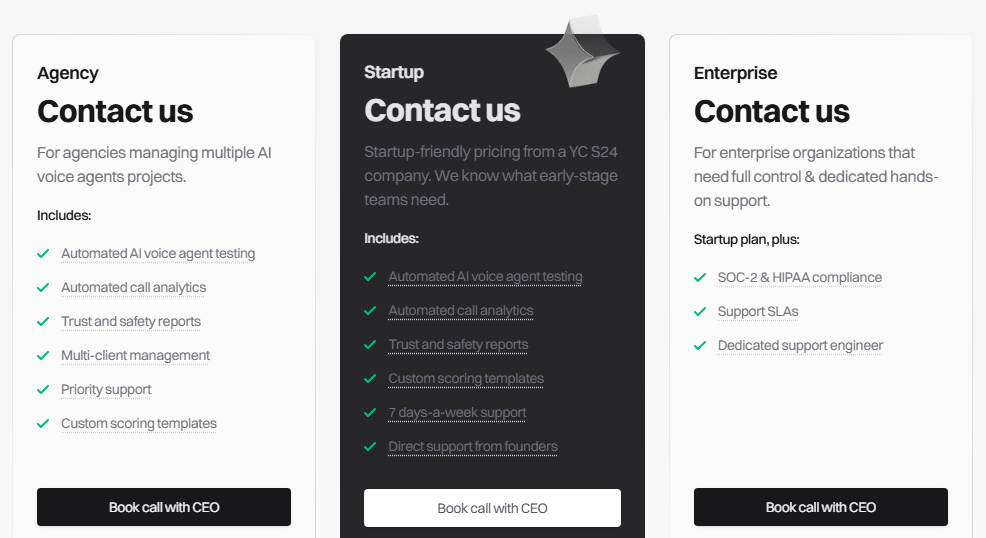
evaluagent’s Approach: evaluagent publishes starting prices on its pricing page: $35/user/month for AutoQM & Improvement and $65/user/month for the Full Bundle. Volume discounts are available for large teams, and the feature comparison between tiers is visible before any sales engagement.
Quality Assurance Scope
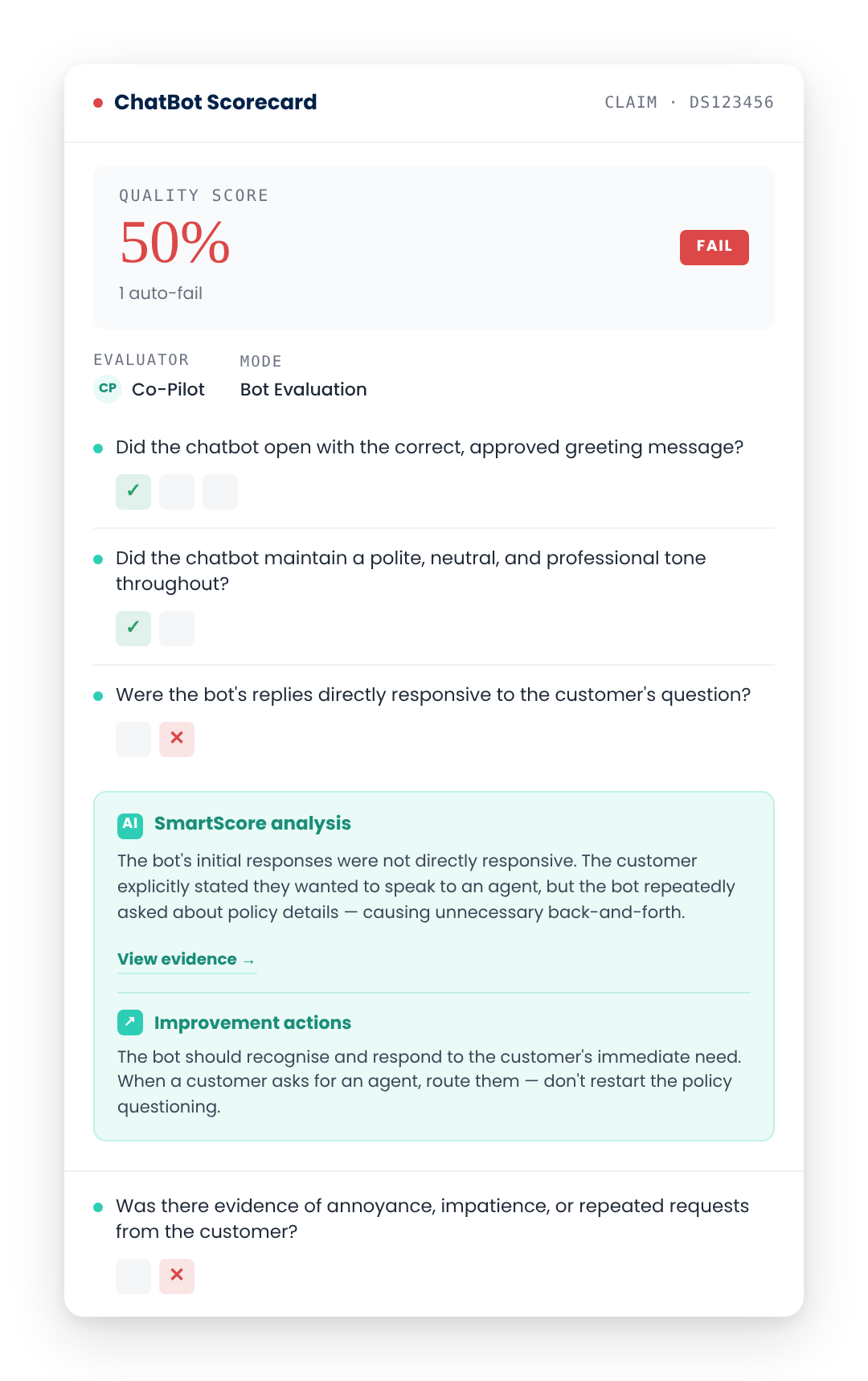
Hamming’s Approach: Hamming focuses on AI voice agents. The platform tests and monitors bot conversations but provides no quality assurance for human agents.
In a contact center where human agents handle overflow, complex cases, or escalations from AI agents, Hamming covers only the bot side. Human agent quality requires a separate platform, creating a fragmented view of service quality.
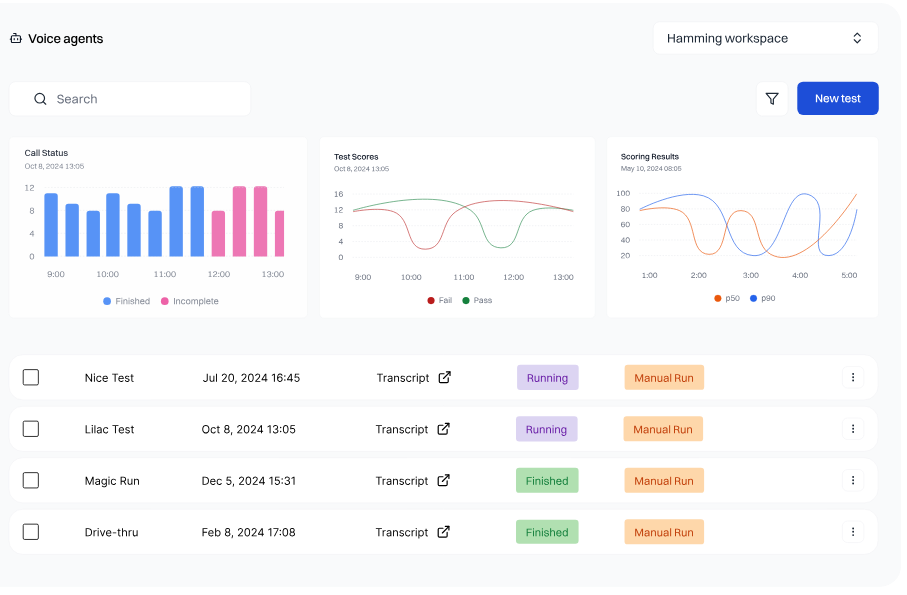
evaluagent’s Approach: evaluagent evaluates both human agents and AI bots against the same scorecard, across voice, chat, and email. A conversation that starts with an AI agent and escalates to a human is covered end-to-end under a single quality framework.
The AI Agent Observability module scores bot conversations with the same Context Engine that scores human interactions, and because evaluagent is independent of any bot vendor, the assessment carries no conflict of interest.
From Evaluation to Improvement
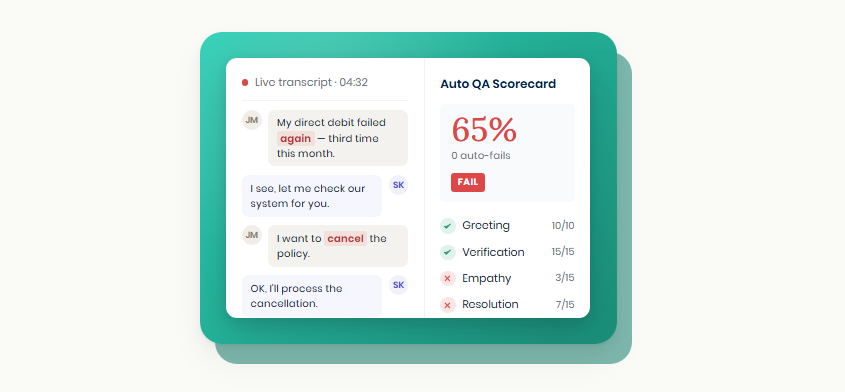
Hamming’s Approach: Hamming identifies quality issues and compliance violations but stops at detection. The platform has no coaching workflows, no performance improvement plans, no agent development tracking, and no gamification. Teams that find problems in Hamming must build their own processes to fix them, using spreadsheets, separate coaching tools, or manual follow-up.
evaluagent’s Approach: evaluagent connects every evaluation finding to structured coaching sessions, 1-to-1s, performance improvement plans, eLearning auto-enrollment, and gamification. When an AI score flags a problem, the platform can automatically trigger a coaching session, assign training, or escalate to a performance plan with a full audit trail. Quality scores become starting points for improvement, not endpoints.
Pre-Deployment Testing vs Post-Interaction Evaluation
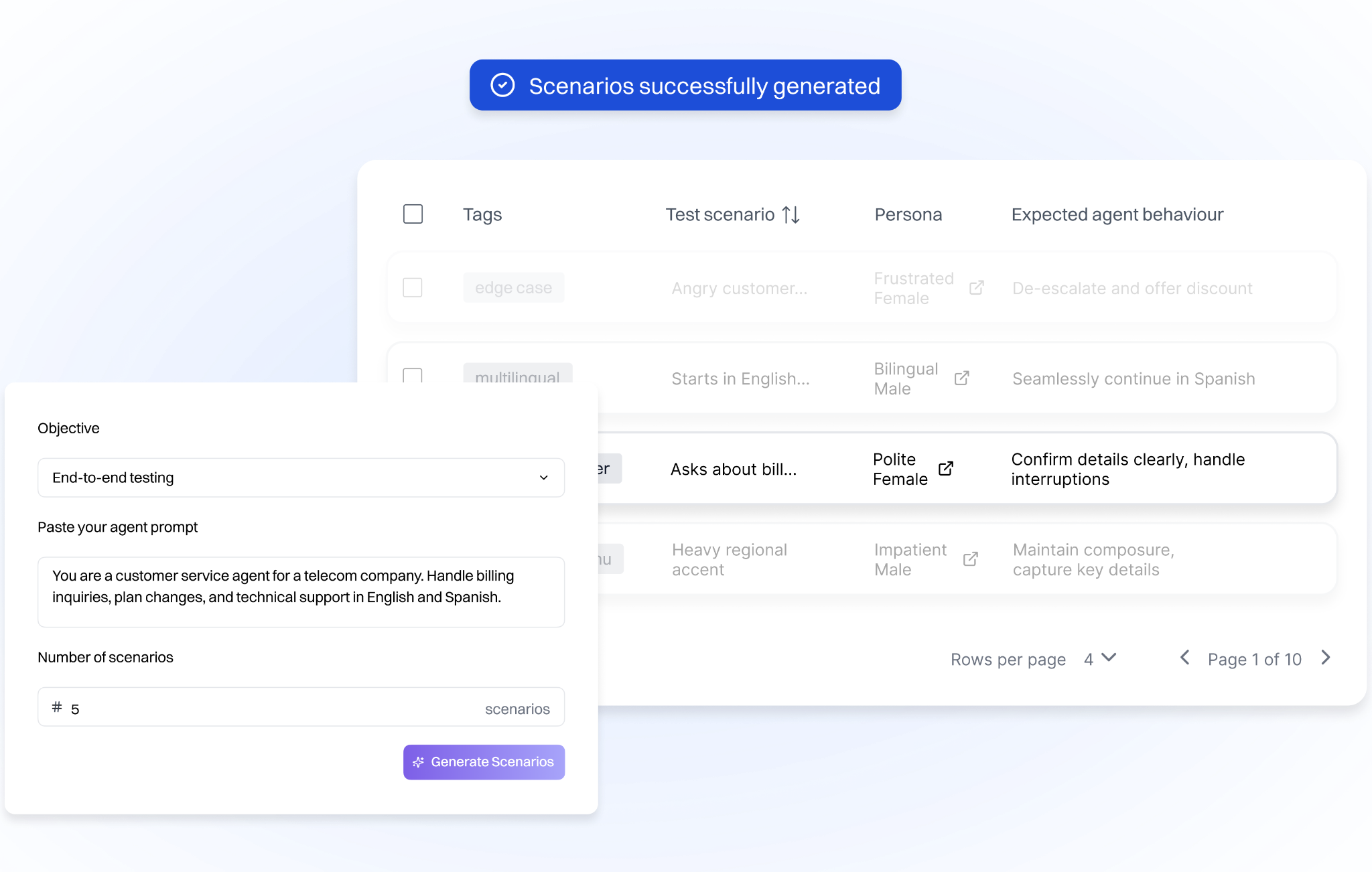
Hamming’s Approach: Hamming’s core strength is pre-deployment testing.
The platform auto-generates test scenarios from an agent’s system prompt, runs hundreds of concurrent simulated calls with accents and background noise, and gates CI/CD releases on quality thresholds. This catches problems before customers encounter them. The 95–96% agreement with human evaluators and 50,000+ concurrent test call capacity are capabilities no post-interaction tool can replicate.
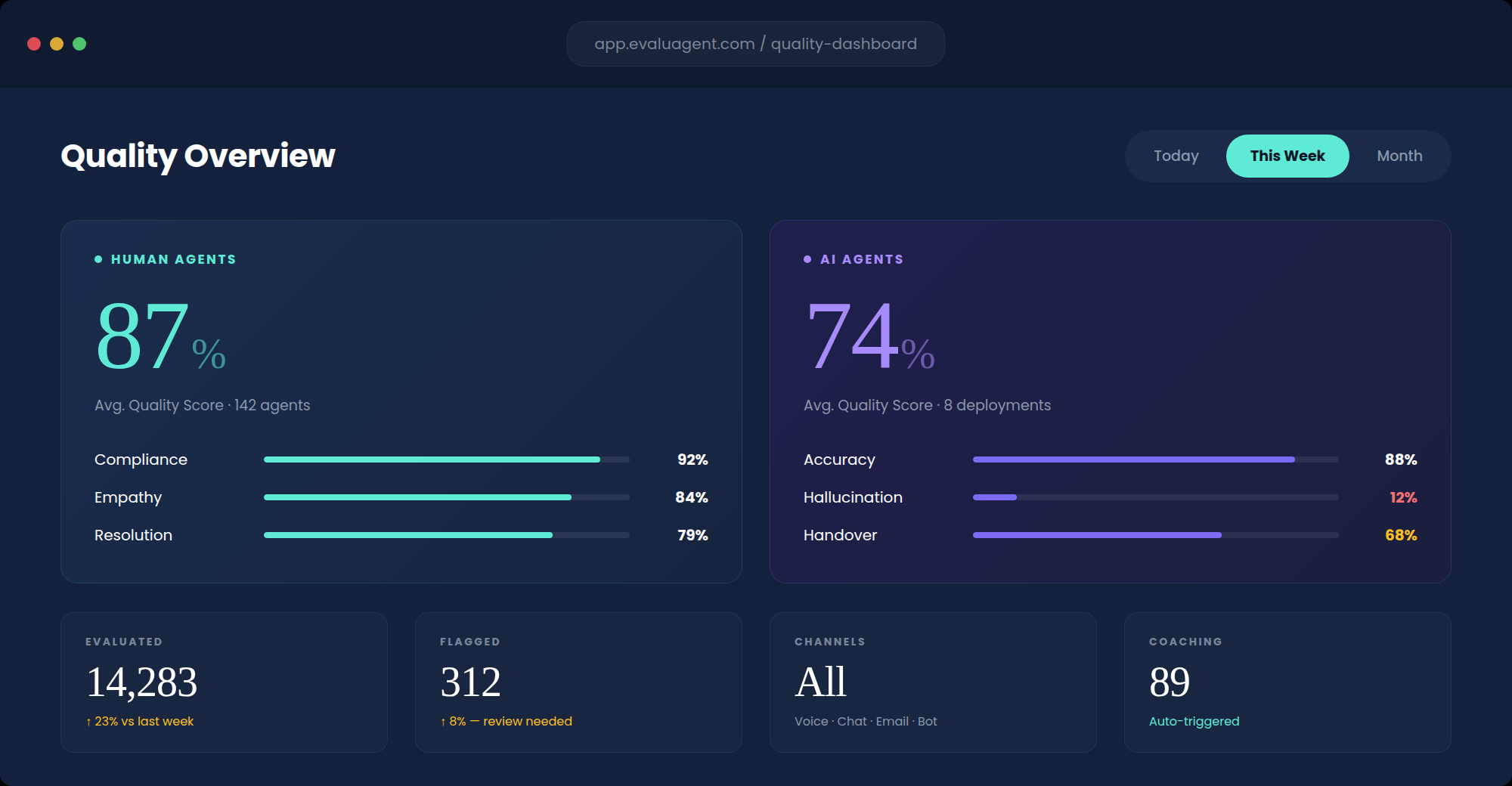
evaluagent’s Approach: evaluagent evaluates conversations after they happen, scoring 100% of interactions that flow through your CCaaS or helpdesk. It does not simulate test calls or gate deployments.
Instead, it provides continuous quality monitoring with trend detection and root-cause analysis. For AI agents, the platform detects hallucinations and off-policy responses in production conversations and surfaces them for remediation.
Integration Breadth
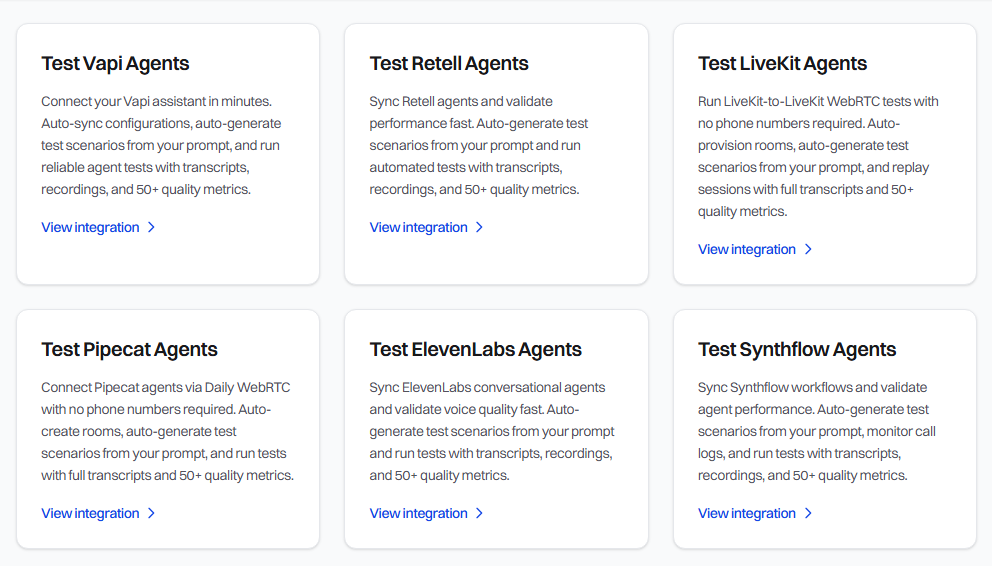
Hamming’s Approach: Hamming integrates with voice agent frameworks: Vapi, Retell, LiveKit, Pipecat, ElevenLabs, Synthflow, and Cisco Webex AI Agent through a strategic partnership. It also supports OpenTelemetry ingestion and alerting through Slack and PagerDuty. For unsupported platforms, SIP connectivity provides a fallback. No iPaaS connectors (Zapier, Make) are offered.
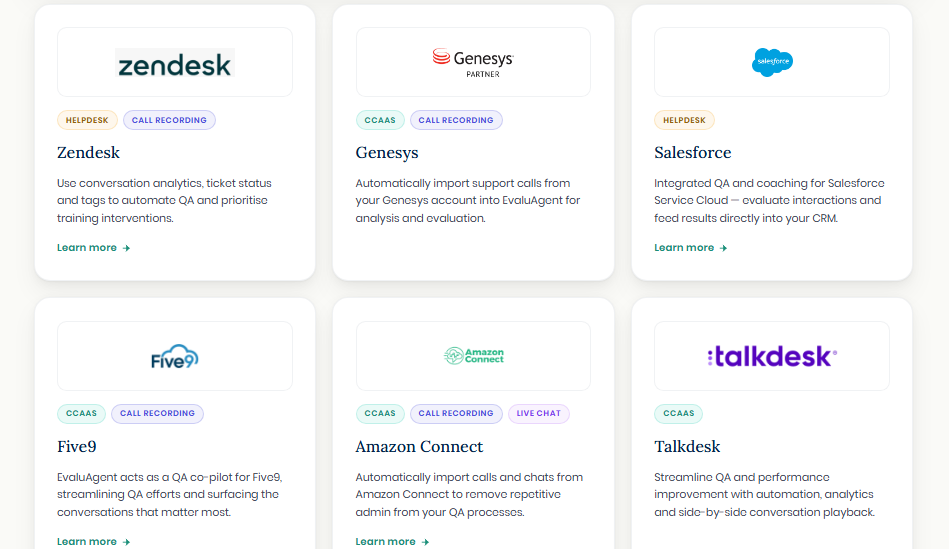
evaluagent’s Approach: evaluagent integrates with the contact center ecosystem: Zendesk, Salesforce, Genesys, Five9, Amazon Connect, Freshdesk, RingCentral, Talkdesk, Intercom, Puzzel, Aircall, Assembled, and Peopleware. BI export supports Power BI, Tableau, Looker, and Metabase. For AI agents, cross-vendor scoring covers Cognigy, Sierra, Decagon, and proprietary bots. An open REST API handles unlisted platforms. No iPaaS connectors are offered either.
Final Verdict: Hamming vs evaluagent
The choice between Hamming and evaluagent depends on what stage of the AI agent lifecycle you need to govern and how broad your quality assurance needs are:
Hamming is a voice agent testing and monitoring platform for engineering teams that need to validate AI agents before deployment and monitor them in production.
With volume-based pricing (available only through sales), teams can auto-generate test scenarios, run thousands of concurrent simulated calls with diverse accents and background noise, gate CI/CD releases on quality thresholds, and red-team agents for prompt injection and compliance violations.
This pre-deployment focus works best for AI-native companies building voice agents, engineering teams in regulated industries needing HIPAA and SOC 2 documentation, and any team where catching a voice agent failure before it reaches a customer is the primary goal.
evaluagent is a contact center QA and performance management platform built on the principle that finding problems is only valuable if you can fix them.
With published pricing from $35/user/month, 100% conversation coverage across voice, chat, and email, and a system that connects every evaluation to coaching, performance plans, and measurable agent improvement, it addresses the broader quality challenge.
This makes it a strong fit for contact centers running hybrid human-plus-AI operations, QA teams that need coaching integrated with their scoring system, and any organization that wants to know what quality management costs before signing a contract.
Get started with evaluagent here.
The difference is scope. Hamming asks “Is this AI agent safe to ship?” evaluagent asks “Is every agent, human and AI, getting better over time?”