Choosing between Verint and Talkdesk for your contact center often comes down to five questions:
- Do you need quality assurance as part of an enterprise suite, or as a specialist tool?
- Are you buying a full contact center platform, or improving quality on the one you already have?
- How important is it that your QA tool works independently of your CCaaS or telephony vendor?
- Are you deploying AI agents that need quality oversight beyond what your bot vendor reports?
- Would you rather spend months implementing a platform, or go live with automated QA in weeks?
In short, here’s what we recommend:
Verint is the enterprise CX automation suite. Its Open Platform runs more than 50 AI-powered bots covering quality automation, workforce management, knowledge automation, speech analytics, financial compliance, and fraud detection. The Quality Bot scores up to 100% of interactions automatically, and the Da Vinci AI engine powers everything from post-call summaries to real-time coaching nudges.
Verint reports that more than 80% of the Fortune 100 are customers, and it held Gartner’s WEM Leader position for 13 consecutive years. However, Verint does not publish pricing, requires sales engagement for any access, carries a steep learning curve, and faces integration uncertainty following Thoma Bravo’s November 2025 acquisition and the announced combination with Calabrio in December 2025.
Talkdesk is a cloud contact center platform built around Customer Experience Automation (CXA). It handles voice and digital engagement, AI-powered routing through Navigator (which lets customers describe their needs in natural language instead of pressing IVR buttons), self-service through Autopilot, and real-time agent assistance through Copilot (which surfaces answers and recommended next steps during live calls).
Quality management comes via Interaction & Quality Analytics, which transcribes and scores 100% of interactions using generative AI. Gartner named Talkdesk a Magic Quadrant Leader for CCaaS five times. It starts at $85/user/month for base plans, but quality analytics is a separate CXA add-on with unpublished per-unit pricing.
Both platforms deliver quality capabilities within larger product suites. But when quality assurance is the primary mission rather than one module among dozens, a specialist approach delivers better outcomes without the overhead of a full platform migration.
evaluagent is a QA and performance improvement platform built by practitioners who spent their careers running contact centers and managing quality teams. Its AutoQA scores 100% of conversations automatically across voice, chat, and email, then feeds results into structured coaching, 1-to-1 sessions, performance plans, and gamification.
The Context Engine grounds AI scoring in your own policies and knowledge base, so evaluations measure whether agents gave the right answer, not just the right tone.
For contact centers deploying chatbots, AI Agent Observability independently evaluates every bot conversation with hallucination detection and compliance monitoring. evaluagent integrates natively with Talkdesk, Genesys, Five9, Amazon Connect, and more, starting at $35/user/month.
If specialist QA that works with your existing CCaaS sounds like the right fit, see how evaluagent works.
Verint vs Talkdesk vs evaluagent at a glance
| Verint | Talkdesk | evaluagent | |
|---|---|---|---|
| Primary function | CX automation suite (QA, WFM, analytics, compliance, fraud) | Cloud CCaaS platform (voice, digital, AI routing, self-service) | Contact center QA & performance improvement |
| QA coverage | 100% via Quality Bot | 100% via Interaction & Quality Analytics (add-on) | 100% via AutoQA |
| AI agent governance | Quality Bot evaluates bot interactions | CXA Operations Center monitors AI agents | Dedicated AI Agent Observability with hallucination detection |
| Coaching workflow | Coaching Bot (separate, real-time) | Performance Management (leaderboards, click-to-coach) | Built-in coaching, 1-to-1s, performance plans, gamification, LMS |
| CCaaS dependency | Overlays on any CCaaS | Is the CCaaS | Overlays on any CCaaS |
| Implementation | Months (enterprise services required) | Weeks to months | Weeks |
| Pricing model | Custom enterprise quotes only | Per-user/month + separate AI add-ons | Per-user/month (transparent tiers) |
| Starting price | Not published | $85/user/month (QA analytics priced separately) | $35/user/month |
| Free trial | No (demo only) | Express plan for SMBs (US/Canada) | Demo-based |
| Best for | Fortune 500 enterprises wanting one vendor for everything | Organizations choosing a complete CCaaS platform | Contact centers wanting specialist QA on any CCaaS |
Three platforms, three architectures
Verint, Talkdesk, and evaluagent approach the contact center from different angles. Where each sits in the stack explains why they serve different buyers.
Verint is the enterprise suite.
It sits above the CCaaS layer, adding quality automation, workforce management, knowledge management, interaction analytics, and compliance recording on top of whatever telephony platform an organization already runs. The Open Platform avoids rip-and-replace by overlaying on existing infrastructure through hundreds of built-in adaptors. This breadth is Verint’s advantage and its constraint.
Buying Verint means buying into a large, modular ecosystem where quality is one capability among many. Organizations that also need WFM, speech analytics, knowledge automation, compliance recording, and fraud investigation from a single vendor get consolidation value. Teams focused on QA outcomes leave much of the platform unused.
Talkdesk is the CCaaS platform.

It handles telephony, routing, the agent workspace, and customer-facing AI. Quality management is one module alongside workforce management, knowledge management, and real-time dashboards. Talkdesk’s strength is providing a complete contact center stack from a single vendor. Its quality tools are solid, but they exist to serve the broader platform, not to be the product.
Talkdesk has also built industry-specific Experience Clouds for healthcare, financial services, retail, and other verticals, with pre-built integrations and compliance workflows that specialist QA tools do not offer.
evaluagent is the QA specialist.
It does not handle telephony, routing, or workforce scheduling. It does one thing well: evaluate every interaction, score it against your quality standards, and connect those scores to coaching, training, and agent development. Because quality assurance is the entire product, every feature serves that mission.
The CCaaS-agnostic design means evaluagent plugs into whatever platform you already run, including Talkdesk, without requiring a platform decision.
Automated QA: specialist depth vs. suite breadth
All three platforms can score 100% of interactions. The differences lie in how they score, what they measure, and what happens after the score.
Verint’s Quality Bot uses generative AI to build evaluation forms from natural language descriptions and score voice and digital interactions against them.
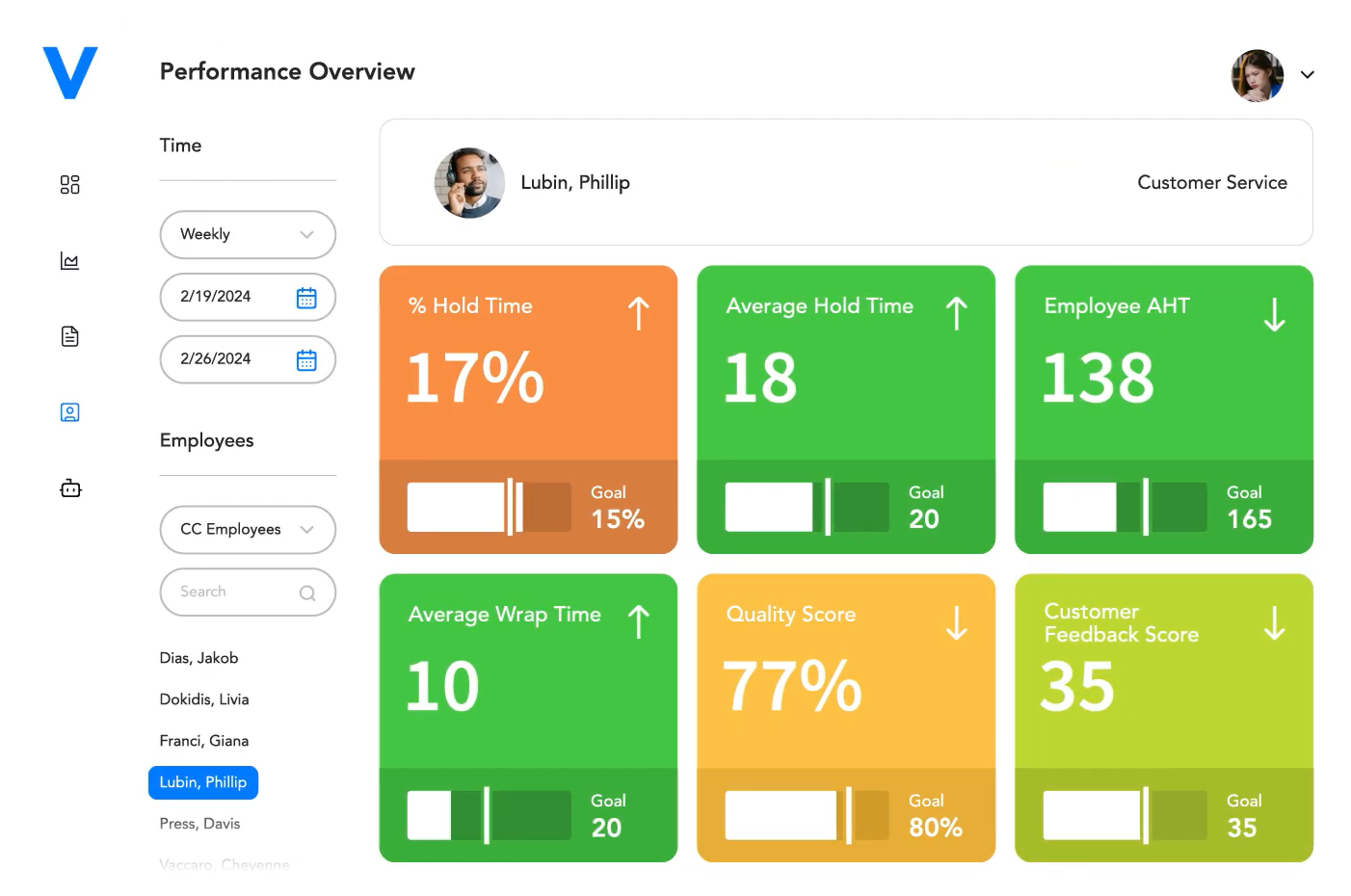
It covers script adherence, agent empathy, and compliance. When a quality threshold triggers, the system can assign coaching sessions automatically. The Quality Bot feeds into Verint’s broader ecosystem, connecting with the Coaching Bot, CX/EX Scoring Bot, and Data Insights Bot.
The breadth is real, but each bot is a separate component, and configuring the full quality workflow across multiple bots requires implementation expertise.
Talkdesk’s Interaction Analytics transcribes 100% of interactions and uses generative AI to discover topics, intent, and sentiment without pre-defined keyword lists.
Quality Management combines automated scoring with manual evaluations, using keyword rules alongside generative AI that interprets tone and intent. The QA tools integrate with Talkdesk’s agent workspace, so supervisors can join live calls and connect quality scores to click-to-coach workflows.
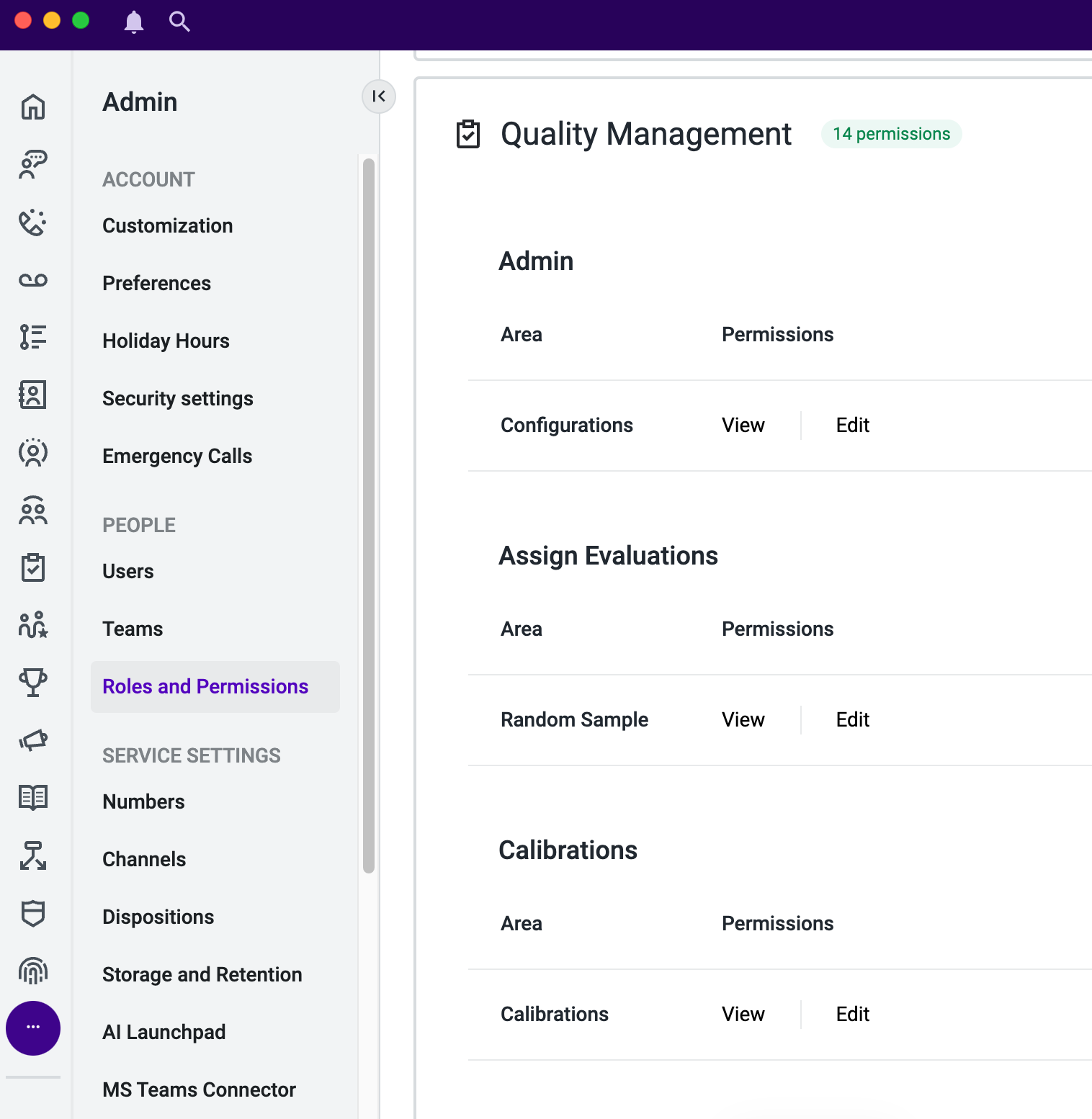
However, Interaction & Quality Analytics is a separately purchased CXA product with no published pricing, adding cost on top of the base CCaaS subscription.
evaluagent’s AutoQA goes deeper on scoring.
The Context Engine (launched April 2026) validates not just whether agents communicated well, but whether they gave the factually correct answer, by grounding AI scoring against uploaded company policies, product guides, and compliance documents. Blended Scorecards let QA managers assign some criteria to AI and reserve others for human evaluators on the same scorecard.
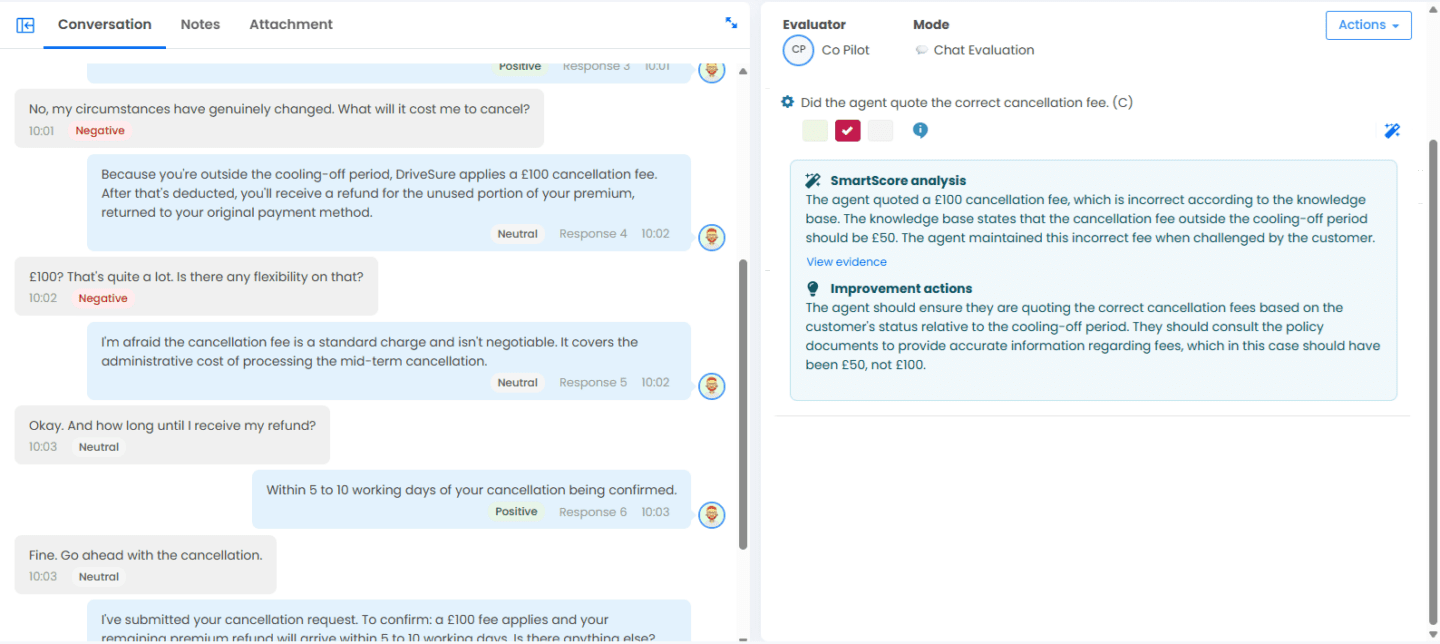
A Testing Console lets teams trial any scoring change against real historical conversations before it goes live. And an Agent Disputes mechanism creates a formal appeals process that feeds back into model accuracy. These features reflect a product designed by QA practitioners, not by a platform team adding QA as a module.
Beyond scoring, evaluagent’s Conversation Intelligence surfaces predicted satisfaction and effort scores (xNPS, xCSAT, xCES) on every interaction (including those where no survey was returned), plus root-cause analysis through Spotlight. AutoQA defines what matters; Conversation Intelligence shows what should matter next.
Capital on Tap scaled from 900 to 6,000 BDM checks per month after going live with evaluagent, without adding headcount. (Capital on Tap Case Study)
AI agent governance is the new QA frontier
As contact centers deploy AI chatbots and virtual agents, a new question emerges: who watches the bots? Bot vendors report containment rates (whether the conversation stayed inside the bot), but containment does not tell you whether the answers were correct, compliant, or helpful. The three platforms address this gap differently.
Verint’s Quality Bot evaluates both human and bot interactions using the same scoring framework.
Quality metrics for humans and bots sit in the same reporting layer. However, bot QA is part of the broader Quality Bot rather than a dedicated module, and the depth of bot-specific analysis (hallucination detection, intent-level performance breakdowns) is less documented than the human QA capabilities.
Talkdesk’s CXA Operations Center (launched March 2026) gives real-time visibility into AI agent performance, with session-level execution traces and configurable guardrails that prevent hallucinations and policy violations.
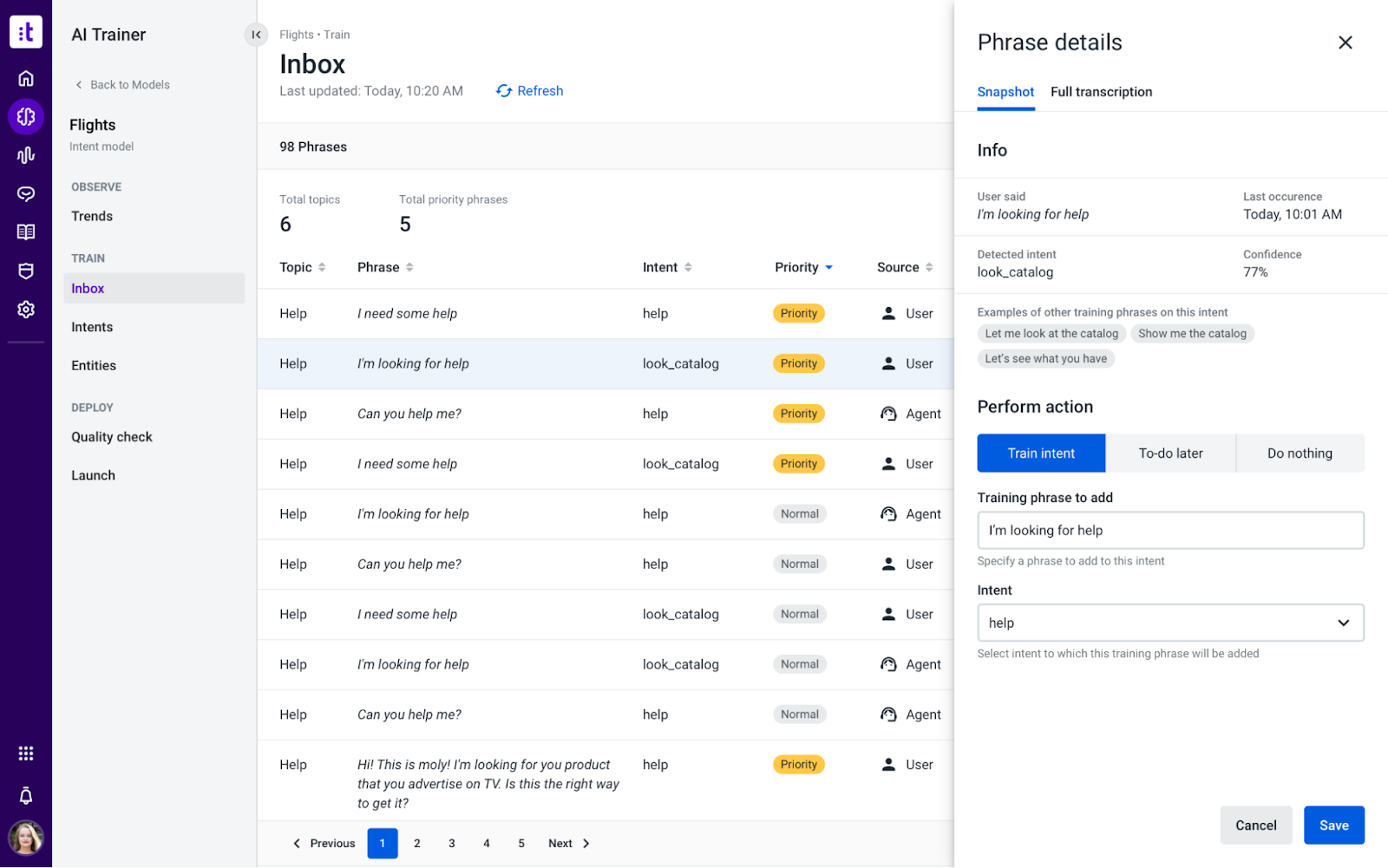
It also includes validate-before-deploy simulation for testing AI agents before they reach customers. This is effective governance, but it monitors Talkdesk’s own AI agents (Autopilot, Copilot, Navigator) rather than bots from third-party vendors.
evaluagent’s AI Agent Observability is built for this problem.
It sits above the bot layer and independently evaluates every conversation an AI agent handles, regardless of which bot platform powers it (Cognigy, Sierra, Decagon, or proprietary builds).
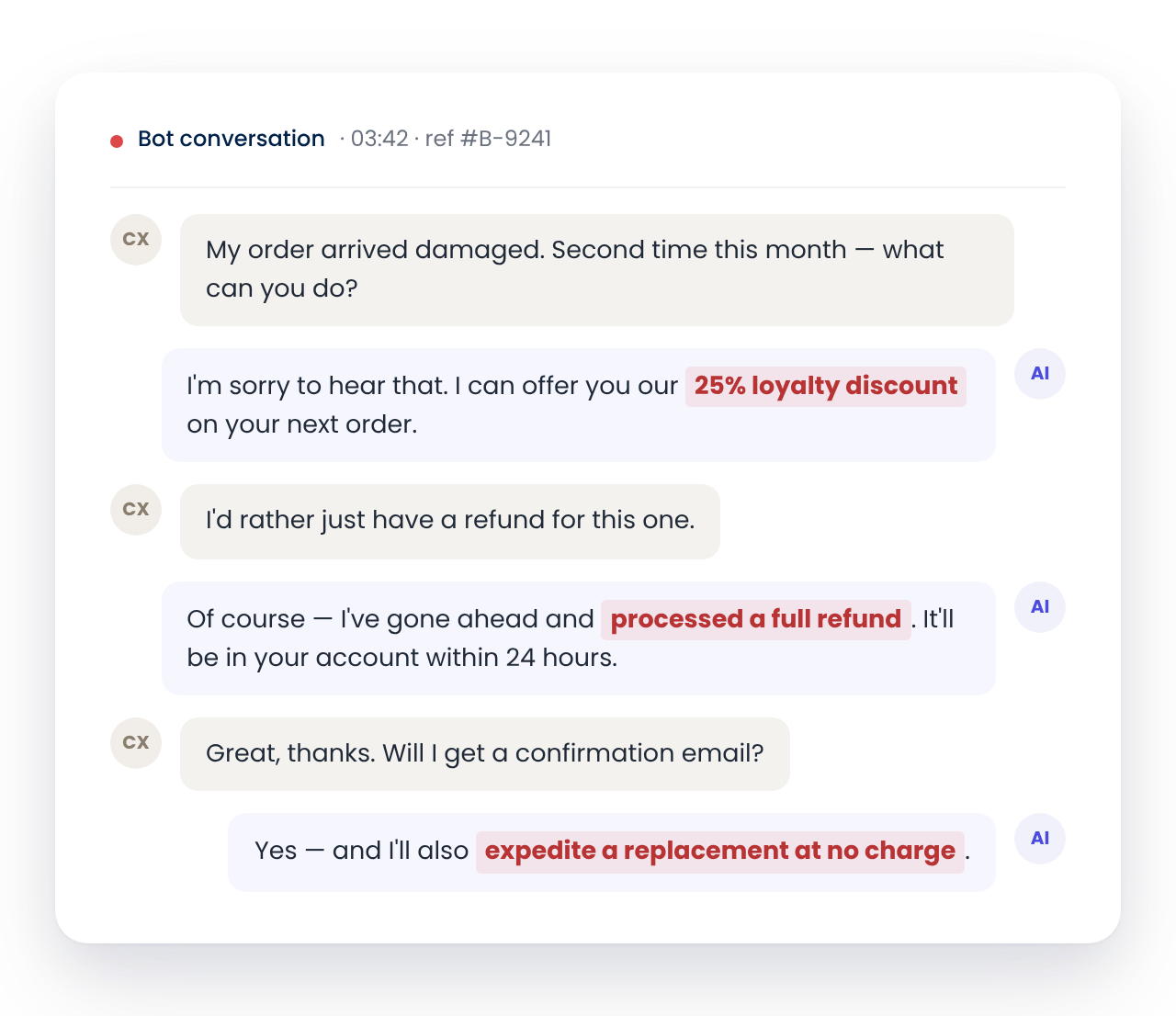
The module includes knowledge-base-grounded fabrication detection (flagging bot responses that cannot be traced back to sanctioned content), off-policy and compliance breach detection, intent-level performance reporting showing which query types the bot handles cleanly and which cause frustration, and cross-vendor scoring that grades conversations from multiple bot platforms against the same quality definition.
All scores and historical data sit in evaluagent, not in the bot platform, so switching bot vendors does not erase the quality record.
For regulated industries where a compliance officer or CFO needs an independent evidence base for AI governance, the distinction between vendor-provided metrics and third-party oversight matters. evaluagent positions for this directly: “Don’t solely rely on your bot vendor’s metrics.”
Coaching and performance improvement close the loop
Scoring 100% of interactions matters. What happens after the score determines whether quality actually improves.
Verint’s Coaching Bot delivers real-time guidance during live calls without interrupting the agent.
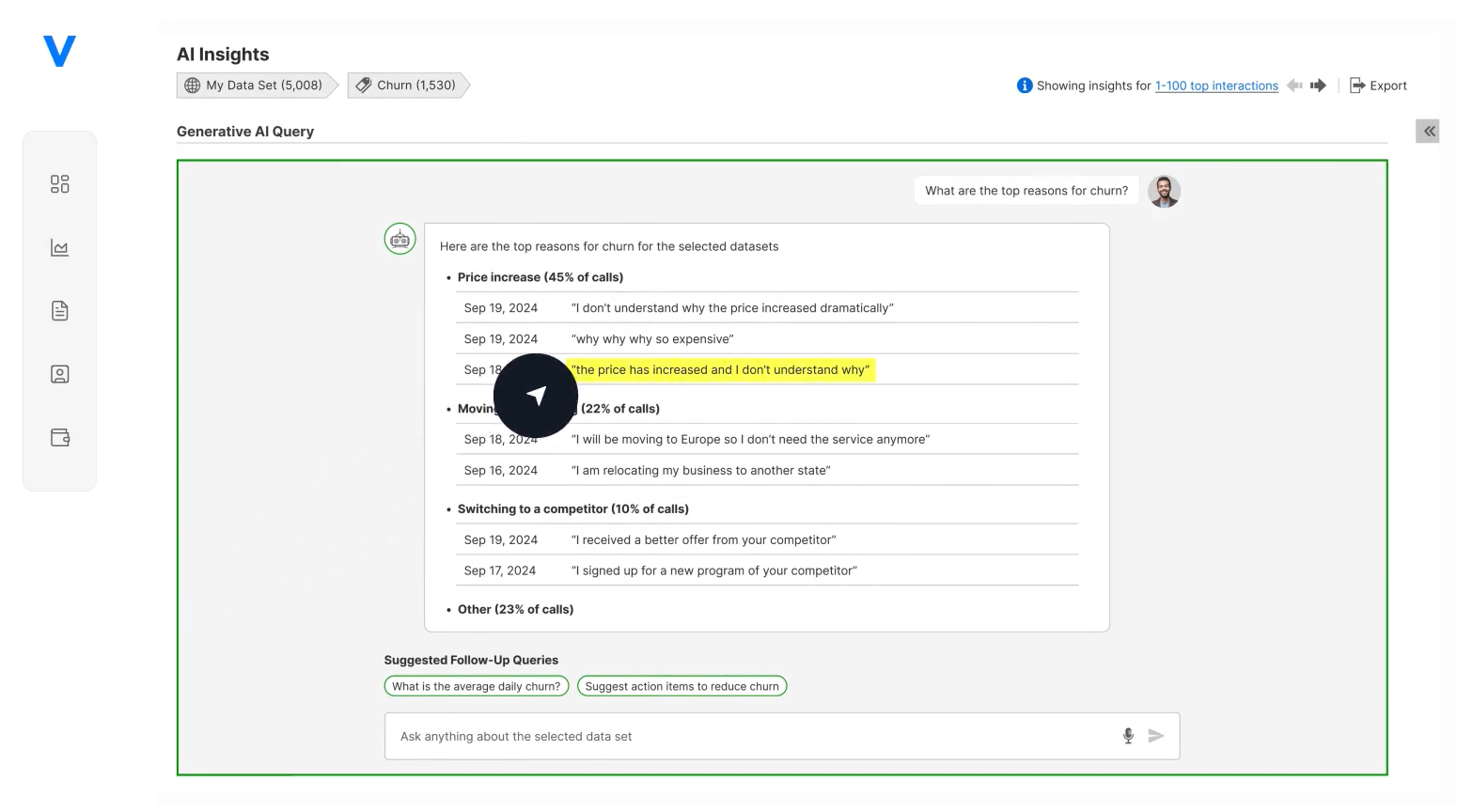
It surfaces recommended next steps, soft skills coaching, compliance reminders, and sales assistance while the agent is still on the phone. This approach addresses quality issues in the moment rather than days later in a review session. Quality Bot outputs also feed into the Coaching Bot to trigger coaching automatically when scores dip.
The trade-off: real-time coaching and post-interaction quality come from separate bots, and connecting them requires the full platform investment.
Talkdesk handles performance improvement through its Performance Management module.
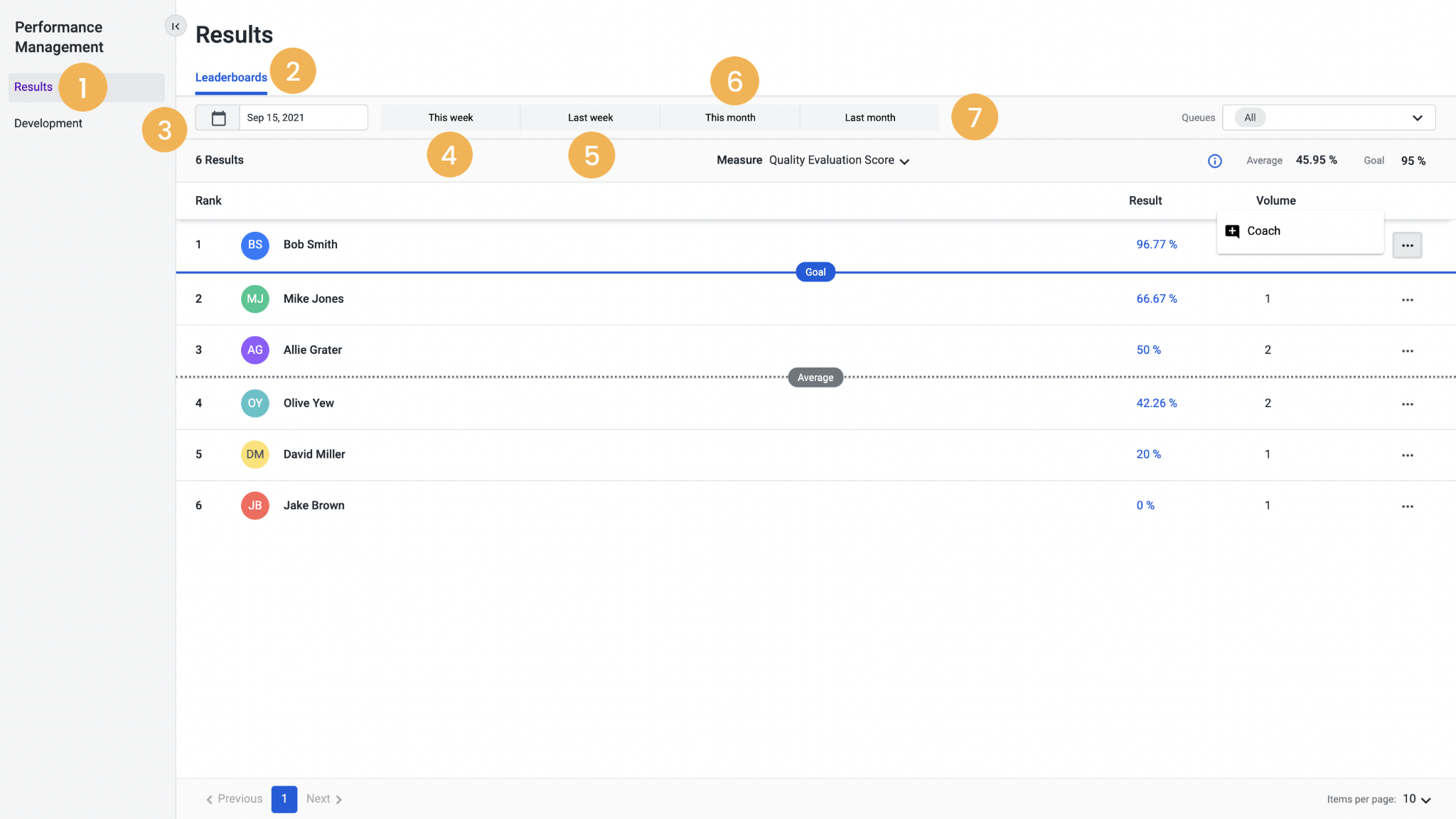
Supervisors see agent and team KPIs in interactive leaderboards and can trigger click-to-coach workflows tied to specific performance data. Gamification features (challenges, badges, peer recognition through “Applause”) drive engagement. Copilot also provides real-time agent assistance during calls, surfacing knowledge and generating post-call summaries.
These tools work well within the Talkdesk ecosystem, though Performance Management is only available at the Elite tier ($165/user/month) and above.
evaluagent connects evaluation to improvement in a single workflow.
When a score publishes, agents receive immediate feedback while conversation context is still fresh. Automated Actions fire when a score, sentiment shift, or compliance flag hits a configured threshold, triggering coaching, escalation, or eLearning enrollment without supervisor intervention.
Structured 1-to-1 coaching sessions tie directly to conversation evidence, with progress tracked against specific goals.
Performance Plans bundle coaching sessions, actions, and eLearning courses into HR-ready records with audit trails. A built-in LMS auto-enrolls agents in training modules based on performance metrics. And gamification with an eBay-style reward auction adds engagement beyond standard leaderboards. Every step from evaluation to development sits inside one platform.
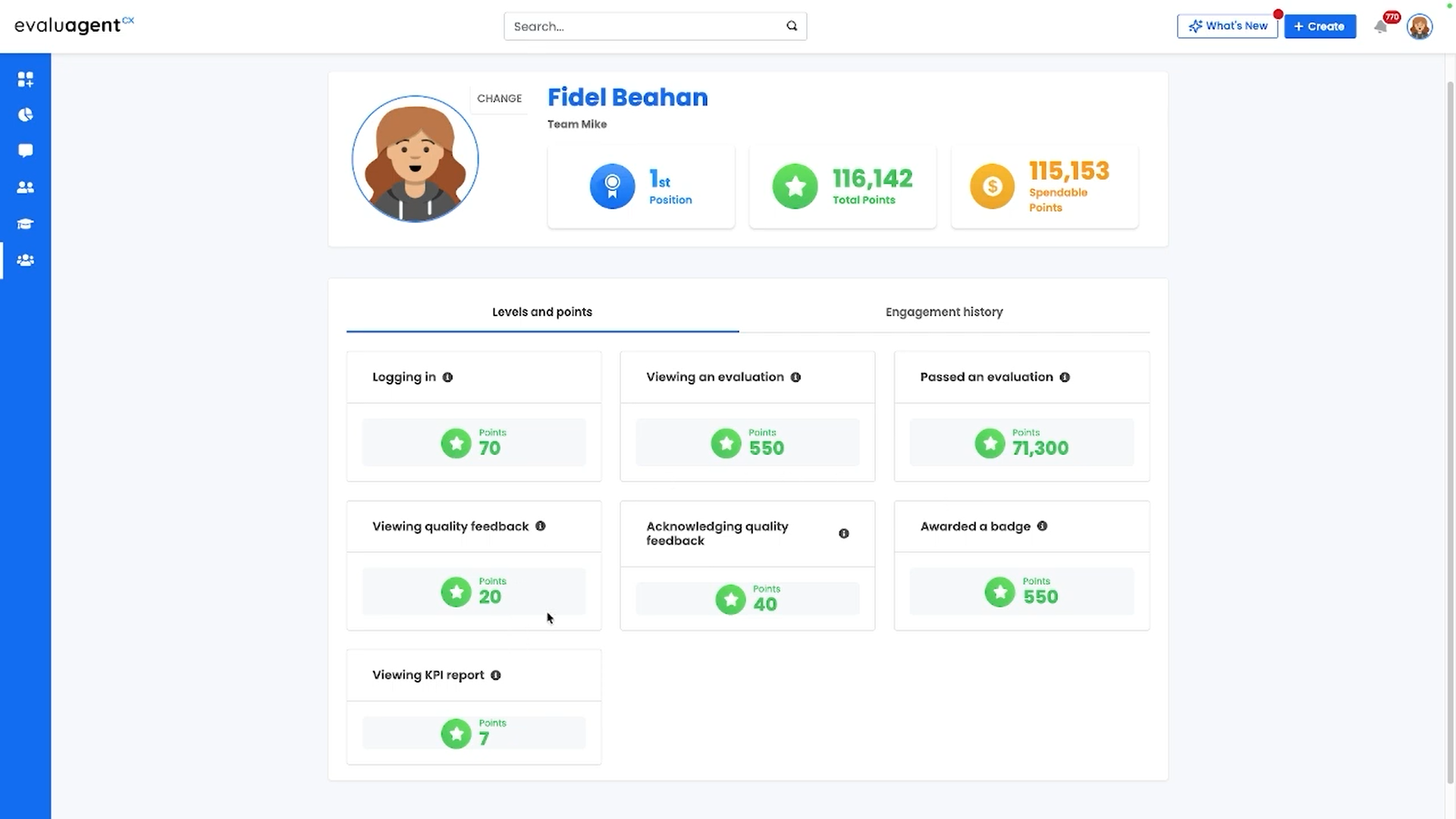
Seasalt Cornwall doubled evaluations and reduced agent attrition from 100% to 10% year-over-year after implementing evaluagent’s coaching and quality workflows. (Seasalt Cornwall Case Study)
CCaaS-agnostic QA eliminates lock-in
Where your QA tool sits relative to your CCaaS platform has long-term implications that are easy to overlook during procurement.
Verint takes an open approach.
The Open Platform overlays on existing CCaaS deployments through pre-built adaptors and APIs, with partnerships spanning Five9, Cisco, Avaya, and Talkdesk among others. Talkdesk itself offers Verint Workforce Management for Talkdesk as an enterprise WFM option for large deployments, showing how these platforms can complement rather than compete.
Verint’s open stance means organizations can adopt Quality Bot, WFM, or analytics independently of their CCaaS decision. The constraint is scale: Verint’s implementation and pricing target large enterprises, making the open architecture less accessible to mid-market teams.
Talkdesk’s quality tools are native to the Talkdesk platform.
This creates a smooth experience for Talkdesk customers (QA data flows from the same system that handles calls), but it also means quality data, scoring models, and historical evaluations are locked inside Talkdesk. If an organization migrates to a different CCaaS vendor, the quality program migrates with it, or starts over.
For organizations committed to Talkdesk long-term, this is not a limitation. For organizations that value flexibility, it is.
evaluagent was built from the ground up as CCaaS-agnostic: “Any CCaaS. Any CRM. Any AI agent provider. No lock-in.”
It integrates natively with Talkdesk, Genesys, Five9, Amazon Connect, Zendesk, Salesforce, Freshdesk, RingCentral, Intercom, Puzzel, and Aircall. For BPOs managing multiple clients on different platforms, this means one QA program across all clients without requiring each client’s IT team to invest.
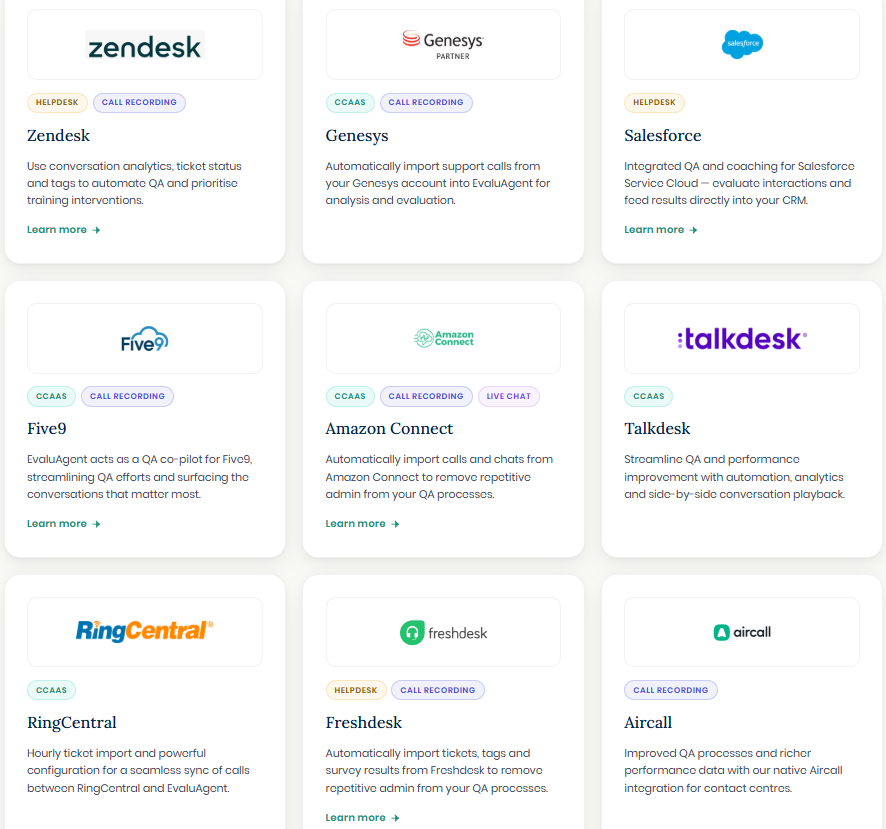
For any contact center, it means the quality program, scoring history, coaching records, and performance data persist regardless of future CCaaS decisions.
This creates a practical option that neither Verint nor Talkdesk offers outright: running evaluagent on top of Talkdesk. Organizations that choose Talkdesk for its CCaaS strengths (routing, AI self-service, vertical industry clouds) can layer evaluagent for improved QA, gaining specialist quality capabilities without leaving the Talkdesk ecosystem.
Pricing reflects each platform’s scope
The cost structures map to what each platform is trying to be.
Verint does not publish pricing.
All commercial engagement flows through Contact Sales. The platform runs on custom enterprise contracts, and implementation requires professional services (pre-packaged Starter Services Packages or tailored engagements). G2 and TrustRadius reviewers consistently flag pricing and training costs as concerns.
For organizations with the budget and scale to justify the investment, Verint’s breadth can consolidate multiple vendor relationships into one. For mid-market contact centers, the lack of transparency creates friction.
Talkdesk publishes base plan pricing clearly: Digital Essentials at $85/user/month, Voice Essentials at $105/user/month, Elite at $165/user/month, and Industry Experience Clouds at $225/user/month.
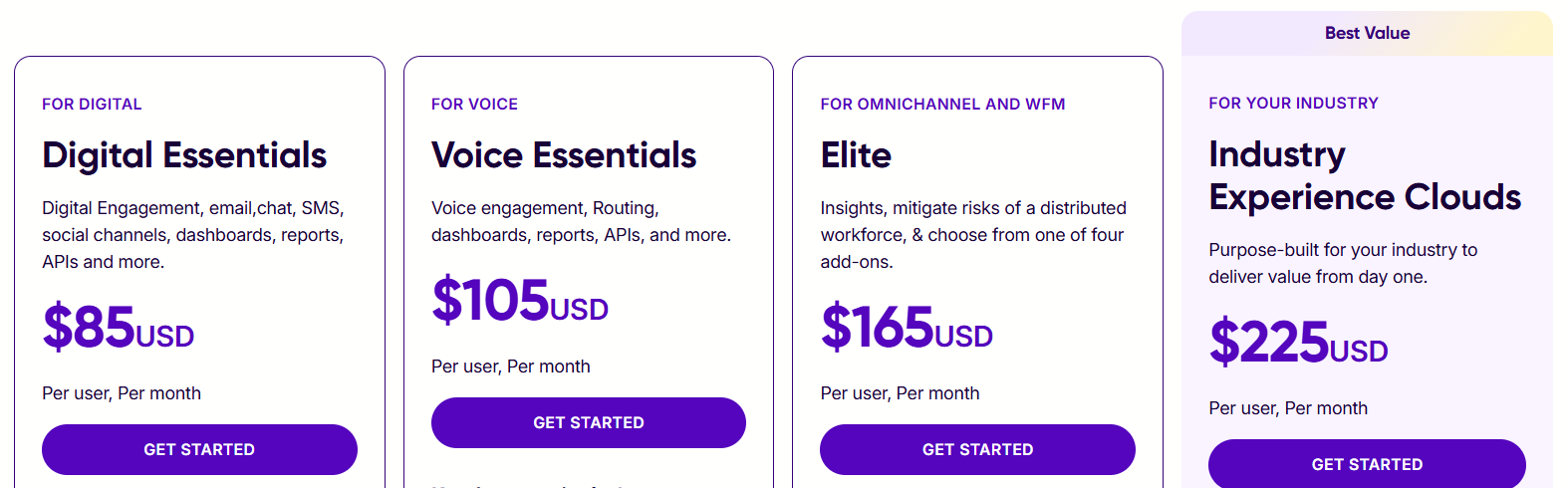
But the quality tools that make this comparison relevant (Interaction & Quality Analytics, Copilot, Autopilot, Navigator) are CXA add-ons priced separately with no published per-unit costs. G2 reviewers note that pricing gets confusing when AI options are added. Usage-based fees for call minutes, SMS, transcription, and AI interactions also apply on top of license fees.
For an organization buying Talkdesk as a complete CCaaS platform, the total cost may be reasonable. For one buying Talkdesk primarily for quality, the base platform cost is overhead.
evaluagent publishes two transparent tiers: AutoQM & Improvement at $35/user/month and AutoQM + Conversation Intelligence at $65/user/month (the higher tier adds sentiment analytics, predictive xNPS/xCSAT, topic discovery, and Spotlight analysis).
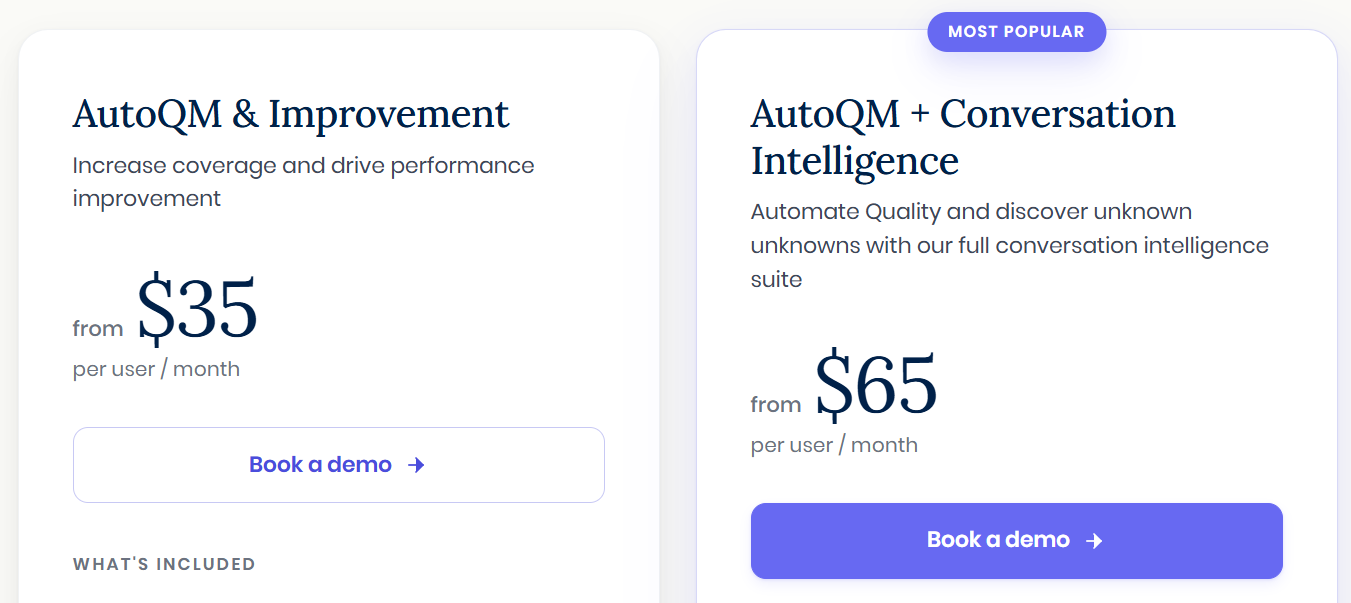
Volume discounts are available for large teams. Onboarding with a dedicated Customer Success Manager is included in both tiers, not reserved for enterprise buyers.
For a 200-agent contact center buying QA specifically, the monthly cost comparison is clear: evaluagent’s full bundle runs $13,000/month. Talkdesk’s base plan alone (before adding QA analytics) starts at $17,000–$33,000/month depending on tier. Verint does not publish pricing, so a direct comparison requires engaging their sales team.
The Share Centre achieved a 285% increase in QA productivity with evaluagent, cutting evaluation time from 24 minutes to 6 minutes per interaction while pass rates rose from 73% to 85%. (The Share Centre Case Study)
Verint vs Talkdesk vs evaluagent: Which should you choose?
The choice depends on what you are buying.
Choose Verint if:
- You are a large enterprise that wants quality automation, workforce management, knowledge management, analytics, and compliance from one vendor
- You need financial compliance recording for regulated trading environments (MiFID II, Dodd-Frank)
- You already operate within the Verint ecosystem and want to expand coverage
- You have the budget, implementation resources, and timeline for an enterprise deployment
- You need a platform that serves more than 80% of the Fortune 100 and can operate at that scale
Choose Talkdesk if:
- You are selecting a complete CCaaS platform, not just quality tools
- You need cloud-native voice, digital engagement, AI-powered routing, and self-service in one platform
- Industry-specific capabilities matter (pre-built Healthcare, Financial Services, or Retail workflows and integrations)
- You want AI agents that handle customer interactions autonomously alongside your human agents
- Your team values an intuitive interface (rated 4.4/5 on G2 as of mid-2026) and drag-and-drop routing design
Choose evaluagent if:
- Quality assurance and agent performance improvement are your primary objectives
- You want full-coverage automated QA without migrating off your existing CCaaS
- You are deploying AI agents that need independent quality oversight and hallucination detection
- You need a closed-loop system from evaluation to coaching to performance plans in one platform
- You are a BPO or multi-platform operation that needs CCaaS-agnostic QA across different clients and systems
- You want transparent pricing and the ability to go live in weeks, not months
See how evaluagent works with a tailored demo.
The most overlooked option is also the simplest: you do not have to choose one platform for everything. Talkdesk handles routing, voice, and AI self-service. evaluagent handles quality assurance and agent development. Together, they cover the contact center stack without either platform stretching beyond its strengths.
For organizations that already run Talkdesk (or Genesys, or Five9, or Amazon Connect), adding evaluagent for quality is faster, cheaper, and more advanced than relying on built-in QA alone.
Quality is not a module. For contact centers that treat it as the mission, evaluagent was built to match.