If you’ve tried to figure out what Zendesk QA costs, you’ve likely hit every wall at once: the add-on price isn’t published, it requires an existing Zendesk plan starting at $19/agent/month, the only public price point bundles QA with workforce management at $50/agent/month whether you need WFM or not, and you must buy it for every agent on your account.
Even a straightforward QA tool can take a sales call to decode.
Zendesk QA, formerly the standalone product Klaus before Zendesk acquired it in February 2024, is the native quality assurance layer for the Zendesk ecosystem. It scores 100% of customer interactions through AutoQA, surfaces high-risk conversations with Spotlight, and monitors AI agents alongside human ones.
For teams already on Zendesk Support, the integration is real: ticket data flows natively, no connector setup required, and QA results sit in the same system as your helpdesk.
We’ve analyzed Zendesk QA’s pricing structure, add-on requirements, and total cost of ownership. It’s a good choice if:
- You’re committed to the Zendesk ecosystem and want native QA without adding another vendor
- Your team already runs on Zendesk Suite Professional or higher
- You want setup with no external integration work
- You need QA that feeds into Zendesk’s broader AI and Copilot features
- You’re willing to bundle WFM with QA to get a public price point
Zendesk QA’s pricing might not be a good choice if:
- You want publicly listed QA pricing without a sales call
- You need QA that works independently of your helpdesk vendor
- You run a multi-platform contact center (Zendesk plus Salesforce, Genesys, or others)
- You want to license QA for a subset of agents rather than your entire account
- You need coaching, gamification, and performance improvement tools beyond basic feedback workflows
In this case, consider evaluagent: a CCaaS-agnostic QA and performance improvement platform that scores 100% of conversations across any helpdesk, including Zendesk, with pricing starting at $35/user/month and closed-loop coaching that connects evaluation findings to agent development.
We’ve included a detailed pricing comparison with evaluagent in this review, as the best choice for contact centers seeking independent, platform-agnostic QA. If you want to jump straight to the evaluagent pricing breakdown, skip ahead here.
Zendesk QA Pricing Summary
| Zendesk QA | evaluagent | |
|---|---|---|
| Free Trial | Sales-assisted only, no self-serve trial for QA add-on; 14-day Suite trial does not include QA | Demo-based; tailored 30-minute demo, trial available on request |
| Base Requirement | Requires Zendesk Support or Suite plan ($19–$115+/agent/mo) before QA can be added | None; works with any CCaaS or helpdesk (Zendesk, Salesforce, Genesys, Five9, and others) |
| QA Add-on | Standalone QA price not publicly disclosed; must contact Zendesk Sales | AutoQM & Improvement: from $35/user/mo with volume discounts |
| Full Bundle | WEM Bundle (QA + WFM): $50/agent/mo on top of base plan; must purchase for all agents | AutoQM + Conversation Intelligence: from $65/user/mo; includes Spotlight, xNPS, topic detection |
| AI Agent QA | Included in QA add-on; primarily for Zendesk AI agents | Cross-vendor bot scoring with independent fabrication detection |
| Pricing model | Seat-based add-on (all agents), layered on base plan | Seat-based with volume discounts; see pricing page |
| Best For | Teams committed to Zendesk wanting native QA without a separate vendor | Contact centers needing independent, platform-agnostic QA with closed-loop performance improvement |
Zendesk QA Pricing: In-Depth Overview
Zendesk QA is not a standalone product. It’s sold exclusively as a paid add-on to the Zendesk platform, so your total cost is always at least two layers: a base Zendesk plan plus the QA add-on.
The only publicly priced path to QA is the Workforce Engagement Bundle at $50/agent/month, which bundles QA with Workforce Management.
Teams that only need QA must choose between paying for features they don’t need or contacting sales for a standalone QA quote that Zendesk doesn’t publish.
On top of that, when you buy the QA add-on, you buy it for all agents in your account. There is no option to license QA for a subset of seats. Here’s each cost layer broken down.
The Required Foundation: Zendesk Base Plans
| Plan | Price (Annual) | Key QA-Relevant Features |
|---|---|---|
| Support Team | $19/agent/mo | Basic ticketing; QA add-on eligible |
| Suite Team | $55/agent/mo | Ticketing + messaging; QA add-on eligible |
| Suite Growth | $89/agent/mo | Automation; CSAT surveys; QA add-on eligible |
| Suite Professional | $115/agent/mo | Advanced analytics; custom reports; QA add-on eligible |
| Suite Enterprise | Custom pricing | Full platform; Copilot add-on eligible |
Before you can buy Zendesk QA, you need an active Zendesk Support or Suite subscription. The base plan determines what platform features sit underneath QA, including reporting, automation, and AI capabilities that QA draws on. Most teams evaluating QA run Suite Professional ($115/agent/month) or higher, since lower tiers lack the analytics that make QA data useful.
| Base Plans (QA Prerequisite) | |
|---|---|
| Pros | Cons |
| – QA add-on available on any plan | – Even the cheapest plan adds $19/agent to QA cost |
| – Suite Professional includes advanced reporting | – Lower tiers lack analytics to use QA data well |
| – Annual billing saves roughly 20% | – Must commit to Zendesk as your primary helpdesk |
| – Established platform with 80,000+ customers | – Switching helpdesks means losing QA investment |
Zendesk QA Standalone Add-on: Price Not Publicly Disclosed
| Feature | Details |
|---|---|
| Price | Not published; requires contacting Zendesk Sales |
| AutoQA | 100% conversation scoring across text, voice, and AI agent interactions |
| Spotlight | Detection of churn risk, escalation, sentiment issues |
| Real-time QA | Live monitoring during active conversations (Early Access) |
| AI Agent QA | Quality scoring of bot-handled interactions |
| Coaching | Pins, structured sessions, quizzes |
| Licensing | Must purchase for all agents on the account |
The QA add-on includes AutoQA scoring, Spotlight anomaly detection, AI Agent QA, coaching tools, and Real-time QA.
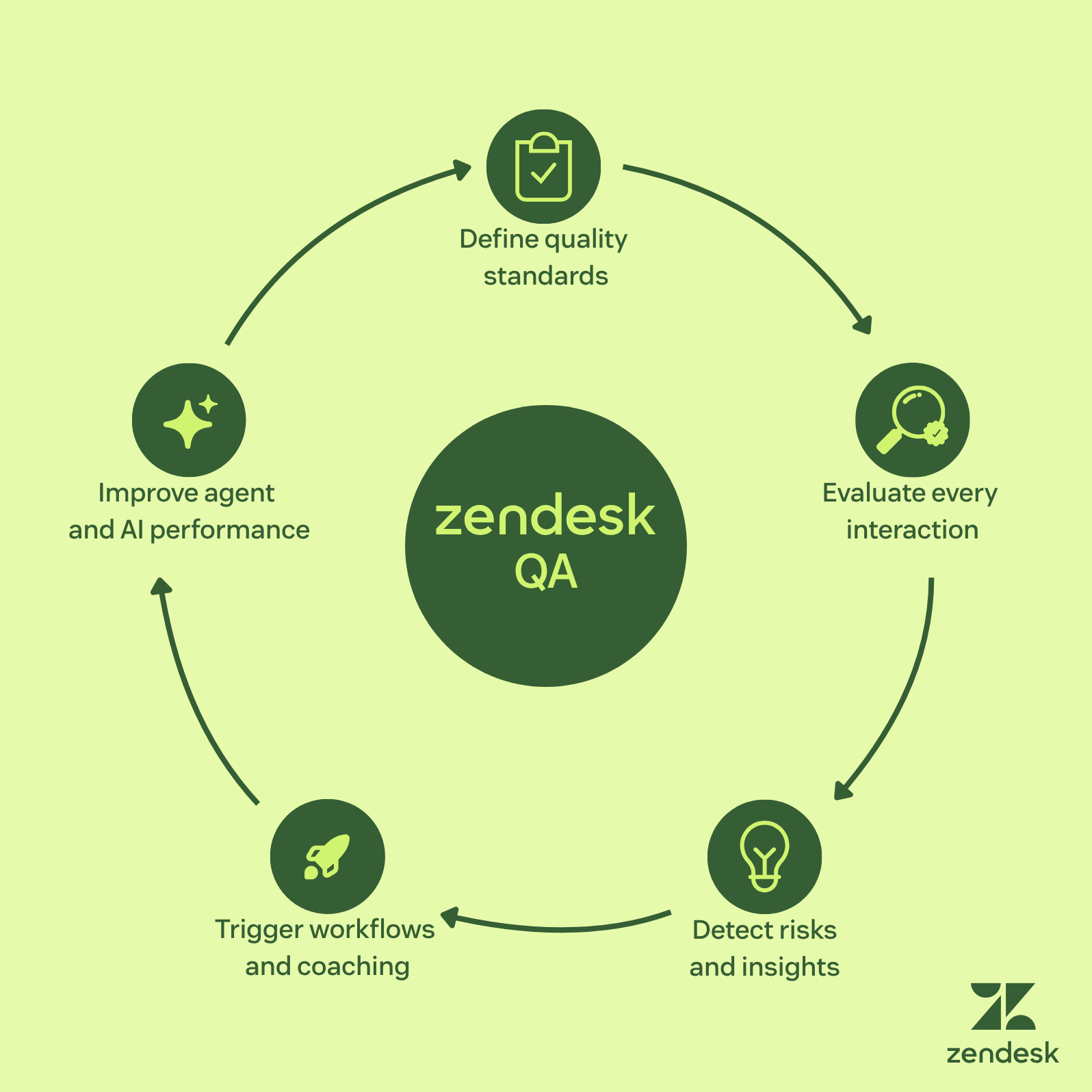
It is available to customers on any Support or Suite plan. But Zendesk does not publish the standalone QA price on its pricing page. The official FAQ links to a pricing page that shows no dollar figure for the QA-only add-on.
To learn the cost, you must contact Zendesk Sales or check the in-product subscription price in Admin Center.
| QA Add-on | |
|---|---|
| Pros | Cons |
| – Full AutoQA and Spotlight included | – Price not publicly disclosed |
| – AI Agent QA at no extra per-conversation fee | – Requires sales conversation to get a quote |
| – Native Zendesk integration, no setup needed | – Must purchase for all agents on account |
| – Coaching module with pins and sessions | – Cannot license for a subset of seats |
Workforce Engagement Bundle: $50/agent/month
| Feature | Details |
|---|---|
| Price | $50/agent/mo (paid yearly) |
| Includes | Zendesk QA + Zendesk Workforce Management |
| Licensing | All agents on the account |
| Savings | Zendesk states buying QA and WFM separately costs more |
| Added to | Any Support or Suite base plan |
The WEM Bundle is the only publicly priced way to get Zendesk QA. At $50/agent/month on top of your base plan, it bundles QA with Workforce Management (the rebranded Tymeshift scheduling and forecasting tool).
Zendesk confirms you save money buying both as a bundle versus buying each separately, but teams that only need QA end up paying for WFM features they won’t use.
For a team on Suite Professional, the total cost is $115 + $50 = $165/agent/month. A 100-agent team pays $16,500/month, or $198,000/year, for helpdesk plus QA plus WFM.
| WEM Bundle | |
|---|---|
| Pros | Cons |
| – Only publicly priced path to QA | – Forces WFM purchase even if not needed |
| – Saves versus buying QA and WFM separately | – $50/agent adds up on top of base plan |
| – Full WEM suite for teams needing both | – All-agent licensing requirement stands |
| – Includes scheduling and forecasting tools | – Total cost reaches $165+/agent/mo on Suite Professional |
Zendesk QA: Additional Costs and Total Ownership
Beyond the base plan and QA add-on, several other cost layers affect total ownership:
Copilot add-on: $50/agent/month for AI writing assistance, Auto Assist, and Admin Copilot. Real-time QA is also accessible through this add-on, so some teams may need both QA and Copilot.
AI Agent automated resolutions: AI Agents are billed per Automated Resolution (a resolution without human escalation), adding variable costs for teams deploying AI agents alongside QA monitoring.
Voice usage: Billed on consumption exceeding plan allowances, relevant for teams using Voice QA on call transcripts.
Premier support: Zendesk’s standard support uses pooled engineers with no guaranteed response times. For 24/7 coverage and guaranteed first-response times, three paid Premier tiers are available, priced as a percentage of annual license spend.
Total cost example: A 100-agent team on Suite Professional with the WEM Bundle and Copilot pays: $115 (base) + $50 (WEM) + $50 (Copilot) = $215/agent/month, or $258,000/year, before AI Agent resolution fees and Premier support.
Where Zendesk QA Falls Short
Zendesk QA delivers real value as a native quality layer for teams already in the Zendesk ecosystem. But its pricing model and post-acquisition positioning create problems for contact centers that need flexibility, transparency, or deeper performance improvement tools:
Opaque Pricing Requires a Sales Conversation
- The standalone QA add-on price appears nowhere on Zendesk’s pricing page
- The only publicly priced path bundles QA with Workforce Management at $50/agent/month
- Teams cannot model QA costs or compare vendors without engaging Zendesk Sales first
- This delays budgeting and purchasing decisions
Ecosystem Lock-in Limits Platform Flexibility
- Zendesk QA’s native integration is with Zendesk Support; dedicated connectors exist only for Front and Gorgias, plus a custom API import path
- The pre-acquisition Klaus supported 10+ helpdesks natively
- Contact centers running Salesforce, Genesys, Five9, or Intercom face limited integration options
- Switching helpdesks means rebuilding your QA program from scratch
All-Agent Licensing Inflates Costs for Targeted QA
- You must purchase QA for every agent on your account with no option to license a subset
- Teams wanting to pilot QA with one department still pay for the entire roster
- This makes gradual adoption expensive compared to per-team or per-user licensing
Coaching Module Lacks Depth for Structured Development Programs
- Capterra reviewers note that coaching form customization feels constrained for teams with complex QA workflows
- No built-in LMS, gamification, or structured performance improvement plans with audit trails
- Teams running formal learning paths or certification programs need external tools
- The post-acquisition transition from Klaus also eliminated live chat support for QA product questions
These constraints have led many contact centers, including teams already using Zendesk for ticketing, to explore independent QA platforms with transparent pricing and deeper performance improvement capabilities…
Best Zendesk QA Alternative: evaluagent
evaluagent provides independent, CCaaS-agnostic QA and performance improvement that works alongside your existing helpdesk (including Zendesk) without locking you into a single vendor’s ecosystem.
For contact centers that find Zendesk QA’s undisclosed pricing, ecosystem lock-in, all-agent licensing, and limited coaching constraining, evaluagent offers pricing starting at $35/user/month, native integrations with Zendesk, Salesforce, Genesys, Five9, Amazon Connect, and 10+ other platforms, and a closed-loop system that connects AI-powered scoring to coaching, performance plans, and gamification.
Founded in 2012 by three contact center operators who had managed quality programs themselves, evaluagent serves customers including Samsung, Jet2, Capital on Tap, and Seasalt Cornwall.
The platform rests on two pillars: AutoQM for AI-powered scoring of 100% of conversations, and AI Agent Observability for independent governance of chatbots and virtual agents across any vendor.
Its Context Engine (launched April 2026) grounds AI scoring in your company’s own policies, knowledge base content, and compliance rules, so scores reflect factual accuracy alongside behavioral quality.
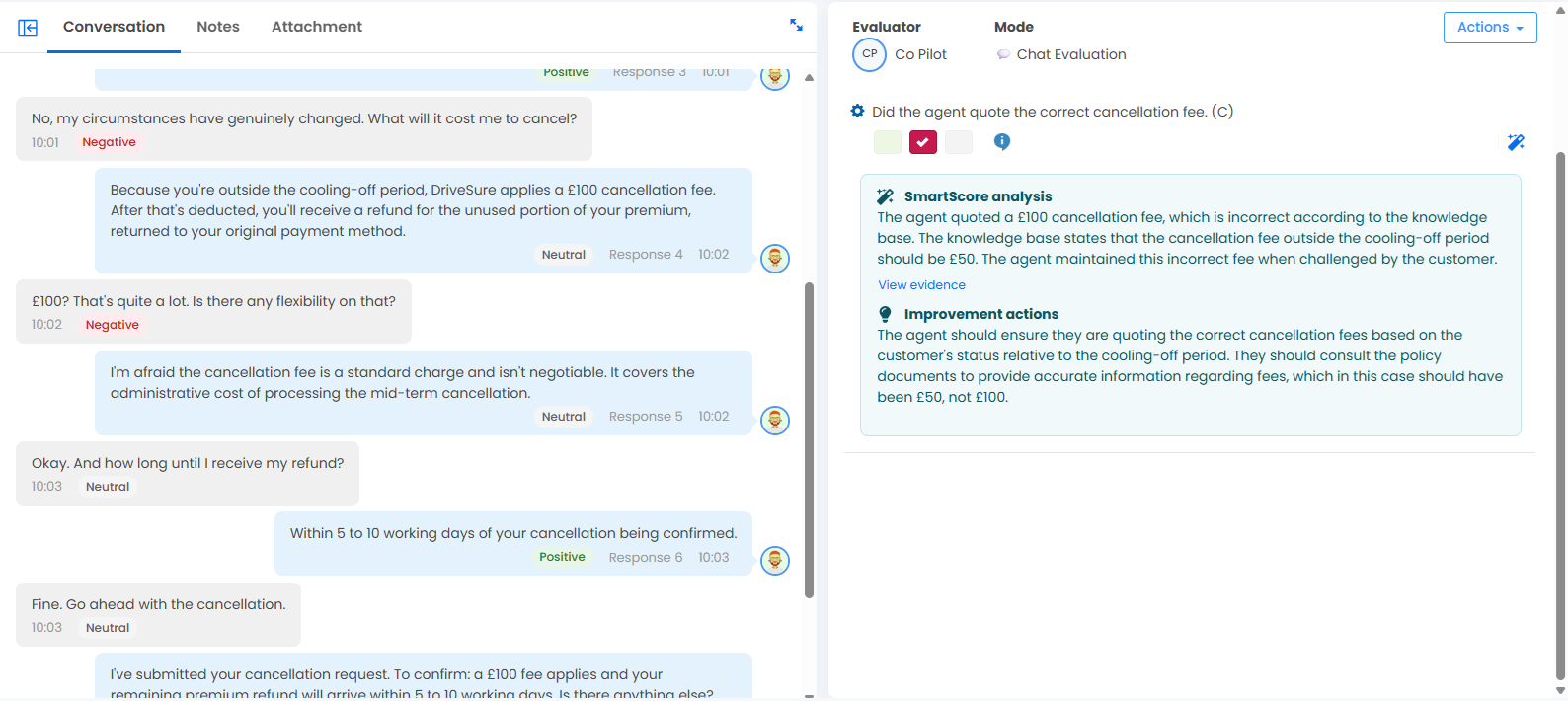
For teams already on Zendesk, evaluagent integrates natively with Zendesk, importing tickets, tags, and survey results with automated redaction and side-by-side evaluation. You keep Zendesk for ticketing and use evaluagent as your independent quality and coaching layer, with no vendor lock-in on either side.
evaluagent AutoQM & Improvement: From $35/user/month
| Feature | Details |
|---|---|
| Price | From $35/user/month with volume discounts |
| AutoQM Scoring | 100% of conversations across voice, chat, and email |
| Context Engine | Grounded in company policies, knowledge base, and compliance rules |
| Scorecards | Drag-and-drop builder with weighted criteria and auto-fail logic |
| Coaching | 1-to-1 sessions, performance plans, gamification, built-in LMS |
| Integrations | Zendesk, Salesforce, Genesys, Five9, Amazon Connect, and more |
| Security | SOC 2 Type II, ISO 27001, HIPAA, GDPR, EU AI Act Ready |
The entry tier includes evaluagent’s full AutoQM scoring engine, Context Engine, SmartScore AI reasoning, blended scorecards (AI + human evaluation on one scorecard), coaching workflows, performance plans with audit trails, gamification with a reward auction, and a built-in LMS with auto-enrollment.
At $35/user/month with volume discounts for larger teams, it covers the QA scoring, coaching, and agent development that Zendesk QA’s coaching module only partly addresses.
| AutoQM & Improvement | |
|---|---|
| Pros | Cons |
| – Transparent pricing, publicly listed | – Does not include Conversation Intelligence features |
| – Works with any CCaaS including Zendesk | – AI agent QA not included in seat tier |
| – Closed-loop coaching with gamification and LMS | – Configuration may take several weeks for large deployments |
| – Context Engine validates factual accuracy | – Requires existing CCaaS or helpdesk |
Capital on Tap scaled from 900 to 6,000 BDM quality checks per month after go-live without adding headcount. (Capital on Tap Case Study)
evaluagent AutoQM + Conversation Intelligence: From $65/user/month
| Feature | Details |
|---|---|
| Price | From $65/user/month with volume discounts |
| Everything in Tier 1 | Plus full Conversation Intelligence suite |
| Reason for Contact | Automated classification across all interactions |
| Spotlight | On-demand AI analyst across up to 1,000 conversations |
| Predictive Metrics | xNPS, xCSAT, xResolution, xVulnerability |
| Topic Discovery | Automated theme identification with no-code custom topics |
| Sentiment Analytics | Conversation-level scoring with trend tracking |
The Full Bundle adds evaluagent’s Conversation Intelligence suite to the AutoQM foundation.
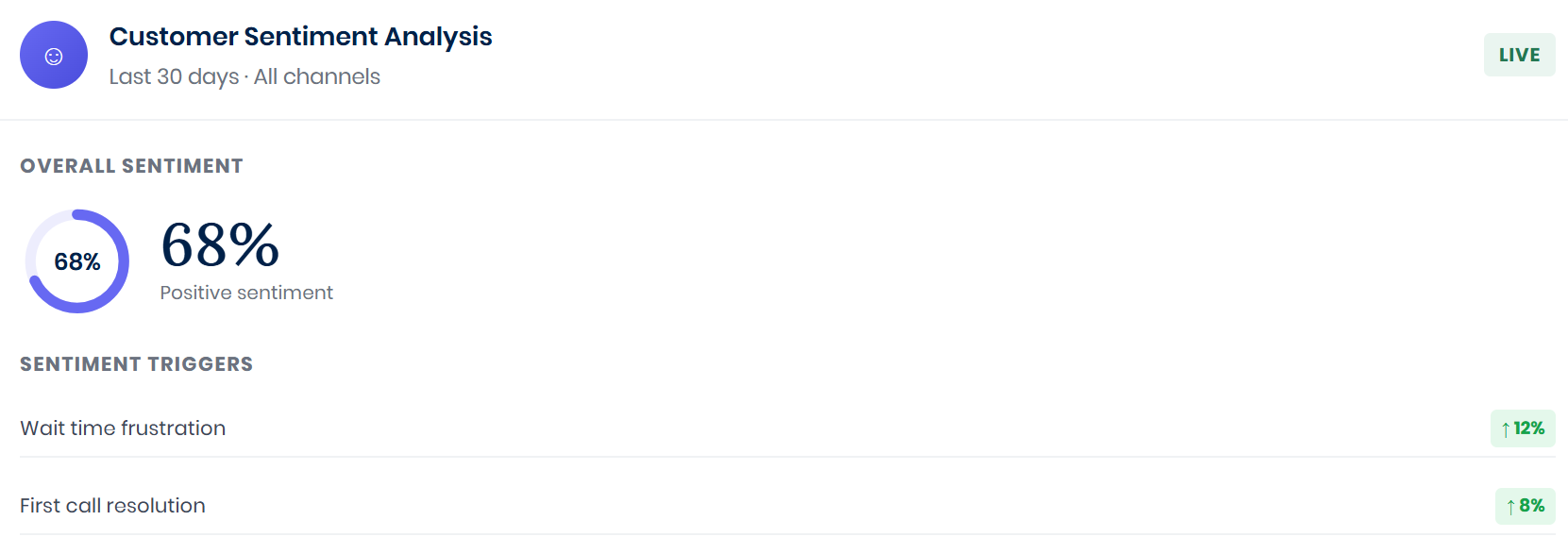
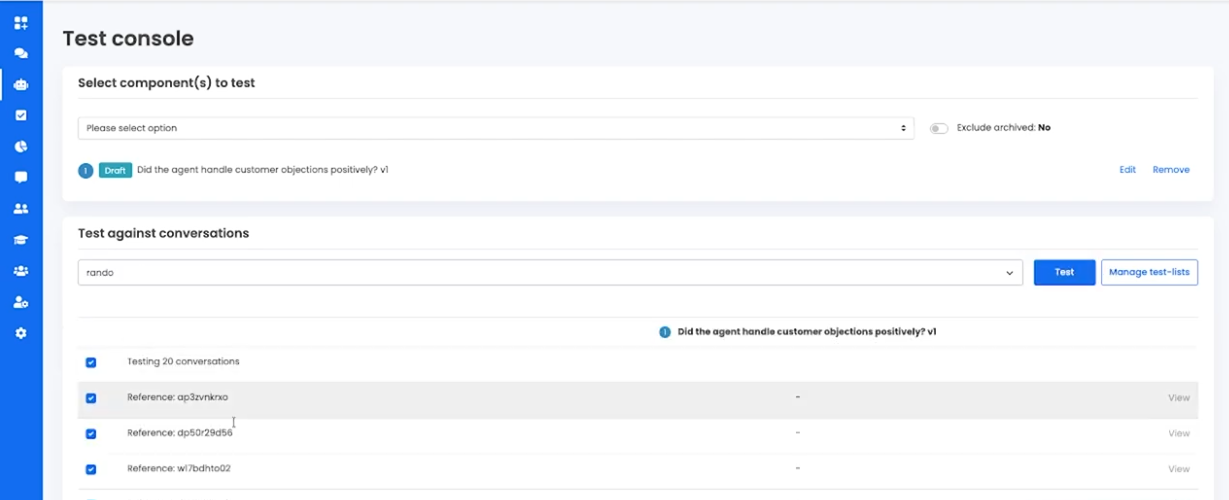
This includes automated reason-for-contact detection, predictive voice-of-customer metrics derived from 100% of conversations rather than survey response rates, on-demand AI investigation through Spotlight, and no-code custom topic building with a testing console.
At $65/user/month, the total cost is comparable to Zendesk’s WEM Bundle ($50/agent/month) plus the base plan overhead Zendesk requires.
| AutoQM + Conversation Intelligence | |
|---|---|
| Pros | Cons |
| – Predictive metrics across 100% of contacts | – Higher monthly cost than entry tier |
| – Spotlight investigates root causes on demand | – Requires active engagement to get full value |
| – No-code topic builder with testing console | – AI agent QA requires separate tier |
| – Includes everything from Tier 1 | – Volume discounts require larger team sizes |
The Share Centre cut evaluation time from 24 minutes to 6 minutes (a 285% increase in QA productivity) while pass rates rose from 73% to 85%. (The Share Centre Case Study)
evaluagent AI Agent Observability
| Feature | Details |
|---|---|
| Cross-Vendor Scoring | Scores bots from Cognigy, Sierra, Decagon, and proprietary builds |
| Fabrication Detection | Grounded in your organization’s knowledge base |
| Prerequisite | Requires a human-agent seat tier |
| Handover Coverage | Bot-to-human handover conversations covered by seat license at no extra charge |
| Pricing | See evaluagent pricing page |
evaluagent’s AI Agent Observability applies the same quality framework to bots and AI agents as it does to human agents.
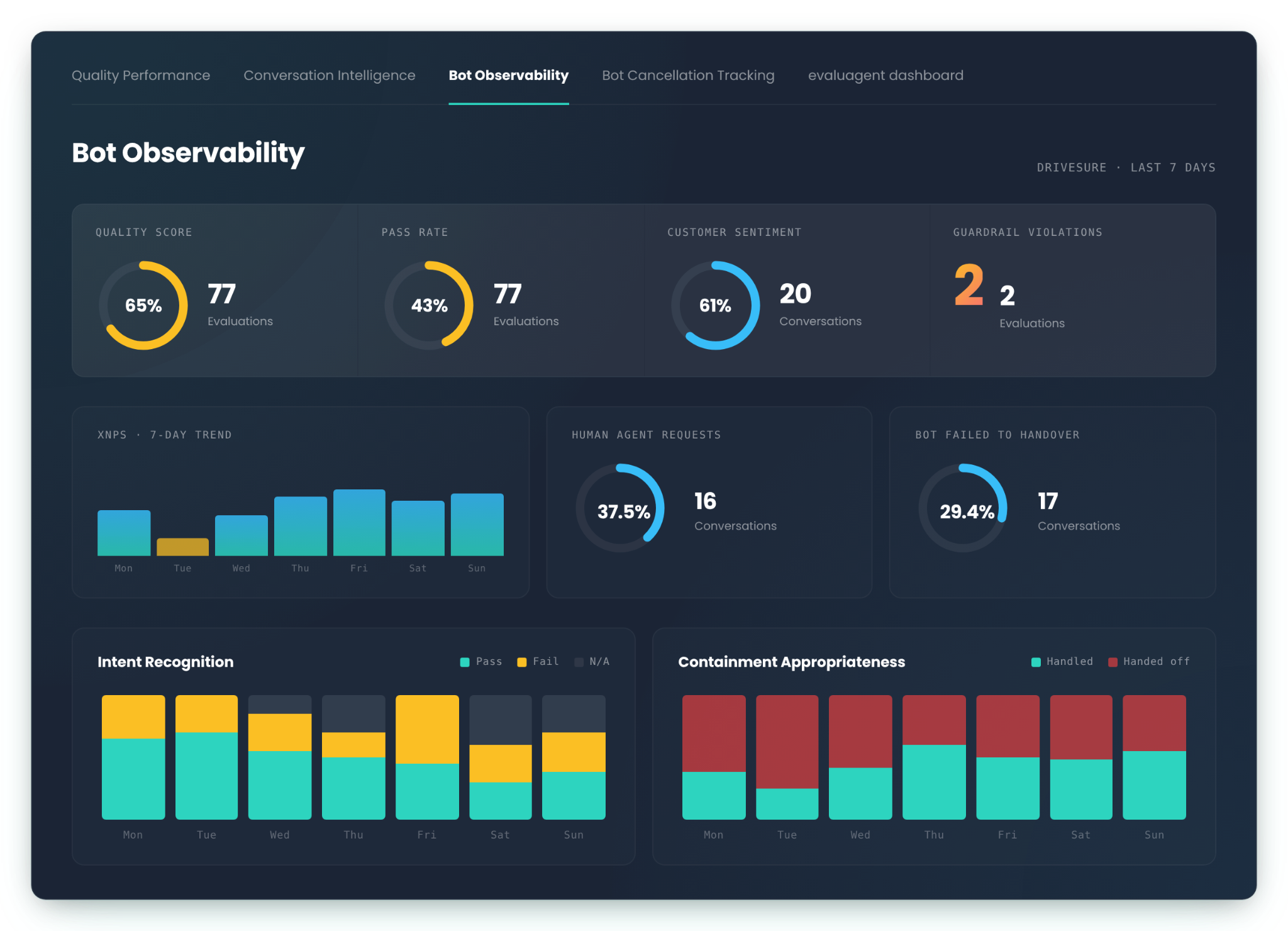
It scores bots from any vendor (Cognigy, Sierra, Decagon, or proprietary builds) with independent fabrication detection grounded in your own knowledge base rather than the bot vendor’s metrics. Because evaluagent does not sell the bots it assesses, there is no conflict of interest.
Conversations that start with a bot but end with a human agent are covered under the existing seat license at no extra charge, so the handover moment is always captured.
| AI Agent Observability | |
|---|---|
| Pros | Cons |
| – Cross-vendor scoring (not locked to one bot platform) | – Requires a seat tier as prerequisite |
| – Independent fabrication detection | – Separate from human-agent pricing |
| – Same quality standard for humans and AI | – Newer capability with evolving feature set |
| – Handover conversations covered by seat license | – Requires knowledge base setup for fabrication detection |
Zendesk QA Feature Value Breakdown (vs evaluagent)
Platform Independence vs Native Integration
Zendesk QA’s Approach: Zendesk QA is built into the Zendesk platform. For teams already on Zendesk Support, ticket data flows natively, no connector setup required, and QA results sit alongside ticketing, reporting, and AI agent management in one interface.
The trade-off: this tight integration only extends to Zendesk Support. Dedicated connectors exist for Front and Gorgias, and a custom API import path covers other systems, but post-acquisition Klaus lost much of its former multi-platform reach.
evaluagent’s Approach: evaluagent is CCaaS-agnostic: “Any CCaaS. Any CRM. Any AI agent provider. No lock-in.” It integrates natively with Zendesk, Salesforce, Genesys, Five9, Amazon Connect, Freshdesk, RingCentral, Talkdesk, Intercom, Puzzel, Aircall, Assembled, and Peopleware.
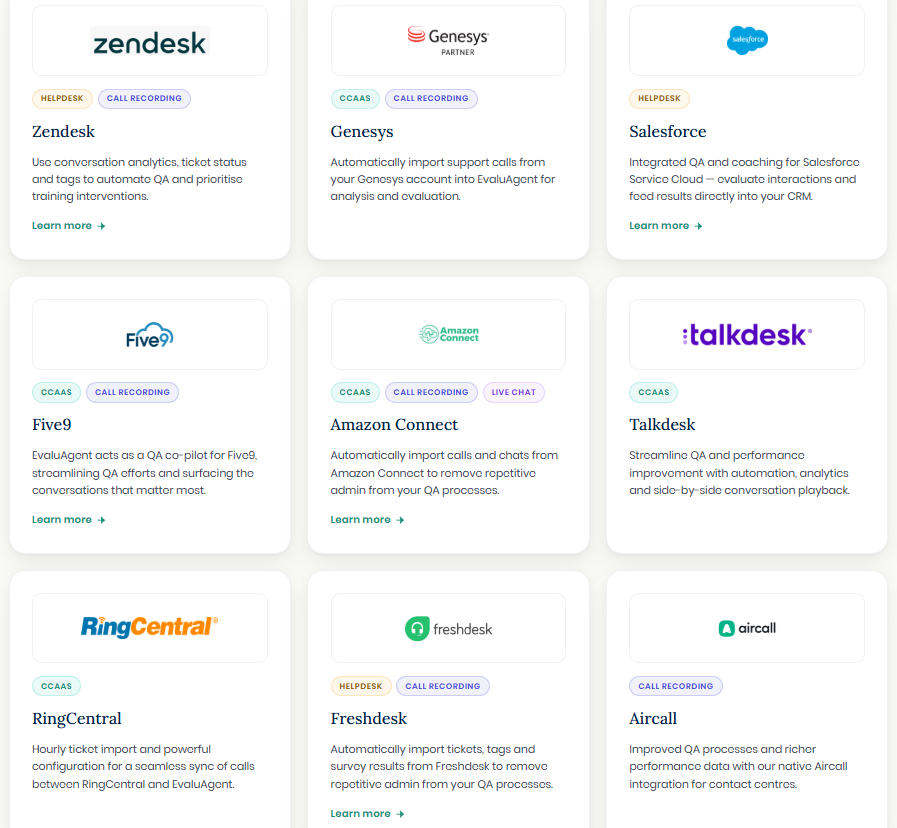
For teams on Zendesk Support, evaluagent imports tickets, tags, and survey results with automated redaction and side-by-side evaluation, settable “in minutes.”
You can keep Zendesk for ticketing while using evaluagent as your independent quality layer, and if your contact center spans multiple platforms, one QA program covers them all.
Coaching and Performance Improvement
Zendesk QA’s Approach: Zendesk QA’s coaching module includes conversation pinning, structured 1-to-1 sessions with talking points and action items, and multiple-choice quizzes. Sessions surface the agent’s IQS, per-category scores, and quiz results in a side panel.
The system provides a foundation for structured feedback, but reviewers note that coaching form customization feels constrained for teams with complex QA workflows. There is no built-in LMS, gamification, or formal performance improvement plan with audit trails.
evaluagent’s Approach: evaluagent connects evaluation findings to coaching sessions, 1-to-1s, eLearning modules, performance improvement plans, and gamification in a single platform. The built-in LMS includes auto-enrollment triggered by performance metrics, quizzes, learning paths, and gamified certificates. Performance Plans produce HR-ready documentation with full audit trails.
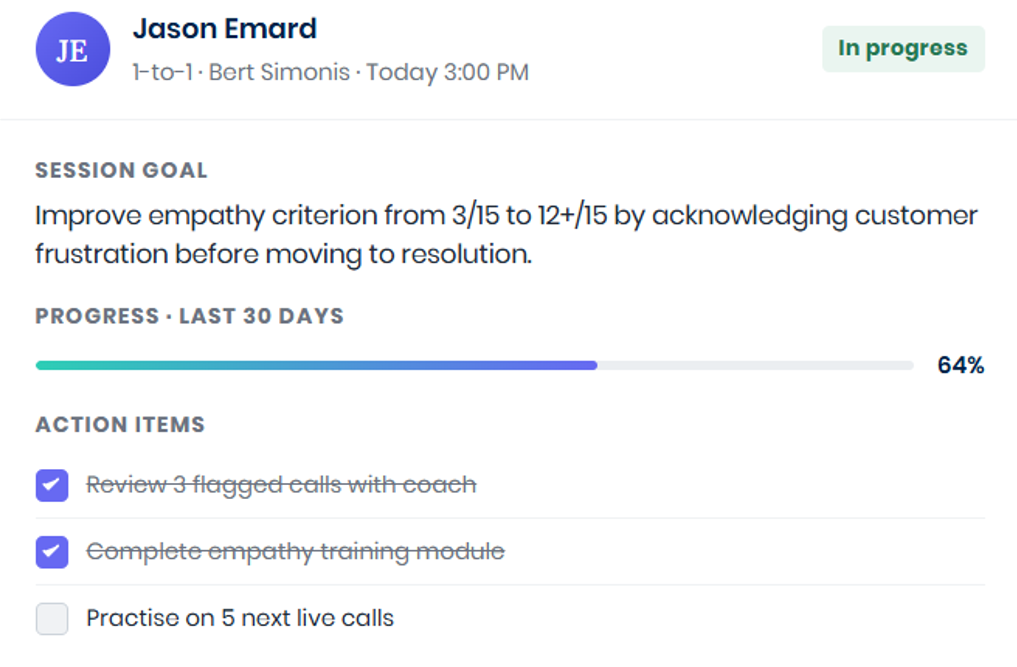
The gamification layer goes beyond leaderboards to include a reward auction where agents bid earned points on prizes.
Seasalt Cornwall doubled evaluations and reduced agent attrition from 100% to 10% year-on-year, attributed in part to coaching consistency and transparency through evaluagent. (Seasalt Case Study)
AI Scoring Calibration and Accuracy
Zendesk QA’s Approach: AutoQA ships with eight built-in scoring categories (Greeting, Empathy, Spelling and Grammar, Closing, Solution Offered, Tone, Readability, Comprehension) and supports up to 10 custom AI prompt-based categories using natural language.
The Accuracy Score metric measures agreement between AutoQA and human reviewer scores, with 75%+ indicating high effectiveness.
evaluagent’s Approach: evaluagent’s Context Engine goes beyond behavioral scoring to validate whether agents gave the right answer, by grounding AI evaluation in uploaded company policies, product guides, knowledge base content, and compliance documents.
A Testing Console lets QA managers trial any scoring change against real historical conversations before going live.
Blended Scorecards mix AI-scored and human-scored criteria on a single scorecard, and Agent Disputes create a feedback loop where evaluator disagreements improve model accuracy over time.
Pricing Transparency and Total Cost
Zendesk QA’s Approach: Zendesk QA requires a base plan ($19–$115+/agent/month) plus either the undisclosed standalone QA add-on or the WEM Bundle at $50/agent/month. The add-on must be purchased for all agents on the account.
A team on Suite Professional with the WEM Bundle pays $165/agent/month. Additional layers (Copilot at $50/agent/month, AI Agent resolutions, Premier support) push costs higher.
evaluagent’s Approach: evaluagent publishes its pricing: $35/user/month for AutoQM & Improvement, $65/user/month for the Full Bundle, with volume discounts for large teams. Because evaluagent works with any helpdesk, teams keep their existing CCaaS investment and add QA independently.
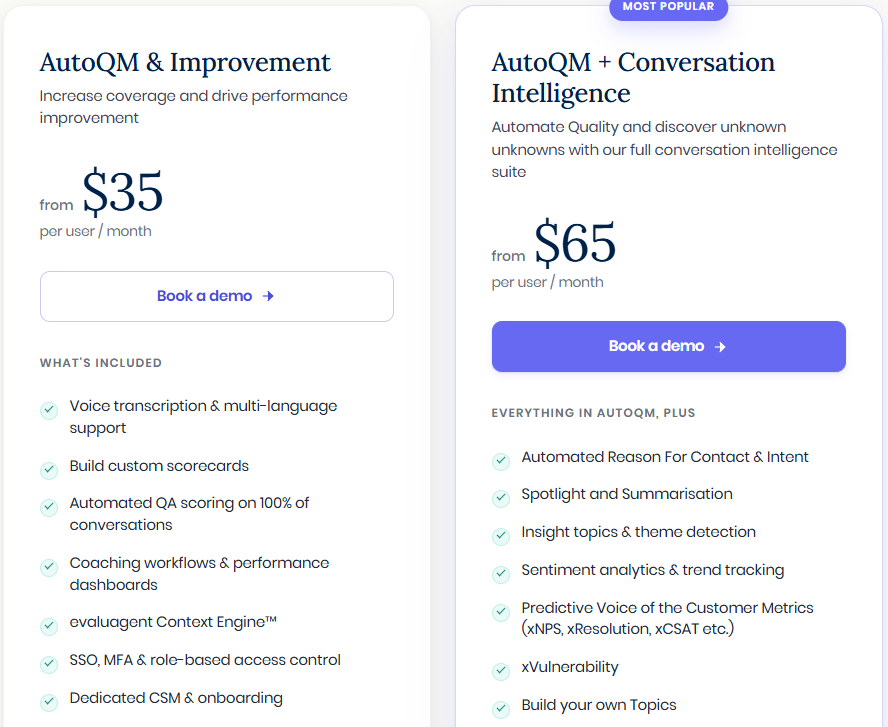
A team on Zendesk Suite Professional ($115/agent/month) can add evaluagent at $35/user/month for a total of $150/agent/month ($15 less than the Zendesk WEM Bundle path) while getting a dedicated quality and coaching platform.
Final Verdict: Zendesk QA vs evaluagent
The choice between Zendesk QA and evaluagent depends on how committed you are to the Zendesk ecosystem and what you need from your QA program beyond scoring:
Zendesk QA is a native quality assurance layer for teams that have standardized on Zendesk and want QA embedded in their existing workflow. With the WEM Bundle at $50/agent/month on top of a base Zendesk plan, quality teams can score 100% of conversations, detect churn and escalation signals through Spotlight, and monitor AI agent quality without adding a separate vendor.
This native approach works best for teams invested in the Zendesk ecosystem, organizations that value single-vendor simplicity over platform independence, and contact centers where Zendesk handles all customer interactions.
evaluagent is an independent, CCaaS-agnostic QA and performance improvement platform built by contact center operators who understood that scoring conversations is only half the problem.
With pricing from $35/user/month and native integrations across Zendesk, Salesforce, Genesys, Five9, Amazon Connect, and others, it delivers 100% conversation coverage, knowledge-grounded accuracy validation through the Context Engine, and a closed-loop system that connects every score to coaching sessions, performance plans, gamification, and a built-in LMS.
This platform-independent approach makes it the stronger choice for multi-platform contact centers or BPOs, teams that need structured agent development beyond basic feedback, and organizations that want their QA data to remain portable regardless of helpdesk.
Get started with evaluagent here.
The core difference is independence. Zendesk QA asks “How can we make quality native to the Zendesk platform?” evaluagent asks “How can we give contact centers an independent quality standard that works with any platform and drives measurable agent improvement?”