Choosing between Amazon Connect and Genesys Cloud CX for your contact center comes down to five questions:
- Do you need a complete contact center covering routing through workforce management, or a flexible infrastructure you can build on?
- Is your organization already invested in AWS, or do you need a platform-agnostic solution?
- Are you willing to pay per seat for a polished experience, or do you prefer pay-as-you-go pricing tied to actual usage?
- How important is native quality assurance and workforce engagement, versus the ability to choose independent QA tools?
- Do you have the technical resources to configure and maintain a developer-centric platform, or do you need something closer to turnkey?
In short, here’s what we recommend:
Amazon Connect is the natural choice for organizations already running on AWS. Its pay-as-you-go pricing eliminates per-seat licensing, charging $0.038 per voice minute and $0.010 per chat message with all AI capabilities included. The platform handles over 16 million interactions daily and has been named a Gartner Magic Quadrant Leader for CCaaS three years running.
But it functions more as a developer toolkit than a turnkey solution, and advanced configuration requires AWS expertise.
Genesys Cloud CX is the enterprise workhorse. It combines voice routing, digital engagement, workforce management, quality assurance, and journey analytics in one platform, with 11 consecutive years as a Gartner Magic Quadrant Leader and over 7,000 customer organizations worldwide. Its AI-powered Virtual Supervisor achieves 94% scoring accuracy.
But that breadth comes at enterprise pricing starting at $75/user/month, with advanced features pushing costs higher.
Both platforms are strong contact center engines. But neither was built to be a quality assurance specialist. Their native QA tools evaluate interactions, but QA is one module among many, not the core focus. For contact centers that treat quality as a strategic function rather than a checkbox, there’s a dedicated layer worth considering.
evaluagent is the independent quality assurance and performance improvement platform that works with both Amazon Connect and Genesys Cloud CX. Instead of relying on your CCaaS vendor’s built-in QA (which evaluates interactions using its own framework), evaluagent scores 100% of conversations automatically against your own quality standards, then connects those scores to coaching, performance plans, and gamification.
Its Context Engine grounds AI scoring in your company’s policies, procedures, and knowledge base, so quality is measured against your definition of success rather than a vendor’s default criteria. And because evaluagent is CCaaS-agnostic, your quality history stays with you if you switch platforms.
If independent, full-coverage quality assurance sounds like the missing layer in your contact center, book a demo with evaluagent.
Amazon Connect vs Genesys Cloud CX at a glance
| Amazon Connect | Genesys Cloud CX | evaluagent | |
|---|---|---|---|
| Core approach | Developer toolkit on AWS | All-in-one enterprise CX platform | Independent QA and performance layer |
| AI capabilities | Bundled in base pricing (Bedrock, Lex, Nova) | Virtual agents, copilots, predictive routing (token-based) | AutoQA, Context Engine, AI Agent Observability |
| Quality assurance | Contact Lens (native, automated evaluations) | Virtual Supervisor and speech analytics (native) | 100% conversation scoring, calibrated to your standards |
| Workforce management | Native forecasting and scheduling included | Native WEM with 25+ ML forecasting models | Integrates with WFM tools (Assembled, Peopleware) |
| Digital channels | Voice, chat, email, SMS, WhatsApp | Voice, chat, email, SMS, WhatsApp, social media | Evaluates conversations from any channel |
| Deployment complexity | Requires AWS expertise for advanced setup | Steeper learning curve on Architect and WEM config | Go-live in weeks; CCaaS-agnostic |
| Analyst recognition | 3-year Gartner MQ Leader for CCaaS | 11-year Gartner MQ Leader for CCaaS | G2 Leader, Contact Center QA (Summer 2026) |
| Pricing model | Pay-as-you-go (per minute/message) | Per-user subscription (annual, $75–$155/user/month) | Per-seat ($35–$65/user/month) |
| Best for | AWS-centric organizations with variable volumes | Enterprises needing a unified CX suite | Contact centers that treat quality as a strategic function |
Two different philosophies of building a contact center
Amazon Connect and Genesys Cloud CX take fundamentally different approaches to the same problem.
Amazon Connect was born inside Amazon’s own customer service operation. The company built an internal contact center system around 2007 because no external vendor met its needs for scale and flexibility, then opened it to external customers in 2017.
The DNA is infrastructure: Amazon Connect gives you building blocks and expects you to assemble them. Its drag-and-drop Flow designer handles routing, IVR, and bot logic without code, but advanced workflows lean on Lambda, DynamoDB, and other AWS services. That makes it flexible for teams with AWS skills, and frustrating for those without.
Genesys Cloud CX took the opposite path. Founded in 1990 as a telephony middleware company, Genesys spent three decades building every contact center capability an enterprise might need, then acquired Interactive Intelligence in 2016 to gain a cloud-native platform.
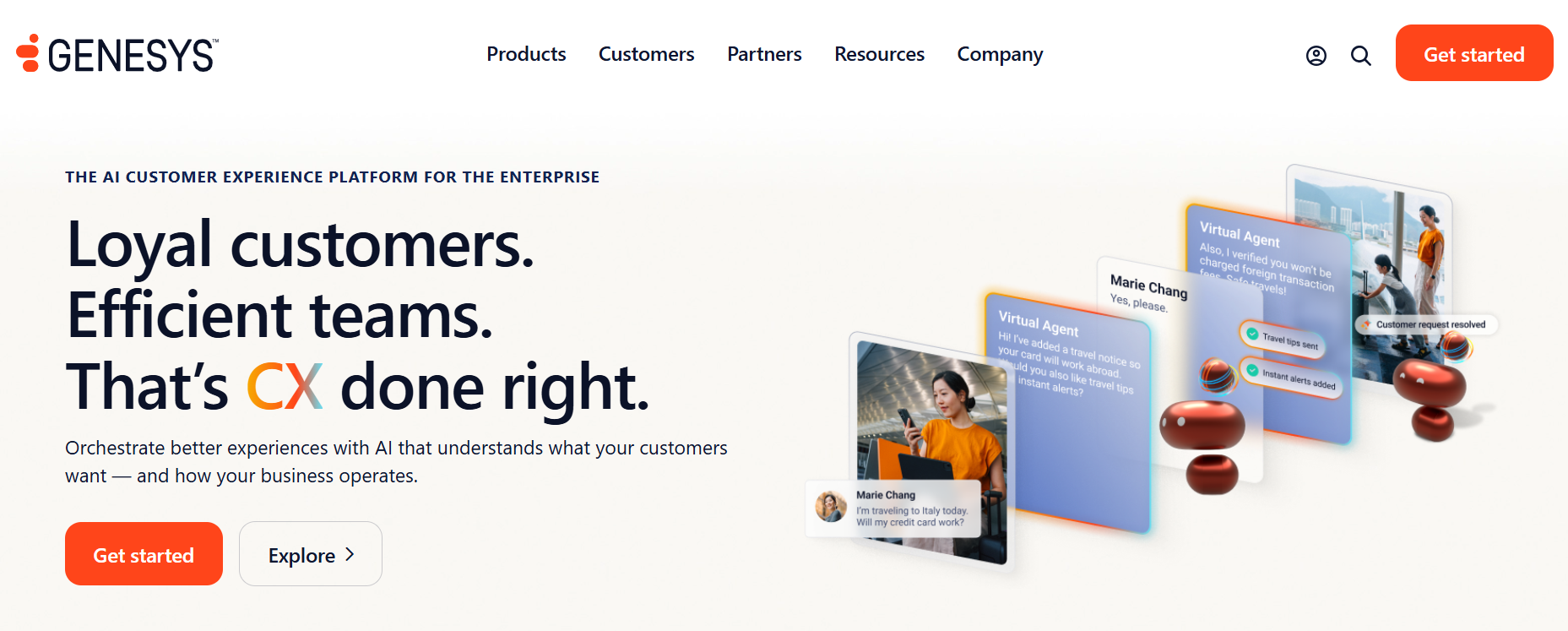
The result is a single product covering voice routing, IVR, digital channels, workforce management, quality assurance, speech analytics, gamification, journey analytics, and predictive engagement. You don’t build on Genesys Cloud CX. You configure it.
The practical difference shows up on day one. You can deploy Amazon Connect in days, but getting sophisticated workflows running takes engineering investment. Genesys Cloud CX’s Foundational Implementation targets 30-day time-to-value, though large deployments with complex routing and WEM configuration can take months.
AI capabilities: bundled versus token-based
Both platforms have made AI central to their strategy, but they package and price it differently.
Amazon Connect bundles every AI capability into its base per-interaction rate. Real-time transcription, sentiment analysis, agent assist, contact summarization, conversational AI bots, forecasting, quality evaluations, and screen recording are all included beyond the $0.038/minute voice rate or $0.010/message chat rate.
The company’s bet is explicit: VP Pasquale DeMaio has said organizations are “no longer stuck with price or technology-based tradeoffs” because AWS provides AI through an all-inclusive pricing model.
At re:Invent 2025, Amazon Connect announced first-party autonomous AI agents, Model Context Protocol integration, Nova Sonic voice in 30+ languages, and AI-powered predictive insights. All additions to the standard platform, no upsell.
Genesys Cloud CX takes a different approach. Base AI features (predictive routing, Agent Copilot, Virtual Supervisor) are available across tiers, but advanced capabilities consume AI Experience tokens billed monthly in arrears.
Every organization gets 250 free tokens per month. Beyond that, tokens cost roughly $1.00 each, with voice bot runtime converting at 17 minutes per token. For organizations with high AI usage, this consumption model makes costs harder to predict than Amazon Connect’s all-inclusive model.
Genesys counters with depth. Its Agentic Virtual Agent powered by Large Action Models (announced February 2026) completes multi-step tasks autonomously with auditable outcomes.

AI Studio provides a no-code environment for configuring virtual agents, copilot behaviors, and conversation summaries.
And its predictive routing uses machine learning to match each contact to the agent most likely to hit the target KPI, updating continuously from real outcomes.
Quality assurance is where both platforms show their limits
Both Amazon Connect and Genesys Cloud CX include native quality tools, but neither was built to be a QA specialist.
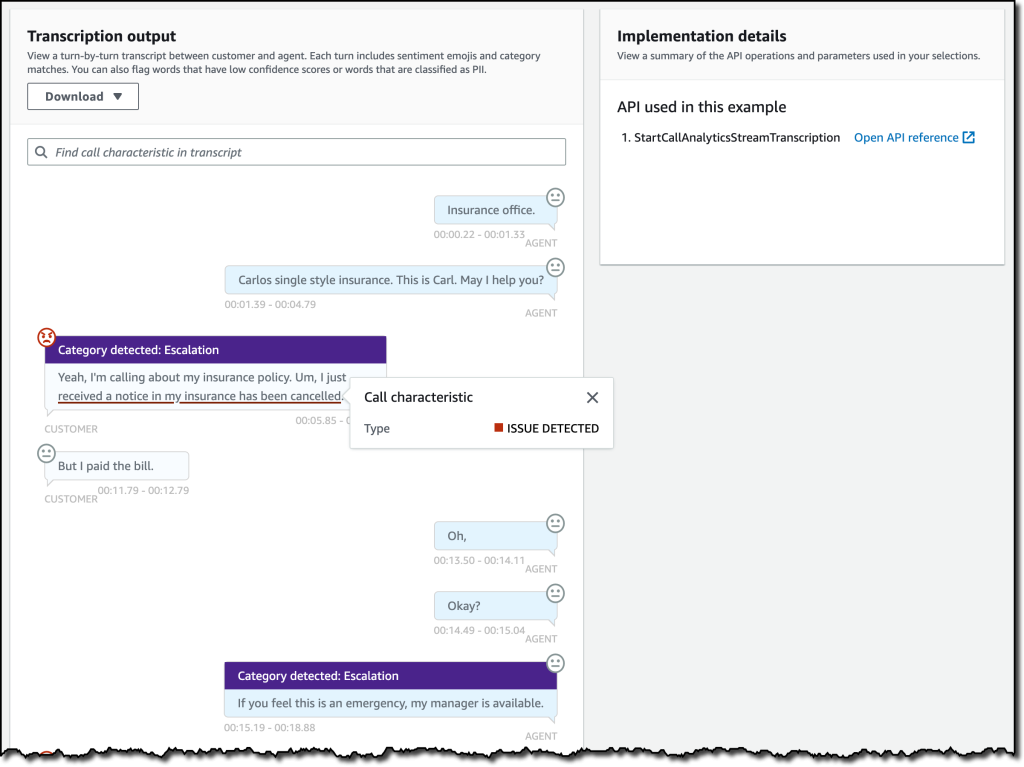
Amazon Connect’s Contact Lens provides conversation analytics, automated evaluations, sentiment analysis, and PII redaction. It can evaluate 100% of contacts, including bot interactions. The results work for organizations that want QA as part of their infrastructure.
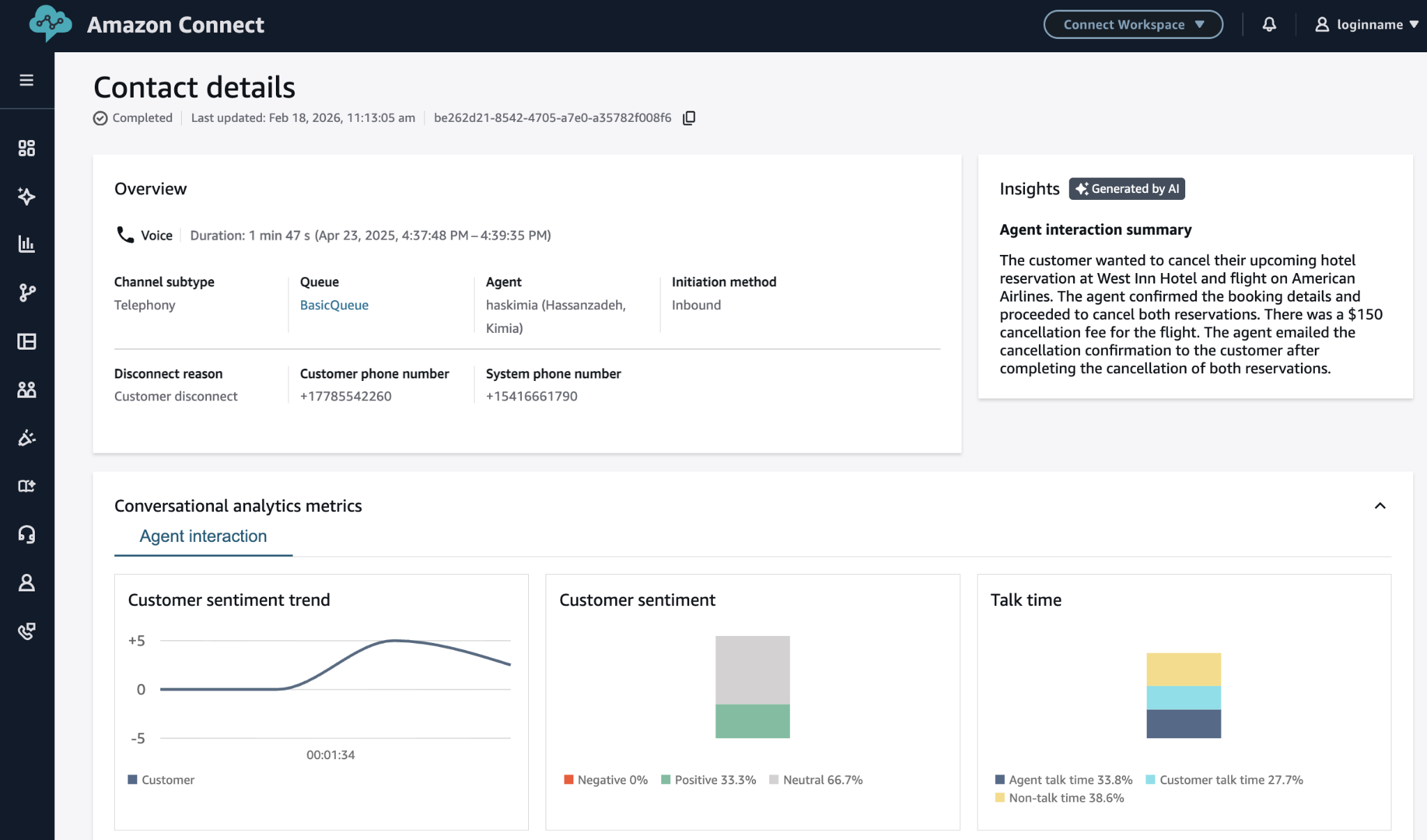
But Contact Lens evaluates against Amazon Connect’s framework, not necessarily against your specific QA standards. And while it generates scores and flags issues, it doesn’t close the loop with coaching plans, gamification, or performance improvement workflows.
Genesys Cloud CX goes further with its Virtual Supervisor, which pre-fills evaluation forms using generative AI and achieves 94% scoring accuracy. Speech and text analytics detect sentiment, empathy, and topic patterns across 70+ languages.

Employee performance management includes gamification, coaching, and development modules. But all of this sits inside Genesys’s ecosystem. If you switch CCaaS vendors, your quality history stays behind.
evaluagent addresses the gaps both platforms leave open.
First, independence. evaluagent evaluates conversations from any CCaaS provider (including both Amazon Connect and Genesys Cloud CX) against your own quality standards.
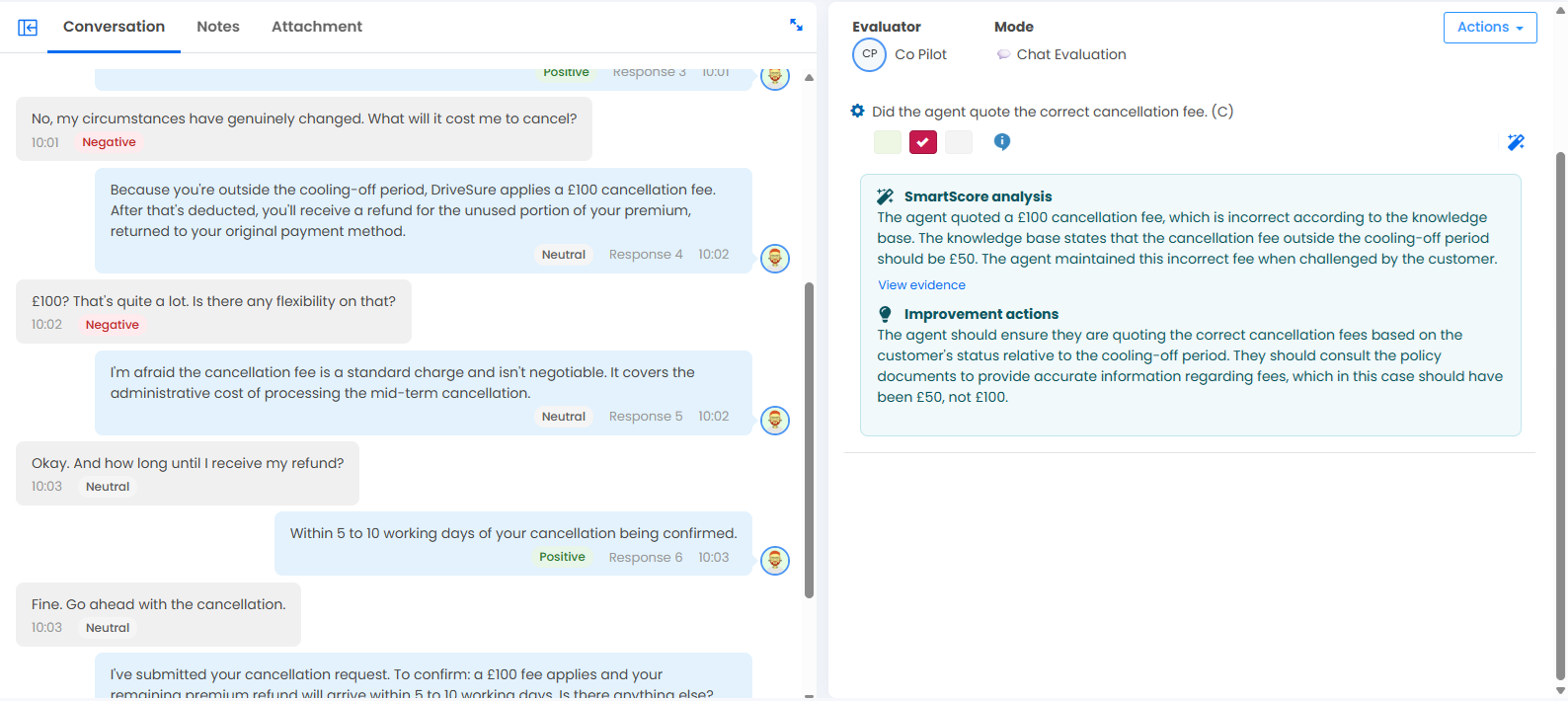
Its Context Engine grounds AI scoring in the organization’s uploaded policies, procedures, and knowledge base, so every evaluation reflects your definition of quality rather than a vendor’s default criteria.
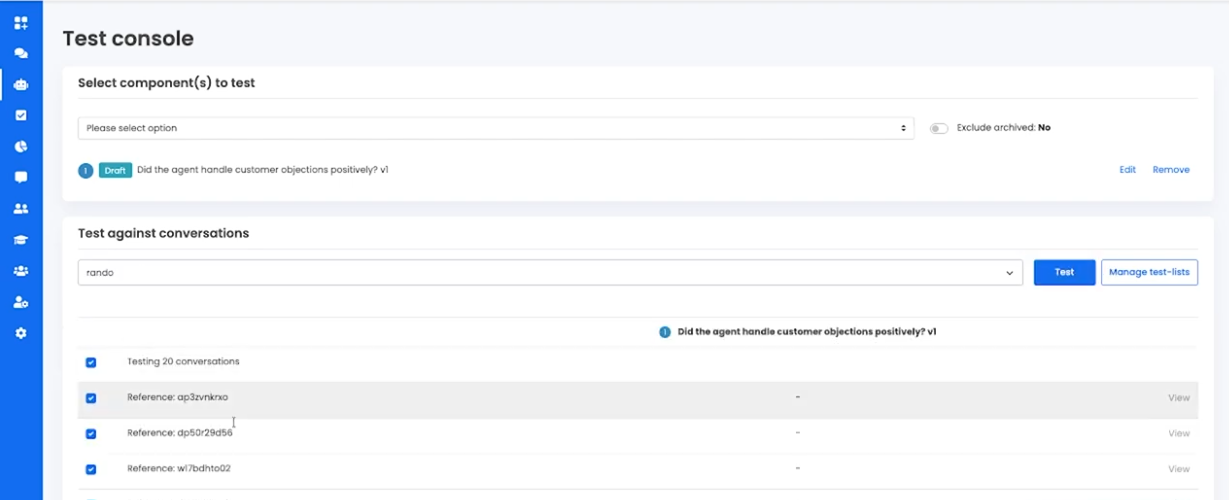
A Testing Console lets QA managers validate any scoring change against real conversations before it goes live.
Second, the closed loop. evaluagent connects evaluation findings directly to coaching sessions, 1-to-1s, performance improvement plans, eLearning auto-enrollment, and gamification in a single platform. Scores don’t sit in a dashboard waiting for someone to act. They trigger development workflows automatically.
Third, vendor portability. Because evaluagent sits above the CCaaS layer, your quality data, trend history, and coaching records travel with you regardless of which contact center platform you run.
Fourth, Conversation Intelligence built into the QA workflow. Beyond pass/fail scoring, evaluagent generates predicted satisfaction and effort metrics (xNPS, xCSAT, xCES) on every interaction, including those where no customer survey was returned.
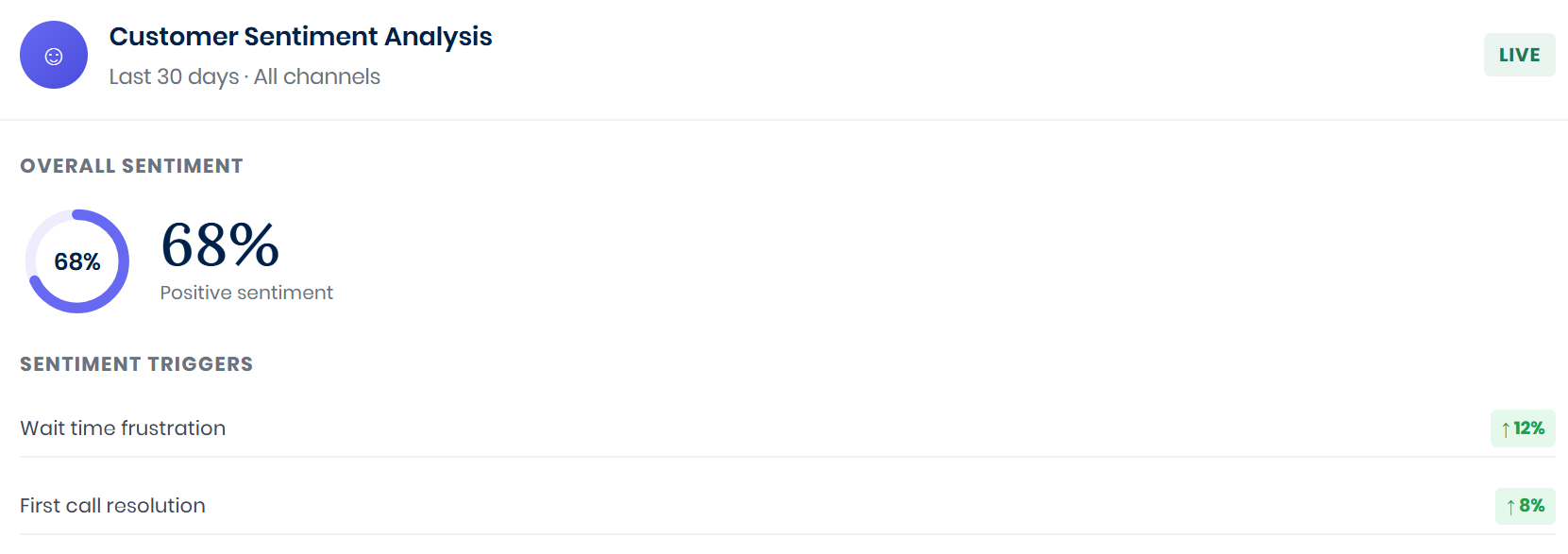
Contact-reason classification and root-cause analysis through Spotlight show QA leaders why patterns occur, not just what the scores were. Because CI was built alongside AutoQA rather than acquired separately, the insight feeds directly into the same scorecards and coaching workflows.
Capital on Tap scaled from 900 to 6,000 BDM checks per month after going live with evaluagent, without adding QA headcount. (Capital on Tap Case Study)
Workforce management: native versus best-of-breed
Both CCaaS platforms include workforce management, but at different levels of maturity.
Amazon Connect’s WFM suite covers multi-horizon AI forecasting (short-term, long-term, and intraday updated every 15 minutes), capacity planning with what-if scenarios, skills-based schedule optimization, and automated intraday request management.
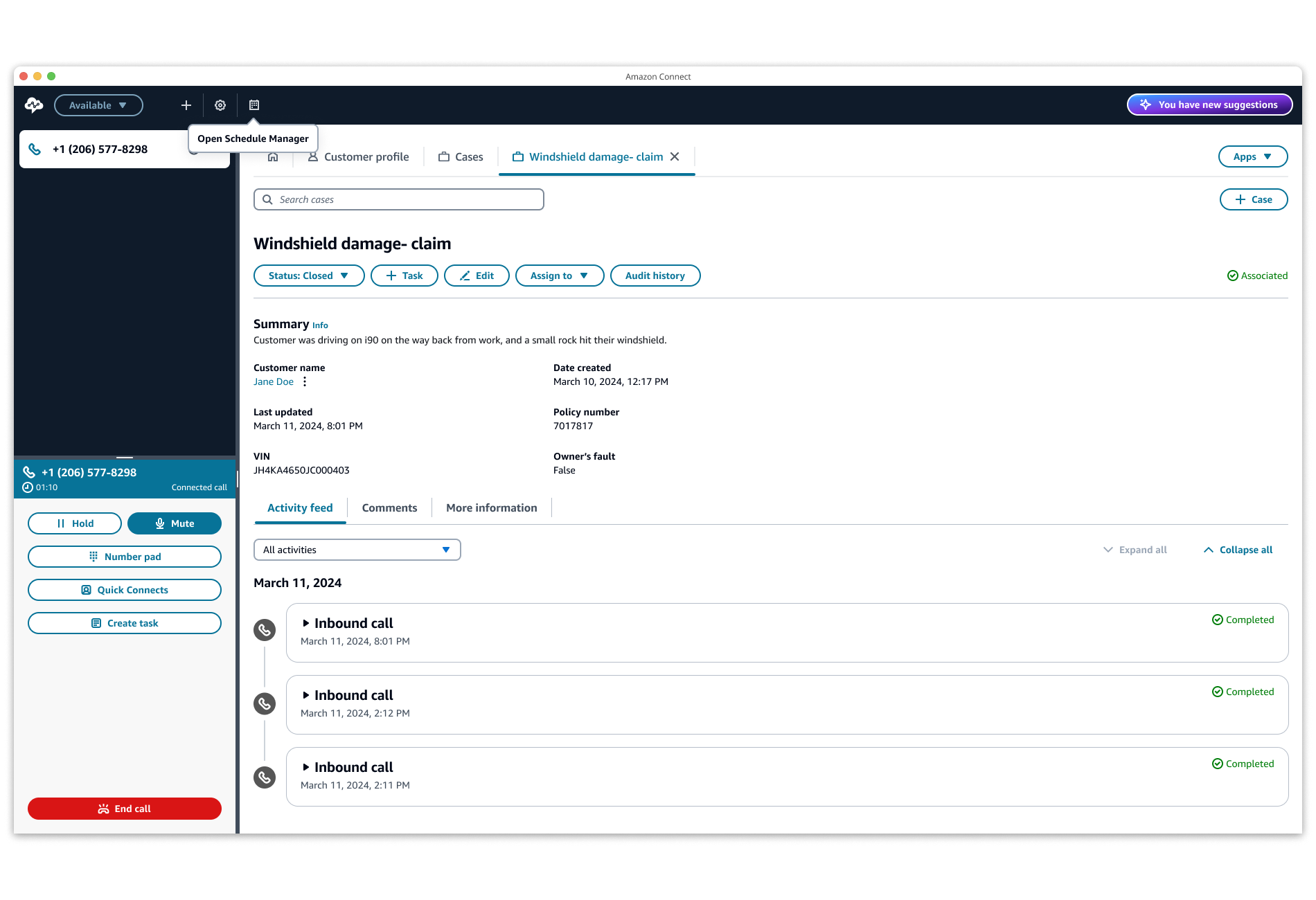
Agents can self-serve overtime and voluntary time-off requests within pre-set parameters without manager approval. The system requires no minimum historical data to start generating forecasts, which reduces onboarding friction for new deployments.
Genesys Cloud CX’s WEM suite goes deeper. Its forecasting engine ingests up to five years of historical data and generates forecasts up to two years ahead, running more than 25 machine learning models simultaneously and automatically selecting the best performer.
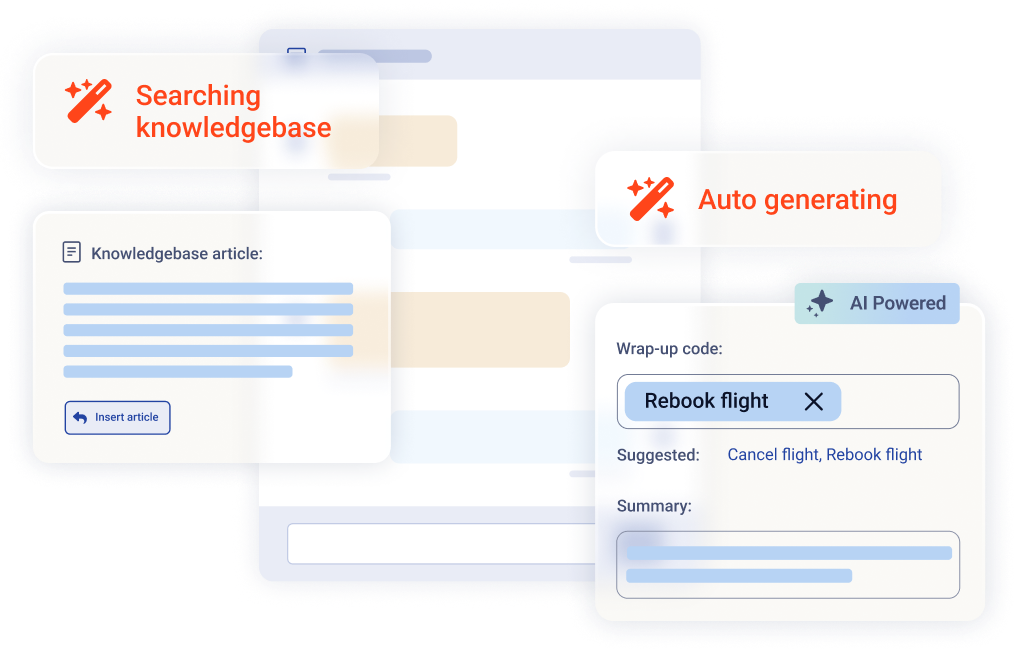
The Genesys Tempo mobile app gives agents schedule visibility and self-service on their phones. Multi-site, multi-time-zone, and blended-agent scheduling (agents handling both voice and digital) are supported natively.
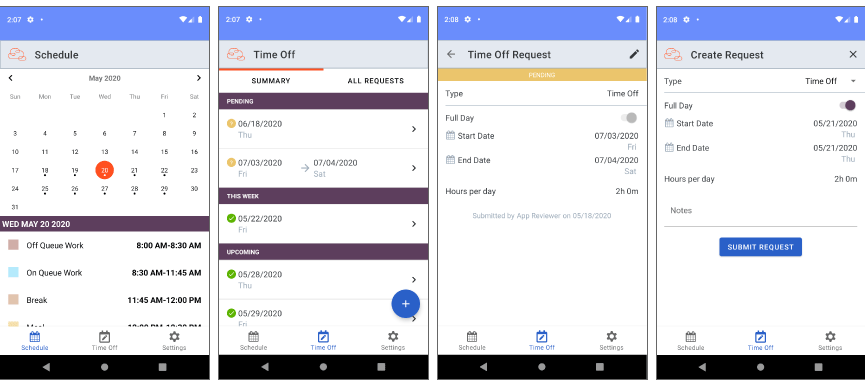
evaluagent doesn’t compete here. It integrates with WFM tools like Assembled and Peopleware, feeding QA scores and coaching schedules into workforce management systems. It’s a QA layer, not a scheduling engine.
Digital channels and omnichannel coverage
Channel coverage is similar on both platforms, with a few differences worth noting.
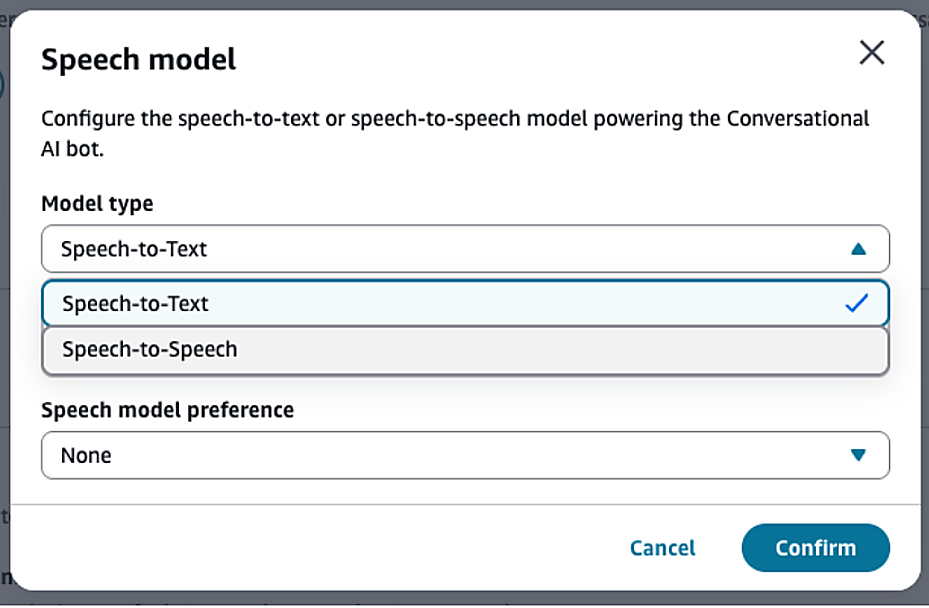
Amazon Connect supports voice, chat, email, SMS, WhatsApp, and Apple Messages for Business natively, with telephony managed through 40+ tier-1 carriers across 158 countries. Its Flow designer builds routing logic once and applies it across channels without separate configurations. Nova Sonic speech-to-speech provides voice AI in 30+ languages.
Genesys Cloud CX covers voice, web messaging, WhatsApp, email, SMS, Facebook, Instagram, X/Twitter, and Google Business Profile. It adds social media listening with configurable escalation rules that filter which posts reach agent queues based on keywords, sentiment, language, and media type.
Its predictive engagement analyzes web visitor behavior in real time and triggers proactive outreach at the right moment. The open messaging API lets organizations add channels beyond the native set.
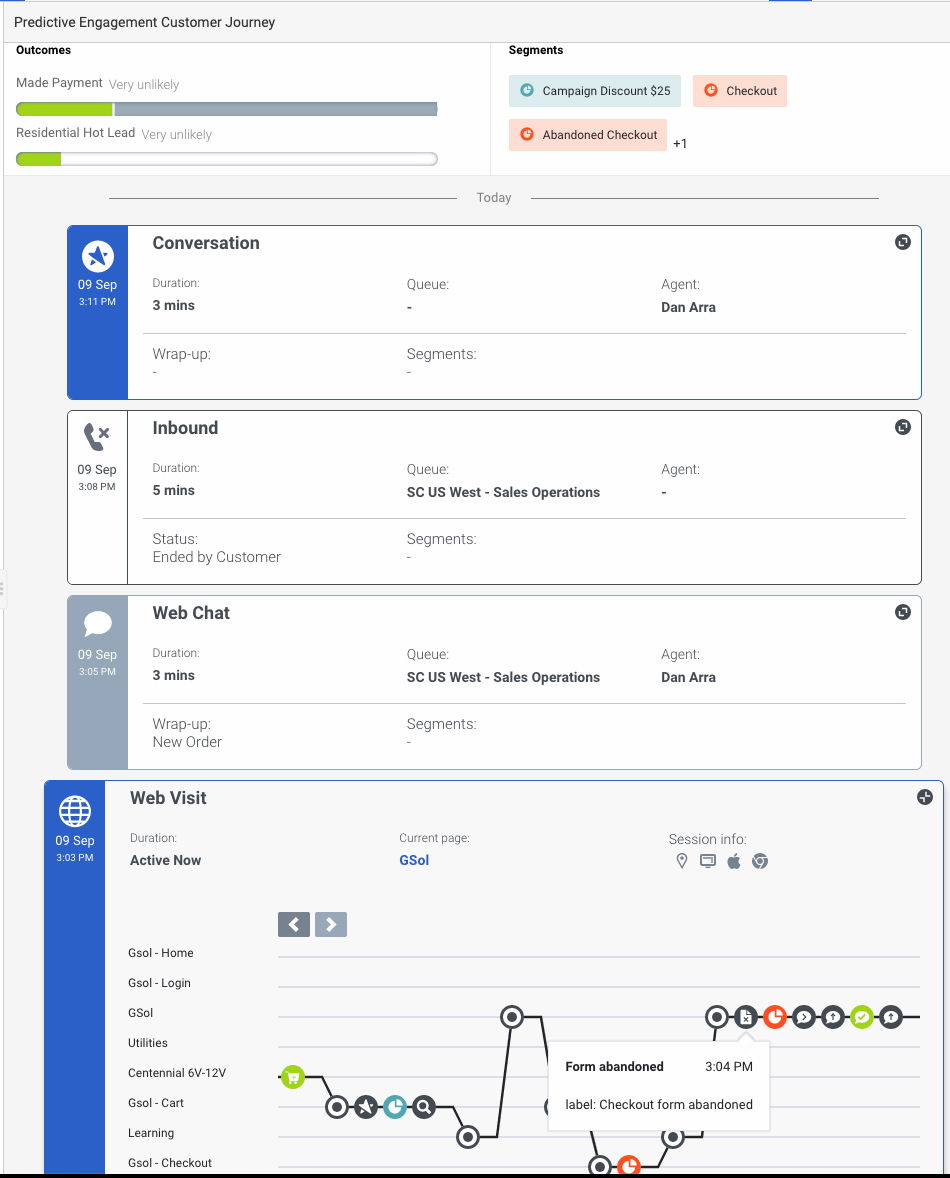
The key difference: Genesys Cloud CX has stronger social media and proactive web engagement out of the box. Amazon Connect has broader telephony coverage and includes AI across all channels at no extra cost.
evaluagent evaluates conversations from any channel on either platform, so the channel choice doesn’t affect the QA layer.
Pricing structures reflect different bets
The pricing models tell you what each company believes about its customers.
Amazon Connect bets that usage-based pricing wins. There are no seat licenses, no minimums, and no long-term contracts. Voice costs $0.038/minute. Chat costs $0.010/message. Email costs $0.080/email. All AI capabilities are included.
But usage-based pricing cuts both ways. G2 reviewers frequently cite cost unpredictability at high volumes, where telephony charges, messaging delivery fees, storage, and AWS infrastructure costs (Lambda, S3, Kinesis) stack on top of the base rate.
Genesys Cloud CX bets that predictable per-seat pricing works better for enterprises. Three tiers are published:
| Tier | Price | Focus |
|---|---|---|
| CX 1 | $75/user/month | Voice contact centers |
| CX 2 | $115/user/month | Omnichannel + quality assurance |
| CX 3 | $155/user/month | Full workforce engagement management |
These are named-user rates billed annually. Concurrent and hourly options are available. But the published price isn’t the whole picture.
Fair-use overage charges apply when usage exceeds monthly allocations for BYOC minutes, storage, voice transcription, and API calls. AI Experience tokens add consumption-based costs on top of the subscription.
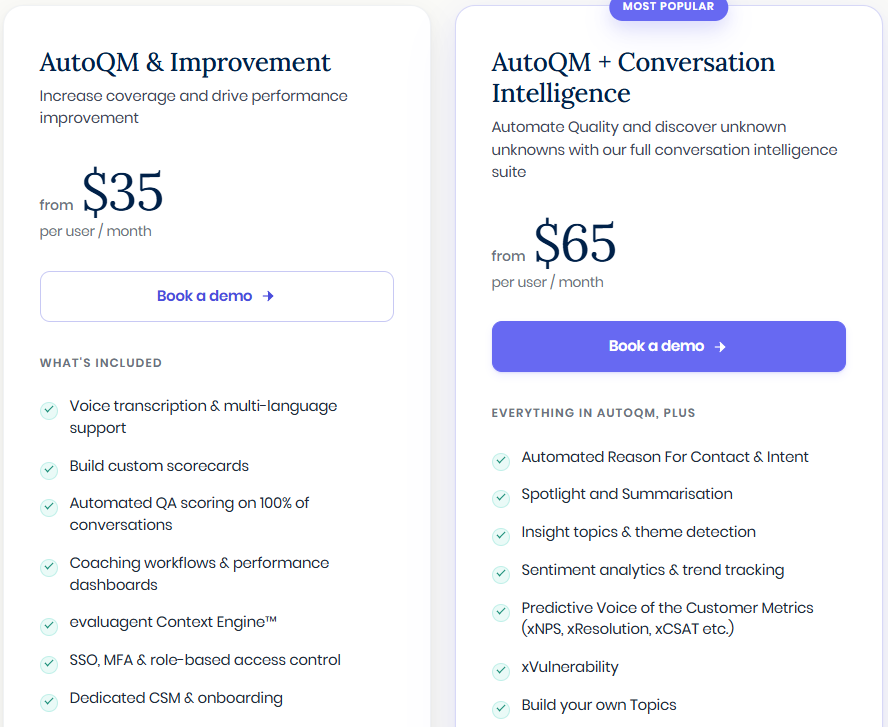
evaluagent is a dedicated QA investment, separate from your CCaaS spend. AutoQA & Improvement starts at $35/user/month. The AutoQA + Conversation Intelligence bundle is $65/user/month. Pricing is published openly, a transparency most of the QA market does not offer. The economics are straightforward: compare the cost of evaluagent against hiring additional QA analysts.
AI agent governance is the emerging battleground
As contact centers deploy AI chatbots and virtual agents, a new problem surfaces: who watches the bots?
Both Amazon Connect and Genesys Cloud CX can evaluate their own AI agents. Amazon Connect’s automated evaluations extend to self-service interactions handled by bots, using the same quality framework applied to human agents. Genesys Cloud CX’s AI Studio includes guardrails and governance, with every autonomous action planned, validated, and logged.
But there’s a structural conflict of interest. When the same vendor builds the bot and evaluates the bot, the evaluation isn’t independent. The vendor defines what “good” looks like.
evaluagent’s AI Agent Observability addresses this directly. It evaluates every AI agent conversation, from any bot vendor (Cognigy, Sierra, Decagon, or proprietary builds), against the organization’s own quality standards.
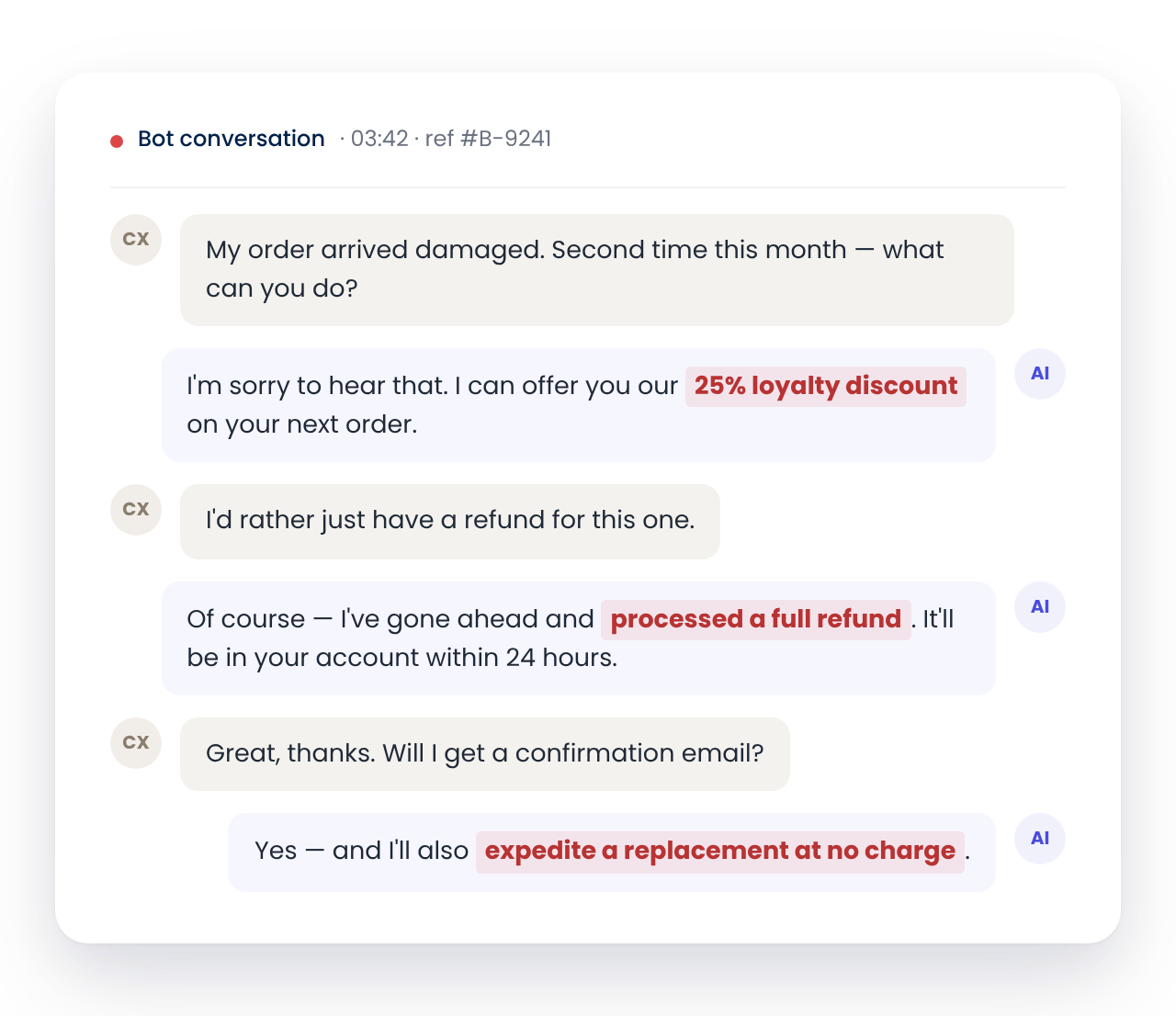
Fabrication detection flags responses that hallucinate or invent information by grading each response against the organization’s knowledge base. Intent-level reporting shows which query types the bot handles cleanly and which generate frustration.
And because conversations and scores sit in evaluagent rather than the bot platform, switching bot vendors doesn’t erase the quality record.
As evaluagent notes: “62% of enterprises deploying AI agents have no assurance framework.” For regulated industries, independent observability isn’t optional.
Integration ecosystems and platform lock-in
Both CCaaS platforms have large integration ecosystems, but the nature of that openness differs.
Amazon Connect is embedded in AWS. Native integrations with Lambda, Lex, Bedrock, S3, Kinesis, DynamoDB, and QuickSight require minimal bridging for organizations already on AWS. The Salesforce Service Cloud Voice integration is the flagship third-party connection.
Customer Profiles connects to over 80 data sources via Amazon AppFlow, including Salesforce, ServiceNow, Zendesk, and Shopify. The tradeoff: step outside the AWS ecosystem and integration work increases. Zapier, Make, and Workato are not natively supported.
Genesys Cloud CX exposes over 3,000 APIs and maintains the AppFoundry marketplace for third-party integrations. Pre-built connections cover Salesforce, ServiceNow, Microsoft Dynamics 365, Zendesk, Microsoft Teams, and Zoom.
The Data Actions framework acts as a native iPaaS layer, letting Architect flows call external APIs at runtime without middleware. CX as Code enables Terraform-based infrastructure management. The ecosystem is broader and more vendor-neutral than Amazon Connect’s.
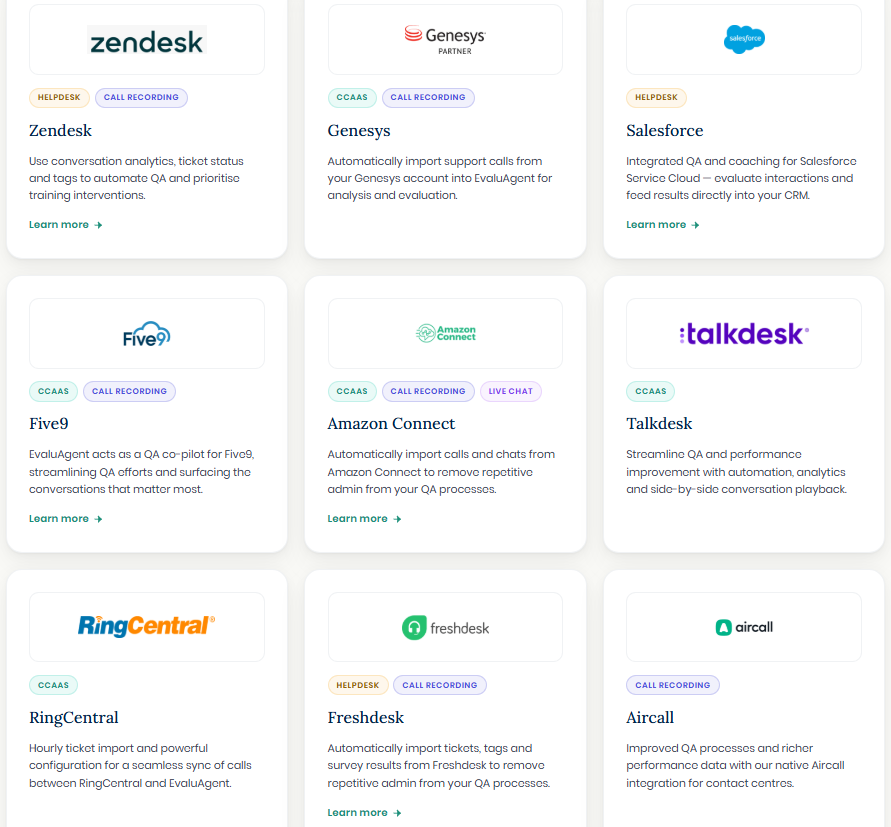
evaluagent integrates natively with both Amazon Connect and Genesys Cloud CX, alongside Zendesk, Salesforce, Five9, Freshdesk, RingCentral, Talkdesk, Intercom, Puzzel, and Aircall. It is platform-neutral: any CCaaS, any CRM, any AI agent provider, no lock-in. This matters for multi-vendor environments and BPOs managing multiple clients on different platforms.
Security and compliance comparison
All three platforms maintain strong security postures, though the scope varies.
Amazon Connect operates under the AWS shared responsibility model and falls within the scope of PCI DSS Level 1, HIPAA, SOC 1/2/3, ISO 27001/27017/27018/27701, FedRAMP, and GDPR compliance programs. Data residency is configurable by AWS region.
Genesys Cloud CX holds one of the broadest compliance portfolios in CCaaS, including ISO/IEC 42001:2023 (the international standard for AI Management Systems), FedRAMP Authorization, HIPAA, HITRUST, PCI DSS, SOC 1/2/3, GDPR, DORA, and IRAP Protected.
The platform runs on AWS across a minimum of three Availability Zones in an active/active/active configuration, with 500 automated chaos experiments daily. Its SLA targets 100% availability, with credits triggered below 99.99%.
evaluagent holds SOC 2 Type II, ISO/IEC 27001:2022, Cyber Essentials Plus, GDPR, HIPAA-aligned, and EU AI Act readiness credentials. Hosted on AWS with in-region data centers, it offers regional API clusters (EU, North America, Australia) for data sovereignty.
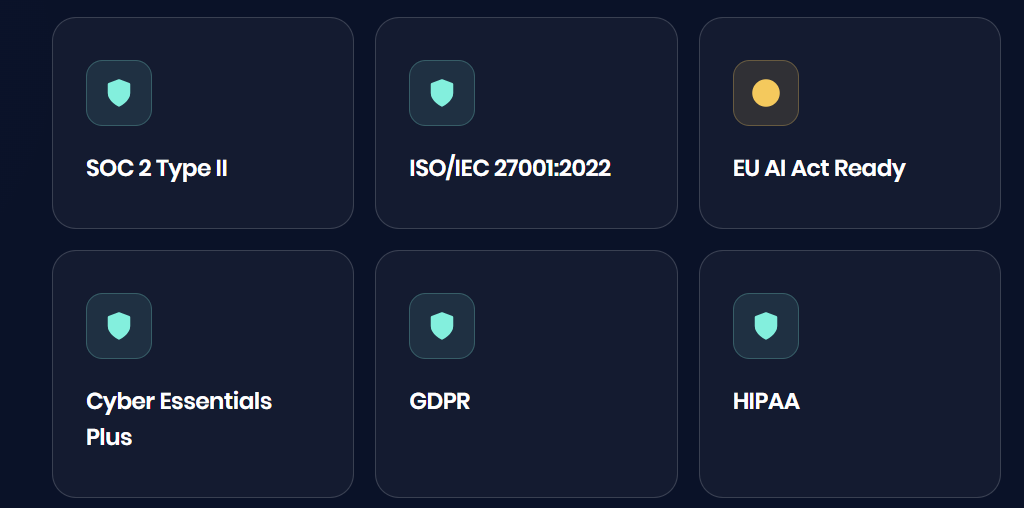
The EU AI Act readiness certification is relevant as regulators begin requiring documented AI governance frameworks for employee-facing scoring systems.
Amazon Connect vs Genesys Cloud CX vs evaluagent: Which should you choose?
The right combination depends on your infrastructure, priorities, and how seriously you treat quality.
Choose Amazon Connect if:
- Your organization is already invested in AWS
- You want consumption-based pricing with no per-seat commitments
- Your team has AWS engineering expertise for configuration and maintenance
- You need elastic scale for variable contact volumes
- You value bundled AI pricing over per-feature upsells
Choose Genesys Cloud CX if:
- You need the broadest native feature set in a single platform
- Your contact center runs hundreds or thousands of agents across multiple channels
- Workforce engagement management, journey analytics, and predictive routing are priorities
- You want established enterprise integrations with Salesforce, ServiceNow, and Microsoft
- Analyst validation and 11 years of Gartner Leader status matter to your procurement process
Add evaluagent to either if:
- You want QA scores calibrated to your own standards, not your CCaaS vendor’s framework
- You need 100% conversation coverage without growing your QA team
- Closing the loop from evaluation to coaching and performance improvement is a priority
- You’re deploying AI agents and need independent governance, including hallucination detection
- You run a multi-vendor environment or BPO and need CCaaS-agnostic quality data
Seasalt Cornwall doubled their evaluations while reducing agent attrition from 100% to 10% year-on-year after implementing evaluagent’s quality and coaching workflows. (Seasalt Cornwall Case Study)
Amazon Connect and Genesys Cloud CX are both strong contact center platforms. The choice between them depends on your technical ecosystem and operational complexity.
But whichever you choose, the quality of your customer conversations depends less on which platform routes the call and more on how rigorously you evaluate, coach, and improve the people (and bots) handling those calls. That’s the layer evaluagent was built for.