If you’re comparing NICE CXone vs Zendesk, the decision hinges on a few questions most comparisons overlook:
- Do you need a full enterprise contact center suite with workforce management, quality monitoring, and advanced routing, or a service platform built around ticketing and AI-first resolution?
- Is voice your primary channel, or does your operation run mainly on messaging, email, and chat?
- How large is your contact center? Are you managing 500+ agents across multiple geographies, or running a leaner operation under 500?
- Are you willing to accept bundled quality management as one module among dozens, or does QA deserve a dedicated, independent tool?
- Do you want to lock your quality data inside your CCaaS vendor, or keep it portable and vendor-neutral?
In short, here’s what we recommend:
NICE CXone is built for large enterprise contact centers that want everything under one roof. With native workforce management, quality management, interaction analytics, omnichannel routing, and agentic AI, it is the broadest CCaaS platform on the market, backed by 11 consecutive years as a Gartner Magic Quadrant Leader. It is the default choice for 500+ agent operations that need compliance infrastructure and vendor consolidation. The trade-off is complexity: pricing requires modeling across per-seat fees, per-session charges, and add-on modules, and the platform demands ongoing IT investment to configure and maintain.
Zendesk takes a different approach. Originally a help desk, it has evolved into an AI-first service platform that unifies ticketing, messaging, voice, knowledge management, and AI agents in a single workspace. Its AI is trained on roughly 20 billion ticket interactions, and the platform offers lower entry pricing and faster implementation than NICE CXone. For mid-market teams and digital-first contact centers that value accessible tools over platform depth, Zendesk delivers. Its contact center product is newer (built on an Amazon Connect partnership), though, and QA and WFM are paid add-ons rather than core inclusions.
Both platforms offer quality management as part of their broader suites. But when QA is one feature among dozens, it rarely gets the depth it deserves. For contact centers where quality is the priority (not an afterthought), there is a dedicated option.
evaluagent is the independent QA and performance improvement platform built for contact centers. It scores 100% of conversations automatically across voice, chat, and email, then closes the loop with coaching, performance plans, and gamification. Its Context Engine grounds AI scoring in your own policies, compliance rules, and knowledge base content. Because evaluagent is CCaaS-agnostic, it integrates with both Zendesk and NICE CXone (plus Genesys, Five9, Talkdesk, and more), so you can choose or change your contact center platform without losing your quality data.
If platform-neutral quality assurance is what your contact center needs, book a demo with evaluagent.
NICE CXone vs Zendesk vs evaluagent at a glance
| NICE CXone | Zendesk | evaluagent | |
|---|---|---|---|
| Primary function | Full enterprise CCaaS platform | AI-first customer service platform | Contact center QA & performance management |
| Platform scope | Routing, IVR, WFM, QM, analytics, agentic AI | Ticketing, messaging, voice, AI agents, knowledge base | AutoQA, conversation intelligence, coaching, AI agent observability |
| Quality management | Included (module in Workforce Empowerment suite) | Add-on ($50/agent/month) | Core product with full coverage and closed-loop coaching |
| AI approach | Enlighten AI (CX-trained, LLM-agnostic) | Resolution Learning Loop (20B+ interactions) | Context Engine (grounded in your policies and knowledge base) |
| CCaaS-agnostic | No (platform-native only) | No (platform-native only) | Yes (works with any CCaaS or helpdesk) |
| AI agent governance | Cognigy Simulator for pre-deployment testing | AI Agent QA for scoring bot conversations | Independent hallucination detection and observability across bot vendors |
| Analyst recognition | Gartner MQ Leader 11 years; Forrester Wave Leader | Gartner MQ Leader (CRM CEC); Forrester Strong Performer | G2 Leader, Contact Center QA (Summer 2026); SPARK Matrix Strong Contender |
| Starting price | $110/agent/month | $55/agent/month (Suite Team) | $35/user/month |
| Free trial | 60 days | 14 days | Demo-based (case-by-case trials) |
| Best for | Large enterprise contact centers (500+ agents) | Mid-market and digital-first service teams | QA-focused contact centers on any platform |
Full suite vs service platform vs QA specialist
The fundamental difference between these three products is scope.
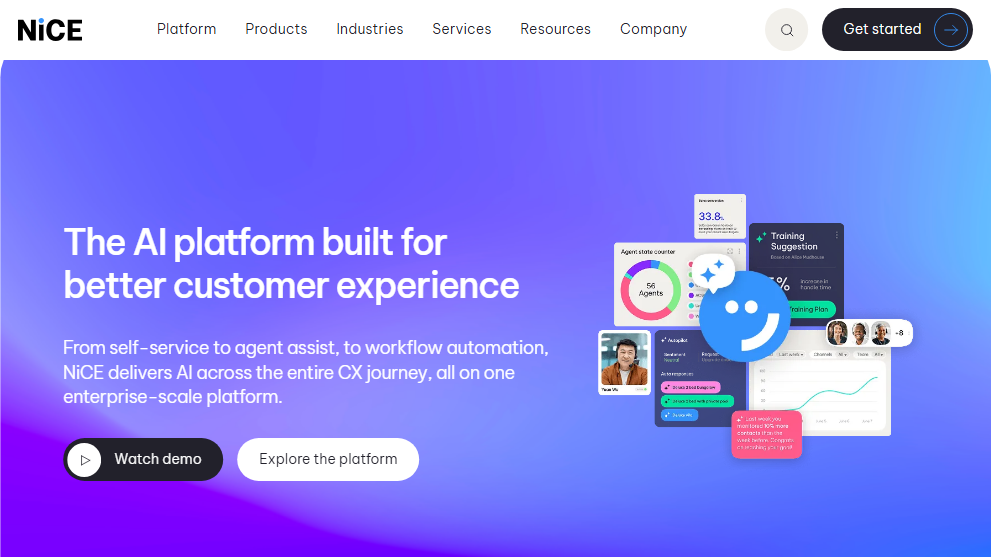
NICE CXone is a contact center operating system.
It handles everything from call routing and IVR to workforce scheduling, quality scoring, interaction analytics, and agentic AI, all within a single platform. Forrester gave it the highest possible score in 17 evaluation criteria in Q2 2025, calling it the broadest capability set in the industry. For enterprises consolidating five or ten point solutions into one vendor, that breadth has real value.
But breadth has a cost: each capability competes for development attention, and users note that reporting and performance management require manual effort and raw data extraction to produce useful output.
Zendesk approaches customer service from the other direction.
It started as a ticketing platform and expanded into messaging, voice, knowledge management, AI agents, and workforce tools. The experience centers on the Agent Workspace, where tickets from every channel converge in a single view. Zendesk’s strength is accessibility: it deploys faster, suits smaller teams, and costs less at the entry level.
Its limitation is depth. The voice and contact center capabilities (built on an Amazon Connect partnership) are newer than NICE CXone’s native telephony, and QA and WFM are add-ons rather than core inclusions.

evaluagent does not try to be either.
It is a dedicated QA and performance improvement platform that sits on top of whichever CCaaS or helpdesk you already use. Where NICE CXone and Zendesk treat QA as one feature among many, evaluagent’s entire product is built around scoring 100% of interactions, connecting those scores to coaching, and measuring whether agents actually improve.
This focus produces capabilities neither full-suite platform matches: the Context Engine validates factual accuracy against your own knowledge base, blended scorecards mix AI and human evaluator judgments on a single scorecard, and AI Agent Observability governs bot conversations independently of the bot vendor.
Quality management is where depth matters
Both NICE CXone and Zendesk can score interactions. The question is how deep that scoring goes and what happens after.
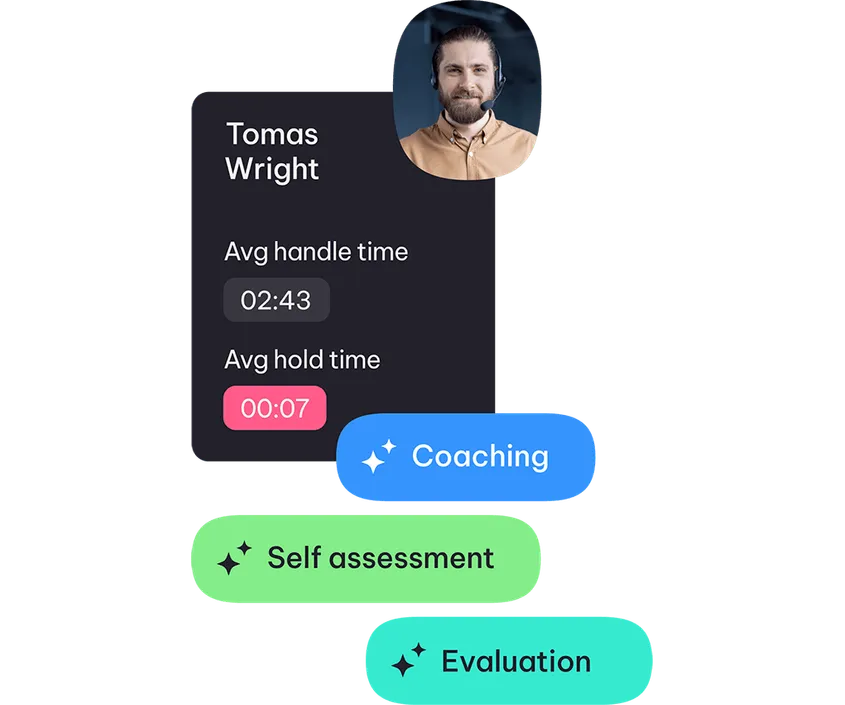
NICE CXone’s Quality Management uses LLMs and NICE’s Enlighten AI to score 100% of interactions across voice, chat, email, social, and CRM tickets. Supervisors receive AI-generated summaries, and agents get personalized scorecards. The module also includes performance management with gamification and a desktop activity monitor.
For enterprises already running the full CXone suite, QM is a natural extension. The challenge is that it is one component inside a large platform, and users report that performance reporting requires manually pulling raw data and that reports can be inconsistent across report types.
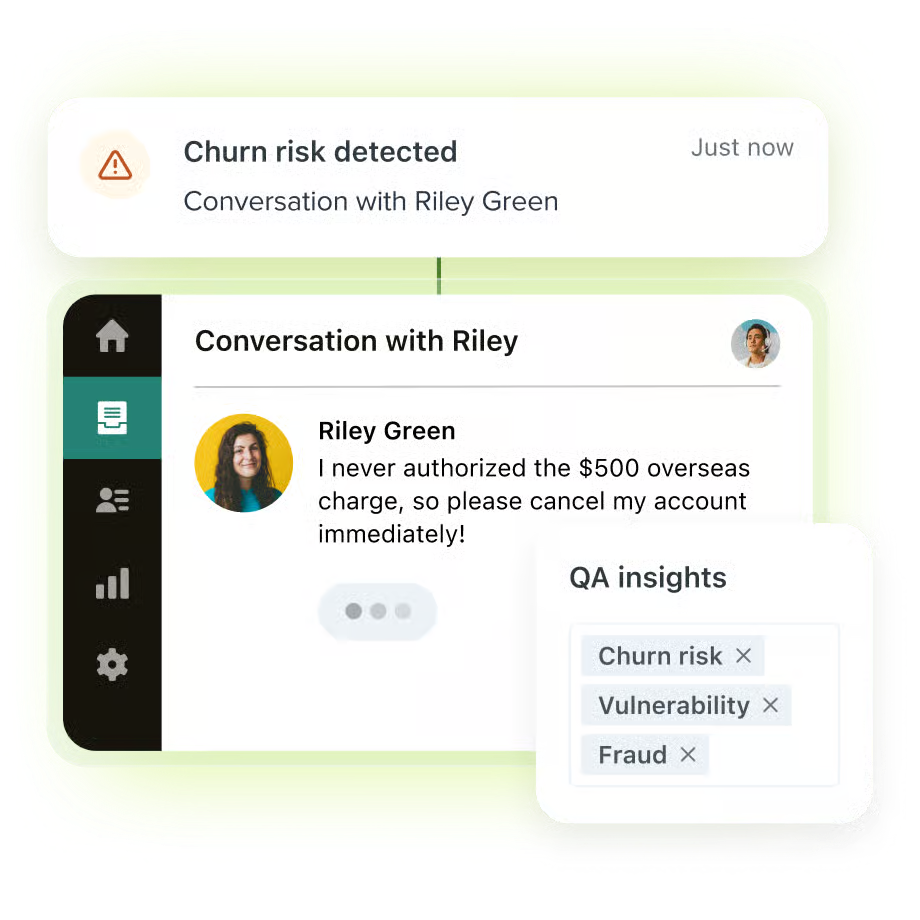
Zendesk’s Quality Assurance is a more recent addition, built partly from its 2023 Tymeshift acquisition. Its AutoQA engine scores every interaction against configurable categories (both standard and custom, defined in plain language), and the Spotlight feature flags churn risks, escalations, and knowledge gaps automatically. It also scores AI agent conversations.
The limitation is that QA costs $50/agent/month on top of the base plan and lacks the closed-loop coaching that dedicated QA platforms provide.
evaluagent’s AutoQA was built from the ground up as a quality management system, not adapted from a broader platform.
The Context Engine goes beyond behavioral scoring to validate whether agents gave the right answer, grounded in uploaded company policies and knowledge base content. A Testing Console lets QA managers test any scoring change against real conversations before it goes live. Blended Scorecards combine AI-automated checks with human evaluator judgments on the same scorecard.
Scoring connects directly to coaching sessions, performance plans, eLearning modules, and gamification without leaving the platform, closing the loop from insight to measurable improvement.
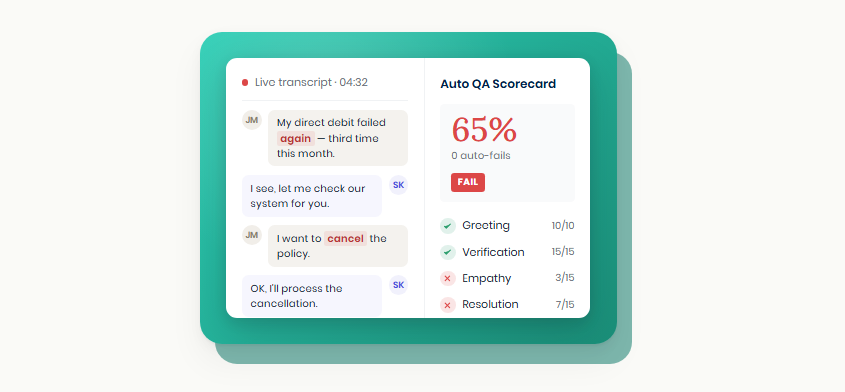
Scoring every conversation also opens the door to evaluagent’s Conversation Intelligence suite. xMetrics generate predicted CSAT, NPS, and effort scores on every interaction (including those where no survey was returned). Spotlight surfaces root causes behind emerging patterns, and Reason for Contact classifies demand drivers across the full conversation volume. AutoQA defines what the organization should measure; Conversation Intelligence shows what to measure next.
Capital on Tap scaled from 900 to 6,000 quality checks per month after going live, without adding headcount. (Capital on Tap Case Study)
AI capabilities serve different missions
All three platforms use AI. Each applies it to a different problem.
NICE CXone’s Enlighten AI is trained on decades of contact center data and powers everything from routing decisions to agent assist to agentic AI resolution.
The platform is LLM-agnostic, supporting models from OpenAI, Anthropic, Google, Mistral, and Amazon Bedrock. The Cognigy acquisition (completed September 2025 for $955 million) added conversational and agentic AI, and the combined offering includes the Cognigy Simulator for testing AI agents before production deployment. NICE’s AI goal is to automate entire customer journeys across front, mid, and back office.
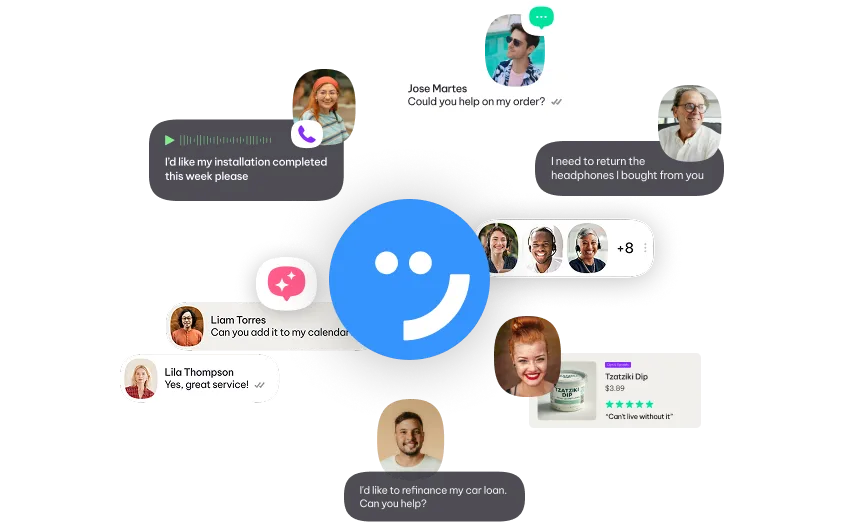
Zendesk’s AI is anchored in the Resolution Learning Loop, trained on roughly 20 billion ticket interactions.
AI Agents resolve customer issues autonomously across messaging, email, and voice, while Copilot guides human agents with suggested replies and next-best actions during live conversations. The Forethought acquisition (completed March 2026) added AI agents that detect failing procedures and refine their own workflows without manual retraining. Zendesk’s AI focus is resolution: verify that the issue was actually solved, not just deflected.
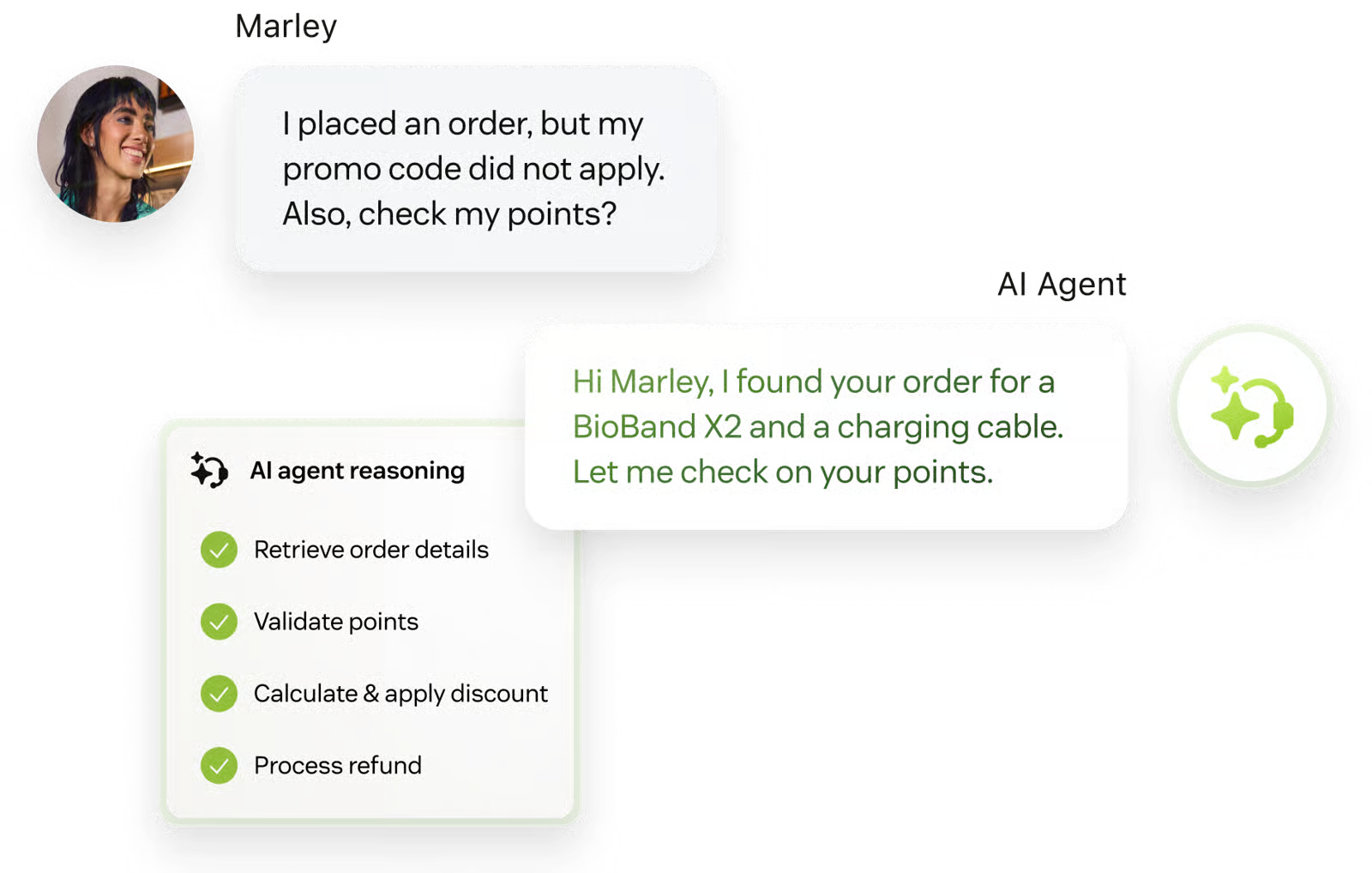
evaluagent applies AI to a different problem: evaluating whether interactions (human or AI) met your quality standard.
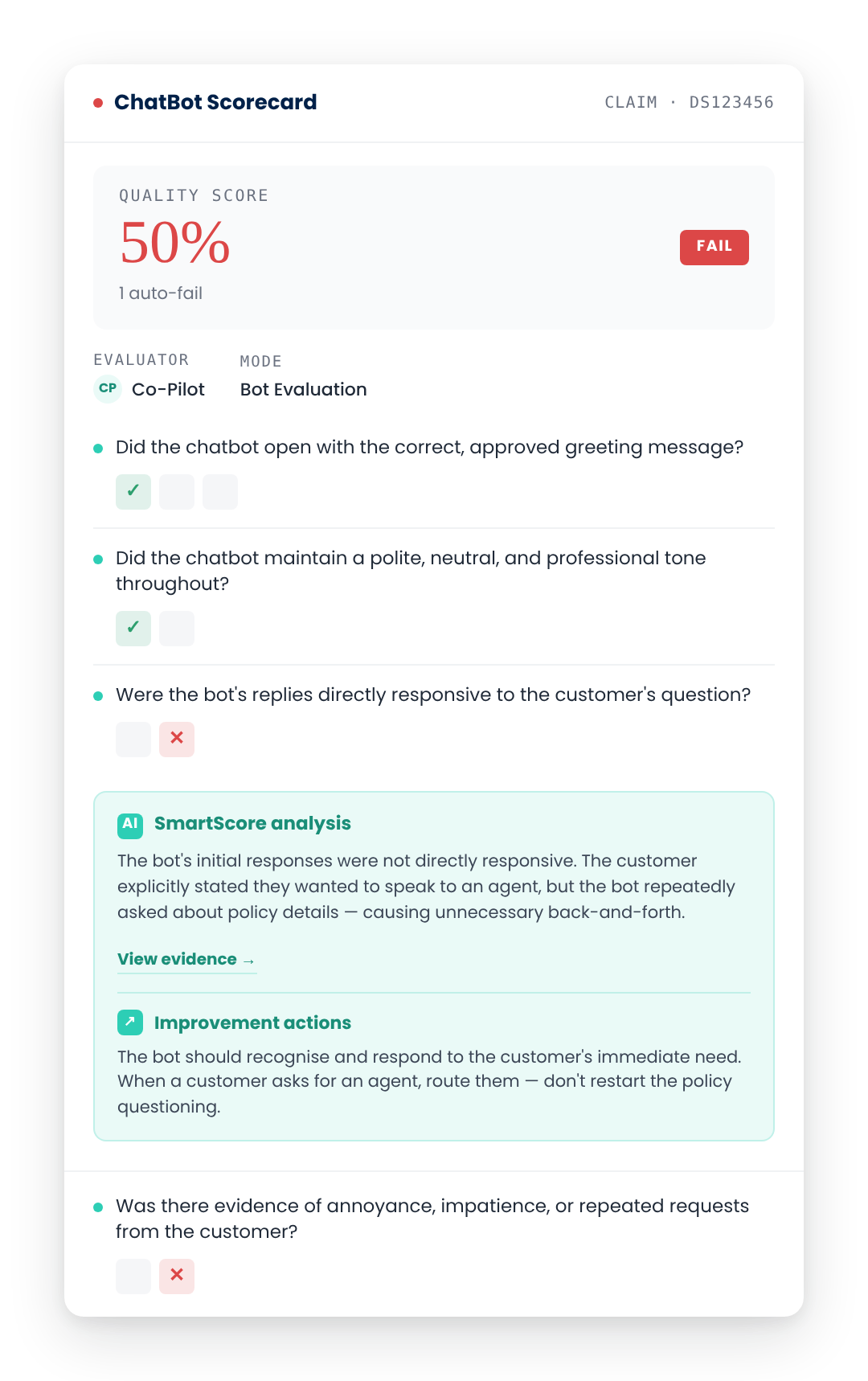
The Context Engine grounds every AI score in your specific policies, tone-of-voice guidelines, and compliance rules, then explains the reasoning behind each mark. SmartScore handles qualitative line items with transparent explanations. And AI Agent Observability applies this same rigor to bot conversations, with fabrication detection that flags hallucinated responses by grading them against your organization’s own source of truth.
This matters because as NICE CXone and Zendesk deploy more AI agents, someone needs to independently verify whether those agents give correct answers. The bot vendor has a conflict of interest in self-reporting quality. evaluagent’s stance is explicit: “Don’t solely rely on your bot vendor’s metrics.”
Pricing models reveal different market targets
The pricing structures tell you who each platform is built for.
NICE CXone starts at $110/agent/month for the Omnichannel Suite and scales to $249/agent/month for the Ultimate Suite, which adds a $0.25 per-session consumption charge. Quality Management, Workforce Management, and Interaction Analytics are add-ons in most tiers, included only at the Ultimate level.
Users note that the pricing involves numerous separately priced add-ons and SKUs, making total cost modeling complex. Industry-specific packages (banking, healthcare, insurance) run $249/agent/month plus per-session fees. A government-specific package uses a different model at $2/consumer/year. Contracts are non-cancelable with minimum monthly and annual recurring charge floors.
Zendesk enters lower at $55/agent/month for Suite Team, with Suite Professional at $115/agent/month and Enterprise at custom pricing.
The features that make Zendesk competitive for contact centers, however, are add-ons: QA is $50/agent/month, WFM is $50/agent/month, and the Contact Center module is $50/agent/month. AI agent resolutions are priced per outcome, with plan allowances (5 to 15 automated resolutions per agent per month depending on tier) and overage billing beyond that. A mid-market team that needs Suite Professional plus QA plus WFM is looking at $215/agent/month before voice usage and AI overages.
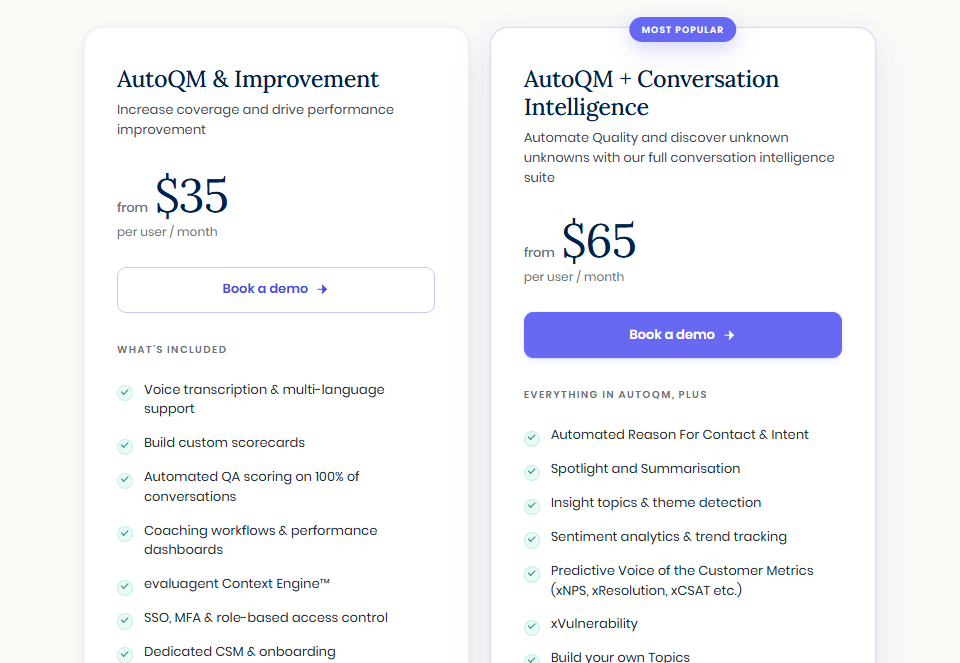
evaluagent prices for QA alone: $35/user/month for AutoQA & Improvement, or $65/user/month for the Full Bundle with Conversation Intelligence.
AI Agent Observability adds $0.05 to $0.13 per conversation on top of a seat tier. No routing costs, no telephony fees, no WFM charges. If your CCaaS already handles routing, voice, and scheduling, evaluagent delivers specialist QA (with pricing published on its website) without requiring a full-suite platform license.
The pricing difference becomes clear at scale.
A 200-agent contact center on NICE CXone Ultimate spends roughly $49,800/month on seats alone (before session charges). The same team on Zendesk Suite Professional plus QA and WFM spends approximately $43,000/month. Adding evaluagent’s Full Bundle to an existing Zendesk or NICE CXone deployment costs $13,000/month for 200 users, delivering deeper QA without replacing the underlying platform.
Implementation speed and usability
NICE CXone’s breadth brings configuration weight.
The platform is built for large deployments, so administrators face setup across IVR flows, routing rules, WFM parameters, quality scorecards, interaction analytics categories, and security policies.
Users describe an app that requires restarts and can struggle with VDI environments. The 60-day trial reflects this: NICE knows the platform takes time to evaluate. Core functionality can go live within about one week during a trial, with advanced applications requiring up to three weeks.
Zendesk is more accessible.
The Agent Workspace centralizes all channels in a single interface, and the platform earned a Gartner MQ Leader position partly on the strength of its user experience. AI agents can be built with the Agent Builder, a no-code interface for describing workflows in plain language. Basic operations can run in hours, though enterprise configurations with triggers, automations, custom fields, and multi-brand setups still require dedicated admin time.
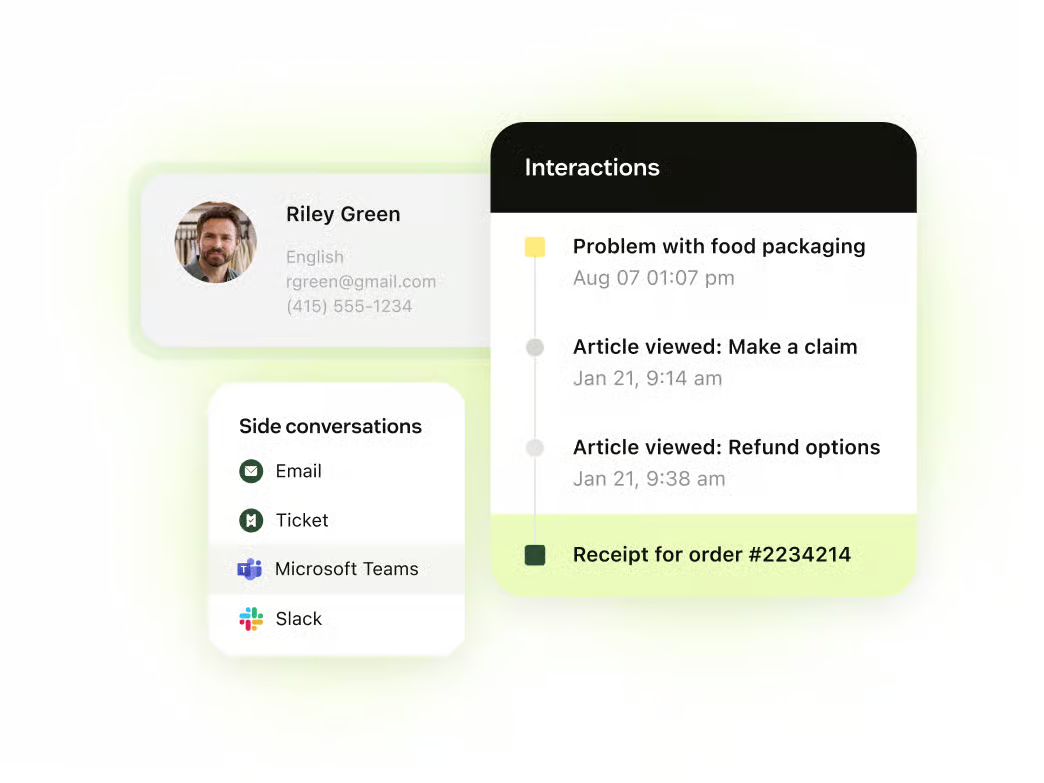
evaluagent deploys fast because it skips routing, telephony, and workforce scheduling.
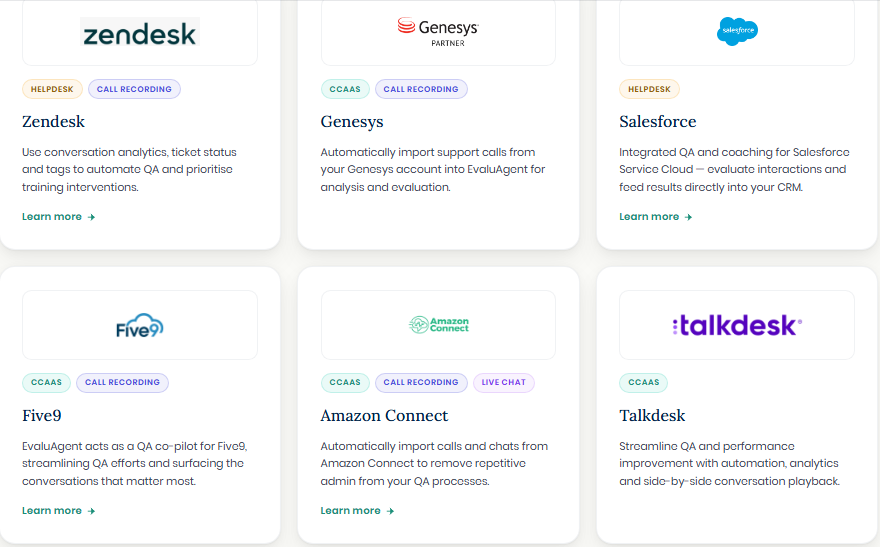
It connects to your existing CCaaS or helpdesk via native integrations with Zendesk, Salesforce, Genesys, Five9, Amazon Connect, Talkdesk, RingCentral, Intercom, and others. A dedicated onboarding team handles the migration, and most organizations go live in weeks, not months. The Testing Console lets QA managers validate AI scoring changes against real conversations before publishing, reducing the risk of a miscalibrated launch.
The Share Centre cut evaluation time from 24 minutes to 6 minutes per interaction (a 285% increase in QA productivity), while pass rates rose from 73% to 85%. (The Share Centre Case Study)
Vendor independence protects your quality data
This is where evaluagent’s architecture creates an advantage that neither NICE CXone nor Zendesk can match.
When your quality management lives inside your CCaaS, your QA data is locked there. Switch from NICE CXone to Zendesk (or vice versa), and your historical quality scores, coaching records, calibration data, and trend analysis do not come with you. You start from zero.
evaluagent sits above the CCaaS layer.
Conversations, scores, and trend reporting sit in evaluagent, not in the contact center platform. Change your CCaaS vendor, and your full quality history carries over. This portability also matters for BPOs managing multiple clients on different platforms. A BPO running Zendesk for one client and NICE CXone for another can maintain a single, consistent QA standard across both without building separate quality programs for each.
The same principle applies to AI agent governance. Contact centers increasingly deploy chatbots and virtual agents from vendors like Cognigy, Sierra, or Decagon, or use the native AI agents from NICE CXone or Zendesk. These vendors report their own containment and resolution metrics, but they are grading their own homework.
evaluagent evaluates AI agent conversations independently, applying the same scorecard used for human agents, with hallucination detection grounded in the organization’s own knowledge base. When 62% of enterprises deploying AI agents have no assurance framework, this independent governance layer addresses a real gap.
evaluagent also integrates with Zendesk, importing tickets, tags, and survey results with automated redaction and side-by-side evaluation. For teams that choose Zendesk as their service platform, evaluagent works as a QA layer that goes deeper than Zendesk’s own add-on, while keeping quality data independent and portable.
NICE CXone vs Zendesk vs evaluagent: Which should you choose?
The right choice depends on what you are solving for.
Choose NICE CXone if:
- You operate a large contact center (500+ agents) and want a single vendor for routing, WFM, QM, analytics, and AI
- Voice is your primary channel and you need carrier-grade telephony with advanced IVR and a 99.99% availability SLA
- You require sovereign cloud deployment and compliance infrastructure (FedRAMP Moderate, PCI DSS, HIPAA)
- You have the IT resources to manage a complex platform
- Analyst validation (Gartner Leader for 11 consecutive years, Forrester Wave Leader) is a procurement requirement
Choose Zendesk if:
- You run a mid-market or digital-first service operation where ticketing and messaging are primary channels
- You want a faster path to AI-powered resolution without enterprise implementation overhead
- You value an accessible, intuitive agent experience over platform depth
- Your contact center needs are growing but you are not yet at 500+ agent scale
- You want a broad ecosystem of 1,800+ marketplace integrations
Choose evaluagent if:
- Quality assurance is a strategic priority, not a checkbox inside your CCaaS
- You want 100% conversation coverage with AI scoring calibrated to your own policies and knowledge base
- You need independent governance over AI agent conversations, separate from the bot vendor’s own metrics
- You want QA data that is portable across CCaaS platforms, not locked inside one vendor
- You already run Zendesk, NICE CXone, or another platform and need deeper QA without replacing your stack
The comparison between NICE CXone and Zendesk comes down to platform scope: full enterprise CCaaS versus AI-first service platform. Both offer quality management, but in both cases QA is one module competing for attention among dozens.
evaluagent offers something different. Quality is the entire product. It goes deeper, deploys faster, and keeps your quality data independent of your CCaaS choice. For contact centers that treat quality as the lever driving everything else, that independence and depth make the difference.