If you’ve ever tried to find Solidroad’s pricing only to land on a “Book a Demo” button with no numbers in sight, you already know the routine. Enterprise QA platform pricing can feel less like comparison shopping and more like applying for a security clearance.
Solidroad has built an AI-powered quality assurance platform for large contact centers. It scores conversations automatically, flags quality gaps, and connects QA findings to training simulations where agents practice against AI-generated customer personas.
The company has raised over $33 million from investors including First Round Capital, Y Combinator, and Hedosophia, and counts Crypto.com, Ryanair, and ActiveCampaign among its customers. But Solidroad hides its pricing behind a sales conversation, with no public tiers, no listed costs, and no self-serve option.
For teams trying to budget or compare, that opacity creates a problem before the platform solves one.
We’ve analyzed Solidroad’s public information, customer case studies, and competitive positioning. We believe it’s the right choice if:
- You operate a contact center with 1,000+ agents and 10,000+ monthly interactions
- You need AI-powered training simulations alongside QA scoring
- Your hiring process could benefit from pre-interview candidate assessment via simulation
- You have the budget and timeline for a six-week implementation with custom configuration
- You’re comfortable with negotiated pricing and annual contracts that require a demo to start
However, Solidroad might not be the right choice if:
- You need published pricing for budget approvals
- Your team has fewer than 1,000 agents and needs a solution that scales down
- You want conversation intelligence features (predictive CSAT, sentiment analysis, topic detection) alongside QA
- You need a platform you can evaluate and deploy in weeks, not months
- You want a self-serve trial or free evaluation period without a sales conversation
In this case, you should consider evaluagent: an AI-powered QA and performance improvement platform with published pricing starting at $35/user/month, AutoQA scoring across 100% of conversations, integrated conversation intelligence, and a coaching workflow that connects quality findings directly to agent development, all deployable in weeks without enterprise-scale commitments.
Because of that, we’ve included a detailed pricing comparison with evaluagent in this review, as the best choice for contact centers seeking transparent pricing with QA and conversation intelligence capabilities. With that said, if you’re eager to jump into the evaluagent pricing breakdown, go ahead and do so with this link.
Solidroad Pricing Summary
| Solidroad | evaluagent | |
|---|---|---|
| Free Trial | No free trial or self-serve signup; demo booking required | No self-serve free plan; free trials offered on a case-by-case basis via demo |
| Entry Tier | Custom pricing only; no published tiers | AutoQA & Improvement: from $35/user/month with 100% conversation scoring, coaching workflows, and Context Engine |
| Full Suite | Custom pricing only; includes QA automation, training simulations, and AI agent oversight | AutoQA + Conversation Intelligence: from $65/user/month with sentiment analysis, predictive xNPS/xCSAT, topic detection, and Spotlight AI analyst |
| AI Agent QA | Included in custom pricing; covers Decagon, Sierra, and Fin | Independent cross-vendor scoring across Cognigy, Sierra, Decagon, and proprietary bots with knowledge-base-grounded fabrication detection |
| Pricing model | Custom and negotiated; no public pricing page | Published per-user/month pricing with volume discounts |
| Best For | Enterprise contact centers with 1,000+ agents that need QA scoring and training simulations in one platform | Mid-market to enterprise contact centers wanting published pricing with QA automation, conversation intelligence, and coaching |
Solidroad Pricing: What We Know
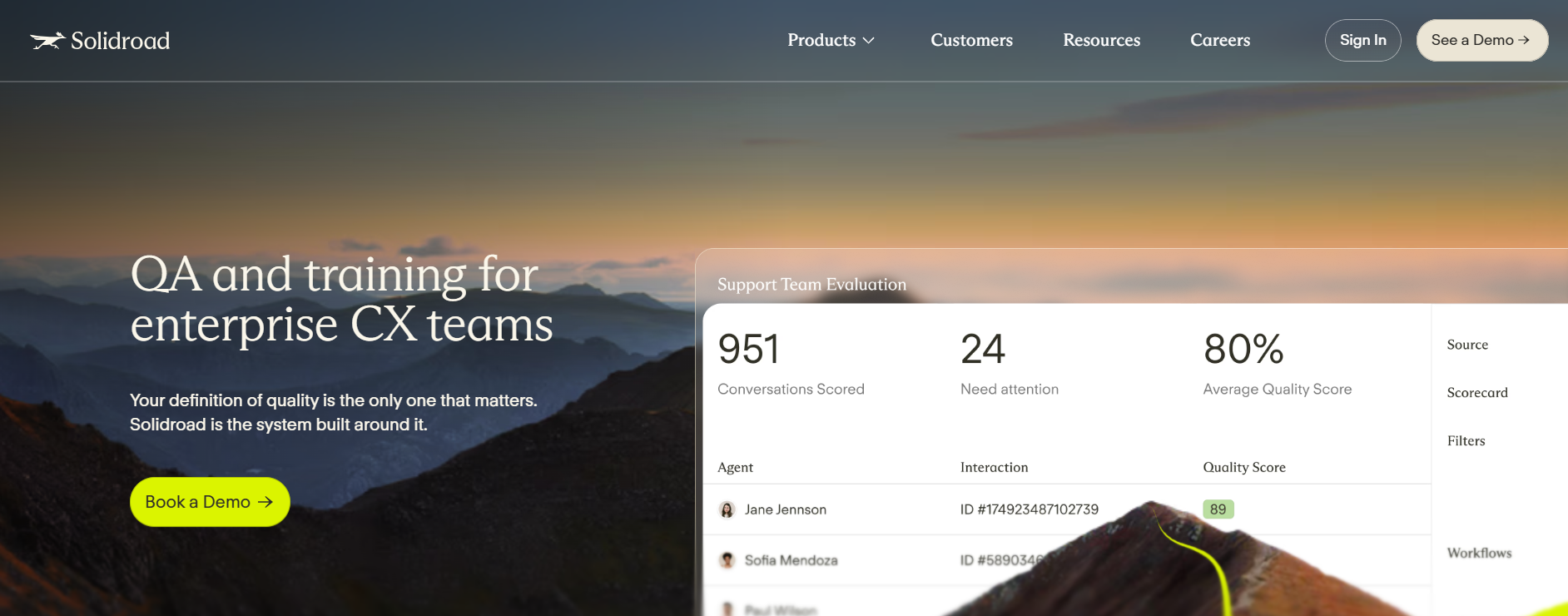
Solidroad does not publish pricing. There is no pricing page on solidroad.com, no listed tiers, no public per-seat or per-conversation rates, and no self-serve signup. The company’s own competitive content says so directly: “pricing is custom and needs a demo (teams that need a public pricing page for budget approval will need to work around this).”
Every detail below comes from Solidroad’s published product pages, help center documentation, competitive positioning content, and customer case studies, not from a pricing table.
Solidroad’s Pricing Model: Custom and Demo-Gated
| Attribute | What’s Known |
|---|---|
| Pricing page | Does not exist; /pricing and /plans return 404 |
| Entry point | Book a Demo at solidroad.com/demo |
| Free trial | None available; no self-serve signup |
| Minimum scale | Targets teams with 1,000+ agents and 10,000+ monthly interactions |
| Contract terms | Not disclosed publicly; negotiated per customer |
| Implementation timeline | Approximately six weeks from contract to go-live |
Solidroad negotiates costs individually based on agent count, conversation volume, feature requirements, and contract length.
For procurement teams used to comparing published rates across vendors, this creates friction: budget approvals require a completed sales conversation before any cost figure exists.
| Custom Pricing Model | |
|---|---|
| Pros | Cons |
| – Pricing tailored to exact needs | – No way to estimate costs before a sales call |
| – Volume-appropriate for large enterprises | – Budget approvals stall without published rates |
| – May include implementation support in the package | – Impossible to compare costs against alternatives without engaging sales |
| – Contract terms negotiable | – Smaller teams are excluded by the minimum scale floor |
What Solidroad Includes (Based on Public Product Information)
While pricing is hidden, Solidroad’s features are well-documented. The platform covers three areas:
QA Automation
- 100% conversation scoring across phone, live chat, video, and email
- Custom scorecards with graded marking (Poor/Average/Strong) and pass/fail modes
- High-risk conversation flagging for QA review
- Testing mode for calibrating AI scoring before going live
- AI agent QA covering Decagon, Sierra, and Fin integrations
Training Simulations
- AI-powered customer personas across email, phone, chat, and video
- Software simulations via Chrome extension for backend tool workflows
- 26 languages for chat/email, 8+ for voice channels
- Difficulty controls (Easy, Medium, Hard) and skill-targeted scenario generation
- Pre-hire candidate assessment using the same simulation infrastructure
Scorecards and Reporting
- Dual-mode scoring (graded and pass/fail) with AI-generated scoring guides
- Training reporting dashboards with learner-level performance profiles
- Calibration workflows to align AI and human reviewer expectations
- CSV export for training data
| Solidroad Feature Set | |
|---|---|
| Pros | Cons |
| – QA and training combined in one platform | – No conversation intelligence or predictive analytics |
| – Training simulations are well-developed | – No published pricing to evaluate cost-per-feature value |
| – AI agent QA across multiple bot platforms | – Six-week implementation delays time to value |
| – Multilingual simulation support across 26+ languages | – Limited native integrations beyond Zendesk, Intercom, and Gong |
Solidroad’s Minimum Scale and Target Buyer
Solidroad targets teams with 1,000+ agents and 10,000+ monthly interactions.
This is not a soft recommendation; the company’s own positioning documents use these figures as the entry point for its ideal customer.
For contact centers below this threshold, several barriers emerge:
- No self-serve tier or SMB pricing exists
- The six-week implementation timeline assumes enterprise-scale configuration needs
- SSO setup requires contacting an account manager rather than self-service configuration
- The demo-gated entry point signals that smaller teams fall outside the commercial focus
This positioning is a deliberate business decision, not a limitation. Solidroad has raised $33 million to pursue enterprise accounts, and its customer base reflects that focus. But for mid-market contact centers with 50 to 500 agents, the platform’s entry requirements don’t align.
Where Solidroad Falls Short
Solidroad builds a QA and training platform for large enterprises, but its positioning and product choices create gaps for many contact center teams evaluating quality assurance solutions:
No Published Pricing Creates Procurement Friction
- Budget approvals require a completed sales conversation before any cost figure exists
- Mid-market teams cannot compare Solidroad against alternatives without engaging sales
- The absence of a pricing page signals enterprise-only focus that excludes smaller operations
No Conversation Intelligence or Predictive Analytics
- Solidroad scores conversations but does not analyze them for demand drivers, sentiment trends, or predictive satisfaction metrics
- Teams needing reason-for-contact detection, topic clustering, or voice-of-customer analytics require a separate tool
- No predictive xNPS, xCSAT, or customer vulnerability scoring across the conversation base
Implementation Timeline Exceeds Competitors
- Six-week rollout from contract to go-live, per Solidroad’s own competitive content
- Custom scenario design adds further configuration time
- Competing platforms that go live in days or weeks deliver value sooner
Limited Integrations
- Native integrations cover Zendesk, Intercom, and Gong, plus three AI agent platforms
- No iPaaS connectors (Zapier, Make, or Workato) for custom workflows
- No public API for custom integrations
- Teams on CCaaS platforms like Genesys, Five9, or Talkdesk have no documented native connector
These gaps hit hardest for mid-market contact centers that need both quality scoring and conversation analytics in one platform, with pricing transparency and faster deployment…
Best Solidroad Alternative: evaluagent
evaluagent delivers AI-powered quality assurance, conversation intelligence, and performance improvement in one platform with published pricing.
For teams frustrated by Solidroad’s hidden pricing, missing conversation intelligence, and enterprise-only scale, evaluagent offers a direct solution: published per-user pricing starting at $35/month, AutoQA scoring across 100% of conversations, integrated sentiment analysis and predictive analytics, and a coaching workflow that connects quality findings to measurable agent development.
Founded in 2012 by contact center operators who built the QA tool they wished had existed, evaluagent serves customers including Samsung, Jet2, Capital on Tap, and Seasalt Cornwall across financial services, insurance, travel, retail, and BPO verticals.
The platform works with any CCaaS provider, integrating natively with Zendesk, Salesforce, Genesys, Five9, Amazon Connect, Talkdesk, RingCentral, Intercom, Aircall, and more, so teams keep their existing infrastructure.
evaluagent was named to G2’s Top 50 UK Software Companies 2026 and earned Leader in Contact Center Quality Assurance and High Performer in Conversation Intelligence in G2’s Summer 2026 reports. The platform holds SOC 2 Type II, ISO/IEC 27001:2022, Cyber Essentials Plus, HIPAA-aligned, and EU AI Act readiness certifications.
evaluagent AutoQA & Improvement: From $35/User/Month
| Feature | Details |
|---|---|
| Price | From $35/user/month |
| Conversation coverage | 100% across voice, chat, and email |
| Core capabilities | AutoQA scoring, custom scorecards, SmartScore AI, Context Engine, fabrication detection |
| Coaching | 1-to-1s, performance plans, gamification, built-in LMS |
| AI agent QA | Bot QA scoring, containment analysis, handover tracking, bot failure modes |
| Security | SSO/MFA/RBAC, SOC 2 Type II, ISO 27001, HIPAA-aligned |
| Onboarding | Dedicated CSM and structured onboarding included |
The AutoQA & Improvement tier provides full-coverage quality scoring with the Context Engine, which grounds every AI evaluation in the organization’s own policies, knowledge base content, and compliance rules. Unlike generic scoring models, the Context Engine checks whether agents gave factually correct answers, not just whether they followed communication best practices.
The tier includes everything needed to close the loop from scoring to improvement: blended scorecards (AI handles repetitive checks, human evaluators retain nuanced judgment), structured coaching and 1-to-1 sessions tied to conversation evidence, performance improvement plans with audit trails, and gamification with points, badges, and an eBay-style reward auction.
At $35/user/month with published pricing, this tier serves contact centers from roughly 20 agents upward, without requiring a sales conversation to learn the cost.
| AutoQA & Improvement | |
|---|---|
| Pros | Cons |
| – Published pricing from day one | – Does not include conversation intelligence features |
| – 100% conversation scoring without headcount growth | – Volume discounts require a quote |
| – Context Engine validates factual accuracy, not just behavior | – No built-in training simulations |
| – Coaching, gamification, and built-in LMS | – AI agent evaluation available as a separate module |
Capital on Tap scaled from 900 to 6,000 BDM quality checks per month after go-live, without adding headcount. (Capital on Tap Case Study)
evaluagent AutoQA + Conversation Intelligence: From $65/User/Month
| Feature | Details |
|---|---|
| Price | From $65/user/month |
| Everything in AutoQA & Improvement | Included |
| Reason for contact detection | Automated across 100% of conversations |
| Sentiment analytics | Conversation-level scoring and trend tracking |
| Predictive metrics | xNPS, xCSAT, xResolution, xVulnerability |
| Topic detection | Out-of-the-box and custom topics with no-code builder |
| Spotlight | On-demand AI analyst reviewing up to 1,000 conversations |
| Summarization | AI-generated conversation summaries |
The Full Bundle adds evaluagent’s Conversation Intelligence suite on top of AutoQA. This is where evaluagent opens a gap with Solidroad: while Solidroad scores conversations and flags failures, evaluagent also analyzes what customers are saying, why they’re contacting the business, and what the aggregate signal across all conversations means for operations, product, and CX strategy.
Predictive xNPS, xCSAT, and xResolution scores come from conversation signals across every interaction, replacing the low-response-rate post-call surveys that most contact centers rely on.
Spotlight acts as an on-demand AI analyst, reviewing up to 1,000 filtered conversations and returning prioritized findings organized into Critical Issues, Monitor Closely, and Performing Well, with evidence excerpts linked to specific transcript moments.
The no-code Custom Insight Topics builder lets teams define and test new topic categories without data science resources, and a testing console validates new topics against existing conversations before they go live.
| AutoQA + Conversation Intelligence | |
|---|---|
| Pros | Cons |
| – Conversation intelligence fills a gap Solidroad does not address | – Higher per-user cost than the base tier |
| – Predictive xNPS/xCSAT across 100% of contacts replaces survey sampling | – Volume discounts require a quote |
| – Spotlight provides on-demand root-cause investigation | – No built-in training simulations |
| – No-code topic builder accessible without data science | – Advanced analytics may require BI tool integration for executive reporting |
Seasalt Cornwall doubled evaluations and reduced agent attrition from 100% to 10% year-on-year after implementing evaluagent’s quality and coaching workflows. (Seasalt Cornwall Case Study)
evaluagent AI Agent Evaluation
evaluagent’s AI Agent Observability module evaluates every conversation an AI agent handles, scoring it against the same quality standard applied to human agents.
The module works independently of whichever bot platform the contact center uses, covering Cognigy, Sierra, Decagon, and proprietary bots with cross-vendor scoring.
Fabrication detection is grounded in the organization’s own knowledge base through the Context Engine, so hallucination flagging reflects what the bots are supposed to know rather than generic language model confidence thresholds. Intent-level performance reporting shows which query types the bot handles well and which generate frustration or unrecoverable escalations.
| AI Agent Evaluation | |
|---|---|
| Pros | Cons |
| – Independent scoring across multiple bot platforms | – Requires an existing seat tier as a prerequisite |
| – Knowledge-base-grounded fabrication detection | – Fair usage policy applies to AI feature consumption |
| – Same quality framework for human and AI agents | |
| – Bot-to-human handovers captured without gaps |
The Share Centre achieved a 285% increase in QA productivity, cutting evaluation time from 24 minutes to 6 minutes per interaction while pass rates rose from 73% to 85%. (The Share Centre Case Study)
Solidroad Feature Value Breakdown (vs evaluagent)
Pricing Transparency and Accessibility
Solidroad’s Approach: Solidroad requires every buyer to start with a sales conversation. There are no published tiers, no listed per-seat or per-conversation rates, and no self-serve evaluation path. The company targets teams with 1,000+ agents, making its commercial model a filter for enterprise-scale buyers.
For procurement teams running formal vendor comparisons, the absence of published pricing adds weeks to the evaluation cycle.
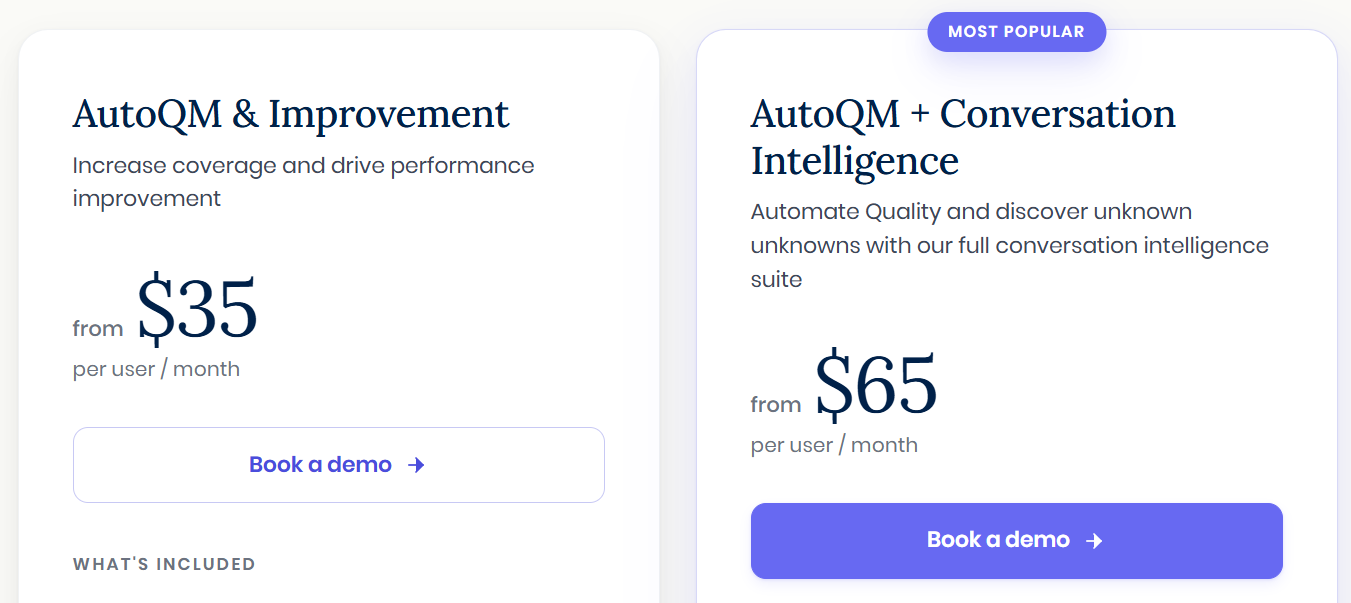
evaluagent’s Approach: evaluagent publishes its pricing: $35/user/month for AutoQA & Improvement and $65/user/month for the Full Bundle with Conversation Intelligence. Volume discounts are available for larger teams, but the base rates are public. This lets teams model costs, compare against alternatives, and secure budget approvals before the first sales call.
Conversation Intelligence and Predictive Analytics
Solidroad’s Approach: Solidroad focuses on scoring conversations and connecting quality gaps to training simulations.
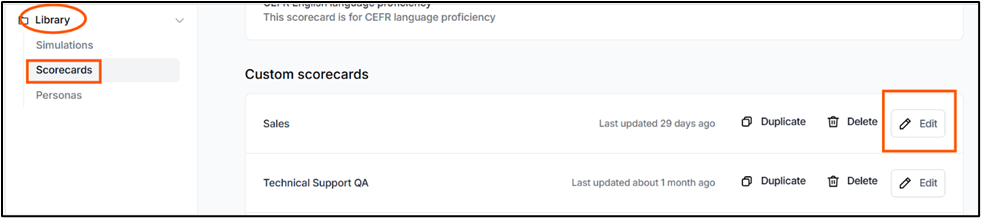
The platform does not offer conversation intelligence: no reason-for-contact detection, no sentiment analysis, no predictive CSAT or NPS scoring, no topic clustering, and no on-demand investigation tools. Teams that need to understand why customers contact the business, or want to forecast satisfaction trends across their full conversation volume, require a separate analytics platform.
evaluagent’s Approach: evaluagent’s Conversation Intelligence module (included in the $65/user/month Full Bundle) analyzes every interaction for reason-for-contact, sentiment, topic themes, and predictive metrics including xNPS, xCSAT, xResolution, and xVulnerability.
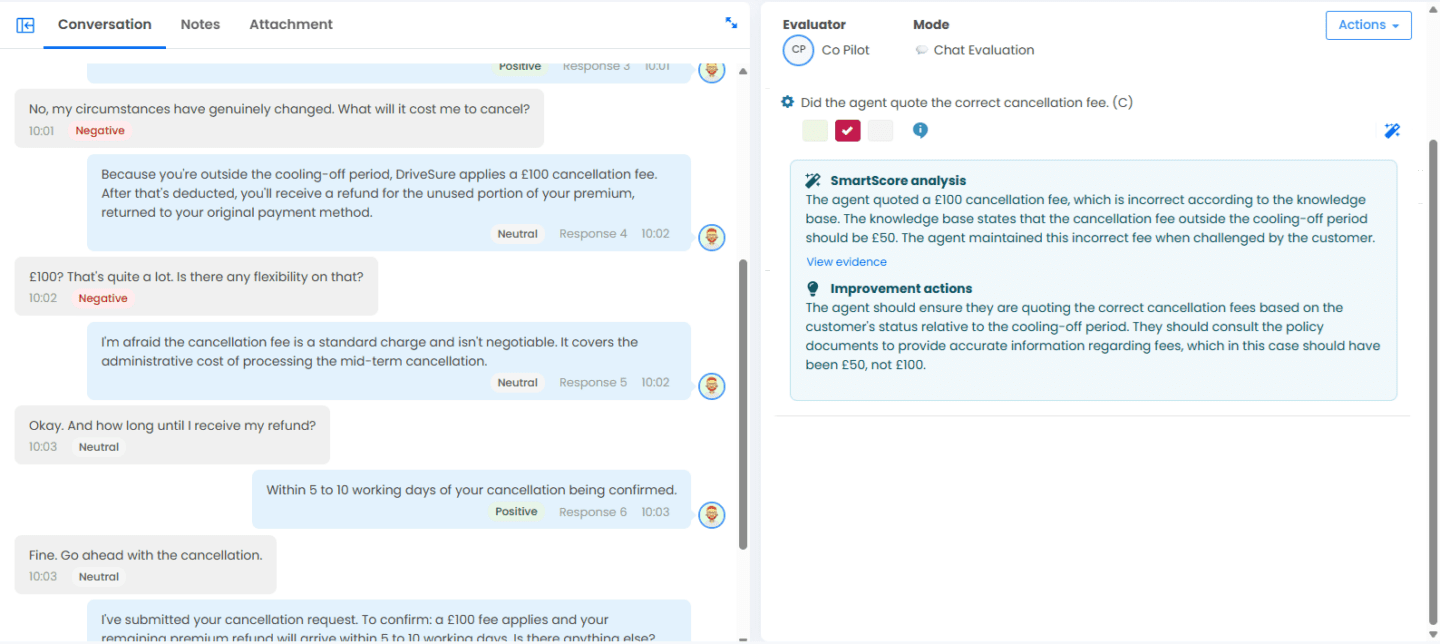
Spotlight provides on-demand root-cause investigation across up to 1,000 conversations, returning prioritized findings with severity tiers and conversation-level evidence. Custom Insight Topics can be built through a no-code interface and tested against existing conversations before going live.
QA-to-Coaching Workflow
Solidroad’s Approach: Solidroad closes the loop between QA findings and agent development through training simulations. When QA identifies a gap, the platform assigns a targeted simulation where the agent practices against an AI customer persona in the specific scenario they struggled with.
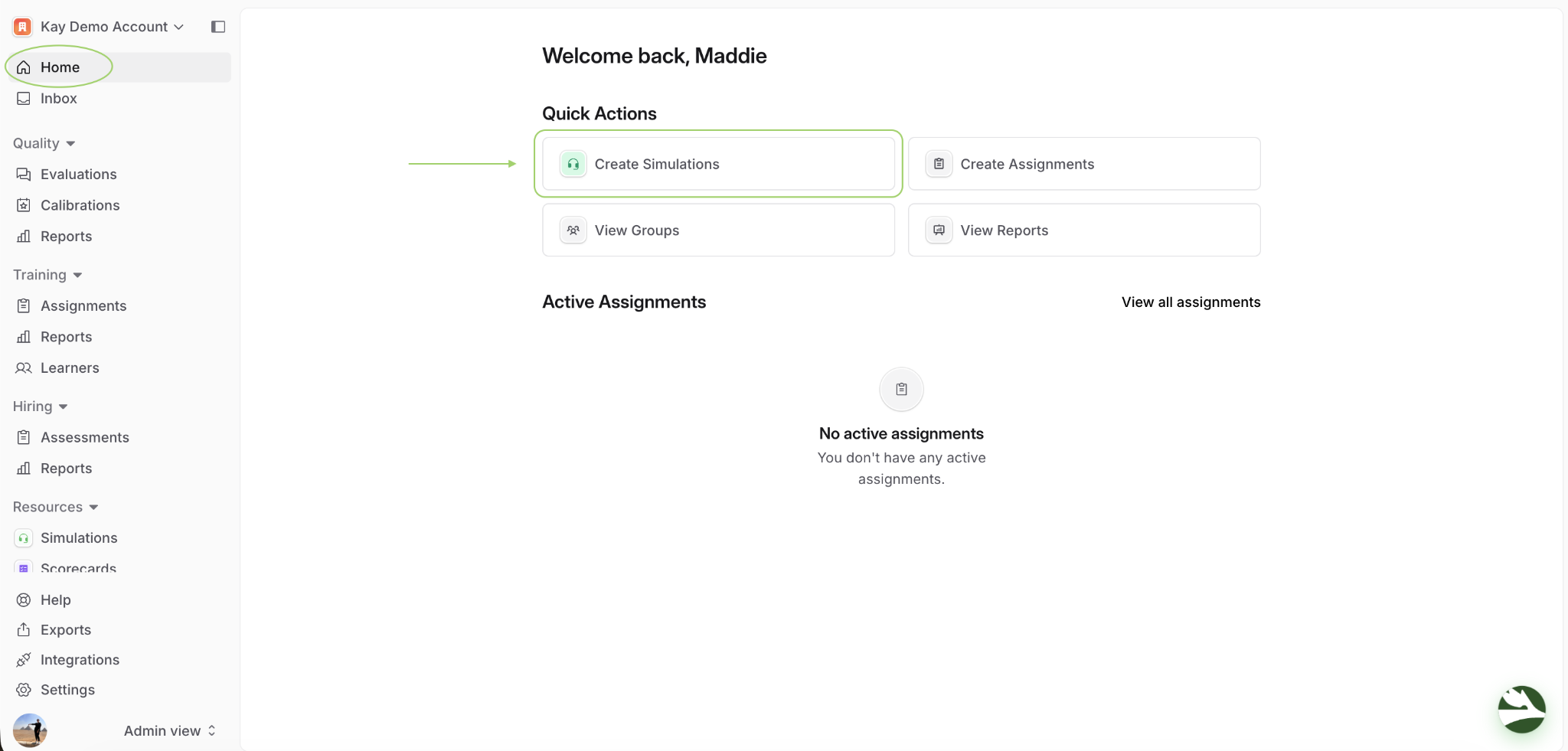
The simulation infrastructure supports email, phone, chat, and video channels, with configurable difficulty levels and multilingual support.
evaluagent’s Approach: evaluagent connects QA findings to structured coaching and 1-to-1 sessions tied to conversation evidence, performance improvement plans with HR-ready audit trails, automated action triggers (coaching escalation, e-learning enrollment), a built-in LMS with quizzes, lessons, and learning paths, and gamification with points, badges, leaderboards, and an eBay-style reward auction.
The coaching workflow does not include AI-generated training simulations but provides a broader set of development tools.
Integration Breadth and Platform Compatibility
Solidroad’s Approach: Solidroad integrates natively with Zendesk, Intercom, and Gong for conversation data, plus Decagon, Sierra, and Fin for AI agent QA, and Guru and Notion for knowledge management.
The platform does not publish an API, and no iPaaS connectors (Zapier, Make, Workato) are documented. Teams on CCaaS platforms like Genesys, Five9, Talkdesk, or Amazon Connect have no documented native connector.
evaluagent’s Approach: evaluagent integrates natively with Zendesk, Salesforce, Genesys, Five9, Amazon Connect, Freshdesk, RingCentral, Talkdesk, Intercom, Puzzel, Aircall, Assembled, and Peopleware.
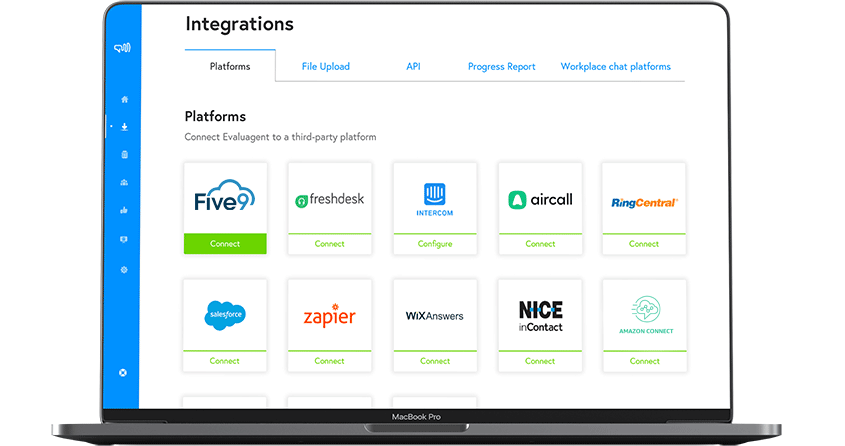
A documented REST API (JSON:API specification with OpenAPI spec) enables custom integrations, with regional API clusters in EU, North America, and Australia for data sovereignty. BI tool export pushes data into Power BI, Tableau, Looker, and Metabase.
Security and Compliance
Solidroad’s Approach: Solidroad holds SOC 2 Type II and ISO/IEC 27001 certifications, supports SAML SSO via Okta, Azure AD, Google, and custom identity providers, complies with GDPR via Standard Contractual Clauses, and retains customer data for 30 days post-termination. The company operates from San Francisco and Dublin.
evaluagent’s Approach: evaluagent holds SOC 2 Type II, ISO/IEC 27001:2022, Cyber Essentials Plus, G-Cloud, GDPR, HIPAA-aligned, and EU AI Act readiness certifications.
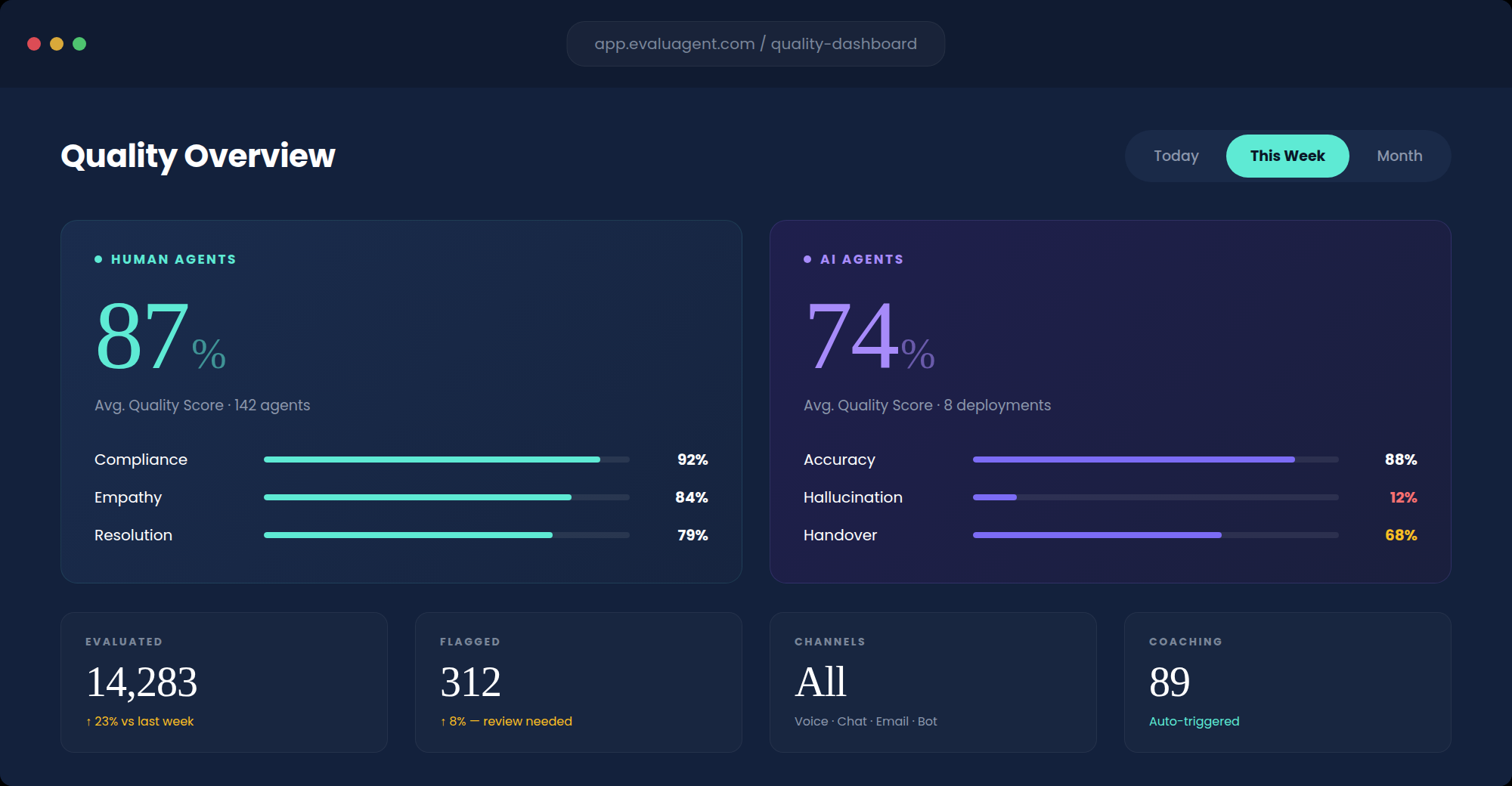
The platform runs on AWS with in-region data centers, includes PII redaction for both text and audio data, and provides SSO/MFA/RBAC at both paid tiers. Regional API clusters enforce data sovereignty across EU, North America, and Australia.
Final Verdict: Solidroad vs evaluagent
The choice between Solidroad and evaluagent depends on your team’s scale, your need for conversation analytics, and how much pricing transparency matters to your procurement process:
Solidroad is an AI-powered QA and training platform built for enterprise contact centers with 1,000+ agents. It combines automated conversation scoring with AI-generated training simulations, so QA gaps translate directly into practice-based remediation.
This model works best for large operations with dedicated procurement teams, contact centers that value training simulations as a core part of their quality program, and organizations prepared for a six-week implementation timeline with custom pricing negotiation.
evaluagent is a QA, conversation intelligence, and performance improvement platform built around published pricing and CCaaS-agnostic deployment. With tiers starting at $35/user/month, it delivers 100% conversation coverage through AutoQA, predictive analytics through Conversation Intelligence, and coaching through structured 1-to-1s, performance plans, and gamification, all deployable in weeks.
This makes it the stronger choice for mid-market to enterprise contact centers that need to budget before they buy, teams that want conversation intelligence and quality scoring in one platform, and organizations across regulated industries that value 14 years of market presence, SOC 2 Type II, ISO 27001, HIPAA-aligned, and EU AI Act readiness certifications.
Get started with evaluagent here.
The difference is not just features but accessibility. Solidroad asks “What does quality look like at enterprise scale?” evaluagent asks “How can every contact center achieve visibility across every agent, regardless of size?”