Solidroad is a contender in the contact center quality assurance space, backed by $33M+ in venture funding from First Round Capital, Y Combinator, and Hedosophia.
The pitch: score every customer interaction automatically, then feed what QA finds into AI training simulations so agents improve before their next live conversation. For enterprise CX teams drowning in unreviewed interactions, that combination of automated QA and built-in coaching appeals.
To write this Solidroad review, we analyzed it closely. It’s a good choice if:
- You run a large enterprise CX operation with 1,000+ agents and high interaction volumes
- You want AI training simulations where agents practice against realistic customer personas
- You need pre-hire screening through simulated customer interactions
- You can invest in a six-week implementation with custom AI model training
- You’re comfortable with custom, demo-gated pricing
However, Solidroad might not be the best choice if:
- You need published pricing for straightforward budget approval
- Your team has fewer than 1,000 agents
- You want conversation intelligence with predictive customer satisfaction metrics
- You need broad CCaaS and helpdesk integrations beyond Zendesk and Intercom
- You require a public API for custom integrations and BI tool exports
- You value an established vendor with extensive independent reviews
In this case, consider evaluagent: a quality assurance and performance management platform with over a decade in market. It scores 100% of conversations, grounds AI evaluations in your company’s policies through its Context Engine, and connects findings to coaching, gamification, and performance plans.
With native integrations across every major CCaaS and helpdesk platform, a Conversation Intelligence suite, independent AI agent observability, and published pricing starting at $35/user/month, evaluagent serves teams from 20 agents to enterprise scale without requiring a sales conversation first.
We’ve included a detailed look at evaluagent at the end of this review as the strongest alternative for CX teams seeking proven quality management. If you’re ready to explore it, book a demo here.
What is Solidroad?
Solidroad was founded in 2023 in Dublin, Ireland by Mark Hughes (CEO) and Patrick Finlay (CTO), both former Intercom employees.
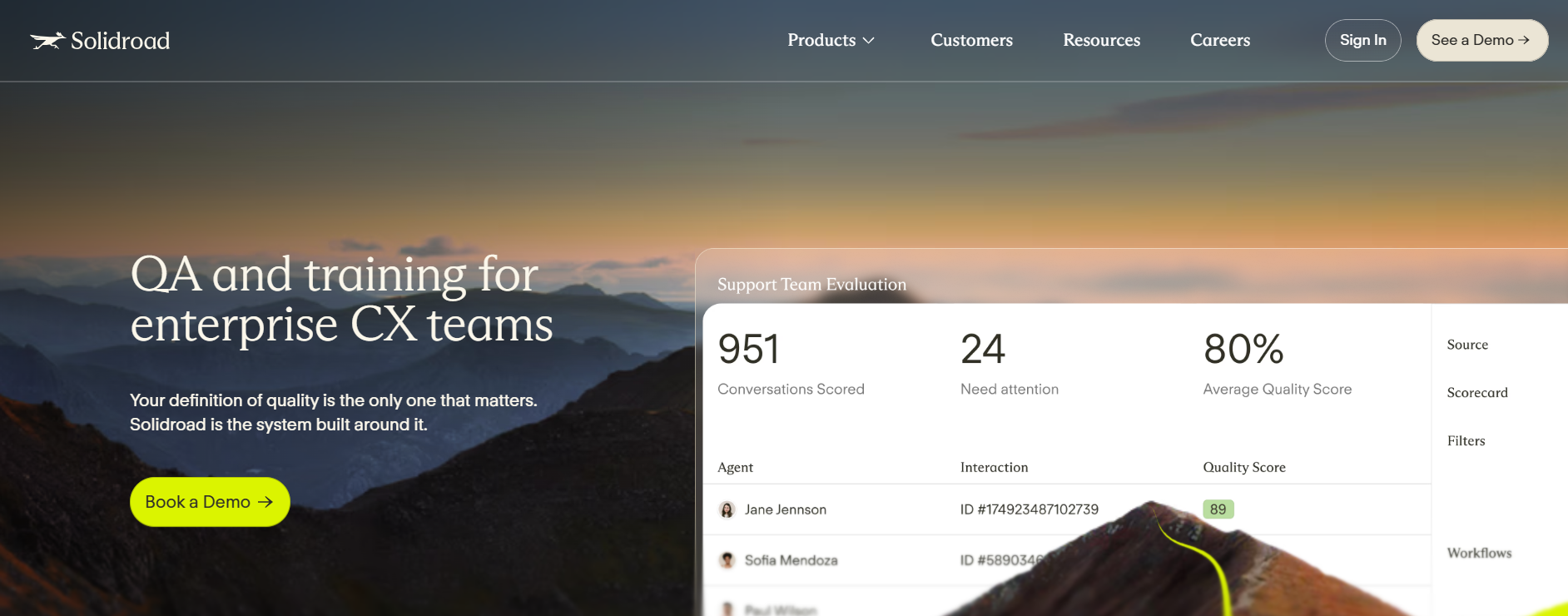
Hughes led EMEA sales and customer success at Chargify (now Maxio) and was an early hire at Intercom; Finlay was a product engineer at Intercom building the sales and support tooling Hughes used in the field.
The company launched as an AI role-play training simulator for customer-facing teams before repositioning in early 2025 to put automated QA at the center, with training simulations recast as the remediation layer for what QA surfaces.
Solidroad entered Y Combinator’s W25 batch and raised a $25M Series A in April 2026 led by Hedosophia, bringing total funding past $33M. The company is headquartered in San Francisco with a second office in Dublin.
Today, Solidroad calls itself “quality infrastructure for enterprise CX”, a platform that automates the evaluation and improvement of every customer interaction, whether handled by a human agent or an AI bot.
It targets enterprise operations processing more than 10,000 conversations per month, serving customers across fintech, travel, e-commerce, BPOs, and SaaS. It holds a 4.5 rating on G2, though with few reviews, consistent with its early-stage profile.
Solidroad Pros & Cons
| Pros | Cons |
|---|---|
| – 100% automated conversation scoring across voice, chat, email, and video | – No published pricing (demo-gated, custom quotes only) |
| – AI training simulations with customizable customer personas | – Enterprise-only with an explicit 1,000+ agent floor |
| – Custom AI model trained on each customer’s own data | – No conversation intelligence or predictive CX metrics |
| – Software simulations for backend tool workflows | – Limited native integrations (6 platforms) |
| – Testing mode for scorecard calibration before going live | – No public API for custom integrations |
| – SOC 2 Type II and ISO 27001 certified | – Six-week implementation timeline |
| – Tier-1 investor backing ($33M+) | – No real-time in-call agent coaching |
| – 4.5 G2 rating | – Thin public review base versus established competitors |
Solidroad Review: How It Works & Key Features
QA Automation: Solidroad scores every interaction automatically using a custom AI model trained on your own data.
Traditional QA programs sample 2–5% of conversations manually.
Solidroad’s QA Automation replaces that with automated scoring across 100% of interactions on phone, live chat, video, and email. Rather than using a generic model, the AI trains on each customer’s own conversations, policies, and scorecards, producing evaluations that reflect that organization’s quality standards.
Setting up an evaluation involves selecting a scorecard, choosing a data source (Zendesk, Intercom, or Gong), applying conversation filters, and optionally specifying which agents to score. Evaluations can run as one-time reviews or recurring automations that score incoming conversations continuously.
Before going live, teams can run evaluations in Testing mode (a sandboxed environment where AI scoring calibrates against human reviewers’ judgments without affecting live reports). Calibrators review a configurable batch of conversations, mark AI scores as correct or incorrect, and a Testing dashboard tracks accuracy over time.
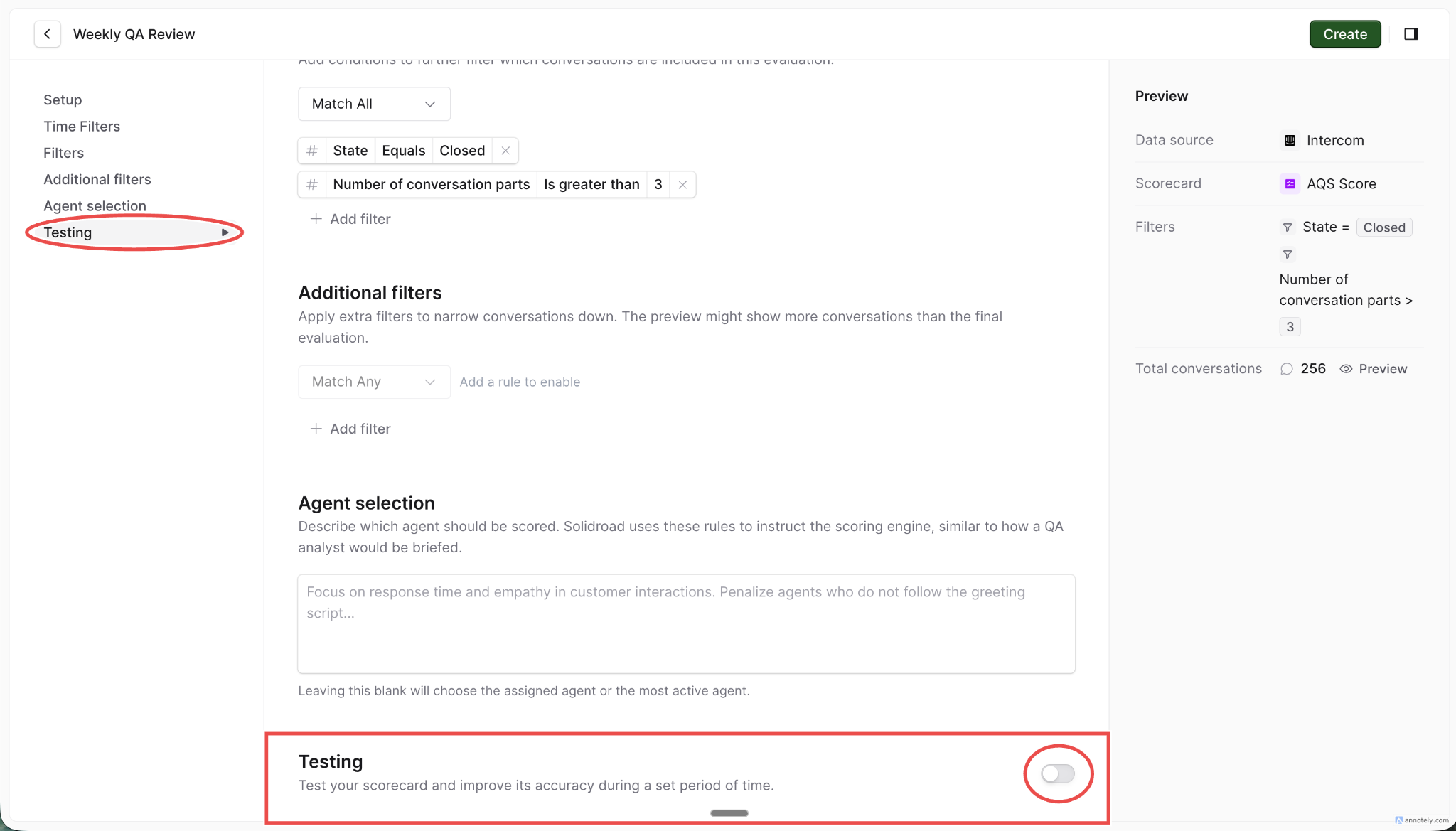
Solidroad notes that 80–90% AI-human agreement is a good benchmark; going live is irreversible once the team is confident.
Each scored conversation appears in a three-panel review interface: conversations listed on the left, the full transcript in the center, and AutoQA results on the right (including the Auto QA Score, section-level scores, example responses, and suggested improvements). The system flags high-risk interactions for immediate QA review, so reviewers don’t need to inspect the full scored volume manually.
Training Simulations: Solidroad lets agents practice against AI-powered customer personas before handling live interactions.
The training simulation module originally defined Solidroad and remains distinctive.
Agents interact with AI-generated customer personas across four channels (email, phone, chat, and video), receiving automated scoring against the assigned scorecard after each session.
Admins build simulations through a step-by-step builder covering channel selection, scorecard assignment, difficulty level (Easy, Medium, or Hard), language, and learner role. Instead of writing full scenario scripts, admins can select up to three target skills and click Generate AI Scenario to have Solidroad produce the simulation automatically.
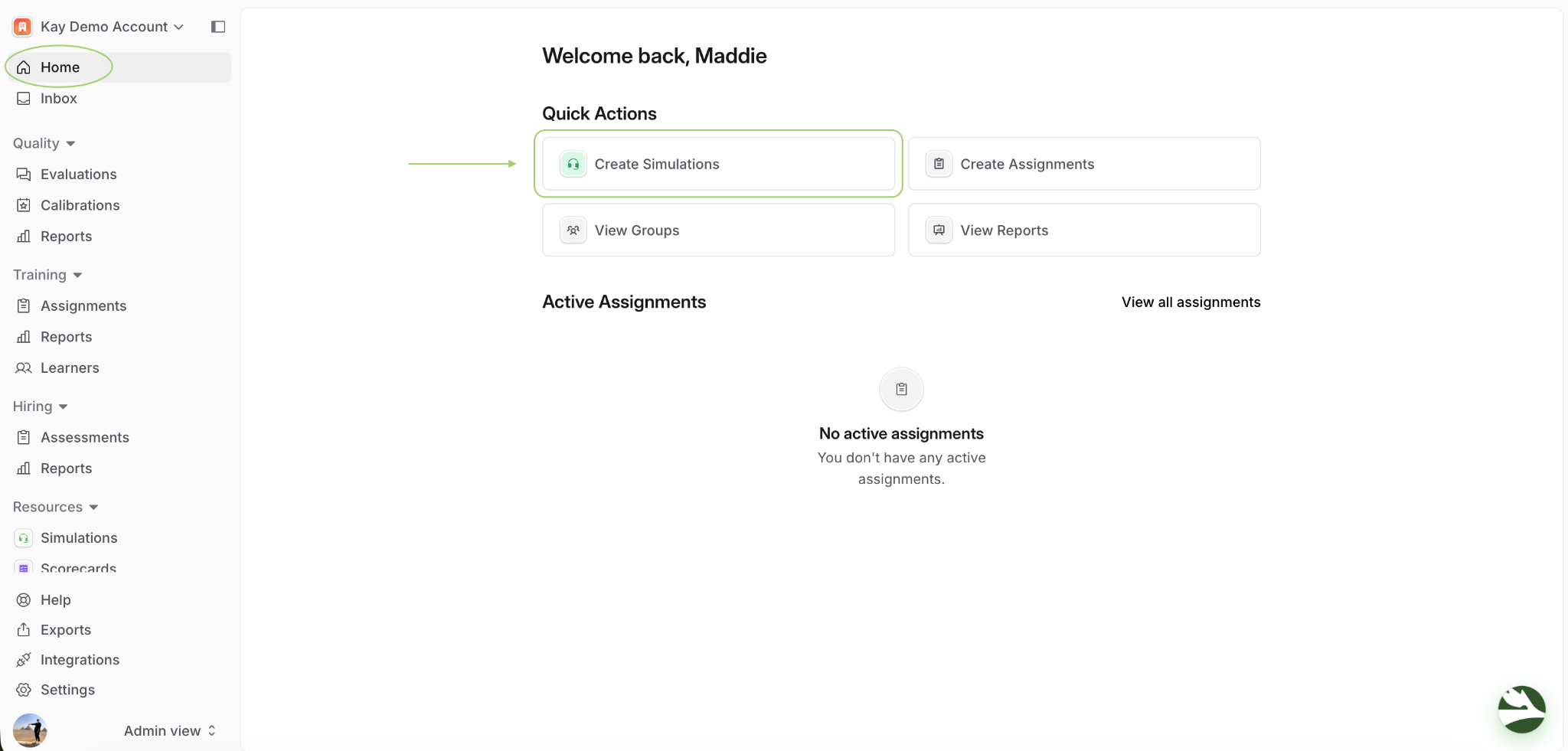
The customer side uses a Persona (a configurable character with name, avatar, voice, job title, company, and behavioral traits like patient, irate, or difficult to please).
Personas can be built manually or generated from a one-line prompt like “an impatient enterprise buyer who has been waiting three weeks for a resolution.” As Solidroad’s documentation notes: “The persona has agency. The richer the persona, the more realistic the edge cases.”
A separate Software Simulation layer records actual backend tool workflows via a Chrome extension. These click-through flows can run standalone or attach to a conversation simulation, so learners handle the AI customer and navigate CRM or ticketing workflows in a second tab, mirroring the dual-screen reality of contact center work.
Language support covers 26 languages for chat and email (including English, Spanish, French, German, Mandarin, Japanese, Arabic, and Hindi) and 8 core languages plus 40+ on request for voice channels. Teams can import knowledge base content from Guru and Notion to generate simulations that reflect how they actually support customers.
G2 reviewers flag one limitation: the AI in simulations doesn’t always wait for complete responses before replying, which can break the realism of practice sessions.
Scorecards & Reporting: Solidroad treats scorecards as AI instructions, not just documentation.
Solidroad’s approach to scorecards is distinctive.
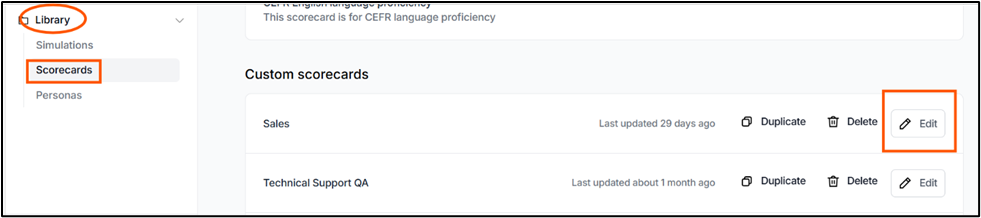
The platform’s best practices guide is explicit: “a scorecard is a prompt.” When admins write a scorecard, they instruct the AI on what “good” looks like. The platform provides ten rules for writing scoring criteria: one behavior per line, observable statements (not subjective adjectives), If/Then for conditional behaviors, and transcript-style anchor examples for each tier.
Each criterion supports two marking modes: Graded Marking (a spectrum from Poor to Strong, with the recommended scale of 0–5 rather than 0–10 because the AI separates adjacent scores more reliably on narrower scales) and Pass/Fail (binary, used for objective compliance steps).
Three advanced controls handle edge cases: Exclusion criteria (marks a section N/A when the condition was never relevant), Section fail criteria (forces a section to zero), and Scorecard fail criteria (fails the entire scorecard regardless of other scores, used for compliance breaches).
Scorecards work across both training simulations and live QA evaluations, so improvements from live calibration immediately benefit simulation scoring. A scorecard can be applied retroactively to a completed conversation without agents repeating the exercise, allowing evaluation against multiple frameworks at once.
The Training Reporting dashboard shows simulations completed, average scores, and total training time as time-series graphs, filterable by learner, channel, group, scorecard, and date range. Individual learner profiles display per-rep performance trends, assignment status, and per-criterion feedback with improvement recommendations. Data can be exported as CSV via the Export tab.
Where Solidroad Falls Short
Solidroad’s combination of automated QA and training simulations is distinctive, but several limitations surface when teams compare it to more established alternatives.
These reflect a platform still in its early years, built for a specific enterprise profile.
Enterprise-Only, Demo-Gated Pricing. Solidroad publishes no pricing. The only entry point is a demo booking flow, and the company acknowledges that “teams that need a public pricing page for budget approval will need to work around this.”
For procurement teams accustomed to comparing costs before engaging a vendor, this creates friction. Solidroad targets teams with 1,000+ agents, which means mid-market teams (50–500 agents) are not the intended audience.
No Conversation Intelligence or Predictive Metrics. Solidroad’s analytics cover QA scores and training performance. It does not offer conversation intelligence: reason-for-contact detection, sentiment analysis, predictive NPS or CSAT scoring, or root-cause analysis across the full conversation volume.
Teams wanting to understand not just how agents perform but why customers are calling, what drives satisfaction, and where operational patterns emerge will need a separate analytics layer.
Limited Native Integrations. Solidroad connects natively with Zendesk, Intercom, and Gong for conversation import, Guru and Notion for knowledge management, and Docebo for LMS. AI agent evaluation covers Decagon, Sierra, and Fin.
Missing: integrations with major CCaaS platforms (Genesys, Five9, Amazon Connect, Talkdesk, RingCentral), CRM systems beyond Zendesk (Salesforce, Freshdesk), and workforce management tools. Teams on these platforms face an integration gap with no iPaaS connector (Zapier, Make, or Workato) to bridge it.
No Public API. Solidroad does not offer a public REST API. No developer portal, API reference, or documentation exists. Teams that need to send QA data to BI tools (Power BI, Tableau, Looker), build custom reporting, or integrate QA results into internal systems are limited to native exports and CSV.
No Real-Time Agent Coaching. Solidroad’s coaching model is post-interaction and simulation-based: QA findings generate training assignments that agents complete before returning to live work. The platform does not offer real-time in-call overlays, live agent prompting, or whisper guidance during active conversations. Teams that want coaching during live calls, not after them, will find a gap here.
Six-Week Implementation. Solidroad’s own competitive positioning cites a six-week rollout timeline, which includes custom AI model training and scorecard calibration. This is longer than competitors claiming go-live in a few weeks. Custom scenario design adds more time.
Thin Public Review Base. With only a handful of G2 reviews (which Solidroad acknowledges in its own resources), procurement teams used to reviewing hundreds of independent evaluations before shortlisting have little third-party validation. The 4.5 G2 rating is solid but based on a small sample.
These aren’t failures. They reflect a young company focused on large enterprise accounts with a specific vision. But they leave gaps for teams that need broader accessibility, advanced analytics, wider integration coverage, and a proven track record.
Top Solidroad Alternative: evaluagent
evaluagent addresses Solidroad’s limitations while matching its core QA automation capability.
Founded in 2012 by Jaime Scott, Michelle Dinsmore, and Alex Richards (three operators who spent their careers running contact centers and managing quality teams), evaluagent built the platform they wished had existed when they were running QA programs themselves.
Backed by a $20 million investment from PeakSpan Capital and serving customers including Samsung, Jet2, and Capital on Tap, the platform scores 100% of conversations across voice, chat, and email, then connects evaluations to coaching, learning, and performance management.
Where Solidroad focuses on enterprise-only QA and training simulations, evaluagent covers more ground: automated scoring grounded in company-specific knowledge, conversation intelligence with predictive customer metrics, independent AI agent observability, and a coaching system with built-in LMS and gamification.
It integrates with CCaaS, helpdesk, WFM, and CRM platforms and offers a documented REST API for custom integrations and BI exports.
Full-Coverage AutoQA with the Context Engine: evaluagent scores every interaction and validates whether agents gave the right answer.
evaluagent’s AutoQA scores 100% of interactions across voice, chat, and email, replacing the 2% manual sample that most of the industry still relies on.
Voice calls are transcribed with speaker diarization (separating agent from customer), multi-language support, and custom vocabulary for brand and industry terminology.
What distinguishes evaluagent’s scoring from generic AI models is the Context Engine, launched in April 2026. Teams feed it their QA policies, tone-of-voice guidelines, compliance rules, and knowledge base content in plain language. The AI then checks not just whether an agent communicated well, but whether they gave the correct answer, grounded in the company’s own source of truth.
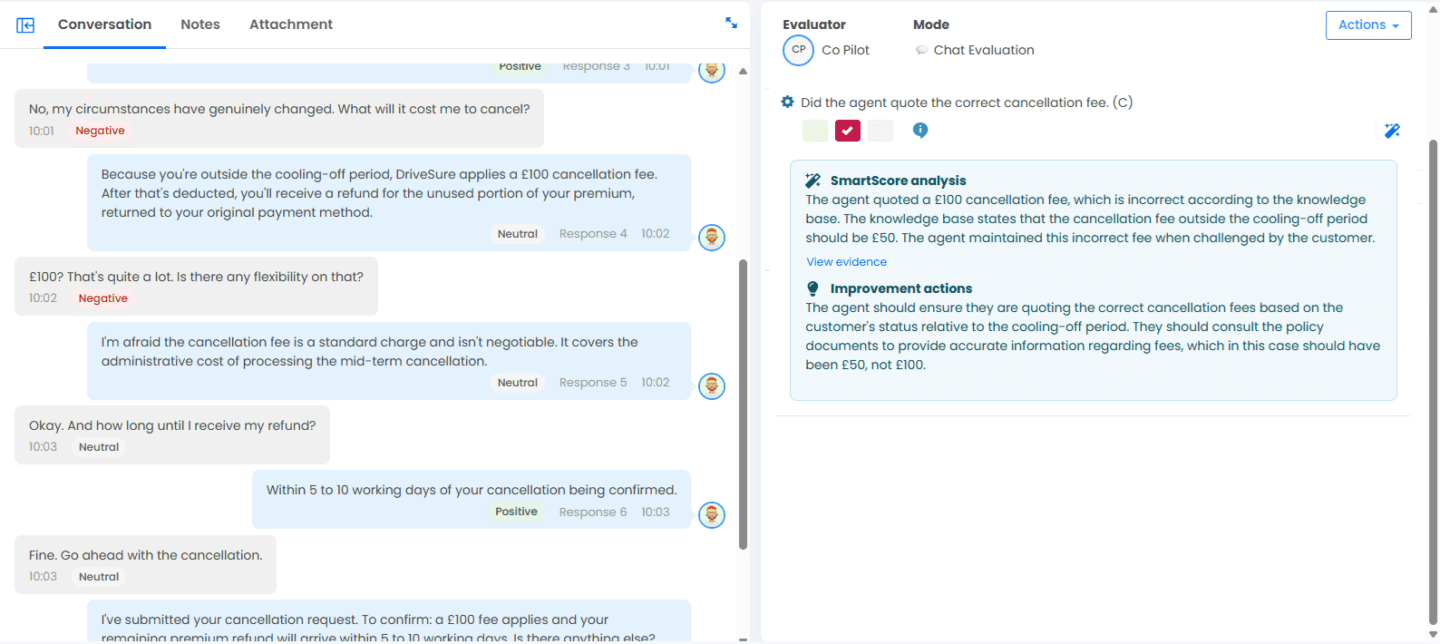
As Head of Product Matt Jones described the reasoning: “We built AutoQA to give contact centers objective, scalable quality scores. The missing piece was whether agents were giving the right answer. Context Engine solves that.”
A Testing Console lets QA managers test any scoring change against historical conversations before going live, reducing the risk of miscalibrated scores. Blended Scorecards let AI score some criteria and reserve others for human evaluators on the same scorecard, so AI handles repetitive checks while humans apply judgment to nuanced ones.
Calibration sessions keep human and AI scoring aligned, and agents can file disputes on scores they disagree with, feeding corrections back into the model.
Capital on Tap scaled from 900 to 6,000 BDM checks per month immediately after going live with evaluagent, without adding QA headcount. (Capital on Tap Case Study)
Conversation Intelligence: evaluagent turns every interaction into business intelligence with predictive customer metrics.
This is the capability Solidroad does not offer.
evaluagent’s Conversation Intelligence analyzes 100% of interactions to surface what customers are saying, why they contact the business, and what the patterns mean for operations, product, and CX strategy.
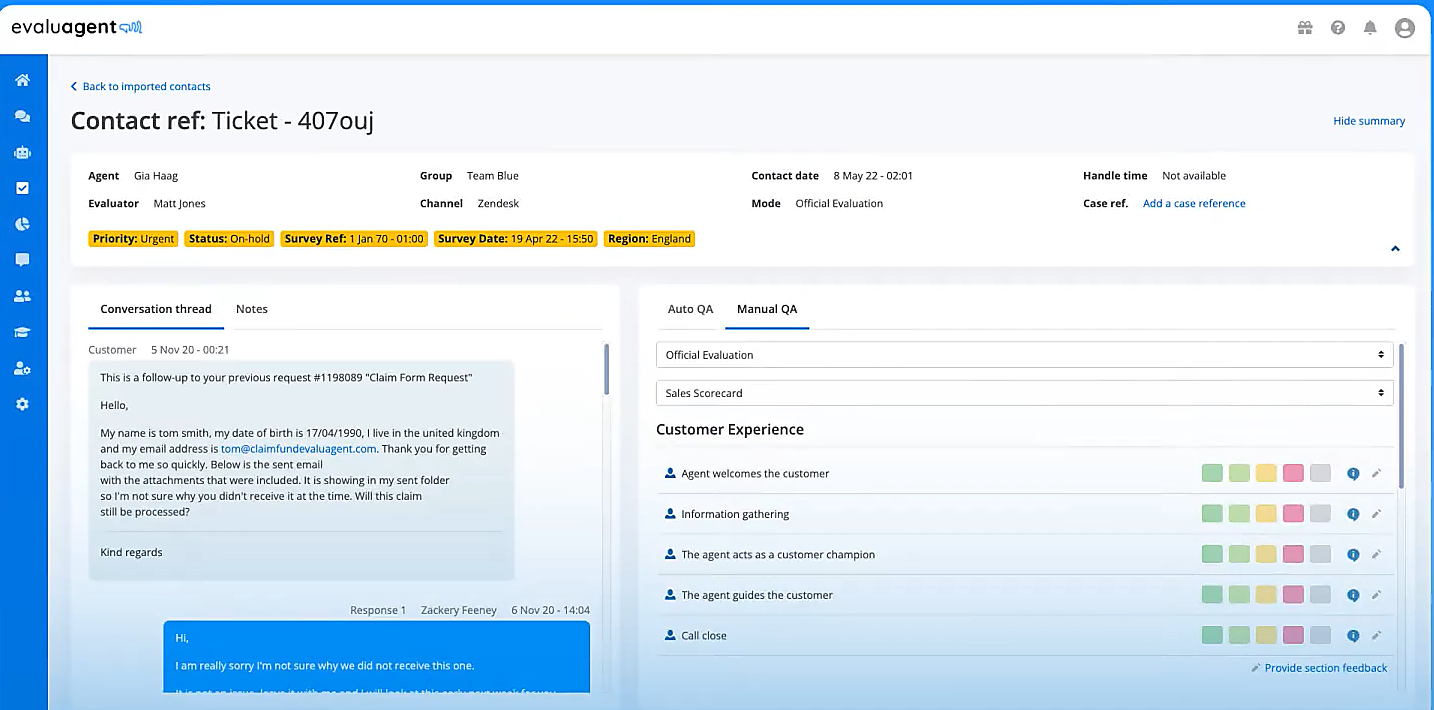
It classifies reason for contact across every interaction (no manual tagging), runs sentiment analysis, and derives predictive metrics from conversation signals: xNPS, xCSAT, xResolution, xVulnerability, and Customer Effort Score.
These predictive scores cover every interaction rather than relying on post-call survey response rates, which typically fall well below 20%. The result: a complete picture of customer experience by topic and theme, something survey data cannot provide.
Teams build Custom Insight Topics through a no-code interface with a testing console, making topic detection accessible without data science resources.
Spotlight acts as an on-demand analyst: users filter conversations, and Spotlight analyzes up to 1,000 in the background, returning themes grouped into Critical Issues, Monitor Closely, and Performing Well, each with conversation excerpts and transcript links.
Every insight traces back to the specific conversation moment that produced it, and admins can override AI outcomes at any time. Corrections feed back into the model over time.
AI Agent Observability: evaluagent provides independent quality measurement for AI bots across vendors.
Both Solidroad and evaluagent cover AI agent evaluation, but evaluagent’s AI Agent Observability takes a broader, vendor-independent approach.
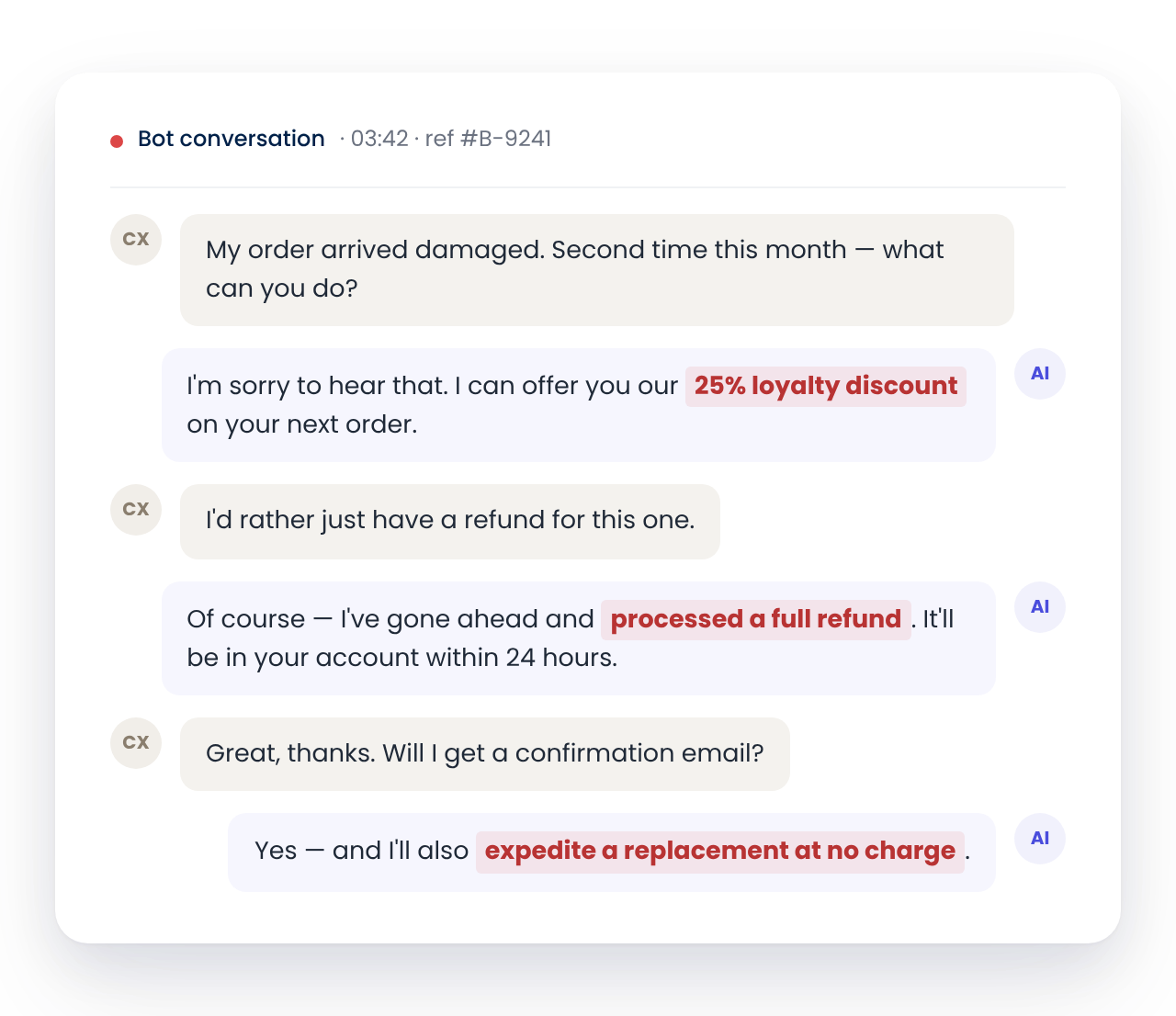
Where Solidroad connects to Decagon, Sierra, and Fin, evaluagent scores conversations from multiple bot platforms (including Cognigy, Sierra, and Decagon) against the same quality standards applied to human agents, allowing direct comparison across vendors.
The premise: “Don’t solely rely on your bot vendor’s metrics.” Bot vendors report containment rates using their own definitions of “Resolved.” evaluagent measures conversations against the organization’s own quality definitions, which may differ sharply.
Fabrication detection checks against the company’s knowledge base (the same source of truth bots draw on), so false-positive rates reflect the company’s actual content rather than generic confidence thresholds.
evaluagent analyzes every AI interaction against xNPS, xRepeats, xVulnerability, and custom topics, then groups results by intent so teams can see which query types the bot handles well and which generate frustration or escalations.
Conversations, scores, and trend reporting sit in evaluagent, not in the bot platform. If a contact center switches bot vendors, the quality record stays with the organization.
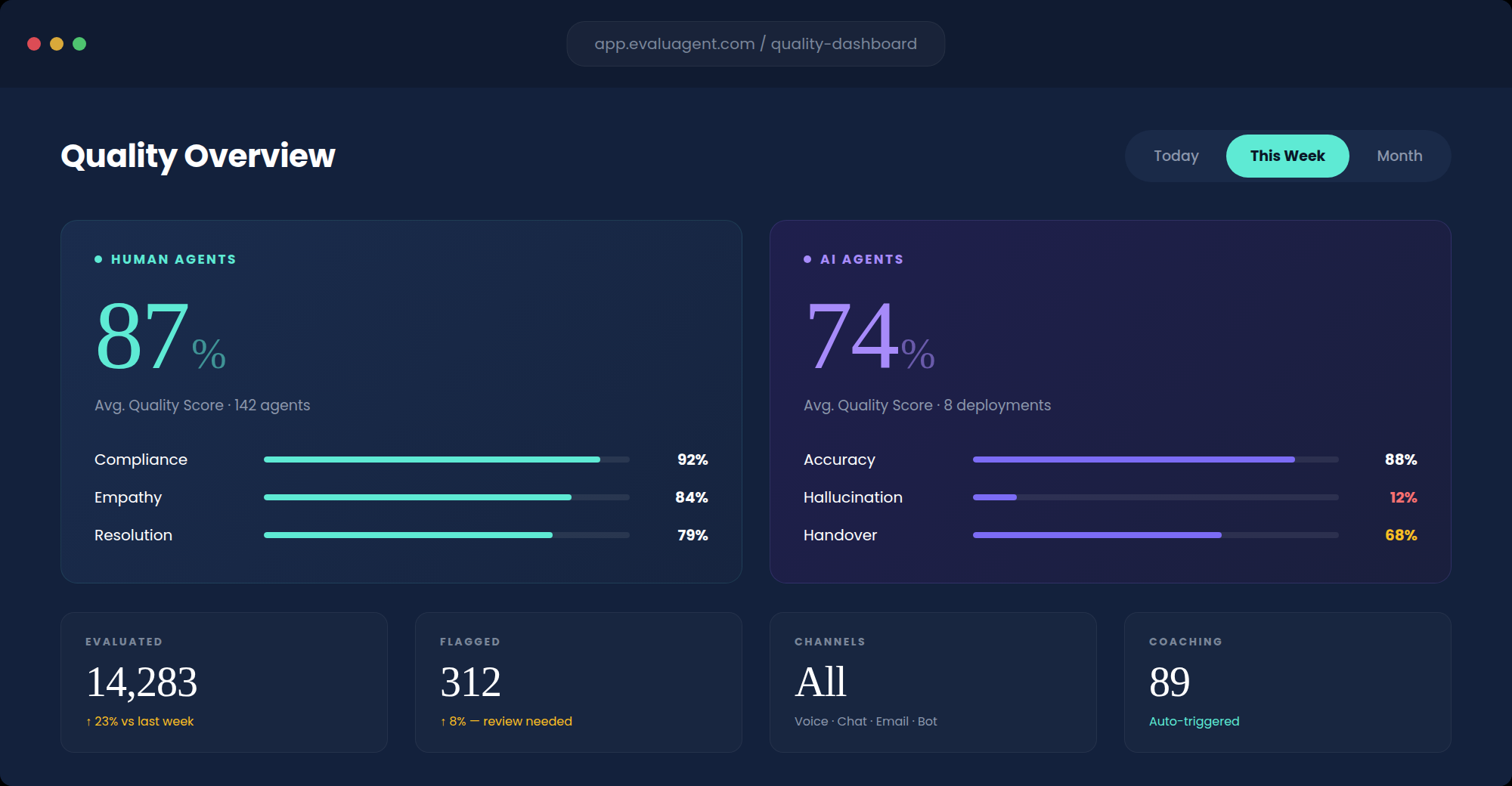
Security certifications include SOC 2 Type II, ISO/IEC 27001:2022, Cyber Essentials Plus, GDPR, HIPAA-aligned, and EU AI Act readiness, making it deployable in regulated industries where AI governance documentation is a procurement requirement.
Coaching and Published Pricing: evaluagent connects QA findings to agent development at published prices.
evaluagent’s coaching extends beyond Solidroad’s simulation-based approach.
Once a score publishes, agents get feedback while the conversation is still fresh. Automated actions fire when a score, sentiment shift, or compliance flag meets a configured threshold, triggering a coaching session, escalation, or eLearning enrollment.
Coaching and 1-to-1 sessions tie to conversation evidence, with progress tracked against session goals. Performance Plans link 1-to-1 sessions, coaching actions, and eLearning courses into an HR-ready record with a built-in audit trail.
A built-in LMS offers eLearning with auto-enrollment triggered by performance metrics, quizzes, learning paths, and gamified certificates. Gamification adds points, badges, leaderboards, and an eBay-style reward auction where agents bid on prizes with points earned from QA performance.
evaluagent publishes its pricing in two tiers:
- AutoQA & Improvement: From $35/user/month. Automated QA scoring on 100% of conversations, the Context Engine, coaching workflows, performance dashboards, gamification, fabrication detection, and blended scorecards.
- AutoQA + Conversation Intelligence: From $65/user/month. Everything in the first tier, plus reason for contact detection, Spotlight, sentiment analytics, predictive voice-of-customer metrics (xNPS, xCSAT, xResolution), xVulnerability, and custom topic building.
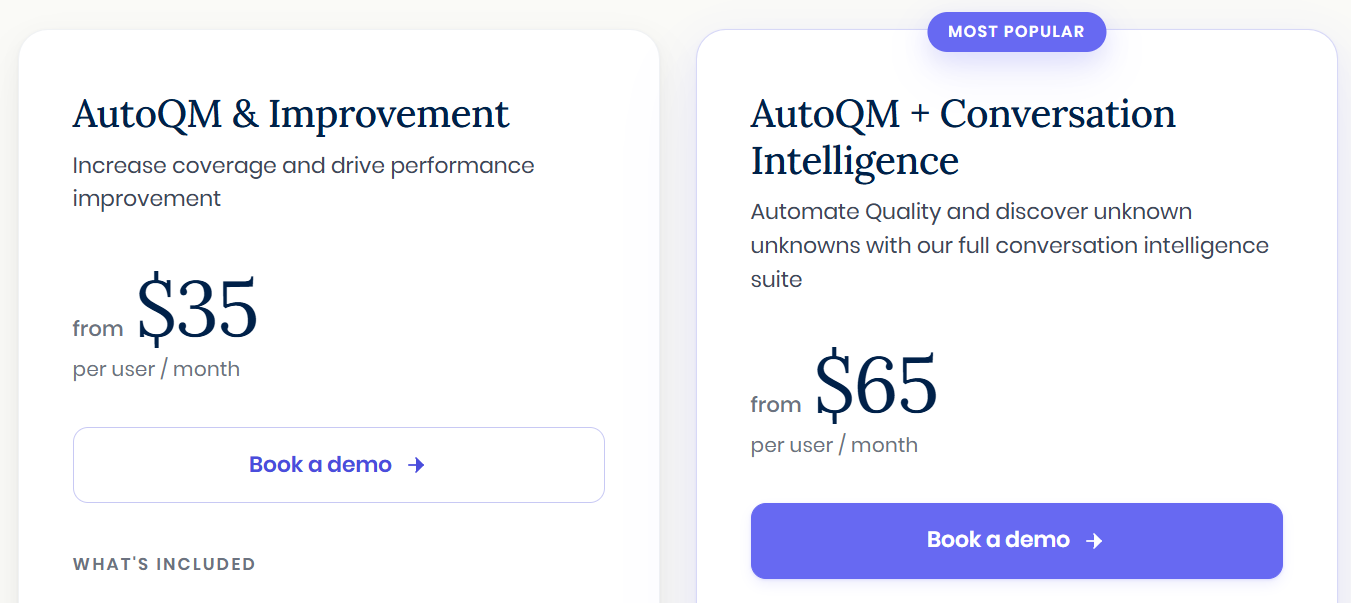
Volume discounts apply for large teams, and both tiers include a dedicated CSM and onboarding. evaluagent claims most organizations go live in a few weeks.
The integration list covers Zendesk, Salesforce, Genesys, Five9, Amazon Connect, Freshdesk, RingCentral, Talkdesk, Intercom, Puzzel, Aircall, Assembled, and Peopleware, with a documented REST API following the JSON:API specification for teams that need custom integrations or BI exports to Power BI, Tableau, Looker, or Metabase.
Seasalt Cornwall doubled its evaluations while reducing agent attrition from 100% to 10% year-on-year, attributed to the coaching consistency and transparency driven by evaluagent’s platform. (Seasalt Cornwall Case Study)
Solidroad or evaluagent: Comparison Summary
| Solidroad | evaluagent | |
|---|---|---|
| QA coverage | 100% automated scoring | 100% automated scoring |
| Scoring approach | Custom AI trained on customer data | Context Engine calibrated to company policies and knowledge base |
| Training simulations | AI role-play across phone, chat, email, and video | Not available |
| Conversation intelligence | Not available | xNPS, xCSAT, sentiment, topics, Spotlight |
| AI agent evaluation | Decagon, Sierra, Fin | Cross-vendor (Cognigy, Sierra, Decagon, and others) |
| Native integrations | 6 (Zendesk, Intercom, Gong, Guru, Notion, Docebo) | Zendesk, Salesforce, Genesys, Five9, Amazon Connect, and more |
| Public API | Not available | REST API with OpenAPI spec |
| Coaching and development | QA gaps trigger targeted simulations | QA triggers coaching, 1-to-1s, LMS, gamification, and performance plans |
| Security certifications | SOC 2 Type II, ISO 27001 | SOC 2 Type II, ISO 27001, Cyber Essentials Plus, HIPAA-aligned, EU AI Act Ready |
| G2 recognition | 4.5 rating (limited reviews) | Leader in Contact Center QA, Regional Leader EMEA (Summer 2026) |
| Team size fit | 1,000+ agents | 20+ agents |
| Published pricing | Not available (demo required) | From $35/user/month |
| Free trial | Not available | Available (arranged via demo) |
| Implementation timeline | ~6 weeks | Go-live in a few weeks |
| Best for | Large enterprise CX teams wanting automated QA with integrated training simulations | Mid-market to enterprise teams needing QA, conversation intelligence, and coaching |
Final Verdict
The choice between Solidroad and evaluagent depends on your team’s size, priorities, and how much of the quality lifecycle you want one platform to cover.
Choose Solidroad if your primary need is automated QA paired with AI training simulations for a large enterprise CX operation. It fits teams with 1,000+ agents that want to connect quality measurement to agent readiness through realistic practice sessions, and who can accommodate a six-week implementation and custom pricing.
The training simulation capability, with its multi-channel persona builder and software simulation layer, is distinctive and valuable for high-volume hiring and onboarding.
Choose evaluagent if you need a quality platform that covers automated scoring, conversation intelligence, AI agent observability, and coaching for teams of any size.
With over a decade in market, recognition as a Leader in G2’s Summer 2026 Contact Center Quality Assurance report, published pricing, and integrations across every major CCaaS and helpdesk platform, evaluagent is the safer and broader choice for mid-market and enterprise contact centers.
The Context Engine’s ability to check factual accuracy (not just communication quality), the predictive customer satisfaction metrics, and the coaching system with gamification and built-in LMS address more quality challenges than QA scoring and simulations alone.
Get started with evaluagent here.
Both platforms share the conviction that scoring 100% of interactions is the minimum standard for modern QA. The difference is what happens after the score.
Solidroad routes findings into training simulations; evaluagent routes them into a performance management system with conversation analytics, coaching workflows, and predictive customer intelligence. Your choice depends on whether training simulations or operational breadth matters more.