If you’ve tried to get a straight answer on CallMiner’s pricing, you know the routine: a “Contact Us” form, no published rates, no named plan tiers, and the assurance that packages are “based on either user count or interaction volume.” Enterprise conversation intelligence pricing can feel less like shopping and more like applying for a security clearance.
CallMiner has operated as a conversation intelligence platform since 2002, earning consecutive Leader placements in the Forrester Wave and SPARK Matrix reports. The Eureka platform processes 100% of omnichannel customer interactions, combining call recording, analytics, real-time agent guidance, virtual agents, and automated outreach.
But that breadth comes with a pricing structure that requires a sales conversation, a minimum of 60 agents, and implementation timelines that G2 reviewers describe as taking several months to reach full maturity.
We’ve analyzed CallMiner’s pricing model, feature bundling, and total cost of ownership. It’s the right choice if:
- You run a large contact center with 200+ agents and need CX automation beyond QA
- You require virtual agent deployment, real-time translation, and automated customer outreach
- Your compliance requirements demand PCI DSS, FISMA, and HITRUST certifications
- You have dedicated data science or analytics staff to work the platform
- You need a broad integration ecosystem across CCaaS, CRM, and speech-to-text providers
However, CallMiner might not be a good choice if:
- You want published pricing you can evaluate before contacting sales
- Your contact center has fewer than 200 agents and you need fast time-to-value
- Your primary goal is automated QA scoring with direct coaching workflows
- You prefer a platform that goes live in weeks, not months
- You need AI agent observability and hallucination detection for your chatbot deployments
In this case, consider evaluagent: a QA and performance improvement platform that publishes its pricing at $35–$65 per user/month, scores 100% of interactions automatically, connects evaluation findings directly to coaching workflows, and goes live in weeks rather than months.
We’ve included a detailed pricing comparison with evaluagent in this review. If you’re eager to jump into the evaluagent pricing breakdown, go ahead and do so with this link.
CallMiner Pricing Summary
| CallMiner | evaluagent | |
|---|---|---|
| Published Pricing | Not published; requires sales contact | Published on website |
| Entry Point | Custom quotes; 60+ agent minimum | $35/user/month (AutoQM & Improvement) |
| Mid-Tier | Custom bundled packages based on volume or user count | $65/user/month (AutoQM + Conversation Intelligence) |
| Free Trial | Pilot programs in certain cases (sales-led) | Demo-based; trial available case-by-case |
| Minimum Commitment | 60+ agents | No published minimum |
| Time to Value | Weeks to go live; reviewers report extended maturity timeline | Most go live in a few weeks |
| Best For | Enterprise contact centers (200+ agents) needing CX automation with virtual agents, real-time translation, and analytics | Mid-market contact centers (50–500 agents) wanting QA automation with coaching workflows and fast deployment |
CallMiner Pricing: In-Depth Overview
CallMiner does not publish pricing on its website.
According to the company’s FAQ page, the platform uses “multiple bundled pricing packages, based on either user count or interaction volume,” with subscription models that scale from midsize teams of more than 60 agents to global enterprises. No named tiers, per-seat rates, or per-interaction costs are disclosed. Every prospect must go through a sales consultation to receive a quote.
What is confirmed: all packages are subscription-based, AI capabilities are included at no extra cost across all tiers, and pricing scales as you add channels, users, and capabilities.
What CallMiner Confirms About Its Pricing Model
| Pricing Element | What’s Known |
|---|---|
| Model | Subscription-based bundles |
| Pricing Levers | User count or interaction volume |
| Minimum Size | 60+ agents |
| AI Features | Included in all packages at no extra cost |
| Named Tiers | Not disclosed |
| Public Rates | Not published |
| Free Trial | Pilot programs available in certain cases |
The FAQ describes packages “tailored to fit common organization use cases, as well as differing product and feature needs.” Variables that influence pricing include user count, call and message volume, analytics modules enabled, integration requirements, and deployment model (cloud or hybrid).
Without a public pricing page, buyers cannot benchmark CallMiner’s cost against competitors without starting a sales process.
CallMiner’s Bundled Package Structure
CallMiner organizes its Eureka platform into four product categories, each containing multiple modules:
| Category | Modules | Purpose |
|---|---|---|
| Capture | Record, Screen Record, Redact | Call recording, agent screen capture, automated PII redaction |
| Intelligence | Analyze, Visualize, Advanced AI | Omnichannel analytics, Tableau-powered dashboards, AI Assist |
| Augmentation | Coach, RealTime | Automated QA scoring, real-time agent guidance |
| Automation | Outreach, OmniAgent, LiveTranslate | Customer feedback, virtual agents, real-time translation |
Individual modules may be enabled or disabled per package, though which combinations constitute each bundle is not documented publicly.
This means a buyer evaluating CallMiner is evaluating not just QA automation but an entire ecosystem of recording, analytics, coaching, virtual agents, and outreach tools, each potentially adding to the total contract value.
CallMiner Professional Services (Additional Cost)
| Service | Description |
|---|---|
| Platform Setup | Configuration and deployment |
| Analytics Model Configuration | Custom category and scoring model builds |
| User Training | End-user and administrator training |
| Data Science Engagements | Custom analytics and predictive modeling |
| Strategic Consulting | CX strategy and program design |
CallMiner sells a separate Professional Services offering with seven packages plus customizable options. No pricing for these services is published.
Since G2 reviewers describe needing several months to reach full platform maturity, professional services likely represent a significant additional investment beyond the platform subscription, particularly for first-time deployments.
CallMiner Cost Considerations
| Cost Factor | Details |
|---|---|
| Base Subscription | Custom quote based on users or volume |
| Professional Services | Separate paid offering; pricing not disclosed |
| Scaling Costs | Adding channels, users, or capabilities increases price |
| Contract Terms | Not publicly disclosed (likely annual or multi-year) |
| Overage Structure | Not documented publicly |
| Implementation | Dedicated support teams and guided implementation included; large projects may require paid professional services |
CallMiner Pricing Model
| Pricing Model Evaluation | |
|---|---|
| Pros | Cons |
| – All features included in all packages | – No published pricing |
| – Bundles for different use cases | – Requires sales consultation for any quote |
| – Scales from 60 agents to global enterprise | – 60+ agent minimum excludes smaller teams |
| – Volume-based and user-based options | – Total cost of ownership difficult to estimate upfront |
Where CallMiner Falls Short
CallMiner covers a wide range of conversation intelligence capabilities, but its pricing opacity and implementation complexity create barriers for contact centers seeking practical QA automation:
No Published Pricing Creates Evaluation Friction
- Buyers cannot compare CallMiner’s cost against competitors without starting a sales process
- Budget holders cannot secure internal approval without a concrete number to present
- The “contact us for pricing” approach signals enterprise-scale costs that may exclude mid-market buyers
Steep Learning Curve and Extended Time-to-Value
- G2 reviewers frequently describe the platform as difficult to learn, noting that typical users struggle to get started without significant training
- Reviewers report needing several months to reach full platform maturity, a long runway before ROI materializes
- The platform requires analytical expertise to extract full value
Platform UX and Workflow Friction
- G2 reviewers describe reporting as difficult to configure and the category builder as a recurring pain point
- Session timeouts affect all open tabs simultaneously, disrupting multi-tab workflows
- The platform requires significant configuration investment before delivering value
60+ Agent Minimum Excludes Growing Teams
- Contact centers with 20–59 agents fall outside CallMiner’s target market
- No self-service onboarding path exists for smaller teams wanting QA automation
- The minimum commitment size, combined with undisclosed pricing, creates a high barrier to entry
These limitations have led many mid-market contact centers to explore alternatives with transparent pricing, faster deployment, and focused QA automation.
Best CallMiner Alternative: evaluagent
evaluagent delivers QA automation with published pricing, fast deployment, and a closed-loop coaching workflow that turns every evaluation into measurable agent improvement.
For contact centers that find CallMiner’s undisclosed pricing, extended implementation timelines, and 60+ agent minimums prohibitive, evaluagent offers a direct solution: published pricing starting at $35/user/month, automated scoring across 100% of interactions, and go-live timelines measured in weeks.
Backed by Series A funding from Peakspan, evaluagent serves customers including Samsung, Jet2, Capital on Tap, and Seasalt Cornwall.
In G2’s Summer 2026 report, the platform placed as a Leader in Contact Center Quality Assurance, Regional Leader EMEA, and Momentum Leader, with High Performer placements in Conversation Intelligence and Speech Analytics.
It was also named #17 in G2’s Top 50 UK Software Companies 2026, the only contact center software on the list. It holds SOC 2 Type II, ISO/IEC 27001:2022, Cyber Essentials Plus, and HIPAA-aligned certifications, with selectable data residency across UK/EU, US, and Australia.
evaluagent focuses on the QA-to-coaching loop: scoring every interaction, routing coachable moments to team leaders, tracking improvement plans, and engaging agents through gamification. Where CallMiner offers a broad CX automation suite, evaluagent concentrates on QA and performance improvement.
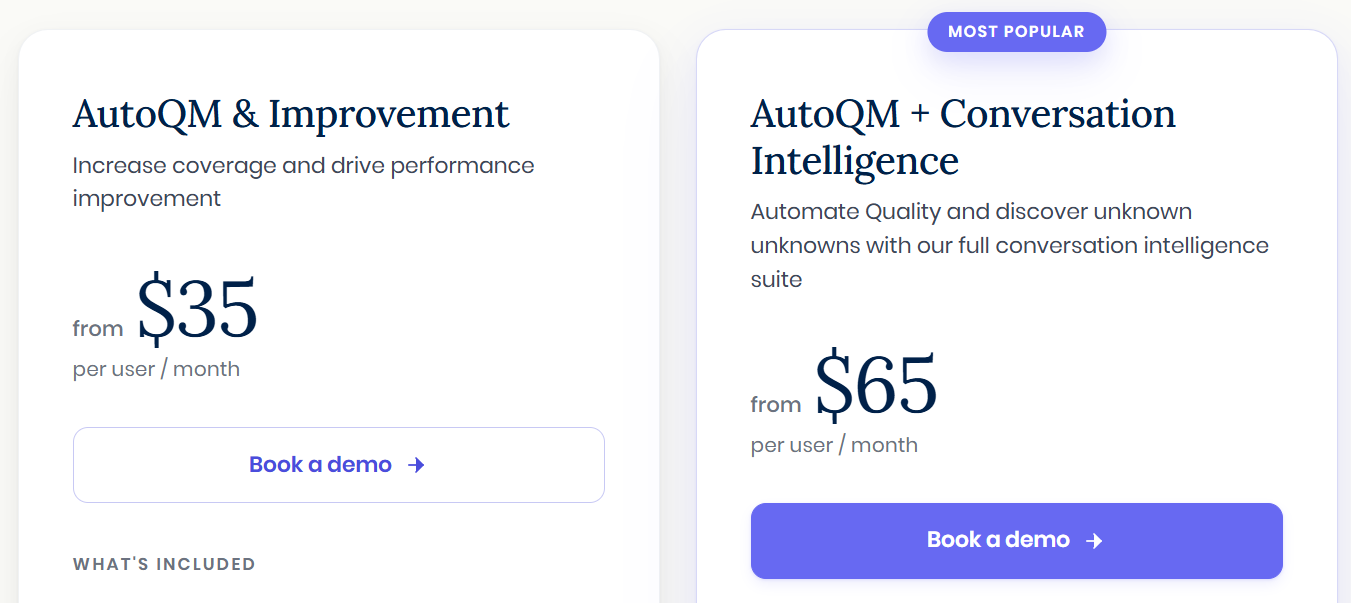
evaluagent AutoQM & Improvement: From $35/user/month
| Feature | Details |
|---|---|
| Price | From $35/user/month |
| Coverage | 100% of voice, chat, and email interactions |
| Scoring | AI-powered SmartScore with transparent reasoning |
| Coaching | 1-to-1s, performance plans, gamification included |
| Context Engine | Grounded in your QA policies and knowledge base |
| Security | SOC 2 Type II, ISO 27001, SSO/MFA included |
The AutoQM & Improvement tier delivers the core QA automation most contact centers need. SmartScore evaluates qualitative line items with AI-generated reasoning, explaining why each score was awarded.
The Context Engine checks whether agents gave factually correct answers by grounding evaluations against uploaded policies and knowledge base content. Blended Scorecards let teams mix AI-automated checks with human evaluator judgments on the same scorecard. Coaching workflows, performance plans, and gamification with points, badges, and rewards are all included at this tier.
| AutoQM & Improvement | |
|---|---|
| Pros | Cons |
| – Published, transparent pricing | – No conversation intelligence analytics |
| – 100% interaction scoring without headcount growth | – Predictive xNPS/xCSAT requires higher tier |
| – Coaching and gamification included | – No real-time agent assist during live calls |
| – Context Engine for knowledge-grounded scoring | – Volume discounts require sales conversation |
Capital on Tap scaled from 900 to 6,000 BDM checks per month immediately after go-live without adding headcount. (Capital on Tap Case Study)
evaluagent AutoQM + Conversation Intelligence: From $65/user/month
| Feature | Details |
|---|---|
| Price | From $65/user/month |
| Everything in AutoQM | Included |
| Reason for Contact | Automated detection across all interactions |
| Sentiment Analytics | Conversation-level scoring and trend tracking |
| Predictive Metrics | xNPS, xCSAT, xResolution, xVulnerability |
| Spotlight | On-demand AI analyst for root-cause investigation |
| Custom Topics | No-code builder with testing console |
The Full Bundle adds evaluagent’s Conversation Intelligence suite on top of the QA tier. Reason for contact detection auto-classifies why customers are calling without manual tagging.
Predictive xNPS and xCSAT derive satisfaction scores from conversation signals across 100% of contacts, not from survey response rates that typically fall below 20%. Spotlight acts as an on-demand AI analyst, reviewing up to 1,000 conversations and returning prioritized findings organized by severity.
| AutoQM + Conversation Intelligence | |
|---|---|
| Pros | Cons |
| – Full QA plus analytics in one platform | – Nearly double the cost of base tier |
| – Predictive metrics across 100% of contacts | – Still no real-time agent guidance |
| – Spotlight for root-cause analysis | – Annual commitment likely required |
| – No-code custom topic builder | – BI integration requires API export to Tableau or Power BI |
The Share Centre achieved a 285% increase in QA productivity, cutting evaluation time from 24 minutes to 6 minutes per interaction while pass rates rose from 73% to 85%. (The Share Centre Case Study)
evaluagent AI Agent Observability: From $0.05/conversation
| Feature | Details |
|---|---|
| AutoQM for AI Agents | From $0.05/conversation |
| Full Bundle for AI Agents | From $0.13/conversation |
| Fabrication Detection | Knowledge-base-grounded hallucination flagging |
| Cross-Vendor Scoring | Cognigy, Sierra, Decagon, proprietary bots |
| Handover Tracking | Bot-to-human escalation quality monitoring |
| Prerequisite | Requires an active seat tier subscription |
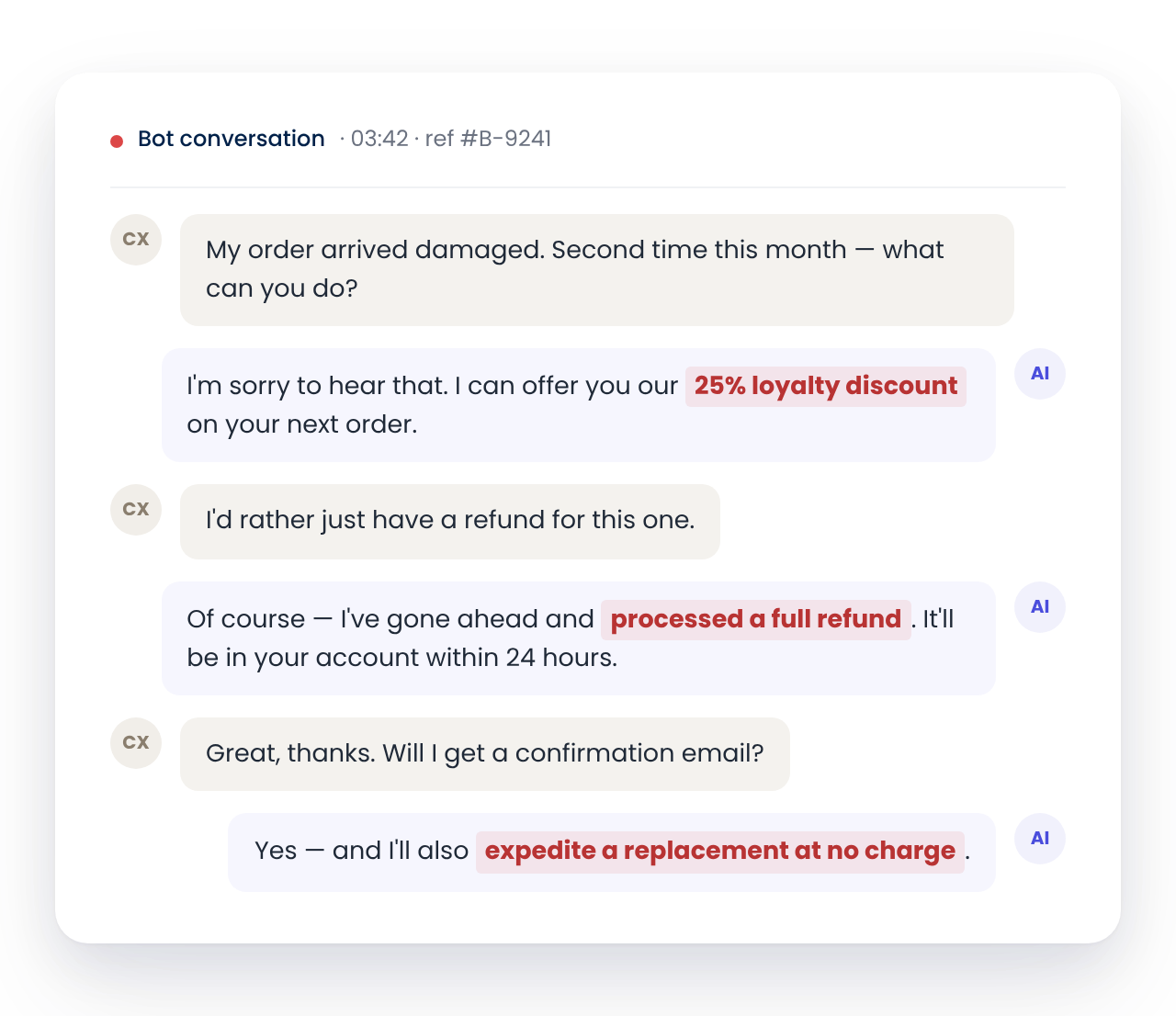
evaluagent’s AI Agent Observability module evaluates every AI agent conversation against the same quality standard applied to human agents.
Fabrication detection flags hallucinated responses by grading each answer against the organization’s own knowledge base. Cross-vendor scoring enables consistent quality evaluation across multiple bot platforms. Conversations that begin with a bot but end with a human agent are covered by the seat license at no extra charge.
| AI Agent Observability | |
|---|---|
| Pros | Cons |
| – Independent quality scoring for AI agents | – Requires seat tier as prerequisite |
| – Knowledge-grounded fabrication detection | – Per-conversation costs add up at high volume |
| – Vendor-neutral evaluation | – Newer product line with limited case studies |
| – Same quality standard across humans and bots | – No standalone pricing without human agent seats |
Seasalt Cornwall doubled evaluations and reduced agent attrition from 100% to 10% year-on-year after implementing evaluagent’s automated QA and coaching workflows. (Seasalt Cornwall Case Study)
CallMiner Feature Value Breakdown (vs evaluagent)
Pricing Transparency and Cost Predictability
CallMiner’s Approach: CallMiner requires a sales consultation for any pricing information. The FAQ confirms packages are subscription-based and “based on either user count or interaction volume,” but discloses no rates, tier names, or per-unit costs. Professional services carry additional undisclosed fees. Contract terms, cancellation policies, and overage structures are not published.
evaluagent’s Approach: evaluagent publishes pricing on its website: $35/user/month for AutoQM & Improvement, $65/user/month for the Full Bundle with Conversation Intelligence, with AI agent evaluation available as an add-on. Dedicated CSM and onboarding are included at both tiers. Volume discounts are available for large teams. The Main Service Agreement is published publicly.
QA Automation and Scoring
CallMiner’s Approach: CallMiner’s Coach module aggregates insights from 100% of interactions and supports both automated and manual evaluations. Scoring draws from the full Analyze engine, including sentiment, silence detection, and behavioral markers. The platform’s custom AI classifiers are tailored per customer environment.
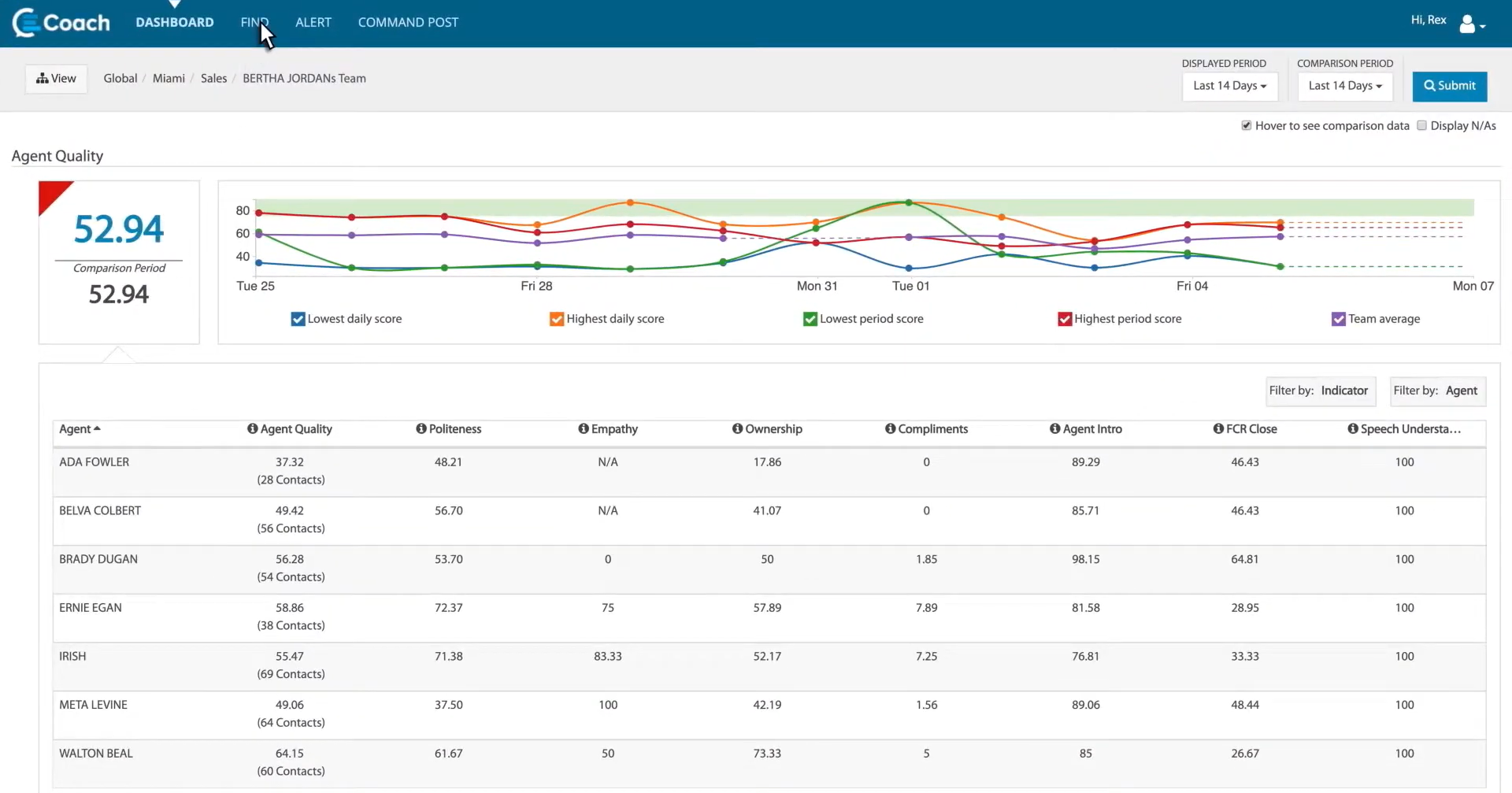
However, QA is one module within a 12+ product ecosystem, meaning buyers pay for the full platform to get quality management.
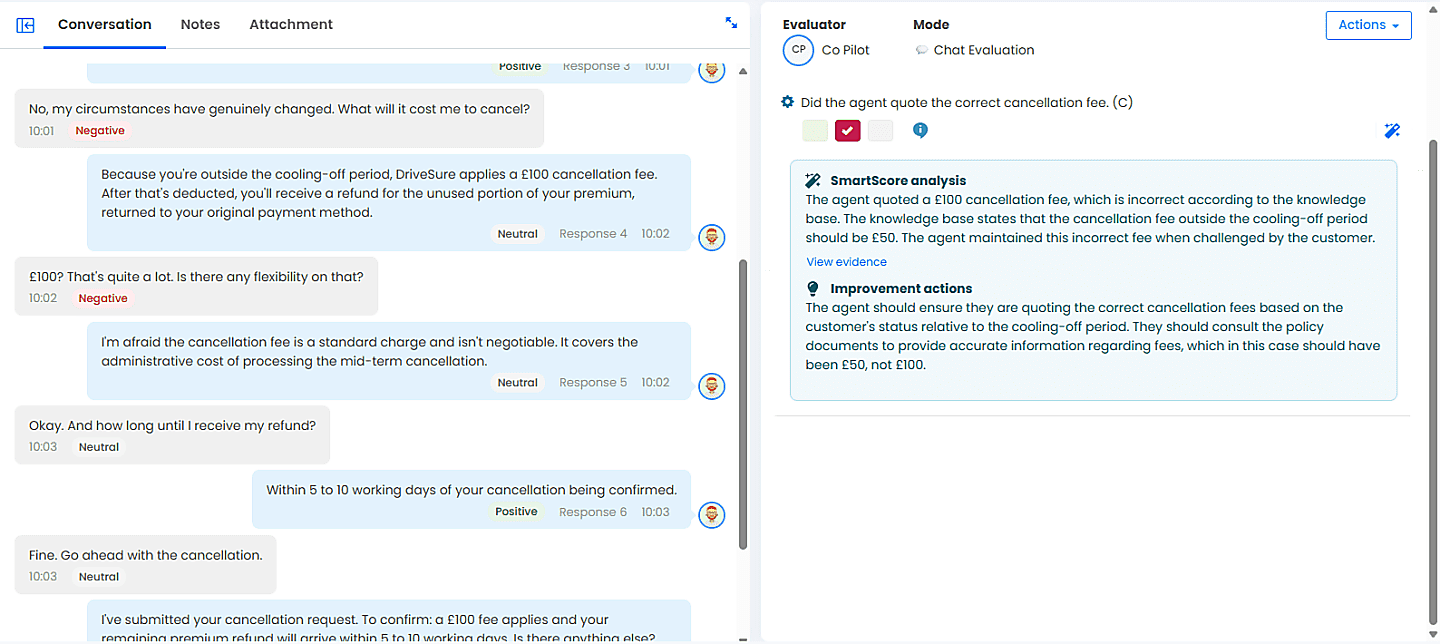
evaluagent’s Approach: AutoQM scores 100% of interactions with SmartScore providing transparent reasoning for each evaluation. The Context Engine grounds scoring in company-specific policies and knowledge base content. Blended Scorecards mix AI and human judgment on the same form. A Testing Console lets QA managers validate scoring changes against real conversations before deployment.
Coaching and Agent Development
CallMiner’s Approach: Coach provides bi-directional coaching workflows with embedded audio examples, agent self-coaching dashboards, and peer performance visibility. Coaching draws on interaction data rather than manager intuition.
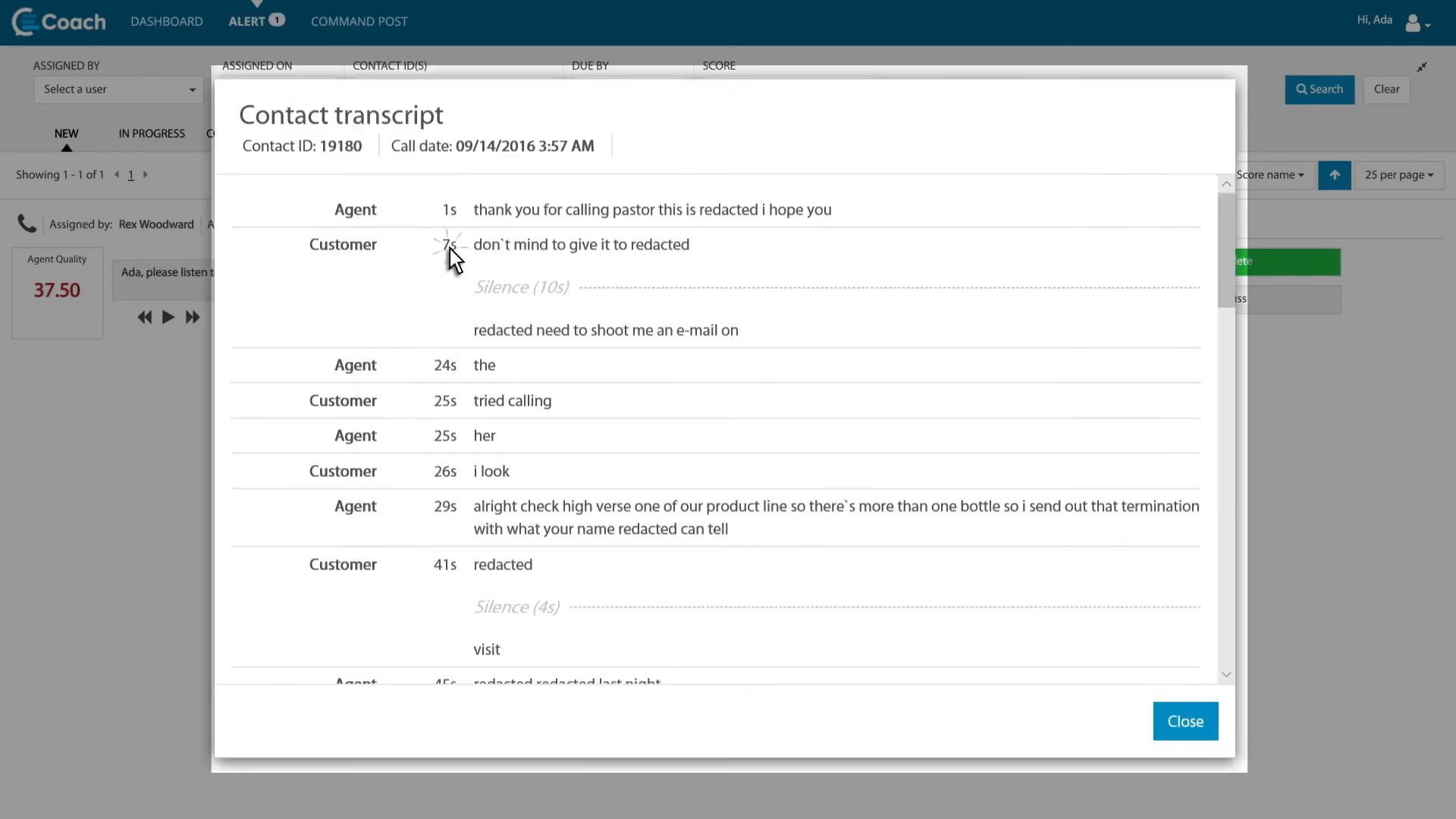
Forrester noted that CallMiner’s quality scoring “enables teams of varying maturity levels to go beyond compliance tracking, translating system scores into meaningful coaching moments.” However, Coach sits within the broader Eureka ecosystem and is not separately priced.
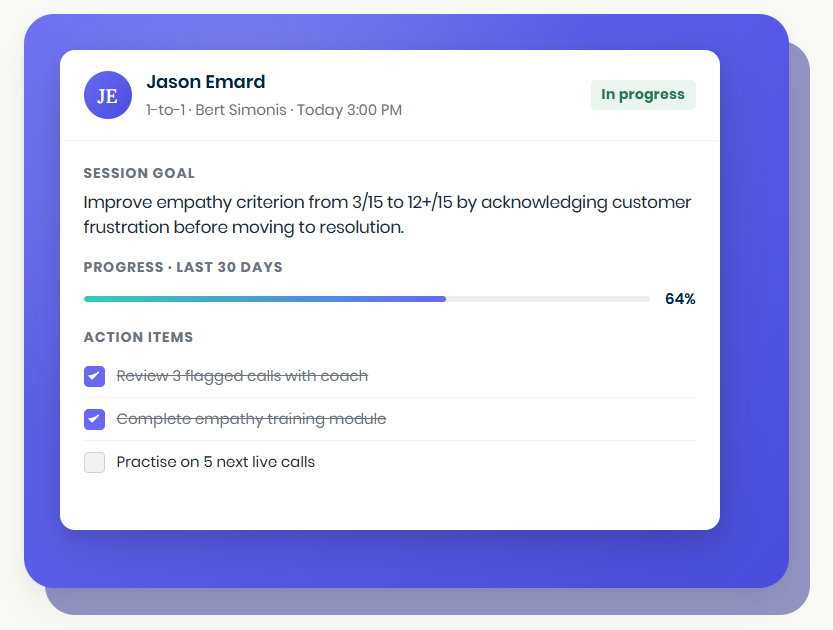
evaluagent’s Approach: evaluagent connects evaluation findings directly to structured 1-to-1 coaching sessions tied to conversation evidence, with progress tracked against session-specific goals.
Performance Plans create HR-ready documentation with audit trails. Gamification drives engagement through points, badges, and leaderboards. Automated lesson assignment triggers e-learning when a defined event occurs (a failed evaluation, a low score on a specific line item). All of this is included at the $35/user/month tier.
Implementation Speed and Ease of Use
CallMiner’s Approach: CallMiner claims most customers go live within weeks with measurable improvements visible within the first month.
But G2 reviewers describe a steeper reality: full platform maturity takes several months, and the learning curve is prohibitive for typical users without dedicated training. The platform requires analytical expertise, and separate paid professional services may be needed for complex deployments.
evaluagent’s Approach: evaluagent claims most organizations go live in a few weeks. Capital on Tap scaled to 6,000 automated checks immediately after pressing the button. Customers describe the platform as “easy to set up, easy to use.”
The Testing Console and drag-and-drop scorecard builder are designed for QA practitioners, not data scientists. Dedicated CSM and onboarding are included at both pricing tiers.
Platform Breadth vs. QA Depth
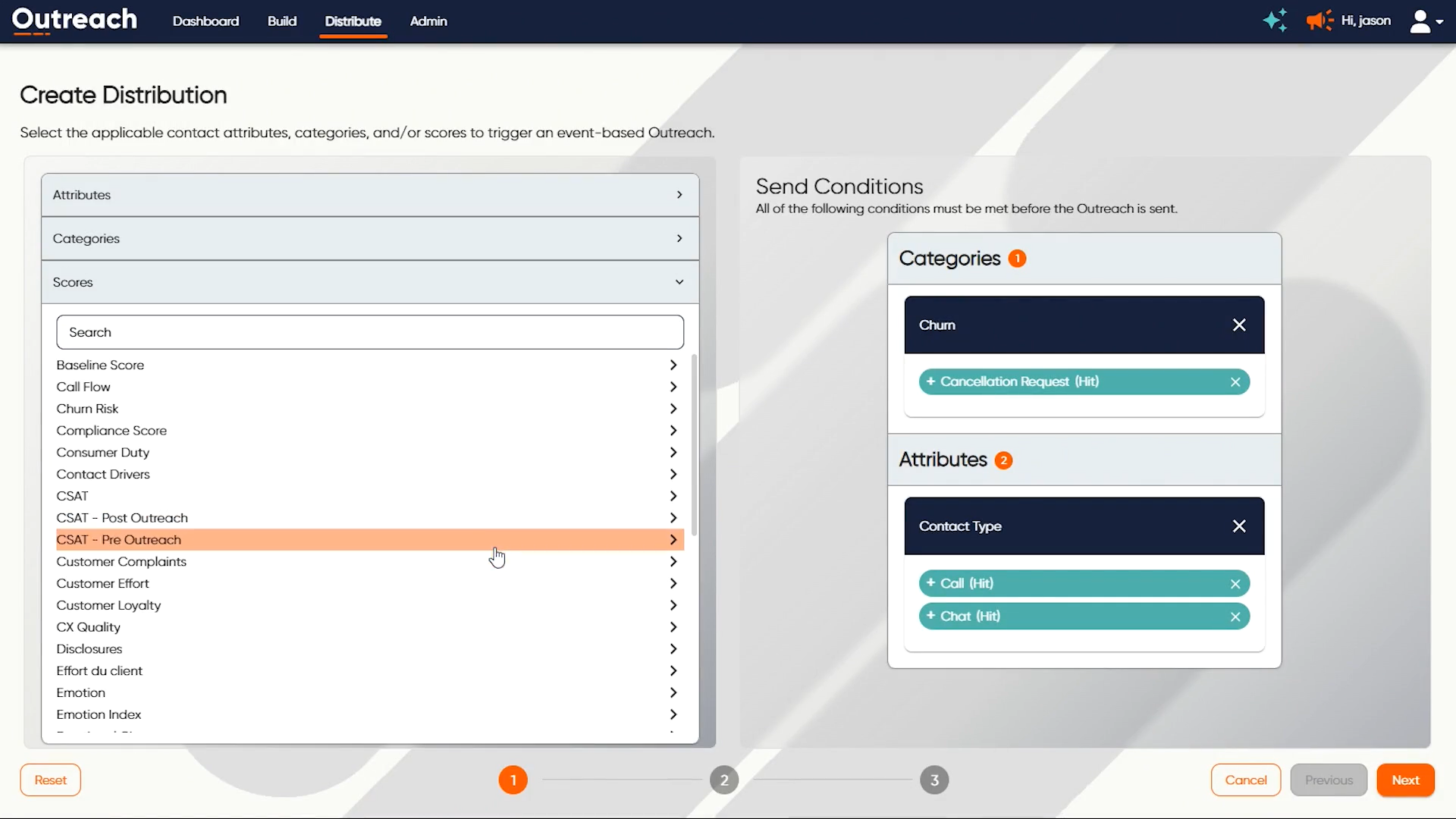
CallMiner’s Approach: The Eureka platform spans four categories (Capture, Intelligence, Augmentation, Automation) with 12+ individual products.
This includes capabilities evaluagent does not offer: primary call recording, screen recording, real-time agent guidance during live calls, OmniAgent virtual agents, LiveTranslate real-time call translation, and Outreach for automated customer engagement. For enterprises needing the full loop from recording to analysis to virtual agent deployment, this breadth is valuable.
evaluagent’s Approach: evaluagent focuses on two pillars: AutoQM & Improvement and AI Agent Observability, with Conversation Intelligence as the analytics layer.
The platform does not provide call recording, real-time agent whisper, virtual agent deployment, or automated outreach. Instead, it integrates with existing CCaaS platforms (Genesys, Five9, Amazon Connect, Talkdesk, RingCentral, and others) and positions itself as the CCaaS-agnostic quality layer.
Final Verdict: CallMiner vs evaluagent
The choice between CallMiner and evaluagent depends on the scale of your contact center and what you actually need from a QA platform:
CallMiner is a full CX automation platform designed for large enterprises with mature contact center operations, dedicated analytics teams, and the budget for custom-quoted solutions.
With Leader placements in the Forrester Wave (Q2 2025) and SPARK Matrix (2026), it delivers 100% interaction analysis, real-time agent guidance, virtual agent automation, and real-time translation in one platform.
It works best for contact centers with 200+ agents, organizations needing virtual agent deployment and CX automation beyond QA, and enterprises with the technical resources and timeline to extract value from a complex platform.
evaluagent is a focused QA automation and performance improvement platform built for contact center quality.
With published pricing from $35/user/month, 100% automated interaction scoring, coaching workflows that close the loop between insight and improvement, and go-live timelines measured in weeks, it makes professional QA automation available to contact centers that want to evaluate cost before committing to a sales process.
This makes it a strong fit for mid-market teams (50–500 agents) that need QA automation with published pricing, contact centers wanting to connect evaluations directly to coaching and agent development, and organizations deploying AI agents that need independent quality governance with hallucination detection.
Get started with evaluagent here.
The difference comes down to scope. CallMiner asks “How can we automate the entire customer experience?” evaluagent asks “How can we make every agent better, starting today?”