Choosing between Five9 and Genesys Cloud CX comes down to five questions:
- Do you need a platform built for outbound dialing and blended campaigns, or one designed for complex omnichannel journeys?
- Is your priority migrating off legacy on-premise infrastructure quickly, or consolidating every CX function into a single native suite?
- How important is AI-powered self-service today versus having the broadest feature set for tomorrow?
- Are you comfortable with add-on pricing for advanced capabilities, or do you prefer bundled tiers?
- Once calls and chats are handled, how do you know whether your agents (human and AI) are delivering quality?
In short, here’s what we recommend:
Five9 is the Intelligent CX Platform for enterprise and mid-market contact centers that need cloud infrastructure, outbound dialing, and Salesforce integration. Five9 covers inbound routing, AI-powered self-service, workforce engagement, and omnichannel support.
Its carrier-grade voice infrastructure and new Voice AI Agents architecture show where its AI investment is heading. However, reviewers consistently flag call stability issues, configuration complexity that demands professional services, and an add-on pricing structure that pushes total cost well above the base $119/seat/month.
Genesys Cloud CX is the experience orchestration platform for enterprises that want voice, digital, workforce engagement, journey analytics, and AI automation under one cloud-native roof.
Its agentic virtual agents powered by Large Action Models and native workforce management are real strengths. The tradeoff: a steep learning curve for advanced configuration, enterprise pricing starting at $75/user/month, and reporting limitations that frustrate teams with non-standard analytics needs.
Both platforms are CCaaS solutions that route, handle, and record customer interactions. But neither was designed to answer a question that grows more pressing as contact centers deploy AI agents alongside human ones: is the quality of those conversations actually good? That’s where evaluagent comes in.
evaluagent is the independent quality assurance and performance improvement layer that works on top of both Five9 and Genesys Cloud CX. Rather than competing with either platform, evaluagent integrates natively with both to score 100% of conversations automatically across voice, chat, and email, then connects those scores to coaching, performance plans, and agent development.
For contact centers deploying AI chatbots, evaluagent’s AI Agent Observability module evaluates every bot conversation for hallucinations, off-policy responses, and compliance breaches, holding AI agents to the same quality standard as human ones. Whether you choose Five9, Genesys, or another CCaaS entirely, evaluagent gives you vendor-independent quality data that stays with your organization.
If independent quality assurance across your contact center sounds like the missing piece, see how evaluagent works.
Five9 vs Genesys Cloud CX at a glance
| Five9 | Genesys Cloud CX | evaluagent | |
|---|---|---|---|
| Core strength | Outbound dialing, Salesforce integration, AI self-service | All-in-one orchestration with native WEM | Independent QA across 100% of conversations |
| AI approach | Genius AI with agentic voice architecture | Agentic virtual agents powered by Large Action Models | AutoQA scoring calibrated to your own QA standards |
| Quality management | Agentic QM (native, add-on) | Native Virtual Supervisor with AI pre-scored evaluations | Full-coverage AutoQA with coaching, gamification, and AI agent governance |
| Channels scored | Voice and digital (within platform) | Voice and digital (within platform) | Voice, chat, and email from any connected CCaaS |
| AI agent governance | AI Trust & Governance for own AI | Guardrails within AI Studio | Independent hallucination detection and bot QA across any bot vendor |
| Integration model | CRM adapters, CX Marketplace | 3,000+ APIs, AppFoundry Marketplace | Native integrations with Five9, Genesys, and other CCaaS and helpdesk platforms |
| Analyst recognition | 8x Gartner MQ Leader | 11x Gartner MQ Leader | G2 Leader, Contact Center QA (Summer 2026) |
| Pricing model | Per-seat bundles from $119/month + add-ons | Per-user tiers from $75/month + AI tokens | Per-user from $35/month |
| Best for | Mid-market to enterprise with outbound needs | Enterprise needing full-suite orchestration | Any contact center that needs independent, full-coverage quality assurance |
Both platforms route calls. Neither was built to tell you if those calls went well.
Five9 and Genesys Cloud CX are infrastructure platforms. They get calls to agents, give agents the tools to handle them, and record what happened. Both have added quality management modules in recent years, and those modules are useful. But they share a structural limitation: they grade their own homework.
Five9’s Agentic Quality Management evaluates up to 100% of interactions and feeds competency data into routing decisions.
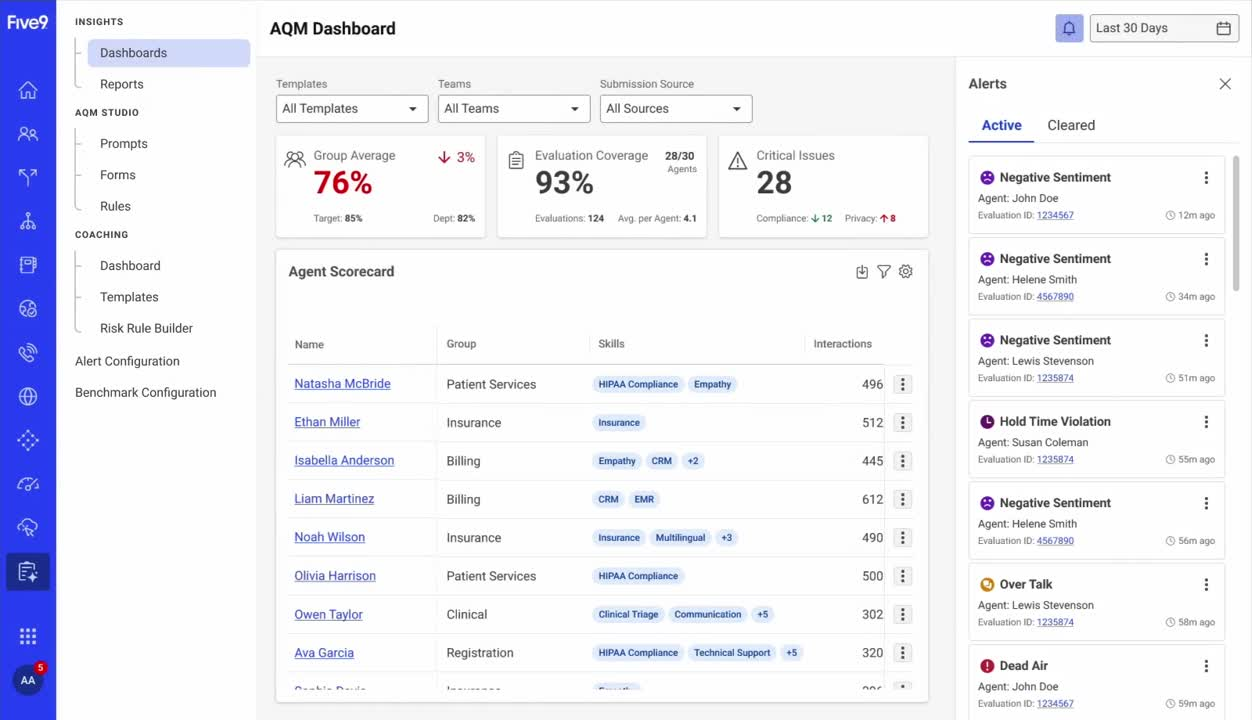
Genesys Cloud CX’s Virtual Supervisor pre-fills quality evaluation forms using AI, achieving 94% average scoring accuracy. Both improve on the old model of sampling 2-5% of calls manually.
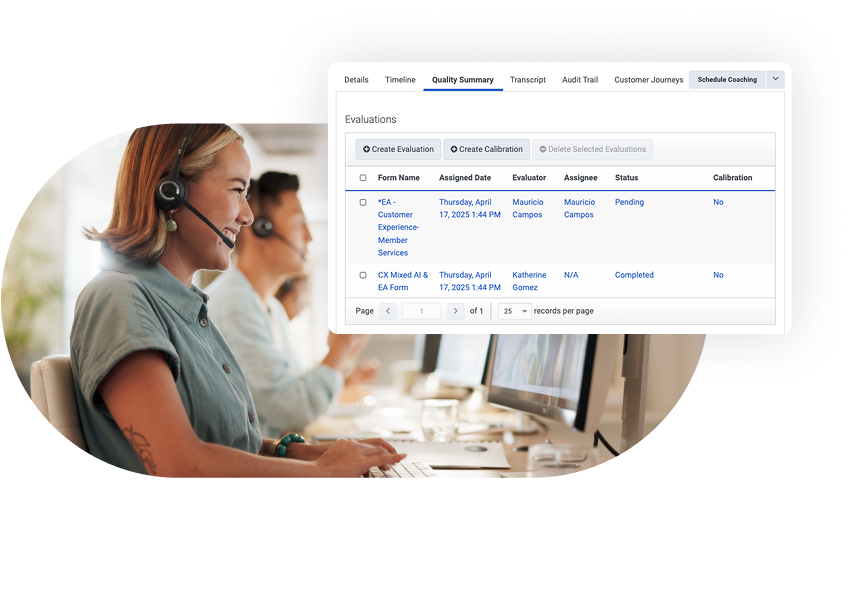
But both are tied to their own platform’s data and AI. If you run Five9 for voice and a separate helpdesk for chat, Five9’s QM only sees voice. If you deploy a third-party AI chatbot on Genesys, Genesys’s quality tools evaluate it using their own framework, not an independent one. And if you switch CCaaS vendors, your quality history doesn’t come with you.
evaluagent was built to solve this problem. It sits above the CCaaS layer, integrating natively with Five9, Genesys, Amazon Connect, Zendesk, Salesforce, Intercom, and others.
Conversations flow in from whichever platform handles them, and evaluagent scores them all against your quality standards using AutoQA and the Context Engine, which grounds scores in your company’s policies, knowledge base, and compliance rules.
The result: a quality record that belongs to your organization, not your CCaaS vendor.
Seasalt Cornwall doubled evaluations and reduced agent attrition from 100% to 10% year-on-year after deploying evaluagent’s QA and coaching workflows. (Seasalt Cornwall Case Study)
Five9 brings enterprise voice and outbound power
Five9 was built on voice and has spent 25 years refining it. If your contact center runs high-volume outbound campaigns, blended inbound/outbound operations, or complex IVR flows, Five9’s infrastructure is hard to match.
The outbound dialer is a differentiator. G2 reviewers consistently cite Five9’s predictive dialer and outbound campaign management as standout features.
The Advanced Campaign Manager adds AI-driven lead prioritization, campaign orchestration across voice, SMS, and email, and built-in compliance controls for TCPA, FDCPA, and GDPR.
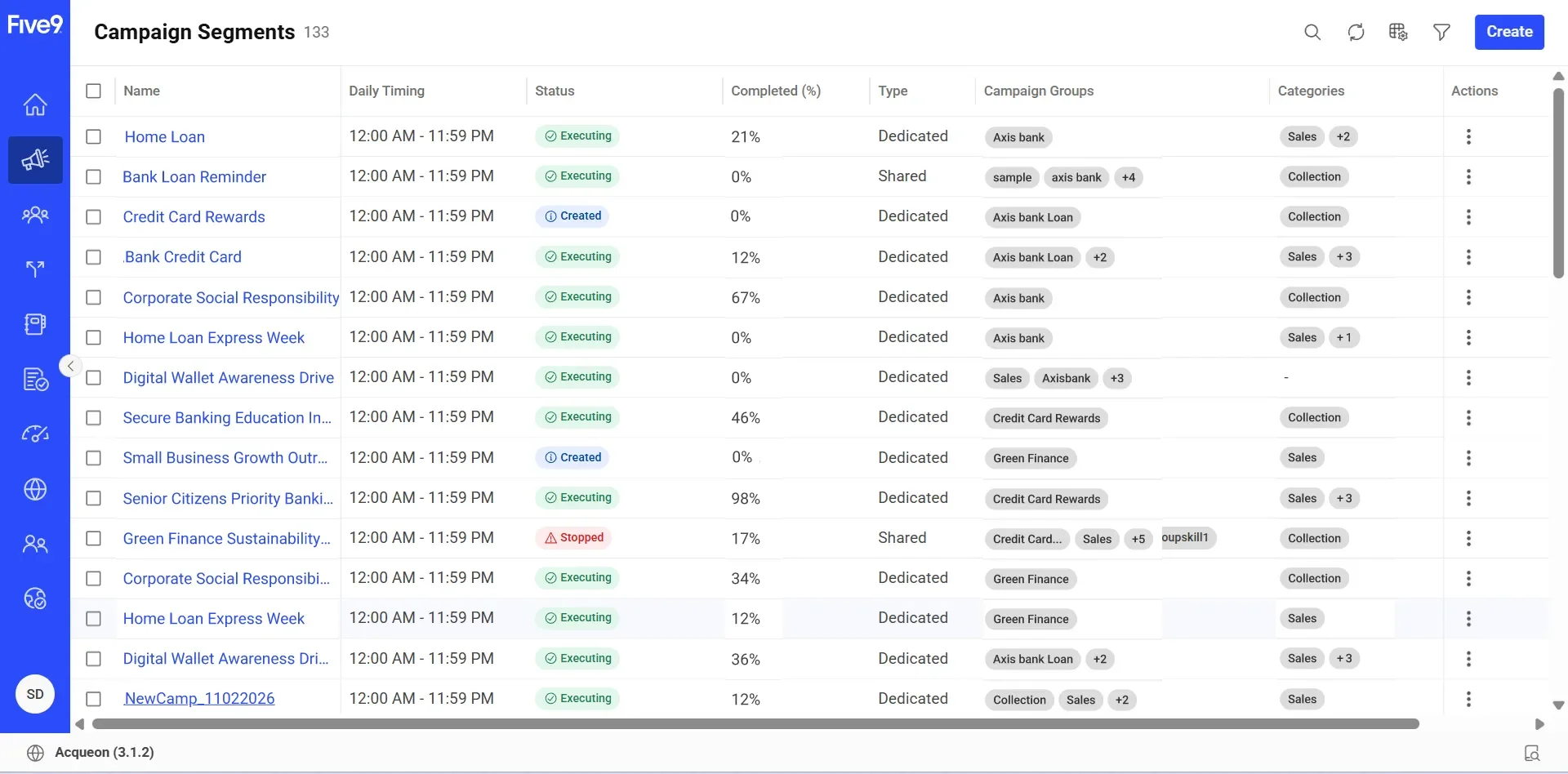
Active Blending shifts agents between inbound queues and outbound lists automatically based on real-time traffic, without manual log-in and log-out.
CRM integration, particularly with Salesforce, is another area where Five9 excels. Capterra reviewers (4.2/5 across 484 verified reviews) cite the Salesforce integration as the most-praised feature, noting automatic contact population and CTI capabilities. Pre-built adapters also cover ServiceNow, Microsoft Dynamics 365, Oracle, and Zendesk.
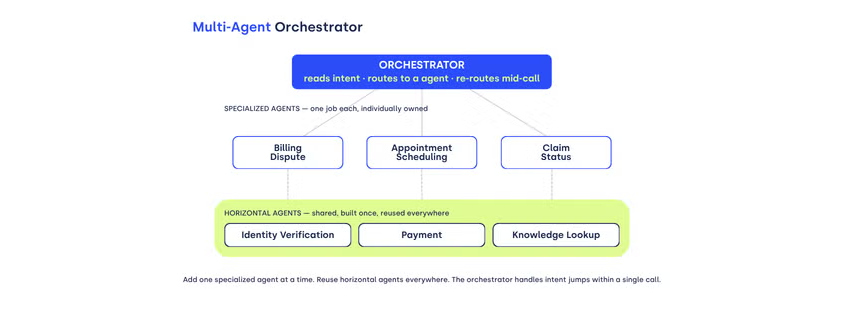
On the AI front, Five9’s recent Voice AI Agents launch introduced multi-agent orchestration for complex voice journeys, with an Agentic Voice Switch built into Five9’s carrier-grade telephony platform.
Where Five9 struggles: Capterra and G2 reviewers report software crashes during live calls, session logouts, and audio dropouts as the most common complaints. The platform’s depth creates configuration complexity that typically requires months of professional services.
And the base bundle at $119/seat/month is just the starting point; WFM, advanced AI, and analytics are add-ons that push total cost higher.
Genesys Cloud CX delivers broad platform coverage
Genesys Cloud CX takes the opposite approach: instead of excelling in one area and adding the rest, it covers everything natively. Voice routing, digital engagement, workforce management, quality assurance, journey analytics, predictive engagement, and AI automation all live in one cloud-native platform with a single admin console and a single agent desktop.
This breadth is real. The platform combines ACD, IVR, omnichannel digital (web messaging, WhatsApp, email, SMS, social), full WEM with AI-powered forecasting using 25+ machine learning models, conversational intelligence with speech and text analytics across 70+ languages, and journey analytics with predictive engagement.
No comparable CCaaS vendor covers this range without requiring third-party tools for core functions.
The AI investments are substantial. Agentic Virtual Agents powered by Large Action Models execute multi-step tasks deterministically, reducing hallucination risk compared to general-purpose LLMs.
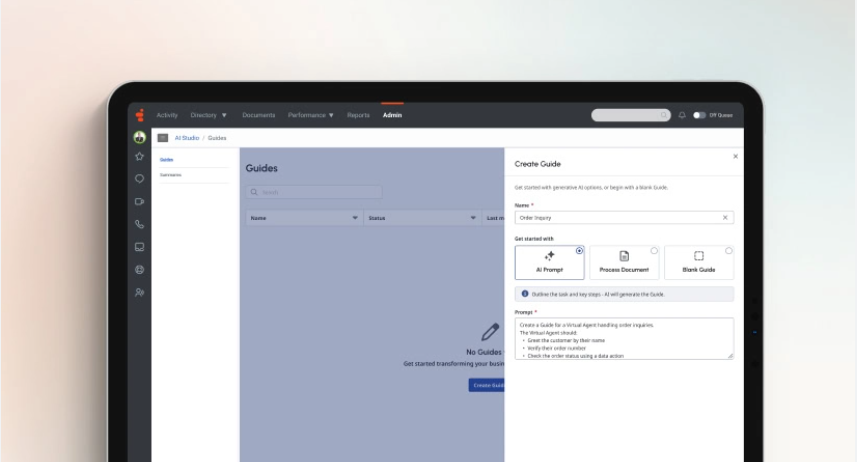
The AI Studio provides a no-code workspace for building virtual agents, copilot behaviors, and conversation summaries from one interface.
Where Genesys Cloud CX creates friction: advanced configuration, particularly through the Architect routing tool, has a steep learning curve that G2 reviewers consistently flag. Standard reporting works for common use cases, but customers with non-standard analytics needs hit limitations.
And the pricing, while starting lower than Five9 at $75/user/month for voice-only (CX 1), adds complexity through AI Experience token consumption and fair-use overage charges on top of the base tier.
AI agent governance is the emerging gap both platforms are still closing
Both Five9 and Genesys Cloud CX have built AI trust and governance features.
Five9’s AI Trust & Governance provides hallucination monitoring, prompt injection detection, and data redaction controls.
Genesys Cloud’s AI Studio guardrails constrain virtual agent behavior within administrator-defined boundaries.
These controls are useful, but they evaluate each platform’s own AI using its own framework. When a contact center deploys AI agents from multiple vendors, uses a third-party bot alongside its CCaaS, or needs an independent assessment of whether its AI is giving correct answers, a different approach is needed.
evaluagent’s AI Agent Observability was built for this scenario. It sits above the bot layer, evaluating every AI agent conversation against the same quality standard applied to human agents, regardless of which bot platform powers it (Cognigy, Sierra, Decagon, or proprietary builds).
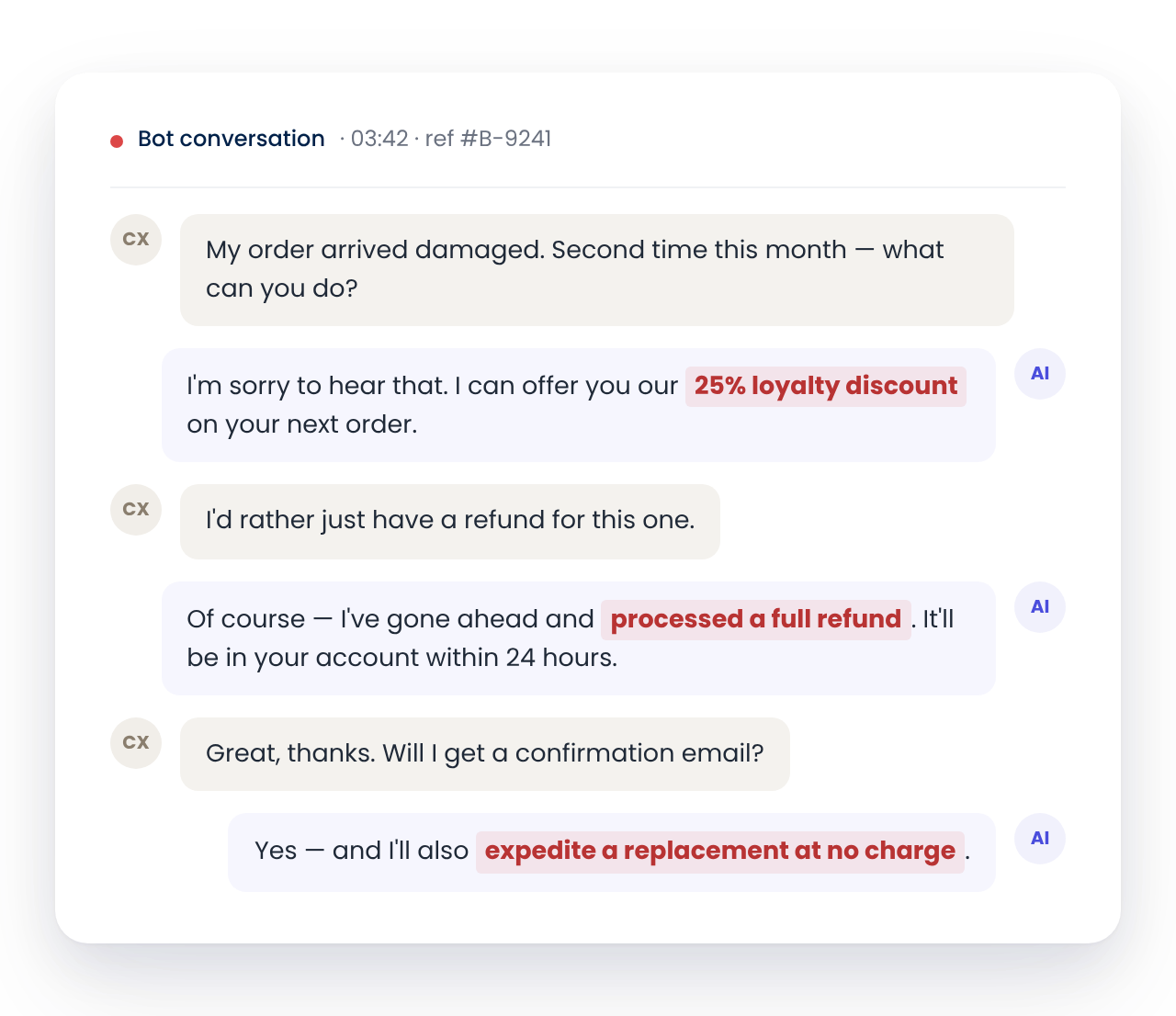
The module provides fabrication detection grounded in the organization’s own knowledge base, off-policy response flagging, containment analysis that goes beyond simple counts, and intent-level performance reporting showing which query types resolve cleanly and which generate frustration.
The key distinction: evaluagent holds conversations to the organization’s own definitions of “good”, not the bot vendor’s. A containment rate that looks good in the bot vendor’s dashboard may mask poor outcomes when measured against a company’s actual quality criteria. evaluagent provides that independent lens.
The quality-to-coaching loop is where value compounds
Scoring conversations matters only if it changes agent behavior. This is where the three platforms diverge most.
Five9 feeds Agentic QM data into routing decisions, so agents who demonstrate competence in specific areas receive matching interactions. That’s a useful feedback loop for routing, but it doesn’t address coaching and development directly.
G2 reviewers note that Five9’s WEM capabilities are add-ons, and that quality management at scale requires the Pro or Enterprise bundle.
Genesys Cloud CX connects quality evaluations to performance management and gamification within the same platform. Supervisors can launch coaching sessions from a quality evaluation screen, and agents and supervisors see the same real-time performance data. The limitation: all of this operates within the Genesys ecosystem.
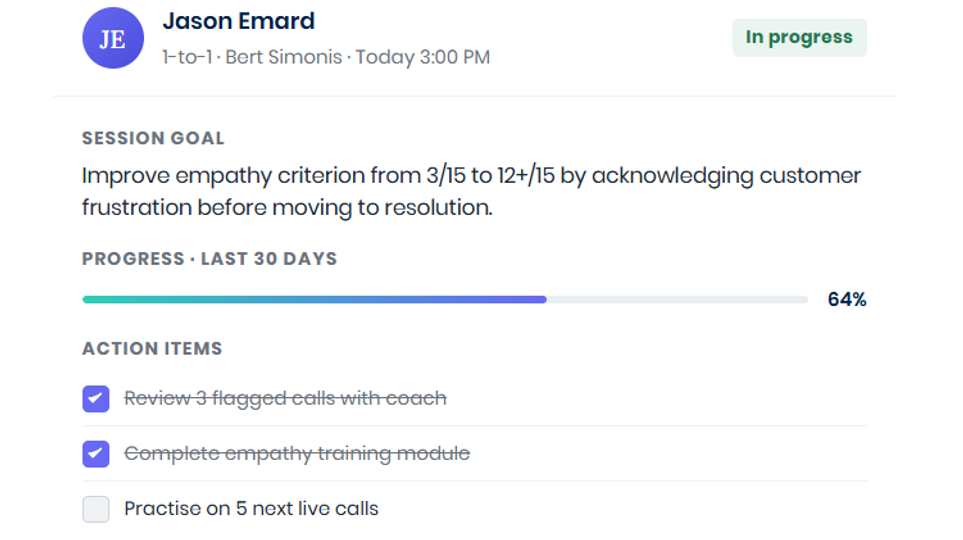
evaluagent makes the quality-to-coaching connection its central design. AutoQA scores feed into structured coaching sessions, 1-to-1s, performance improvement plans, eLearning auto-enrollment, and gamification without switching platforms.
When a score drops below a threshold, Actions fire automatically, triggering a coaching session or escalation.
The gamification layer awards points and badges for QA performance, driving engagement beyond static leaderboards.
And because evaluagent integrates with Assembled and Peopleware for workforce management, coaching sessions can be scheduled without leaving the platform.
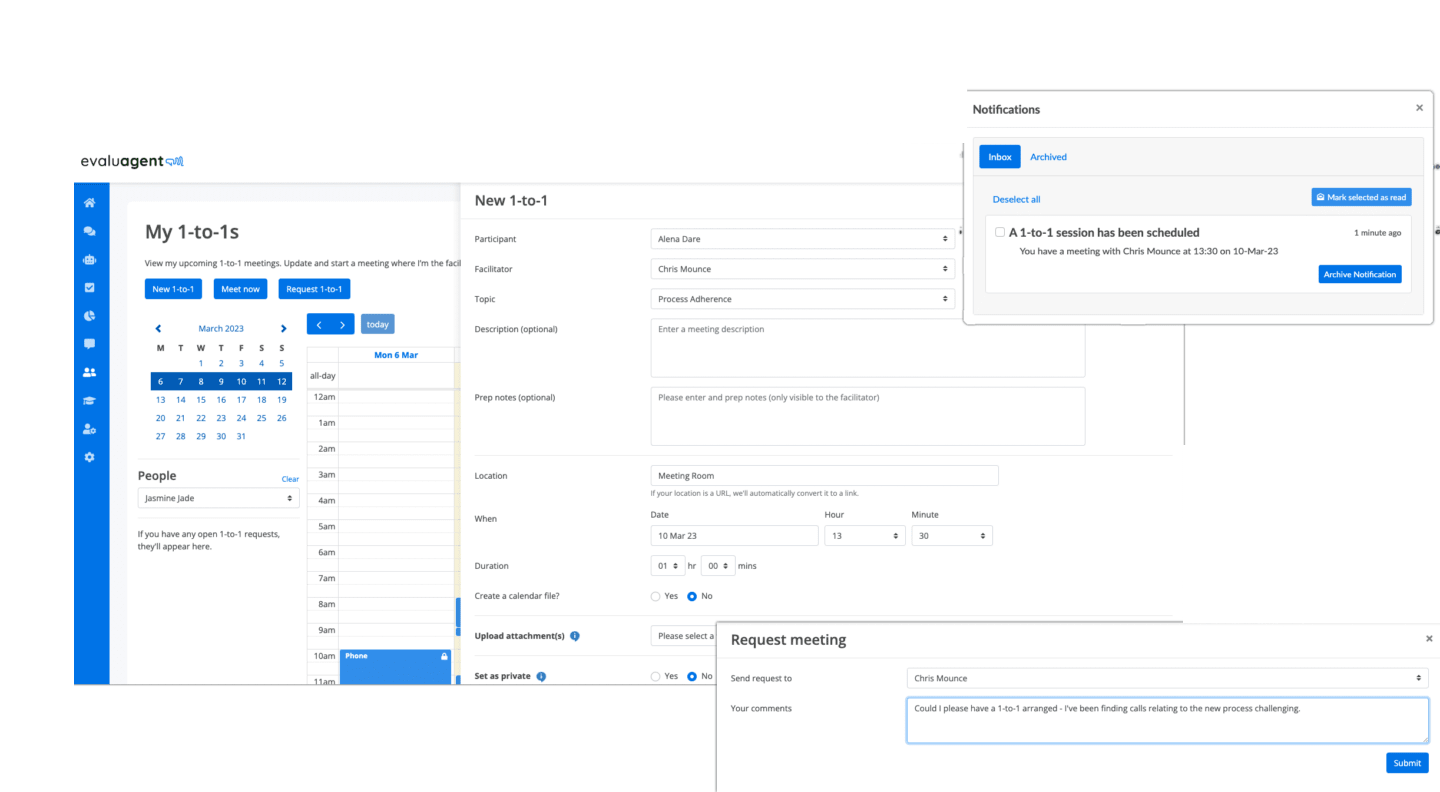
evaluagent’s Conversation Intelligence suite extends this further. It generates predicted satisfaction and effort scores (xNPS, xCSAT, xCES) on every interaction (including those where no survey was returned), while Spotlight surfaces root causes behind quality trends and Reason for Contact identifies which demand could have been deflected to self-service.
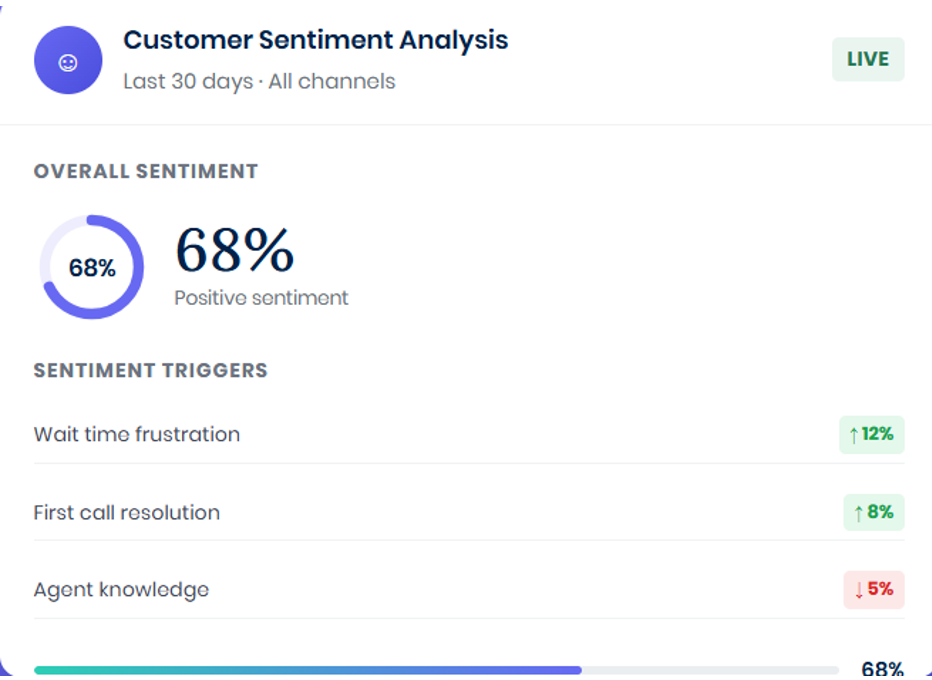
The shift: from knowing whether a conversation met the standard to understanding why customers are calling and whether their issues are resolving.
Capital on Tap scaled from 900 to 6,000 BDM checks per month immediately after go-live without adding headcount, avoiding the need for four or five times the number of analysts. (Capital on Tap Case Study)
Pricing comparison
The pricing models reflect different product categories.
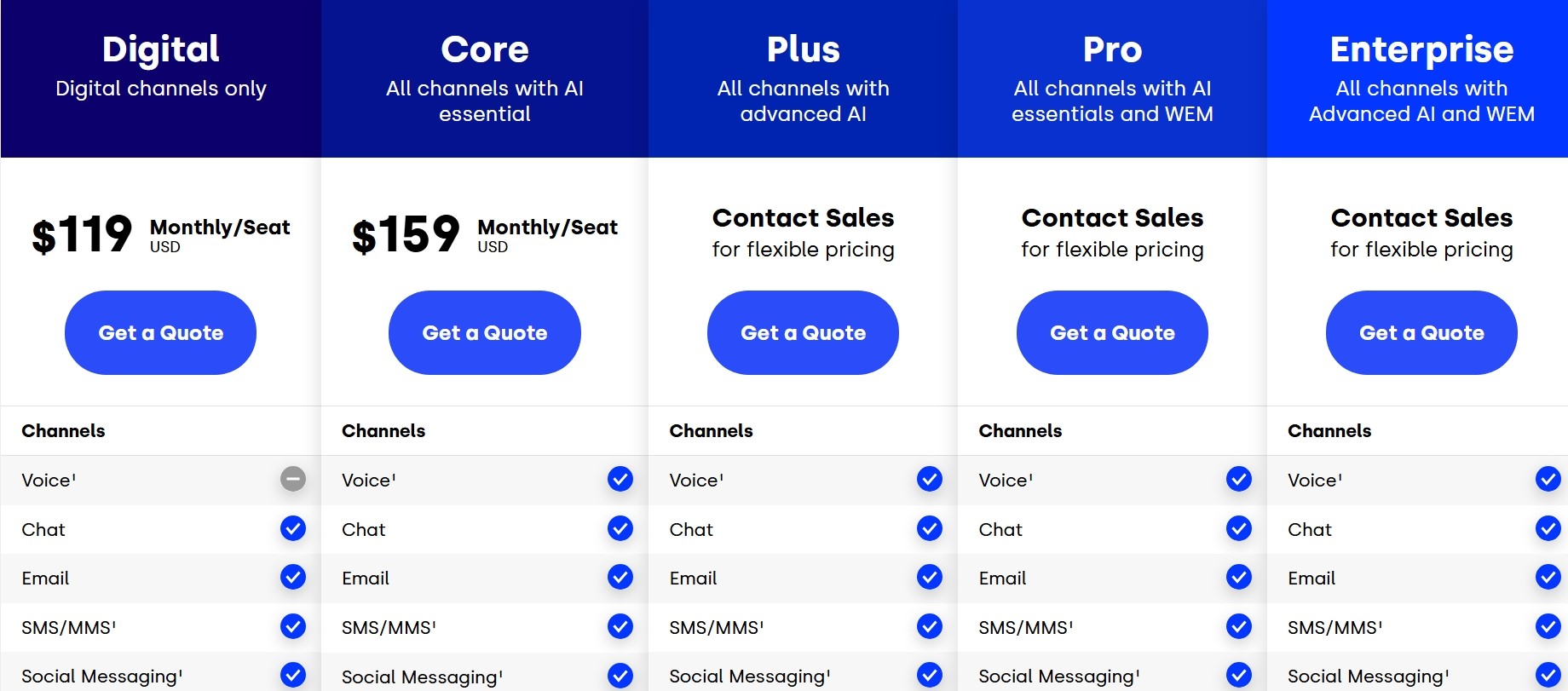
Five9 uses per-seat bundles. The Digital plan starts at $119/seat/month for digital channels only, and the Core plan at $159/seat/month adds full voice. Plus, Pro, and Enterprise tiers require a sales conversation. Each seat includes 3,000 minutes of AI usage, with consumption beyond that billed separately. Add-ons for WFM, advanced AI, and analytics push total cost above the base rate. There is no published free trial.
Genesys Cloud CX uses per-user tiers billed annually. CX 1 starts at $75/user/month for voice-only, CX 2 at $115/user/month adds digital channels and quality assurance, and CX 3 at $155/user/month adds full workforce engagement management.
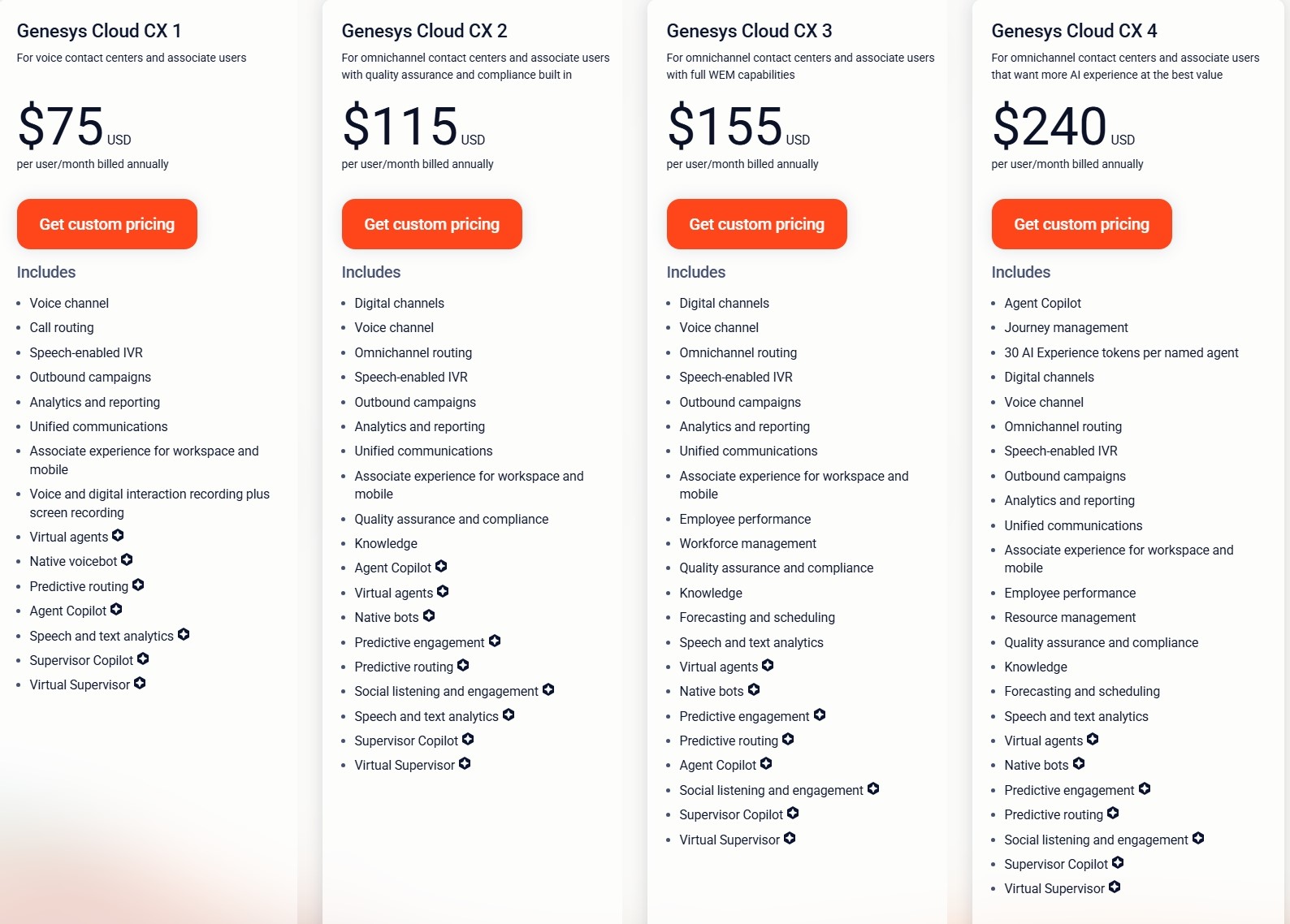
Advanced AI features consume AI Experience tokens billed monthly in arrears, with each organization receiving 250 free tokens per month.
Fair-use overage charges apply across storage, transcription, API calls, and outbound dialing. Concurrent and hourly licensing options are available for shift-based operations.
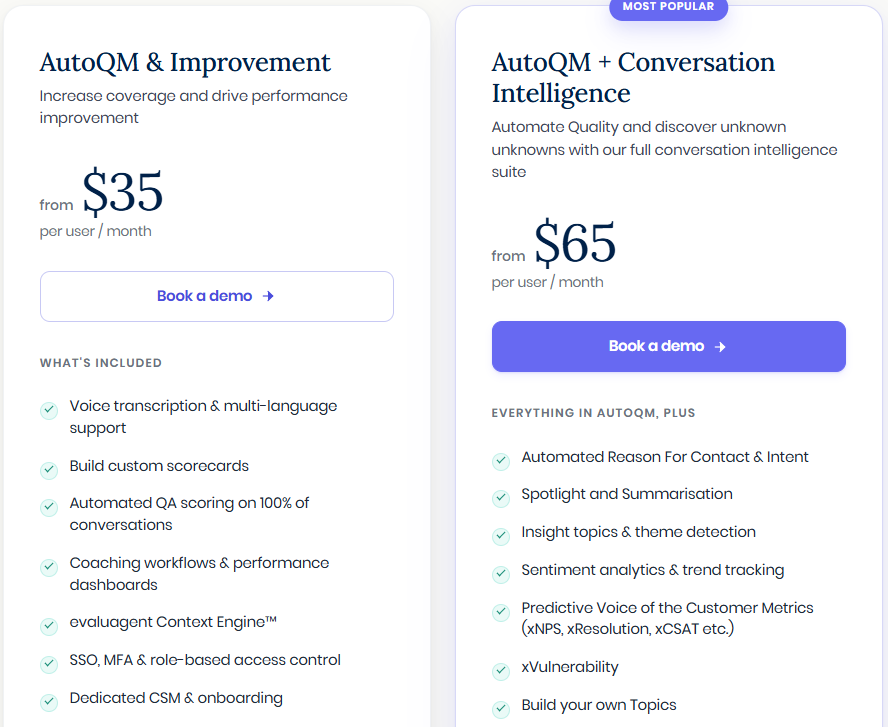
evaluagent sits on top of either platform. AutoQA & Improvement starts at $35/user/month, and AutoQA + Conversation Intelligence at $65/user/month. Volume discounts apply. Because evaluagent replaces what would otherwise require additional QA analysts, the cost comparison is against headcount, not another software line item.
The Share Centre cut evaluation time from 24 minutes to 6 minutes per interaction, a 285% increase in QA productivity.
For a 200-agent contact center, the infrastructure cost (Five9 or Genesys) dominates. evaluagent layers on top as a quality layer, replacing a function that would otherwise require a team of QA analysts.
Integration and platform flexibility
Five9 integrates with five CRM platforms through pre-built adapters (Salesforce, ServiceNow, Microsoft Dynamics 365, Oracle, Zendesk) and extends through the CX Marketplace. UC integrations cover Microsoft Teams, Zoom, and RingCentral. API access spans SOAP and REST, with a Developer Program providing sandbox environments.
The limitation: no published official server-side SDKs, and most API documentation sits behind a customer login.
Genesys Cloud CX is more open by design. Over 3,000 public APIs are documented in the Developer Center with an interactive API Explorer. Official SDKs ship in JavaScript, Java, .NET, Python, iOS, and Go. CX as Code enables Terraform-based infrastructure management.
The AppFoundry Marketplace extends the platform further. Data Actions provide a native iPaaS layer connecting Architect flows to external APIs at runtime.
evaluagent takes a CCaaS-agnostic approach. Native integrations cover Genesys, Five9, Amazon Connect, Talkdesk, RingCentral, Zendesk, Salesforce, Freshdesk, Intercom, Puzzel, Aircall, Assembled, and Peopleware. The open API follows the JSON:API specification with regional endpoints (EU, North America, Australia) for data sovereignty.
For platforms not natively supported, the API enables custom conversation ingestion. BI tools (Power BI, Tableau, Looker, Metabase) receive data through a reports exporter.
This platform-neutral approach matters for two reasons. First, BPOs managing multiple clients on different CCaaS platforms can run one QA program across all of them. Second, organizations that switch CCaaS vendors keep their quality history intact.
Security and compliance side by side
All three platforms maintain strong security postures, though the scope differs.
Five9 holds SOC 2 Type 2, PCI DSS Level 1, HIPAA, ISO 27001:2022, ISO 27017, GDPR, and Cyber Essentials certifications. A dedicated Trust Office provides real-time platform health dashboards and bi-annual trust reviews with technology executives. The 99.999% uptime SLA reflects the carrier-grade infrastructure.
Genesys Cloud CX carries one of the broadest compliance portfolios in the category: ISO 27001, ISO 27017, ISO 27018, ISO 42001 (AI management), PCI DSS, SOC 1/2/3 Type 2, FedRAMP, HIPAA, HITRUST, and GDPR, among others. The ISO 42001 certification is notable as the international standard for AI management systems.
The platform runs across at least three AWS Availability Zones in an active/active/active configuration, with 500 automated chaos experiments running daily.
evaluagent holds SOC 2 Type II, ISO/IEC 27001:2022, Cyber Essentials Plus, GDPR, HIPAA, and EU AI Act readiness certifications. Regional API clusters (EU, North America, Australia) enforce data sovereignty. PII redaction comes out of the box for both text and audio data.
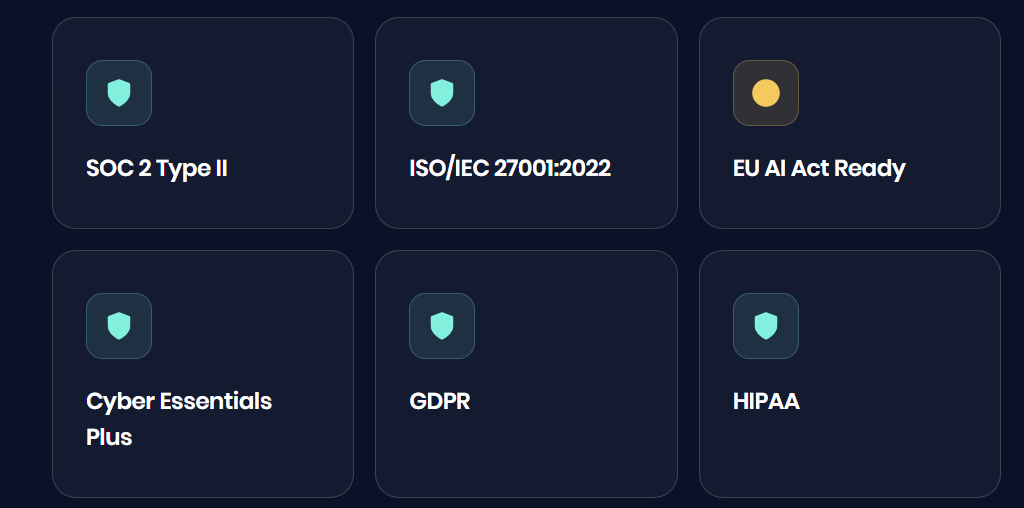
The EU AI Act readiness certification is relevant as regulators begin requiring documented AI governance frameworks for employee evaluation systems.
Five9 vs Genesys Cloud CX vs evaluagent: Which should you choose?
The right answer depends on which problem you’re solving.
Choose Five9 if:
- Outbound dialing, blended campaigns, or collections are core to your operation
- Salesforce is your CRM and native CTI integration is a hard requirement
- You’re migrating from legacy on-premise infrastructure and need enterprise cloud
- You have the budget and IT resources for professional services-led implementation
- AI-powered voice self-service is a near-term priority
Choose Genesys Cloud CX if:
- You want voice, digital, WEM, journey analytics, and AI in a single native platform
- You need flexible telephony options (managed, BYOC Cloud, or BYOC Premises)
- Your organization requires the broadest compliance portfolio (FedRAMP, HIPAA, ISO 42001)
- Developer experience matters and your team wants 3,000+ APIs with official SDKs
- You’re planning agentic AI deployments and want a single AI Studio for governance
Add evaluagent to either if:
- You need independent quality assurance that isn’t tied to your CCaaS vendor
- You want to score 100% of conversations automatically and connect scores to coaching
- You’re deploying AI agents and need vendor-independent hallucination detection
- Your QA team is stretched and can’t scale analysts alongside operational growth
- You run a BPO managing multiple clients on different platforms
Five9 and Genesys Cloud CX are both proven platforms with years of analyst validation, thousands of enterprise customers, and active AI roadmaps. The choice between them hinges on whether you need outbound-first infrastructure with CRM integration (Five9) or all-in-one orchestration with native WEM (Genesys Cloud CX).
But whichever platform handles your interactions, the question of whether those interactions are good requires its own answer. evaluagent provides that answer independently, consistently, and at a scale that manual QA cannot match.
In a market where contact centers deploy AI agents alongside human ones, a single, vendor-neutral quality standard across both isn’t optional. It’s how you prove your CX operation delivers what it promises.
The Share Centre achieved a 285% increase in QA productivity, cutting evaluation time from 24 minutes to 6 minutes per interaction, while pass rates rose from 73% to 85%. (The Share Centre Case Study)