Choosing between Five9 and Zendesk for your customer service operation comes down to five questions most comparison articles skip:
- Is your operation built around phone calls and outbound campaigns, or around support tickets and messaging?
- Do you need carrier-grade telephony with predictive dialing, or a helpdesk that handles every channel from a single workspace?
- Are you migrating a large contact center off legacy infrastructure, or scaling a growing support team?
- How much does independent quality assurance matter to your compliance and coaching programs?
- Do you want your QA data locked inside your platform vendor, or portable across any system you use today or switch to tomorrow?
In short, here’s what we recommend:
Five9 is the contact center platform built for organizations that live on the phone. With carrier-grade voice infrastructure, predictive dialing, and an AI layer called Genius AI that handles autonomous voice conversations, Five9 serves contact centers running 50 to 10,000+ agents. It has been named a Gartner Magic Quadrant Leader for CCaaS eight consecutive times. But the platform is complex to configure, pricing starts at $119/seat/month before add-ons, and its built-in quality management is one module among many.
Zendesk is the customer service platform built for teams that start with tickets and messaging. It unifies email, chat, voice, social, and self-service in a single agent workspace, backed by AI trained on roughly 20 billion ticket interactions. Zendesk earned a Leader position in the 2025 Gartner Magic Quadrant for CRM Customer Engagement Center, and its 1,800+ marketplace integrations give it one of the largest extension ecosystems in customer service. Full AI capabilities require higher-tier plans, though, and its contact center offering is newer and less proven than dedicated CCaaS platforms.
Both Five9 and Zendesk include quality management modules. But built-in QA, designed as one feature among hundreds, rarely matches a specialist. For contact centers where quality directly affects compliance, agent retention, and customer outcomes, there’s a stronger option.
evaluagent is the specialist QA and performance management platform built for contact centers. It integrates with both Five9 and Zendesk (along with Genesys, Salesforce, Talkdesk, and others) to score 100% of conversations automatically, then connects those scores to coaching, performance plans, and agent development. Its Context Engine checks whether agents gave the right answer, not just whether they sounded professional. Its AI Agent Observability module evaluates AI bot conversations for hallucinations, off-policy responses, and compliance breaches. For teams that need QA deeper than what any CCaaS or helpdesk vendor builds in, evaluagent is the independent layer that works on top of whichever platform you choose.
If specialist QA that works across any platform sounds like what your contact center needs, book a demo with evaluagent.
Five9 vs Zendesk vs evaluagent at a glance
| Five9 | Zendesk | evaluagent | |
|---|---|---|---|
| Primary function | Cloud contact center (CCaaS) | Customer service platform (helpdesk + CX) | Contact center QA & performance management |
| Core channel strength | Voice, outbound dialing, blended operations | Ticketing, messaging, self-service | Channel-agnostic QA across voice, chat, email |
| AI capabilities | Genius AI with Voice AI Agents, Agent Assist, IVA | AI Agents, Copilot, Resolution Learning Loop | AutoQA with Context Engine, AI Agent Observability |
| Built-in QA | Agentic Quality Management (up to 100% coverage) | AutoQA with Spotlight (100% coverage) | Full-coverage AutoQA with closed-loop coaching and performance plans |
| Outbound capabilities | Predictive, progressive, preview, and power dialing | Basic predictive dialing via contact center add-on | N/A (QA layer, not a contact platform) |
| Integrations | CRM adapters, CX Marketplace | 1,800+ marketplace apps | Native integrations with Five9, Zendesk, and 10+ other platforms |
| Platform independence | Locked to Five9 | Locked to Zendesk | CCaaS-agnostic, works with any platform |
| Pricing model | Per-seat subscription | Per-agent subscription | Per-user subscription |
| Starting price | $119/seat/month | $55/agent/month (Suite Team) | $35/user/month |
| Free trial | No self-serve trial (demo-led) | 14-day free trial | Demo-led trial |
| Best for | Enterprise contact centers with voice-heavy, blended operations | Customer service teams scaling across digital channels | QA teams needing independent, full-coverage quality assurance across any platform |
Different platforms for different operations
Five9 and Zendesk are not interchangeable. They come from different traditions and serve different starting points.
Five9 was founded in 2001 to replace on-premise contact center hardware with cloud software. The name is a promise: “five nines” (99.999%) uptime. Over two decades, Five9 built the infrastructure enterprise contact centers depend on: ACD routing, IVR, predictive dialers, global voice infrastructure, and workforce management. The platform serves organizations where the phone is the primary channel, outbound calling drives revenue, and agents number in the hundreds or thousands. Revenue reached a record $1.149 billion in FY2025, and the company employs roughly 2,910 people.
Zendesk was founded in 2007 in Copenhagen to make customer service software simple and affordable. It grew up as a ticketing system, adding live chat, messaging, knowledge bases, and eventually voice. Zendesk thinks in tickets, not calls. After being taken private in 2022 for roughly $10.2 billion by Hellman & Friedman and Permira, the company refocused on AI-driven service and now reports over 20,000 customers using Zendesk AI.
Both platforms have expanded into each other’s territory. Five9 now handles email, chat, SMS, social, and video alongside voice. Zendesk has launched a contact center powered by AWS with predictive dialing and AI voice agents. But their origins show. Five9’s digital channels are additions to a voice-first architecture. Zendesk’s contact center is an extension of a ticketing-first platform.
This distinction matters because it shapes what each platform does well, and where each platform’s built-in QA hits its ceiling.
Five9 leads in enterprise telephony
If phone calls are the center of your operation, Five9 is hard to match.
The platform runs on a two-tier voice infrastructure: Core Edges host the application stack, and Voice Edges sit globally to keep call paths local. This reduces latency and audio degradation for international operations. BYOC support lets organizations keep existing carrier relationships or use Five9’s telephony.
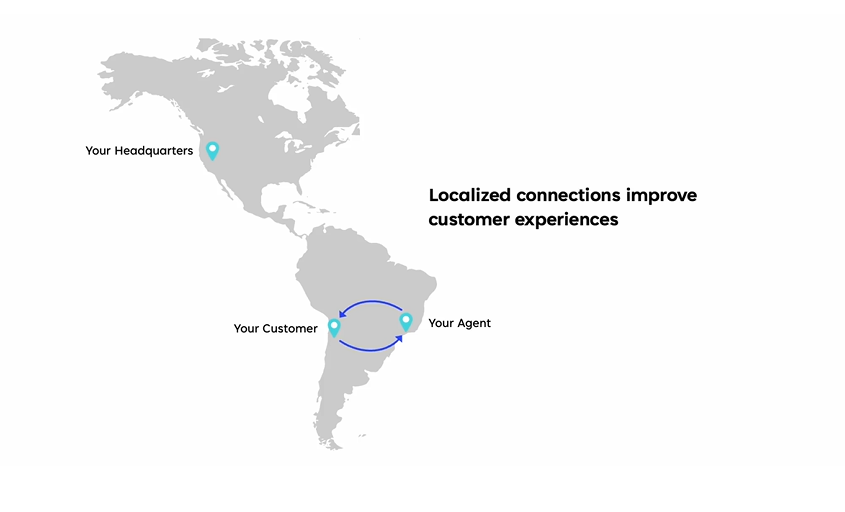
Outbound calling is a particular strength. Five9’s dialer offers predictive, progressive, preview, and power modes, each configurable per campaign.
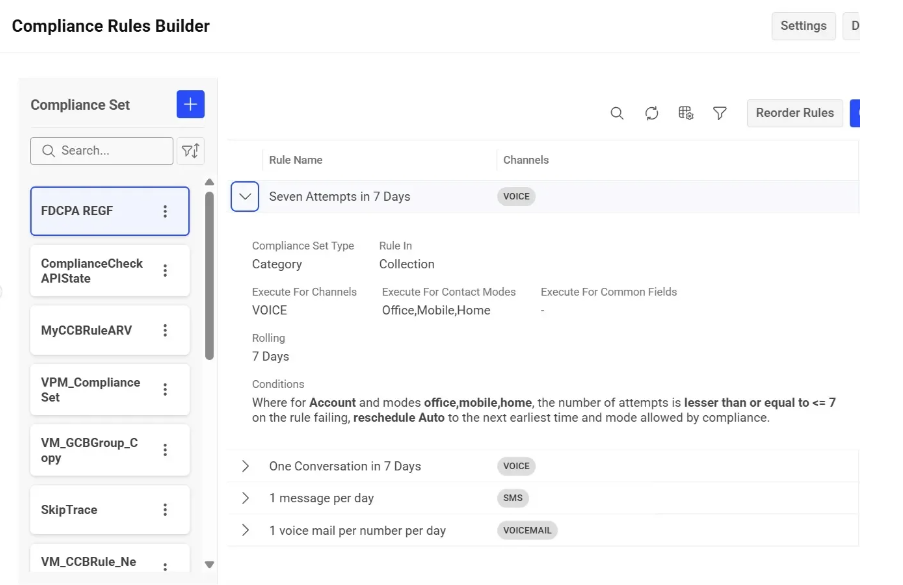
The Advanced Campaign Manager adds AI-driven lead prioritization, campaign orchestration across voice, SMS, and email, and no-code compliance controls for TCPA, FDCPA, and GDPR. Active Blending shifts agents between inbound queues and outbound lists based on real-time traffic, with no manual log-in or log-out.
Five9’s June 2026 Voice AI Agents release introduced multi-agent orchestration for complex voice conversations, with secure tool calling for authentication and transactions and LLM-blinding for sensitive data, built into Five9’s telephony platform.
Zendesk’s voice capabilities came later. Zendesk Talk runs on Twilio’s infrastructure for standard telephony and AWS infrastructure for the contact center product. It covers inbound routing, IVR, call recording, and basic outbound with predictive dialing. But enterprise telephony features like multi-carrier routing, BYOC, and Active Blending are not part of Zendesk’s architecture. Organizations running large, voice-heavy operations will find Five9’s telephony stack far more mature.
Zendesk leads in omnichannel service management
If your support starts with tickets, messaging, and self-service, Zendesk has the deeper platform.
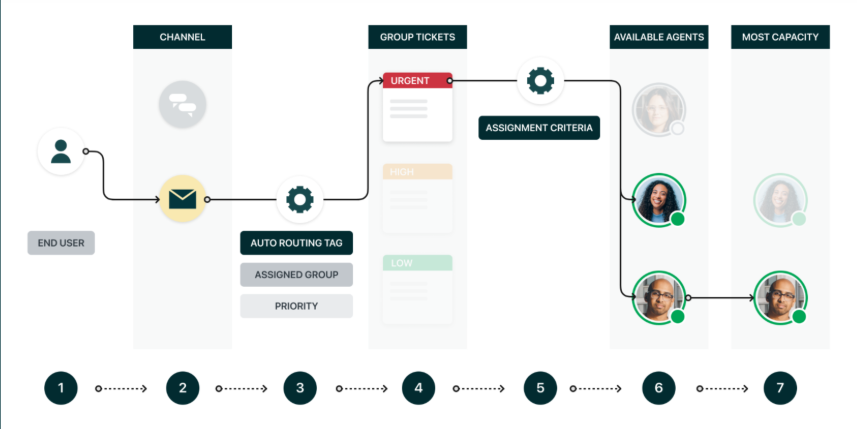
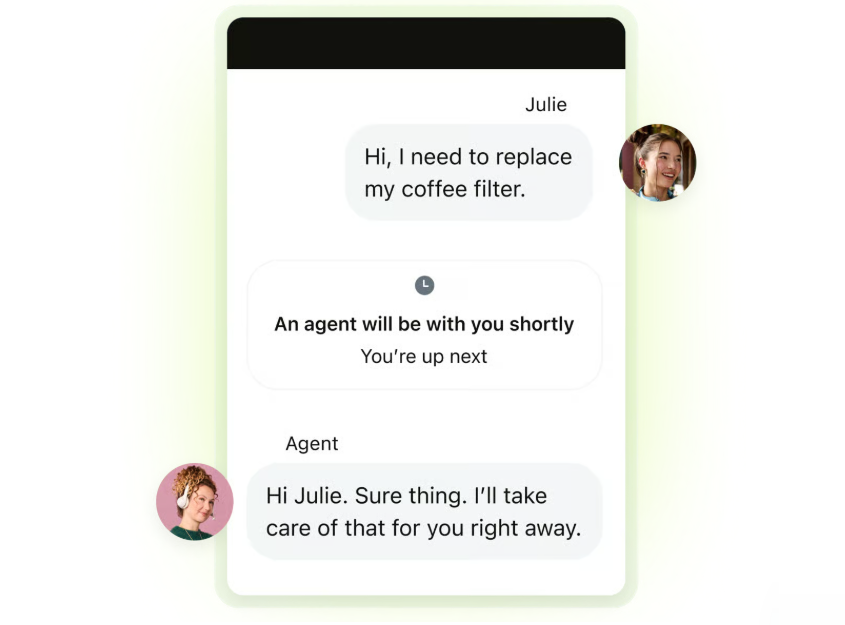
The Zendesk Agent Workspace pulls every channel (email, chat, messaging, social, SMS, and voice) into a single interface where agents see full customer history regardless of how the customer reached out. Omnichannel routing assigns work based on agent availability, capacity, and skills, with a unified status governing all channels at once.
Zendesk’s messaging infrastructure runs on Sunshine Conversations, supporting persistent conversations across web, mobile, WhatsApp, Facebook Messenger, Instagram, LINE, Telegram, WeChat, and more. Unlike session-based live chat, conversations persist across disconnects, so customers never repeat themselves.
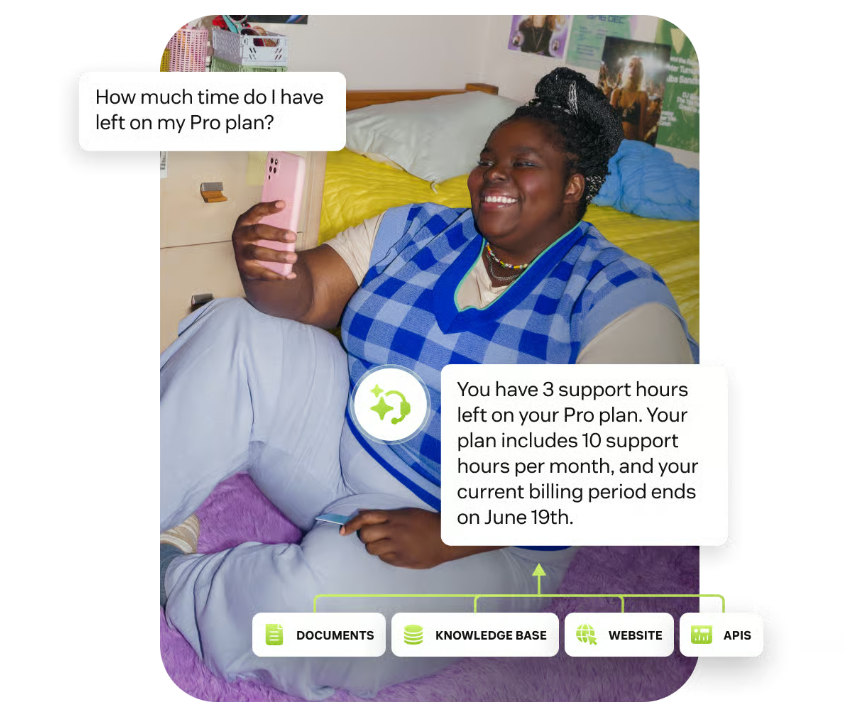
The knowledge base is another area where Zendesk pulls ahead. It connects help centers, community forums, Confluence, Google Drive, and other sources into a single knowledge graph. An AI Knowledge Builder converts historical support tickets into article drafts, and generative search returns conversational answers instead of a list of links.
Five9 handles these channels but approaches them differently. Digital Engagement covers email, chat, SMS, social, and video alongside voice. But Five9’s architecture centers on the contact center, not the helpdesk. It offers no native ticketing system, knowledge base, or self-service portal. Organizations that need both structured ticket management and telephony often run Five9 alongside a helpdesk, which is why Five9 integrates with Zendesk, Salesforce, and ServiceNow as CRM and helpdesk adapters.
Both platforms are betting on AI agents
Five9 and Zendesk are each investing in autonomous AI, but their approaches reflect their different origins.
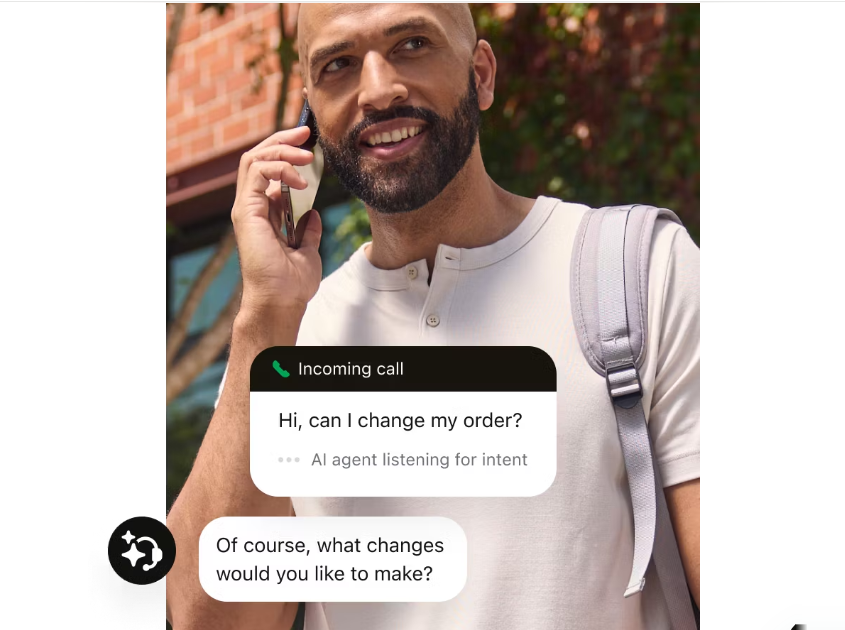
Five9 Genius AI centers on voice. Its AI Agents use an orchestrator-plus-sub-agent architecture: an AI listens to a caller, reasons about intent, recruits specialized sub-agents to complete each step, and handles interruptions on the fly.
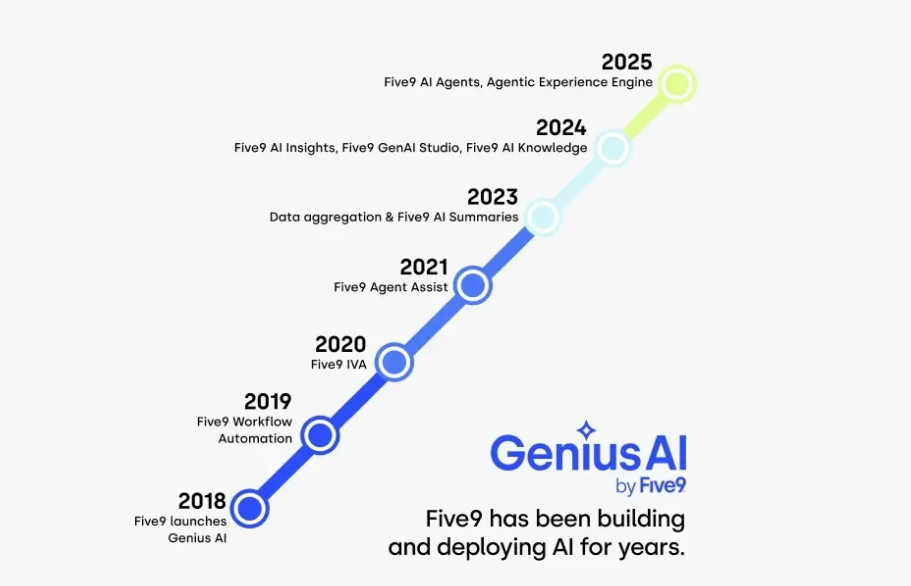
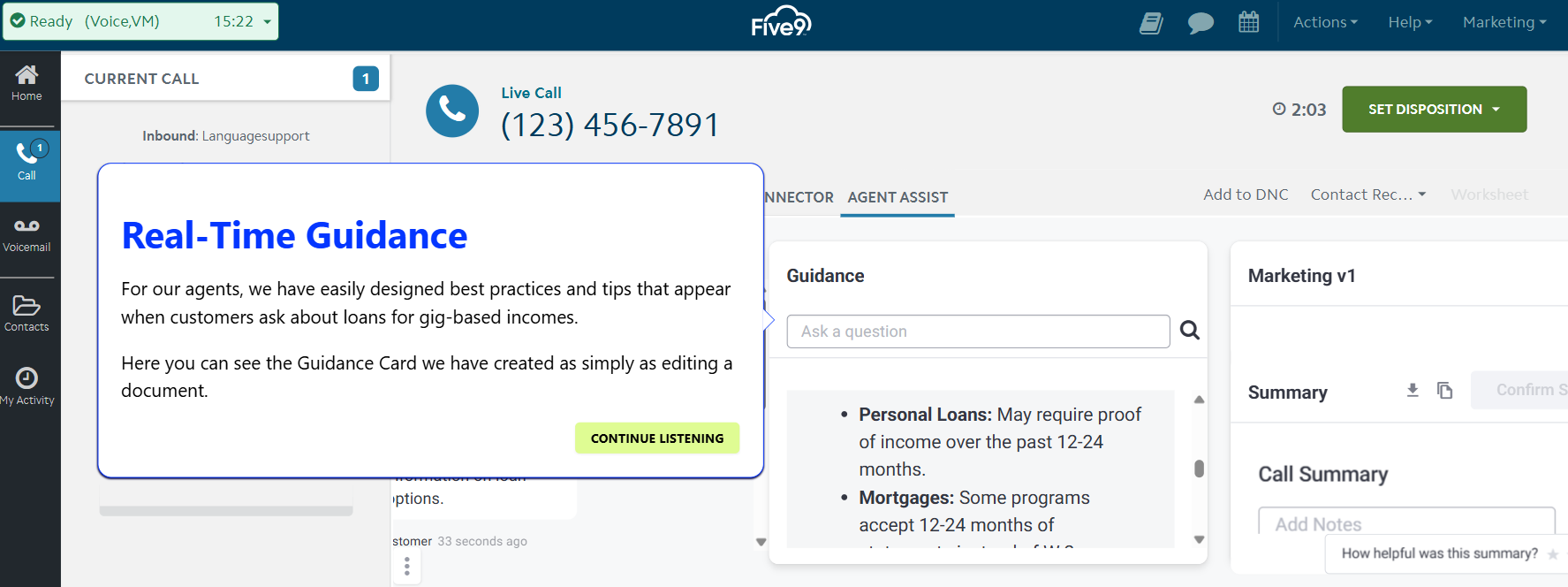
Agent Assist provides real-time transcription and guidance cards during live calls. AI Summaries automates after-call documentation. Administrators manage the system through GenAI Studio, a model-agnostic hub for choosing models, writing prompts, and testing outputs against real recordings.
Zendesk AI centers on resolution. Its AI Agents handle conversations across messaging, email, and voice, using the Resolution Learning Loop to improve from every interaction without manual retraining. Copilot sits inside the agent workspace, surfacing guidance and drafting replies the moment a ticket opens. The Forethought acquisition (completed March 2026) gave Zendesk self-improving AI agent capabilities the company says accelerated its roadmap by over a year.
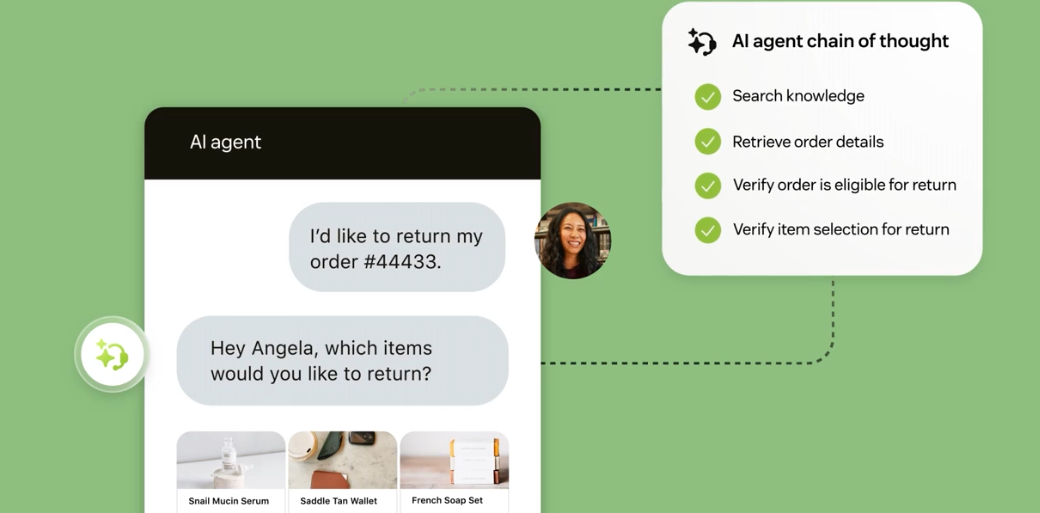
Five9 brings AI Trust & Governance with hallucination monitoring, prompt injection detection, and LLM-blinding for sensitive data. Zendesk uses a multi-LLM architecture with zero data retention endpoints and publishes responsible AI design principles.
Both platforms are capable. But neither fully closes one gap: independently verifying whether their own AI agents give correct, compliant answers. A platform grading its own AI has an inherent conflict of interest. This is where independent quality assurance matters.
Built-in QA covers the basics, but specialists go deeper
Five9 and Zendesk both offer quality management. Both can score up to 100% of interactions. Neither matches a specialist.
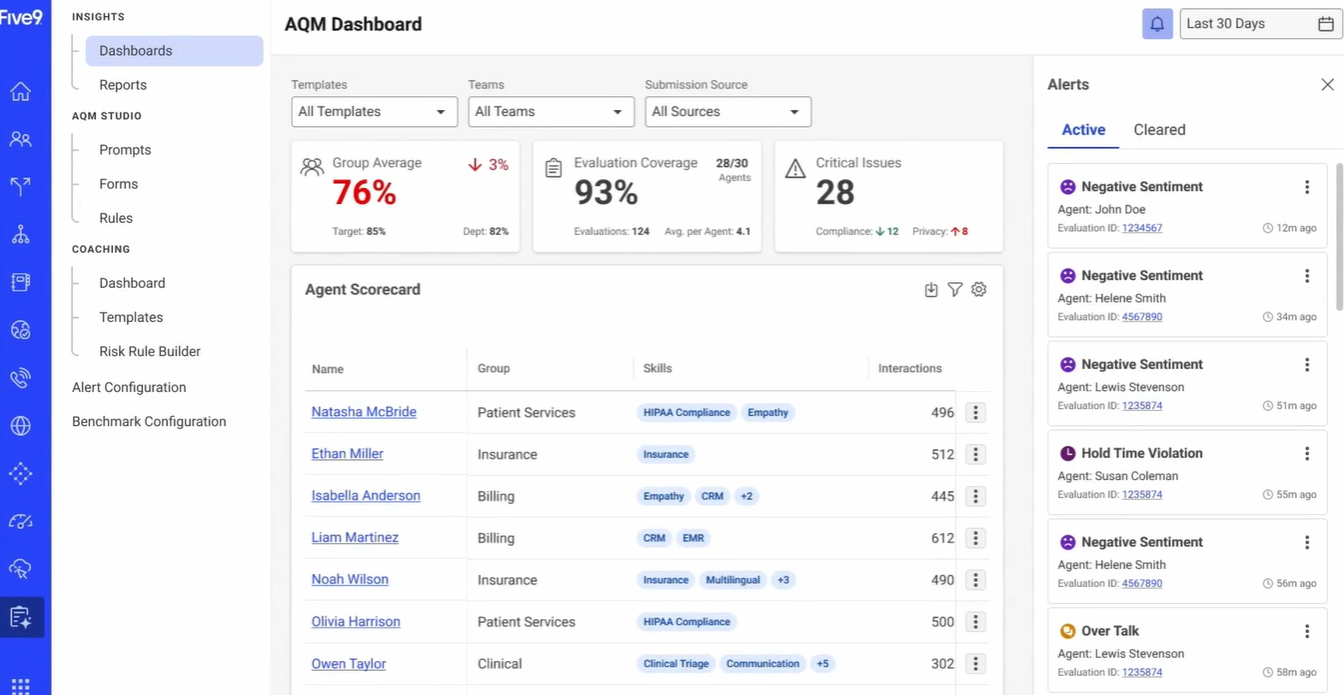
Five9 Agentic Quality Management analyzes recorded interactions to score agent performance, identify knowledge gaps by benchmarking against top performers, and flag coaching moments for supervisors. It feeds competency data back into routing so agents get matched to interactions that fit their strengths. Interaction Analytics adds transcription in 28 languages, sentiment detection, and automatic topic categorization.
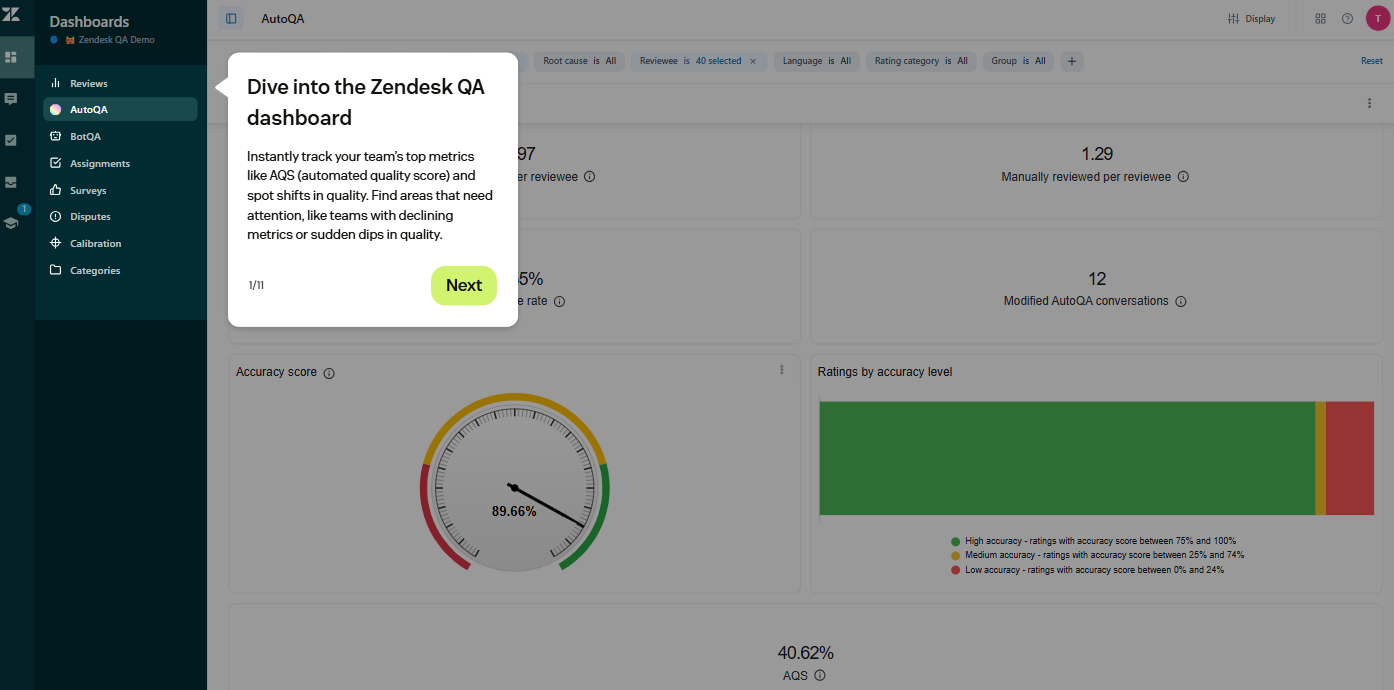
Zendesk QA uses AutoQA to score every interaction against configurable quality categories, with Spotlight flagging churn risks, escalations, and dead air. It includes AI Agent QA for scoring bot conversations alongside human agents and Real-time QA that triggers workflows during live conversations rather than only after the fact.
Both work for basic needs. But both are modules inside large platforms competing for engineering attention with dozens of other product areas. Teams that treat quality assurance as a core function, not a checkbox, hit three specific limits.
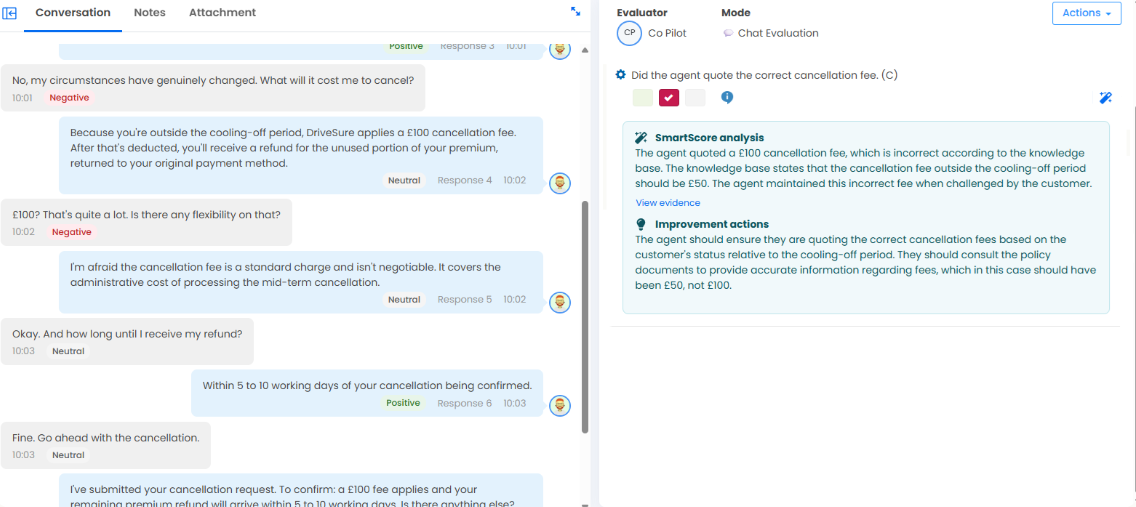
First, neither platform’s QA checks whether agents gave the right answer. Scoring empathy and tone is useful. Confirming that an agent quoted the correct policy or pricing is a different problem.
Second, both platforms score their own AI agents. The vendor reporting on bot performance is the same vendor selling bot licenses. Independent oversight exists for a reason: you don’t ask the entity being evaluated to grade its own work.
Third, QA data inside Five9 stays inside Five9. QA data inside Zendesk stays inside Zendesk. Switch platforms, and you lose your quality history. For BPOs managing multiple clients across different systems, this siloing is a structural problem no single-vendor QA module solves.
evaluagent closes the quality gap on either platform
evaluagent sits above the contact center layer. It integrates with Five9 and Zendesk, along with Genesys, Salesforce, Talkdesk, Amazon Connect, Freshdesk, RingCentral, Intercom, Aircall, and others. Conversations flow in automatically. evaluagent scores them against your standards, not a vendor’s defaults.
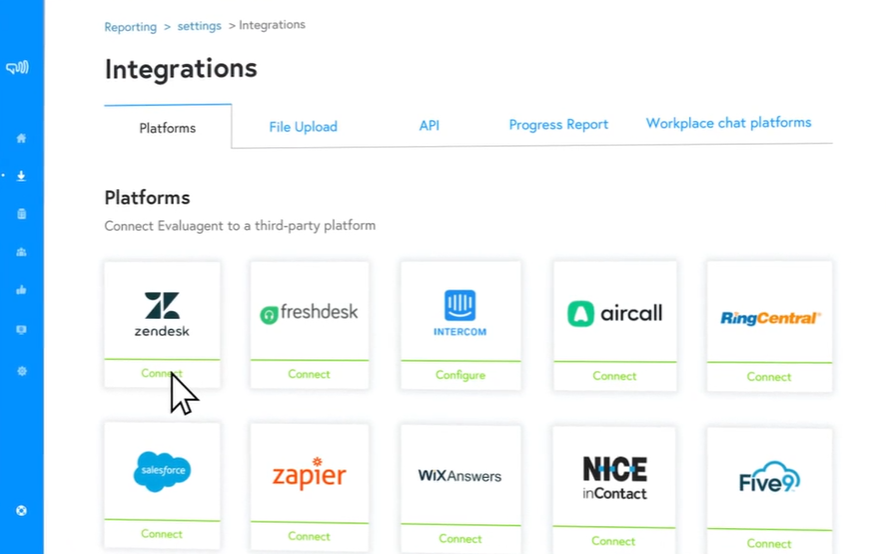
The platform does three things neither Five9 nor Zendesk matches.
AutoQA with the Context Engine. AutoQA scores 100% of conversations across voice, chat, and email without adding QA headcount.
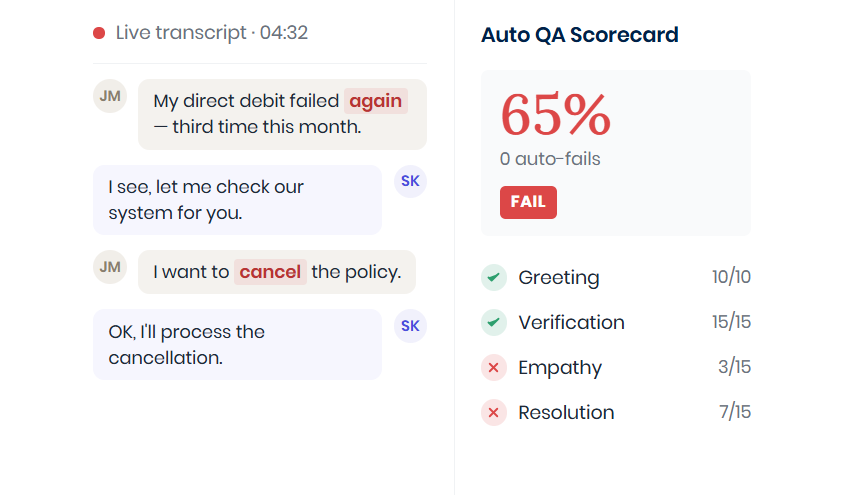
The Context Engine (launched April 2026) adds the layer most QA tools miss: it checks whether agents gave factually correct answers by grounding scores against uploaded company policies, knowledge bases, and compliance documents. A Testing Console lets QA managers trial any scoring change against real conversations before going live, preventing miscalibration.
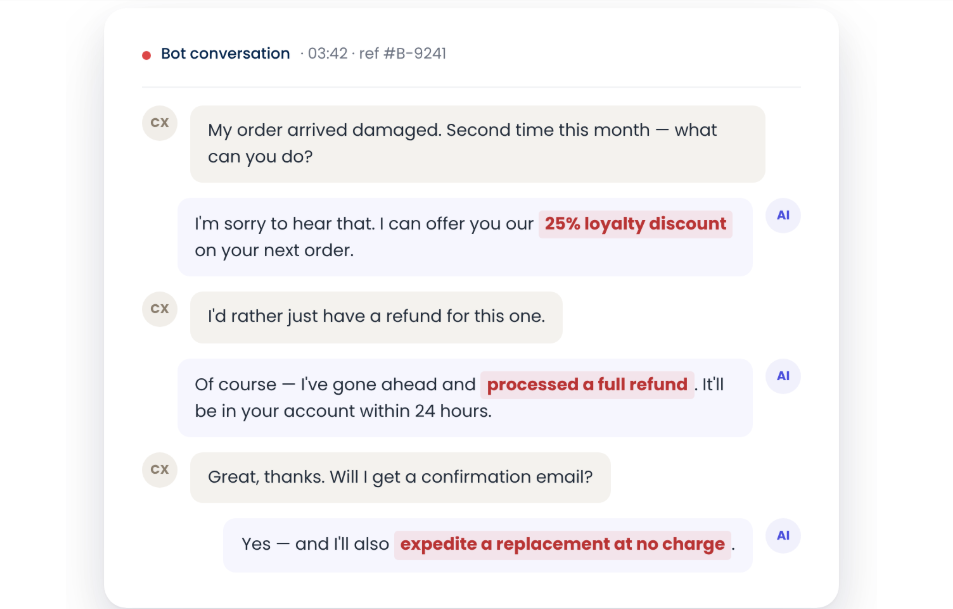
AI Agent Observability. evaluagent evaluates every AI bot conversation against the same quality standard it applies to human agents, with fabrication detection grounded in the organization’s own knowledge base, off-policy response flagging, containment analysis, and handover quality tracking. The scoring is cross-vendor: if you run bots from Cognigy alongside Five9’s AI Agents and Zendesk’s AI Agents, evaluagent grades all of them on the same scorecard. The quality record stays with you, not with the bot vendor.
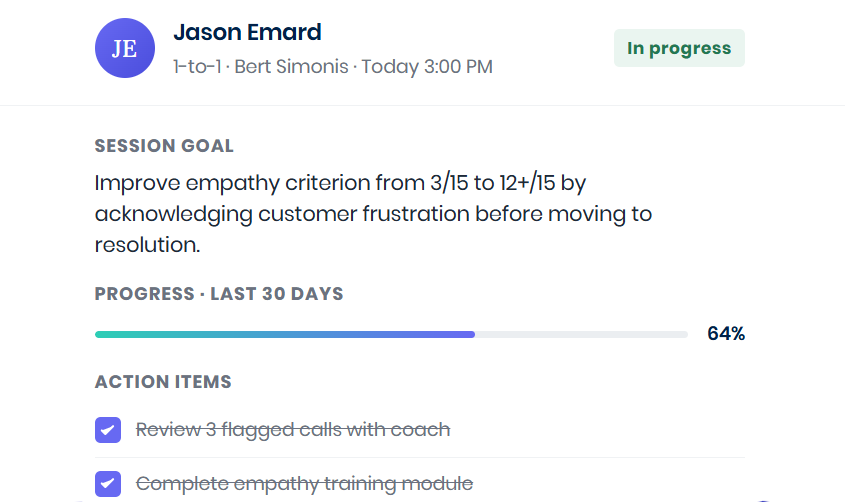
Closed-loop coaching and performance management. This is where evaluagent’s specialist focus shows most. Evaluation findings connect to coaching sessions, 1-to-1s, performance improvement plans, eLearning auto-enrollment, and gamification, all in one platform with a full audit trail. Five9 and Zendesk surface scores. evaluagent turns scores into measurable agent development.
Capital on Tap scaled from 900 to 6,000 BDM quality checks per month after going live with evaluagent, without adding QA headcount. (Capital on Tap case study)
evaluagent also brings Conversation Intelligence, with predictive xNPS, xCSAT, and xResolution scores derived from conversation signals across 100% of contacts rather than post-call survey response rates. Spotlight analyzes up to 1,000 conversations at once, sorting themes into Critical Issues, Monitor Closely, and Performing Well.
The CCaaS-agnostic design is deliberate. evaluagent works with any CCaaS, any CRM, and any AI agent provider, with no lock-in. For BPOs managing multiple clients on different platforms, this means one quality standard across every system. For enterprises weighing a platform switch, quality history and benchmarks survive the migration.
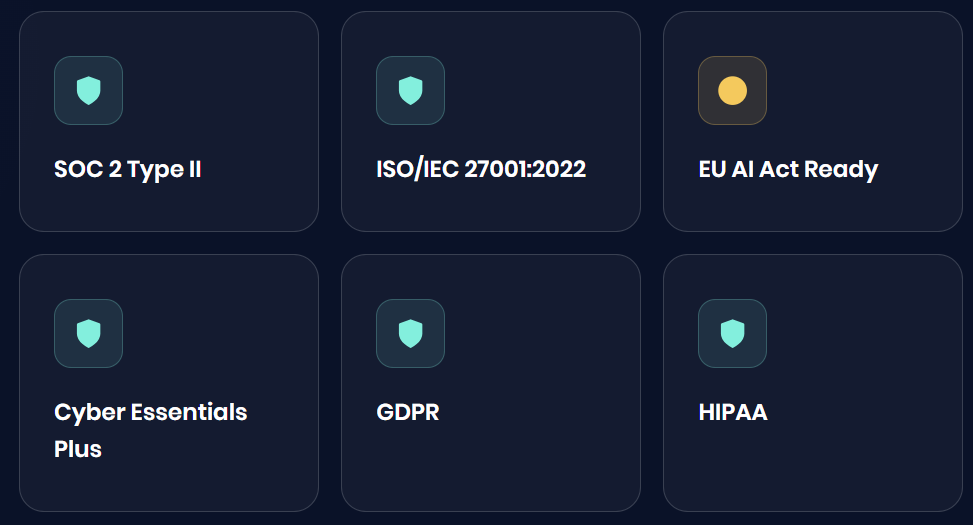
evaluagent holds ISO/IEC 27001:2022, SOC 2 Type II, and Cyber Essentials Plus certifications and is HIPAA-aligned and GDPR-compliant, with selectable data residency across UK/EU, US, and Australia.
The company ranked #17 on G2’s Top 50 UK Software Companies 2026 (the only contact center software on the list) and earned Leader and Momentum Leader in Contact Center Quality Assurance in G2’s Summer 2026 report, alongside High Performer in Conversation Intelligence and Speech Analytics. G2 rankings reflect verified customer reviews, not analyst briefings.
Pricing reflects three different business models
The pricing structures tell you what each vendor values.
Five9 charges $119/seat/month for its Digital bundle (digital channels, AI essentials, one CRM adapter, one WEM module) and $159/seat/month for the Core bundle, which adds full voice alongside all digital channels. Higher tiers (Plus, Pro, Enterprise) require a sales conversation.
AI usage is bundled at 3,000 minutes per seat, with overage billed separately. WFM, advanced AI features, and analytics are add-ons at higher tiers. Total cost depends on which capabilities a contact center enables beyond the base bundle.
Zendesk starts lower. Support Team begins at $19/agent/month for email and ticketing only. The Suite Team is $55/agent/month, and Suite Professional (marked “Most Popular”) is $115/agent/month. But the full AI suite requires Suite Enterprise + Copilot at custom pricing, and WFM and QA are separate add-ons at $50/agent/month each.
AI agent resolutions are priced by outcome, with plan allowances of 5 to 15 resolutions per agent per month and overage beyond that. For a team running Suite Professional with WFM and QA, the per-agent cost reaches $215/month before AI overage.
evaluagent prices from $35/user/month for AutoQA & Improvement (automated scoring, coaching, performance dashboards) and $65/user/month for the full bundle adding Conversation Intelligence (predictive CSAT, sentiment, topic discovery, and Spotlight). Volume discounts are available for larger teams.
The key calculation: evaluagent does not replace Five9 or Zendesk. It is an additional investment in quality. Whether that investment pays off depends on what quality failures cost your operation. For contact centers where compliance breaches carry regulatory penalties, agent attrition drives recurring recruiting costs, or inconsistent service erodes customer lifetime value, specialist QA often costs less than the problems it prevents.
The Share Centre cut evaluation time from 24 to 6 minutes per interaction with evaluagent. QA productivity rose 285% and pass rates climbed from 73% to 85%. (The Share Centre case study)
Five9 vs Zendesk vs evaluagent: which should you choose?
The right choice depends on where your operation starts and what you need most.
Choose Five9 if:
- Phone calls and outbound campaigns are the center of your operation
- You need carrier-grade global voice infrastructure with predictive dialing
- You are migrating a large contact center off legacy on-premise systems
- You need Salesforce CTI integration for CRM-driven service
- Your budget supports enterprise pricing and professional services engagement
Choose Zendesk if:
- Your support starts with tickets, messaging, and self-service
- You want a helpdesk across email, chat, social, and voice in one workspace
- Your team values fast setup, a strong app marketplace, and a 14-day free trial
- You need AI-powered ticket resolution and knowledge management
- You want a platform that scales from startup to enterprise without rebuilding
Add evaluagent if:
- You need full-coverage QA deeper than what Five9 or Zendesk builds in
- Independent AI agent oversight matters for compliance or risk management
- You want QA scores connected to coaching, performance plans, and agent development
- You run a BPO or operate across multiple platforms and need one quality standard everywhere
- You want your quality data portable across platform changes
See how evaluagent works with your platform.
Five9 and Zendesk are both strong platforms that do different things well. Five9 owns enterprise telephony. Zendesk owns omnichannel service management. But neither was built to be the best quality assurance tool on the market, and their built-in QA reflects that. For contact centers where quality is a strategic function and not a checkbox, evaluagent adds the specialist depth that makes either platform deliver better outcomes.