If you’ve tried to find Playvox’s pricing page only to hit a “resource not found” error, then pieced together costs from sales calls where modules are quoted individually and contract terms hide in legal documents, you know WEM pricing feels less like shopping and more like negotiation.
Playvox built its reputation as a digital-first WEM platform for contact centers, earning G2 Leader status in Quality Assurance and Workforce Management through Summer 2024. The platform offered modular tools for QA, workforce management, coaching, gamification, and voice-of-customer analytics, with tight integrations into Salesforce Service Cloud and Zendesk. But in October 2024, NICE Systems acquired Playvox, rebranded it “Playvox by NICE,” and pulled its public pricing. What was once a nimble alternative to legacy WEM vendors now sits inside the largest incumbent’s portfolio.
We analyzed Playvox’s commercial terms, contract structure, and module capabilities. It’s the right choice if:
- You’re already invested in Salesforce Service Cloud and want native WEM inside your CRM
- You need a full WEM suite including workforce management, scheduling, and capacity planning
- Your contact center runs digital channels (chat, email, tickets) alongside voice
- You’re comfortable with quote-based pricing and multi-year contracts
- You have the resources to manage a 4–6 week implementation
Playvox is not the right choice if:
- You want published pricing you can evaluate before a sales call
- You need AI that scores 100% of conversations automatically, not just sentiment tagging
- You’re deploying AI agents and need independent quality governance for bots
- You want a platform independent of any CCaaS vendor’s roadmap
- You prefer flexible contracts without automatic fee increases or no-refund early termination
In this case, consider evaluagent: a CCaaS-agnostic QA and performance improvement platform with published pricing starting at $35 per user per month, AI that scores every interaction against your quality standards, and an AI Agent Observability module for governing bot conversations independently.
We’ve included a detailed pricing comparison with evaluagent in this review. If you’d rather jump straight to the evaluagent breakdown, go ahead.
Playvox Pricing Summary
| Playvox by NICE | evaluagent | |
|---|---|---|
| Free Trial | No free trial or free plan; demo available on request | No free plan; demo-based trial available on request |
| Pricing Model | Per-seat subscription; quote-only; modules sold individually or bundled | Per-seat subscription; published pricing with two tiers |
| Entry Tier | Quote required; individual modules (QA, WFM, Coaching, etc.) priced separately per Order Form | AutoQM & Improvement: $35/user/month; all QA, coaching, and performance features included |
| Full Suite | Quote required; full WEM bundle (QA + WFM + Performance + Coaching + Gamification) | AutoQM + Conversation Intelligence: $65/user/month; adds sentiment, predictive VoC, and topic analytics |
| AI Agent Pricing | Not publicly offered as a standalone capability | From $0.05/conversation (AutoQM) or $0.13/conversation (Full Bundle) |
| Contract Terms | Auto-renewal; up to 10% annual fee increase without consent; no mid-term downgrades; no refunds on early cancellation | Contract terms set per Order Form; dedicated CSM included at both tiers |
| Best For | Salesforce-centric contact centers needing a full WEM suite with WFM, scheduling, and capacity planning | Contact centers needing AI-powered QA across 100% of interactions with transparent pricing and AI agent governance |
Playvox Pricing: In-Depth Overview
Playvox uses a quote-based, per-seat subscription model where all commercial terms are negotiated through individual Order Forms. Since the October 2024 NICE acquisition, the pricing page at playvox.com/pricing returns a “resource not found” error, and no public pricing table exists. What follows draws from Playvox’s own Master Subscription Agreement, third-party partner descriptions, and pre-acquisition documentation.
Playvox Pricing Model: Quote-Only, Per-Seat
| Attribute | Details |
|---|---|
| Pricing Visibility | Not published; requires sales engagement |
| Billing Structure | Per-user subscription; user defined as any individual with a unique login |
| Module Availability | QA, WFM, Performance Management, Coaching, eLearning, Gamification, Customer AI |
| Bundle Options | Individual modules or combined bundles; configured per Order Form |
| Minimum Seats | Reportedly ~35 seats for WFM; not officially confirmed |
The Master Subscription Agreement confirms that each customer receives a “Service Plan” defining which modules are included, with specifics detailed per Order Form rather than in a published matrix. CXponent describes the model as “subscription-based pricing tailored to business size and feature requirements” where “pricing depends on the number of users and the level of customization needed.”
| Quote-Only Pricing | |
|---|---|
| Pros | Cons |
| – Tailored to exact business needs | – No way to evaluate costs before a sales call |
| – Modular flexibility (buy only what you need) | – Budget planning requires completed negotiation |
| – Volume discounts potentially available | – Difficult to compare against competitors |
| – Custom bundles possible | – Price opacity creates information asymmetry |
Playvox Modules: What You’re Buying
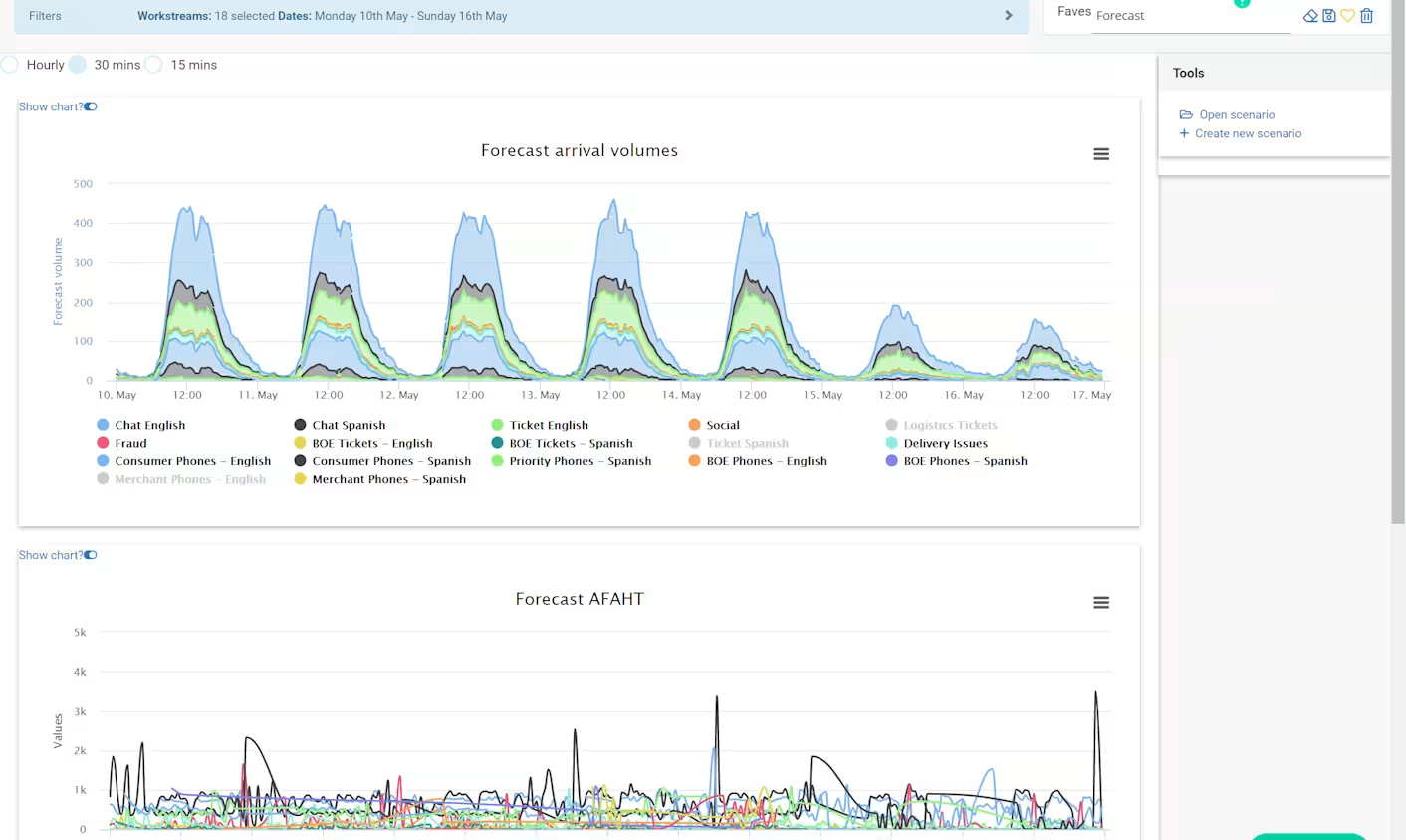
Playvox historically sold its WEM suite as individual modules, each priced separately:
| Module | Primary Function | Key Capabilities |
|---|---|---|
| Quality Management | Agent evaluation and QA scorecards | Customizable scorecards, AutoQA sentiment scoring, calibration sessions, Workloads automation |
| Workforce Management | Forecasting, scheduling, adherence | Omnichannel forecasting, concurrent-channel scheduling, intraday management, capacity planning |
| Performance Management | KPI dashboards and goal tracking | 60+ metrics, real-time plan vs. actual comparison, agent self-service visibility |
| Coaching | Structured agent feedback | QA-triggered coaching recommendations, templates, closed-loop acknowledgment |
| eLearning | Agent training and skill development | Multimedia course builder, learning paths, comprehension checks |
| Gamification (Motivation) | Agent engagement and recognition | Karma points, badges, leaderboards, rewards store, community wall |
| Customer AI | Voice-of-customer analytics | NLP topic tagging, sentiment monitoring, 85+ review source ingestion |
This modular approach means a contact center buying only QA pays less than one licensing the full suite. But costs compound as teams discover they need coaching alongside QA, or WFM alongside performance management. Each additional module adds a per-seat charge defined in the Order Form.
| Modular Architecture | |
|---|---|
| Pros | Cons |
| – Start with one module, expand over time | – Total cost unclear until all modules are quoted |
| – Pay only for what you use | – Module data sits in separate views (no unified dashboard) |
| – Flexibility for phased deployments | – Full suite cost may exceed expectations |
| – WFM available as standalone | – Cross-module reporting requires manual navigation |
Playvox Contract Terms: What the Fine Print Says
The Playvox Master Subscription Agreement contains provisions that directly affect total cost of ownership:
| Contract Provision | Details |
|---|---|
| Auto-Renewal | Subscription automatically renews for an equivalent term unless 30 days’ written notice is given |
| Fee Increases | Up to 10% annual increase per user per service, no customer consent required |
| Mid-Term Downgrades | Not permitted; reductions require 30-day notice before term end |
| Mid-Term Upgrades | Permitted; incremental fees pro-rated for remaining term |
| Early Termination | Full remaining fees immediately due; no refunds or credits |
| Data Access Post-Termination | 10-day window to request data download; data destroyed after |
| Contract Structure | |
|---|---|
| Pros | Cons |
| – Mid-term upgrades permitted | – Up to 10% annual fee increase without consent |
| – Clear termination terms | – No mid-term downgrades or refunds |
| – Auto-renewal simplifies continuity | – 30-day notice window easy to miss |
| – Structured data export on exit | – Only 10 days to retrieve data post-termination |
Playvox Hidden and Additional Costs
Beyond the per-seat subscription, the Master Subscription Agreement documents several additional cost layers:
Taxes and Fees:
- All published fees exclude taxes; VAT, sales tax, and withholding tax are invoiced separately
- Late payment interest accrues at 1.5% per month
- Third-party vendor portal fees pass directly to the customer
Professional Services:
- Implementation, training, and consulting are separate line items with their own Order Forms
- Typical implementation runs 4–6 weeks, implying professional services engagement during onboarding
Integration Costs:
- Playvox’s contract explicitly excludes third-party service integrations
- Customers must maintain their own licenses and API credentials for connected platforms
Post-Acquisition Uncertainty:
- NICE plans to add capabilities Playvox lacked (conversational QA, True to Interval analytics), but has not disclosed the pricing or packaging
- NICE already offers overlapping WEM functionality via CXone Mpower, raising questions about long-term feature overlap and roadmap direction
Where Playvox Falls Short
Playvox earned strong user satisfaction scores as an independent company, but the NICE acquisition and several product gaps create challenges for contact centers evaluating QA and WEM options today:
No Published Pricing
- The pricing page has returned a “resource not found” error since the NICE acquisition
- Buyers cannot evaluate costs, compare plans, or build a business case without engaging sales
- Mid-market teams evaluating multiple vendors lose weeks to quote cycles
No AI-Powered Full Interaction Scoring
- Playvox’s AutoQA provides automated sentiment scoring but does not score interactions against custom quality scorecards using AI
- Teams still rely on manual evaluation for scorecard-based quality, covering only 2–5% of interactions
- Competitors now score 100% of conversations against organization-specific quality criteria automatically
No AI Agent Governance
- No published capability for independently evaluating AI chatbot or virtual agent conversations
- As contact centers deploy AI agents, the absence of bot-specific QA, hallucination detection, and fabrication flagging becomes a growing gap
- Bot vendor metrics remain the only source of truth, with no independent verification
Acquisition Creates Roadmap Uncertainty
- NICE already offers full WEM functionality via CXone Mpower, raising questions about feature overlap and long-term direction
- Playvox headcount dropped from approximately 160 pre-acquisition to approximately 42 post-acquisition
- CX Today flags customer concerns about product direction, pricing trajectories, and forced platform migrations
Fragmented Module Experience
- Capterra reviewers report that QA metrics, WFM data, and coaching outputs live in separate views
- No dashboard spans modules; managers navigate between sections manually
- Reviewers describe reporting as “still quite basic” with insufficient depth
These limitations have led many contact centers to look for alternatives with transparent pricing, AI-powered QA, and independence from CCaaS vendor roadmaps.
Best Playvox Alternative: evaluagent
evaluagent is a CCaaS-agnostic QA and performance improvement platform that scores 100% of conversations automatically using AI calibrated to each organization’s quality standards.
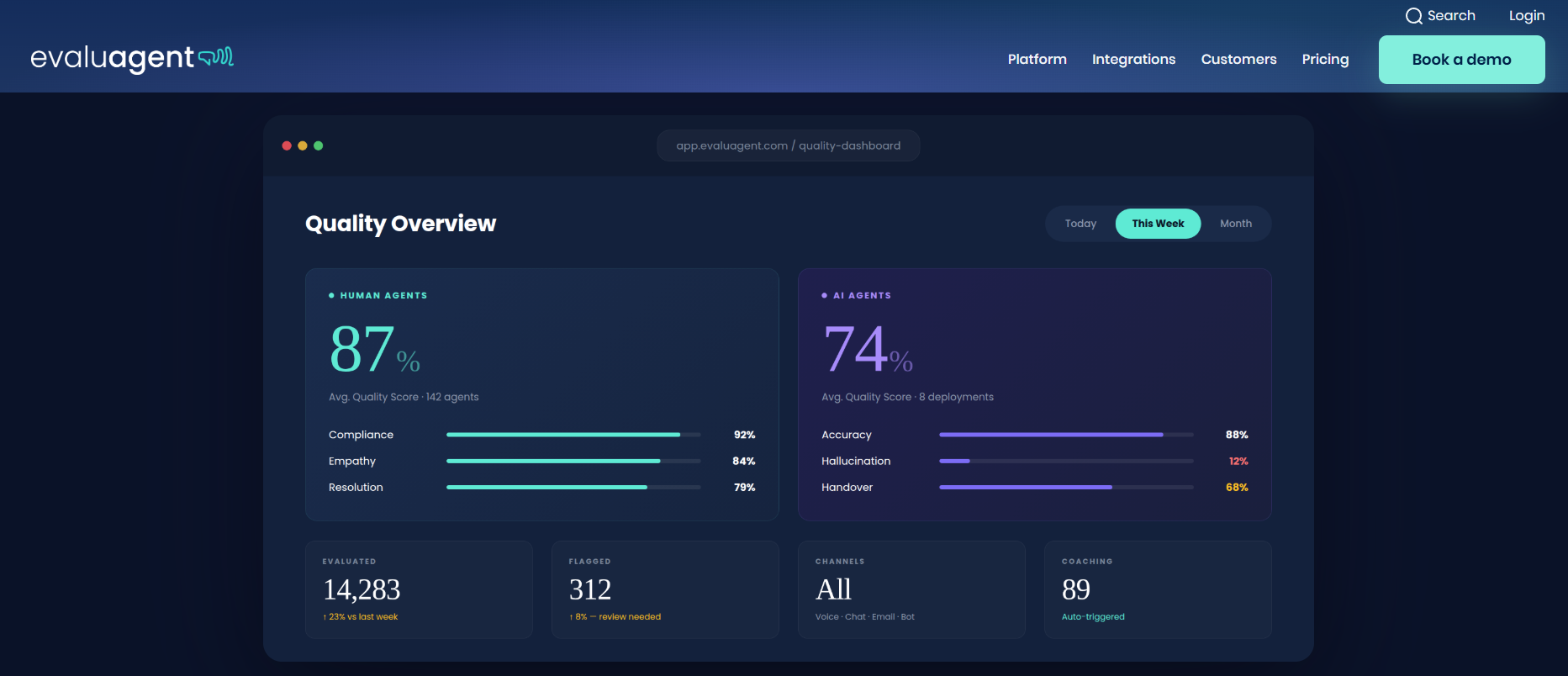
For contact centers frustrated by Playvox’s opaque pricing, sampled QA model, missing AI agent governance, and post-acquisition uncertainty, evaluagent offers a direct alternative with published pricing starting at $35 per user per month, AI scoring across every interaction, an AI Agent Observability module, and independence from any CCaaS or bot vendor’s roadmap.
Contact center operators founded evaluagent in 2012, building the QA tool they wished had existed. It now serves customers including Samsung, Jet2, Capital on Tap, 1st Central, and ManyPets. The platform was named a Top 50 UK Software Company in 2026 and a Leader in Contact Center Quality Assurance in G2’s Summer 2026 report, with rankings drawn from verified customer reviews.
evaluagent fits best for contact centers that need full interaction coverage without growing their QA team, regulated industries that require compliance automation and audit trails, and organizations deploying AI agents that need independent quality governance.
evaluagent AutoQM & Improvement: From $35/user/month
| Feature | Details |
|---|---|
| Price | From $35/user/month |
| AI Scoring Coverage | 100% of conversations (voice, chat, email) |
| Scorecard Builder | Drag-and-drop with weighted criteria, auto-fail logic |
| Blended Scorecards | AI-scored and human-scored criteria on the same card |
| Context Engine | AI grounded in your policies, knowledge base, and compliance rules |
| Coaching & Performance | 1-to-1s, performance plans, gamification, e-learning included |
| Security | SOC 2 Type II, ISO/IEC 27001:2022, Cyber Essentials Plus, HIPAA-aligned, GDPR-compliant |
The AutoQM & Improvement tier replaces sampled QA with AI that scores every interaction against the organization’s own quality framework. The Context Engine checks whether agents gave correct answers by validating responses against uploaded policies and knowledge base content. A Testing Console lets QA managers test any scoring change against real historical conversations before going live.
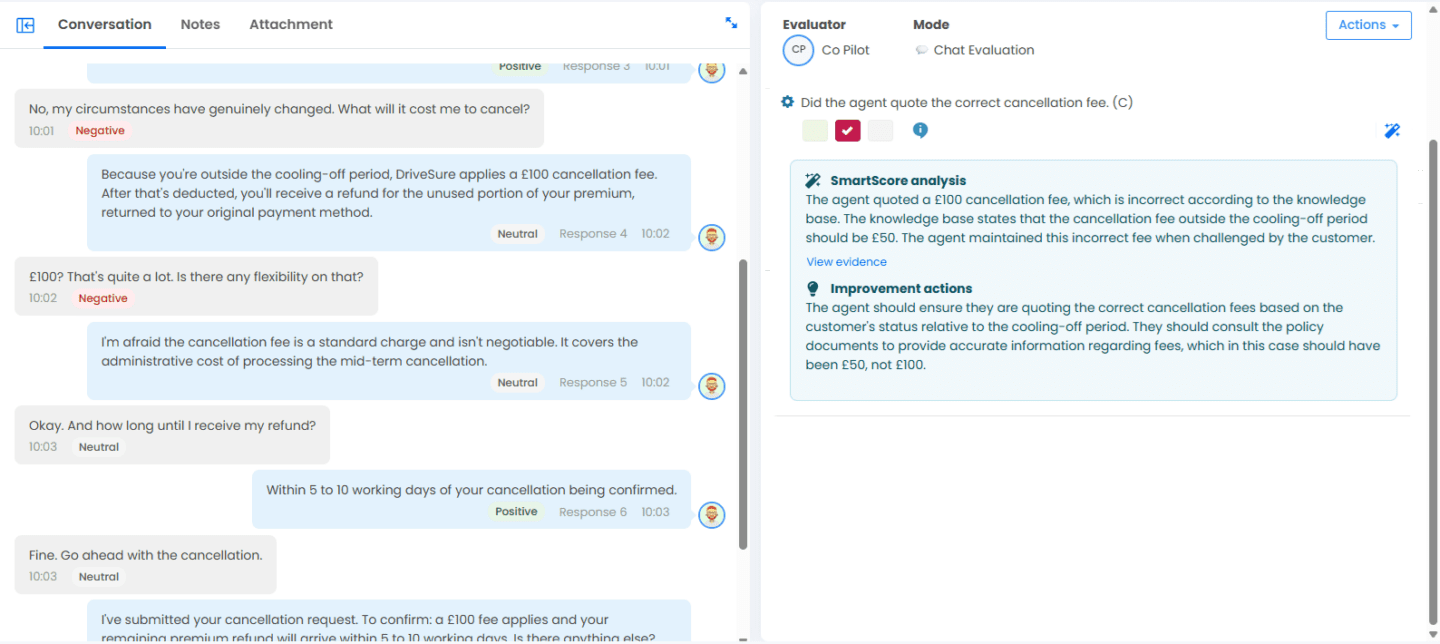
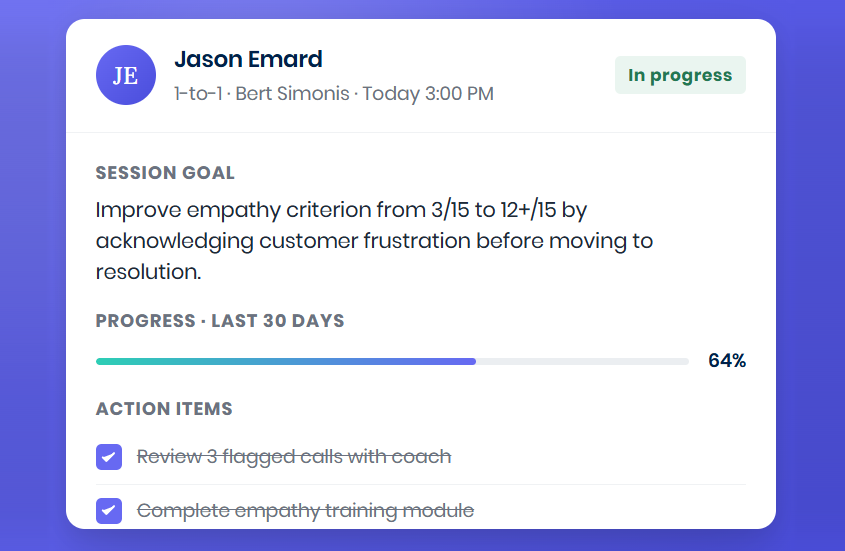
Beyond scoring, this tier includes the full performance improvement workflow: coaching sessions tied to conversation evidence, performance plans with audit trails, automated action triggers, e-learning with auto-enrollment, and gamification with points, badges, and an auction-style reward system.
| AutoQM & Improvement | |
|---|---|
| Pros | Cons |
| – 100% interaction scoring vs. Playvox’s manual sampling | – No native WFM or scheduling |
| – Published pricing eliminates quote cycles | – Requires existing CCaaS or helpdesk |
| – Coaching and gamification included at base tier | – Volume discounts require sales engagement |
| – SOC 2 Type II, ISO/IEC 27001:2022, Cyber Essentials Plus at every tier | – Configuration tuning takes weeks for complex deployments |
Capital on Tap scaled from 900 to 6,000 BDM quality checks per month after go-live, without adding headcount to their analyst team. (Capital on Tap Case Study)
evaluagent AutoQM + Conversation Intelligence: From $65/user/month
| Feature | Details |
|---|---|
| Price | From $65/user/month (marked “Most popular”) |
| Everything in AutoQM & Improvement | Included |
| Reason for Contact Detection | Automated across 100% of interactions |
| Sentiment & Trend Analytics | Conversation-level scoring with topic-level aggregation |
| Predictive VoC Metrics | xNPS, xCSAT, xResolution, xVulnerability |
| Spotlight | On-demand AI analyst that reviews up to 1,000 conversations and returns prioritized findings |
| Custom Insight Topics | No-code builder with testing console |
The Full Bundle adds Conversation Intelligence on top of AutoQM, turning every interaction into structured business intelligence. Where Playvox’s Customer AI module tags tickets and tracks sentiment from support channels, evaluagent’s Conversation Intelligence derives predictive xNPS, xCSAT, and xResolution scores from conversation signals across 100% of contacts, without relying on post-call survey response rates.
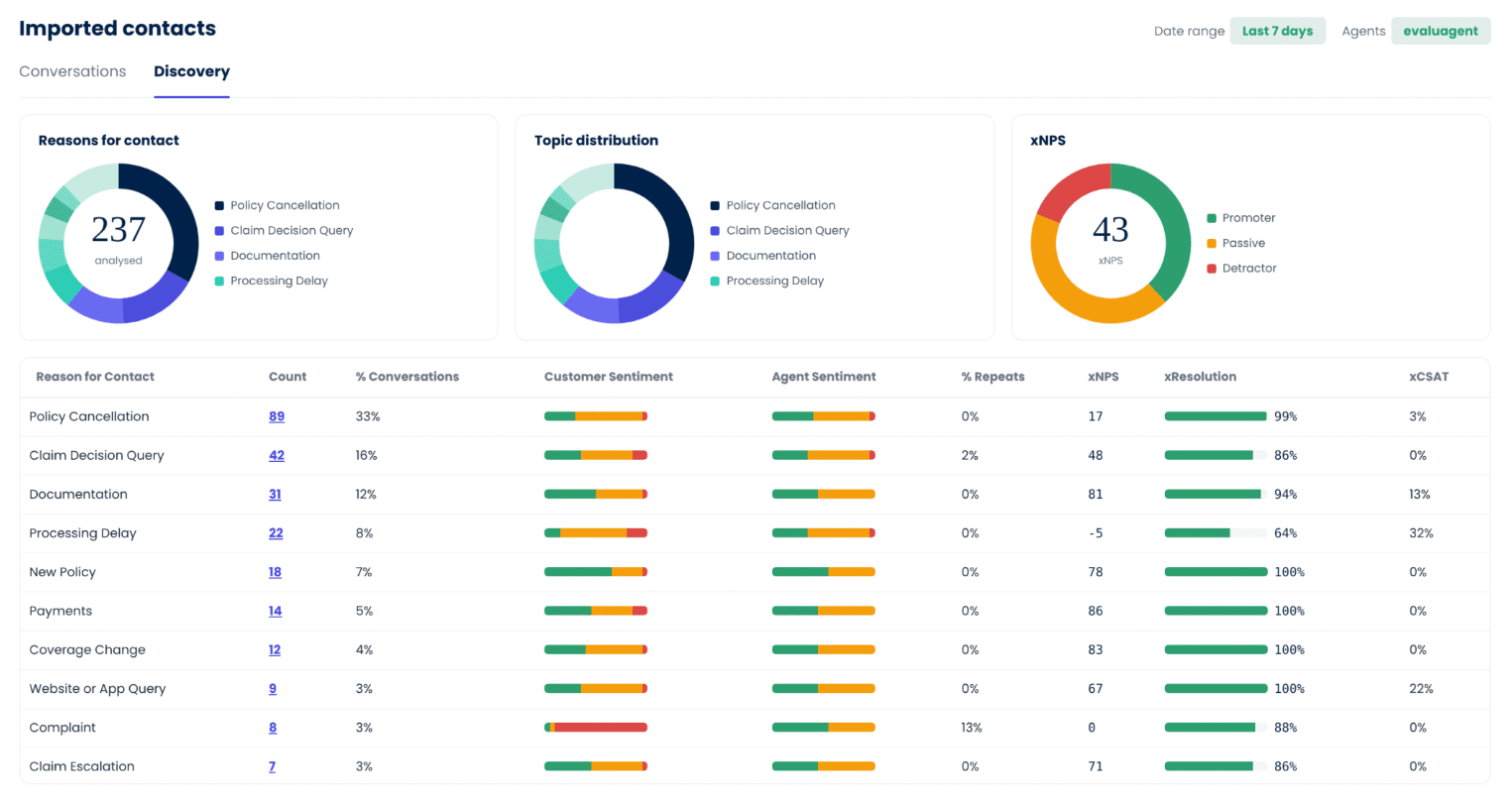
The Spotlight tool works as an on-demand AI analyst: filter a set of conversations, run Spotlight, and get themes sorted into Critical Issues, Monitor Closely, and Performing Well, each with supporting conversation excerpts.
| AutoQM + Conversation Intelligence | |
|---|---|
| Pros | Cons |
| – Predictive VoC across every interaction, not survey samples | – Higher per-seat cost |
| – Spotlight replaces manual root-cause investigation | – Adds complexity for smaller teams |
| – Reason for contact detection eliminates manual tagging | – No native WFM module |
| – Custom topic builder with no-code testing console | – Annual billing terms negotiated per Order Form |
The Share Centre achieved a 285% increase in QA productivity, cutting evaluation time from 24 minutes to 6 minutes per interaction while pass rates rose from 73% to 85%. (The Share Centre Case Study)
evaluagent AI Agent Observability: From $0.05/conversation
| Feature | Details |
|---|---|
| AutoQM for AI Agents | From $0.05/conversation |
| Full Bundle for AI Agents | From $0.13/conversation (AutoQM + Conversation Intelligence) |
| Prerequisite | Requires an active seat tier subscription |
| Bot-to-Human Handovers | Covered under existing seat license at no extra charge |
| Vendor Coverage | Cognigy, Sierra, Decagon, proprietary bots |
Playvox has no equivalent. AI Agent Observability evaluates every AI agent conversation against the same quality standard applied to human agents, with independent hallucination detection, off-policy response flagging, containment analysis, and intent-level performance reporting.
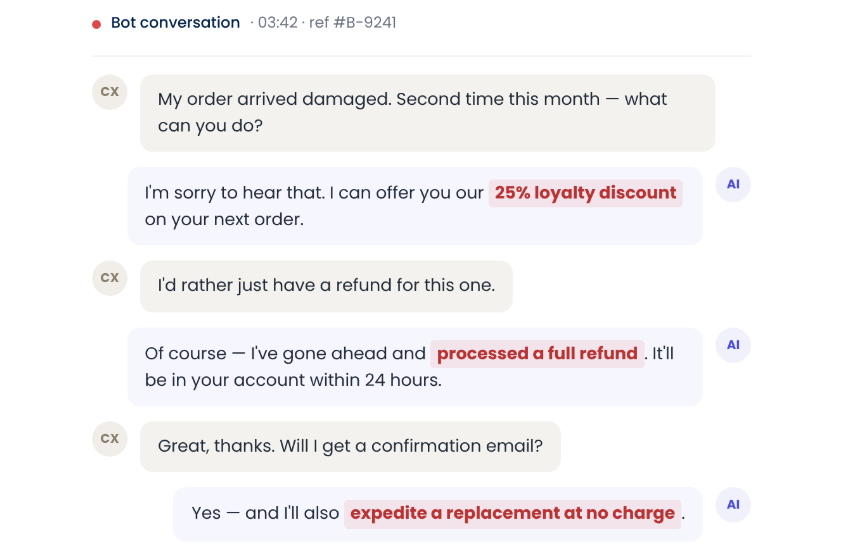
The system sits above the agent layer, not inside it, so it operates independently of whichever bot platform the contact center uses. When a bot conversation escalates to a human agent, the full interaction is covered under the seat license at no additional charge.
| AI Agent Observability | |
|---|---|
| Pros | Cons |
| – Independent bot QA that doesn’t rely on vendor metrics | – Requires a seat tier as prerequisite |
| – Hallucination and fabrication detection grounded in your knowledge base | – Per-conversation pricing adds variable cost |
| – Same scorecard engine as human QA for consistent standards | – Newer module with a smaller installed base |
| – Conversations stay in evaluagent if you switch bot vendors | – Not available as a standalone product |
evaluagent Volume Discounts and Additional Costs
evaluagent offers volume discounts for large teams, though it does not publish specific thresholds. Additional pricing details:
| Item | Details |
|---|---|
| Voice Transcription | Included; Deepgram-powered with speaker diarization |
| Multi-language Support | Included; major European, Asian, and Latin American languages |
| SSO/MFA/RBAC | Included at both tiers |
| Dedicated CSM | Included at both tiers |
| Onboarding | Included; most organizations go live in a few weeks |
| BI Export | Push data to Power BI, Tableau, Looker, Metabase |
| Support Hours | Email helpdesk, 9am–5pm UK time, Monday–Friday |
| Uptime SLA | 99.5% with service credits on downtime |
Playvox Feature Value Breakdown (vs evaluagent)
QA Coverage Model
Playvox’s Approach: Playvox QM combines manual human evaluation with AutoQA sentiment scoring. Human analysts score interactions against customizable scorecards, and the Workloads feature delivers interactions for review automatically. AutoQA adds AI sentiment analysis across 100% of digital interactions, but it produces sentiment tags (positive, neutral, negative), not scorecard-based quality scores. Scoring against your rubric still depends on human analysts reviewing a fraction of total volume.
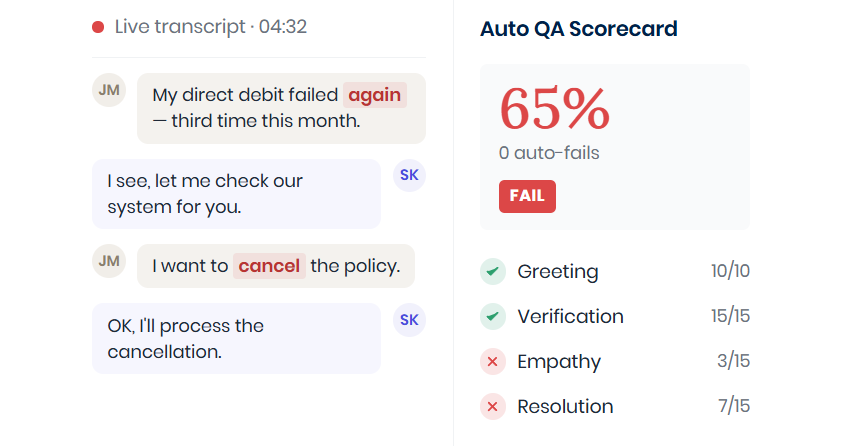
evaluagent’s Approach: evaluagent’s AutoQM scores 100% of conversations against custom scorecards using AI, with SmartScore providing transparent reasoning for every mark. Blended Scorecards let teams assign some criteria to AI and reserve others for human evaluators on the same card. The Context Engine validates factual accuracy against uploaded policies, so scores reflect not just communication quality but whether the agent gave the right answer.
Pricing Transparency
Playvox’s Approach: Playvox does not publish pricing. All costs are negotiated through Order Forms with a sales team. The Master Subscription Agreement permits up to 10% annual fee increases without customer consent, prohibits mid-term downgrades, and requires full remaining fees on early termination with no refunds. Since the NICE acquisition, NICE’s enterprise licensing framework governs pricing.
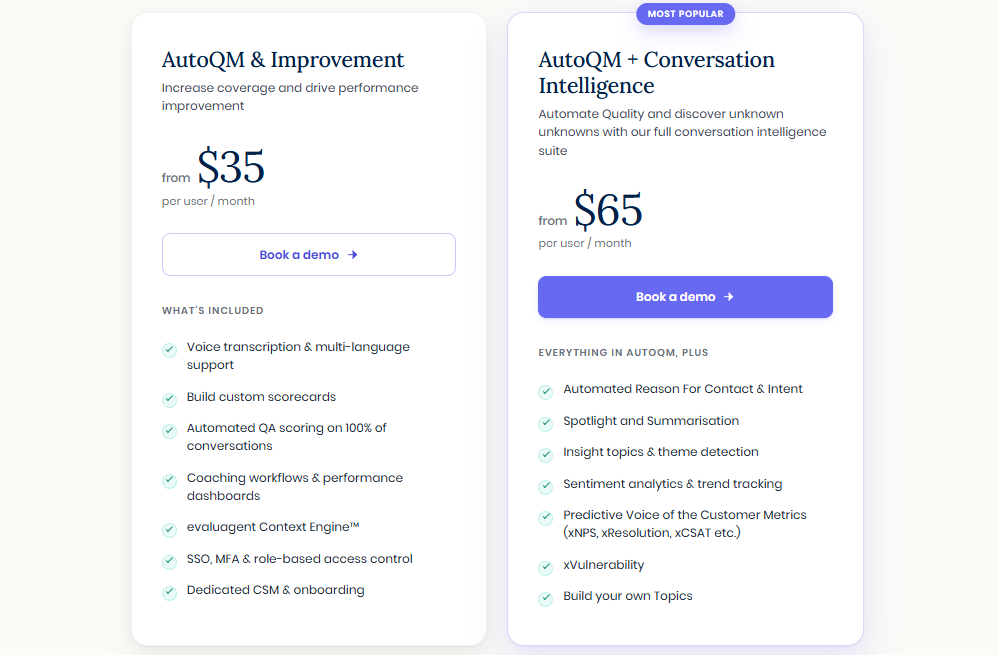
evaluagent’s Approach: evaluagent publishes two-tier pricing on its pricing page: $35/user/month for AutoQM & Improvement, $65/user/month for the Full Bundle, and $0.05–$0.13 per conversation for AI agent coverage. Volume discounts are available for large teams, and both tiers include SSO, MFA, a dedicated CSM, and onboarding at no extra charge.
AI Agent Quality Governance
Playvox’s Approach: Playvox has no publicly documented capability for independently evaluating AI chatbot or virtual agent conversations. Contact centers deploying AI agents alongside Playvox must rely on the bot vendor’s own quality metrics, with no independent check on hallucinations, off-policy responses, or fabricated information.
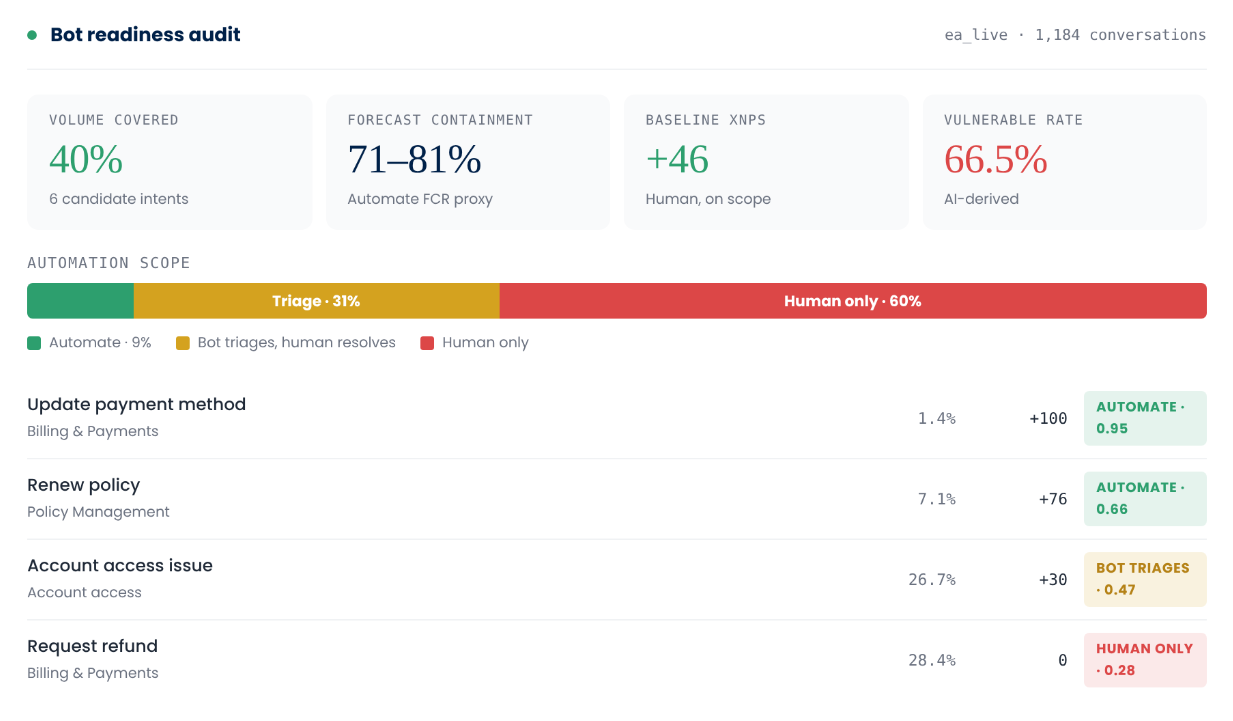
evaluagent’s Approach: AI Agent Observability evaluates every bot conversation against the same scoring engine used for human agents. It includes fabrication detection grounded in the organization’s knowledge base, containment analysis, handover quality tracking, and intent-level performance reporting. evaluagent stores the conversations (not the bot platform), preserving the quality record if the contact center switches vendors.
Platform Independence
Playvox’s Approach: Playvox’s tightest integration was with Salesforce Service Cloud, where it served as the preferred WEM solution. After the NICE acquisition, Playvox sits inside the portfolio of a CCaaS vendor that sells its own contact center platform (CXone Mpower). CX Today notes that Playvox customers now sit inside NICE’s funnel for a CXone upsell, a dynamic that may shape platform loyalty and roadmap priorities.
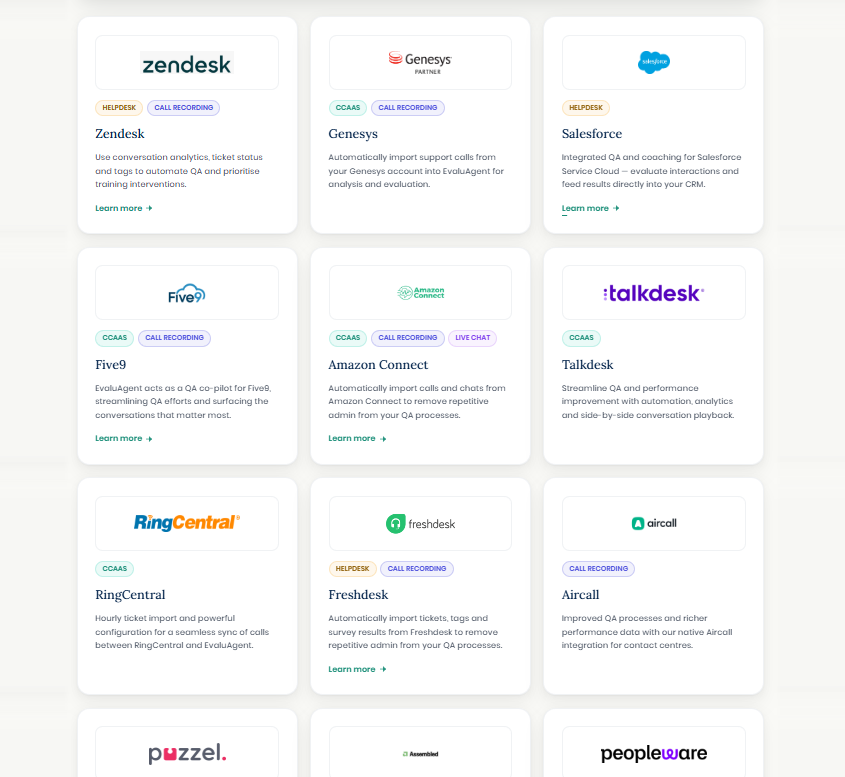
evaluagent’s Approach: evaluagent positions as CCaaS-agnostic: “Any CCaaS. Any CRM. Any AI agent provider. No lock-in.” Native integrations span Zendesk, Salesforce, Genesys, Five9, Amazon Connect, Freshdesk, RingCentral, Talkdesk, Intercom, Puzzel, Aircall, Assembled, and Peopleware. The company is Series A-backed by Peakspan with no CCaaS parent company influencing its roadmap.
WEM Suite Breadth
Playvox’s Approach: Playvox offers a full WEM suite: workforce management with forecasting, scheduling, intraday management, and capacity planning, plus QA, coaching, eLearning, gamification, and Customer AI. For contact centers that need WFM and QA under one roof, this breadth is a genuine advantage, particularly concurrent-channel scheduling for digital channels and the Capacity Planner for long-range resource allocation.
evaluagent’s Approach: evaluagent focuses on QA, conversation intelligence, and performance improvement. It does not offer native WFM, scheduling, or capacity planning. Instead, it integrates with WFM platforms like Assembled and Peopleware, letting teams view schedules inside evaluagent and feed QA scores back to their WFM system.
Final Verdict: Playvox vs evaluagent
The choice between Playvox and evaluagent depends on what your contact center needs most and how much pricing transparency matters to your evaluation:
Playvox by NICE is a modular WEM platform that combines quality management, workforce management, coaching, gamification, and voice-of-customer analytics in a single suite. With quote-based pricing negotiated per Order Form, it serves Salesforce-centric and digital-first contact centers that need the full WEM stack (workforce scheduling, forecasting, and capacity planning) under one roof. This model works best for enterprise contact centers with procurement teams experienced in vendor negotiation, organizations invested in Salesforce Service Cloud, and teams that buy WFM and QA together rather than separately.
evaluagent is a QA-first platform built on the principle that every conversation deserves evaluation, not just the 2–5% a human analyst can reach. With published pricing from $35 to $65 per user per month and per-conversation AI agent governance from $0.05, it gives contact centers AI-powered quality coverage, a closed-loop coaching workflow, and independent bot observability without tying them to any CCaaS vendor’s roadmap. This makes it the stronger choice for contact centers that need 100% interaction scoring against their own quality standards, organizations deploying AI agents that require independent governance and hallucination detection, and teams in regulated industries where compliance automation, audit trails, and certifications (SOC 2 Type II, ISO/IEC 27001:2022, Cyber Essentials Plus) are procurement requirements.
Get started with evaluagent here.
The difference is not just features or pricing but independence. Playvox now operates inside the world’s largest WEM vendor, its roadmap shaped by NICE’s broader interests. evaluagent remains independently funded and CCaaS-agnostic, its roadmap shaped by QA practitioners who built the platform to solve the problem they lived with every day.