Choosing between RingCentral vs Talkdesk for your contact center often comes down to five questions:
- Do you need unified communications (phone, video, messaging) alongside your contact center, or is a dedicated CCaaS platform enough?
- Are you looking for a general-purpose platform or one with pre-built workflows for your industry?
- How much of your customer interaction volume do you want AI to handle on its own?
- Does your quality program evaluate every interaction, or just a 2-5% sample?
- When your QA scores a conversation, does that score connect to coaching and agent development, or does it sit in a spreadsheet?
In short, here’s what we recommend:
RingCentral is the right choice for organizations that want their business phone system, team messaging, video meetings, and contact center on a single platform. RingEX handles internal communications while RingCX manages customer interactions across voice and 20+ digital channels, all from the same app.
The platform includes AI Quality Management that scores 100% of interactions, and its 99.999% uptime SLA backs 11 consecutive years as a Gartner Magic Quadrant Leader for UCaaS. However, quality management is one module among dozens, and the platform doesn’t connect QA scores to structured coaching or agent development workflows.
Talkdesk serves enterprises that need a contact center built around their industry’s workflows and compliance requirements. Its Industry Experience Clouds for healthcare, financial services, retail, and government ship with pre-built integrations (Epic, Oracle Cerner, Shopify) and vertical-specific AI agents.
Talkdesk’s Autopilot resolves customer requests on its own, while Copilot guides human agents in real time. The platform has earned five Gartner Magic Quadrant Leader placements for CCaaS and holds over 30 security certifications. Yet like RingCentral, its quality management is part of a larger platform, and its improved QA analytics require a separate add-on.
Both platforms are good at what they do: routing conversations, managing agents, and deploying AI. But quality assurance is a secondary module in each. For contact centers that want quality to drive improvement rather than generate reports that collect dust, there’s a missing layer.
evaluagent is the independent quality assurance platform that works on top of whichever CCaaS you choose. It integrates with both RingCentral and Talkdesk (plus Genesys, Five9, Amazon Connect, and others) and scores 100% of conversations automatically using AI calibrated to your own QA standards.
Where built-in CCaaS quality tools stop at scoring, evaluagent connects every evaluation to coaching sessions, performance improvement plans, and gamified development. Its AI Agent Observability module evaluates bot conversations independently for hallucinations, off-policy responses, and compliance breaches, giving you oversight the bot vendor can’t credibly provide.
For contact centers that want to turn QA data into measurable improvement, evaluagent adds the quality layer that no CCaaS platform prioritizes.
If independent quality assurance and closed-loop coaching sound like what’s missing from your contact center stack, see how evaluagent works with your CCaaS.
RingCentral vs Talkdesk vs evaluagent at a glance
| RingCentral | Talkdesk | evaluagent | |
|---|---|---|---|
| Primary function | Unified communications + contact center | Contact center + CX automation | Contact center quality assurance + performance improvement |
| QA approach | Built-in AI QM in RingCX | Built-in QM + separate analytics add-on | Dedicated platform with AutoQA and Context Engine |
| AI agent oversight | Part of RingCX analytics | CXA Operations Center | Independent AI Agent Observability with hallucination detection |
| Agent coaching | Basic performance dashboards | Performance Management with gamification | Structured 1-to-1s, coaching plans, eLearning, gamification |
| Industry verticals | General business | Healthcare, financial services, retail, government | Any industry (CCaaS-agnostic) |
| Integrations | 500+ apps | 60+ integrations | RingCentral, Talkdesk, Genesys, Five9, Amazon Connect, and more |
| Uptime SLA | 99.999% | Published status across 6 regions | 99.5% |
| Starting price | $65/user/month (RingCX Standard) | $85/user/month (Digital Essentials) | $35/user/month (AutoQA & Improvement) |
| Pricing model | Per-user, per-month | Per-user, per-month + AI add-ons priced separately | Per-user, per-month (published pricing) |
| Best for | Organizations wanting unified communications and contact center on one platform | Enterprises needing industry-specific contact center with AI automation | Contact centers wanting independent, dedicated quality assurance on any CCaaS |
RingCentral unifies communications, Talkdesk specializes in contact center AI
RingCentral and Talkdesk approach the contact center from different starting points, and that shapes everything about how they work.
RingCentral started as a cloud phone system in 1999 and grew outward.
Today it serves over 500,000 businesses with a platform that puts internal communications and customer interactions under one roof. An agent takes a customer call through RingCX, messages a colleague through RingEX, and joins a video meeting, all without leaving the app.
The AI Receptionist handles calls that don’t need a human, and the AI Conversation Expert analyzes conversations for coaching insights and CRM updates. For organizations that want one vendor for their entire communications stack, RingCentral’s breadth is hard to match.
The trade-off is depth. RingCentral covers dozens of capabilities, but each one competes for development resources against everything else in the portfolio. Quality management exists, but it’s one feature among hundreds.
Talkdesk took the opposite path.
Founded in 2011 as a cloud-native contact center, it has spent the last decade going deeper rather than wider. Its current strategy centers on Customer Experience Automation (CXA), a platform where specialized AI agents handle entire customer journeys on their own. Autopilot resolves requests across voice and digital channels in 59+ languages.
Navigator replaces rigid IVR menus with natural-language routing that requires no model training. Copilot surfaces answers and next-best-action recommendations to agents during live calls.
Talkdesk’s biggest differentiator is industry-specific depth.
Its Healthcare Experience Cloud integrates with Epic and Oracle Cerner. Its Financial Services cloud handles loan origination and collections workflows. These aren’t generic templates; they’re pre-built systems with domain-specific AI agents trained on regulated-industry data.
The trade-off: this depth costs $225/user/month for Industry Experience Clouds, and AI modules like Autopilot and Copilot are sold separately.
Both platforms are mature, well-funded, and trusted by large enterprises. The question isn’t which one is “better.” It’s which starting point matches your needs: unified communications with contact center included, or a dedicated contact center with industry-specific AI.
Both platforms have built-in QA, but quality isn’t their primary focus
RingCentral and Talkdesk both score customer interactions with AI. But their QA modules exist to support their core mission (routing and managing conversations), not to run a quality program.
RingCentral’s AI Quality Management analyzes 100% of customer interactions within RingCX, replacing the traditional 1-2% manual sample.
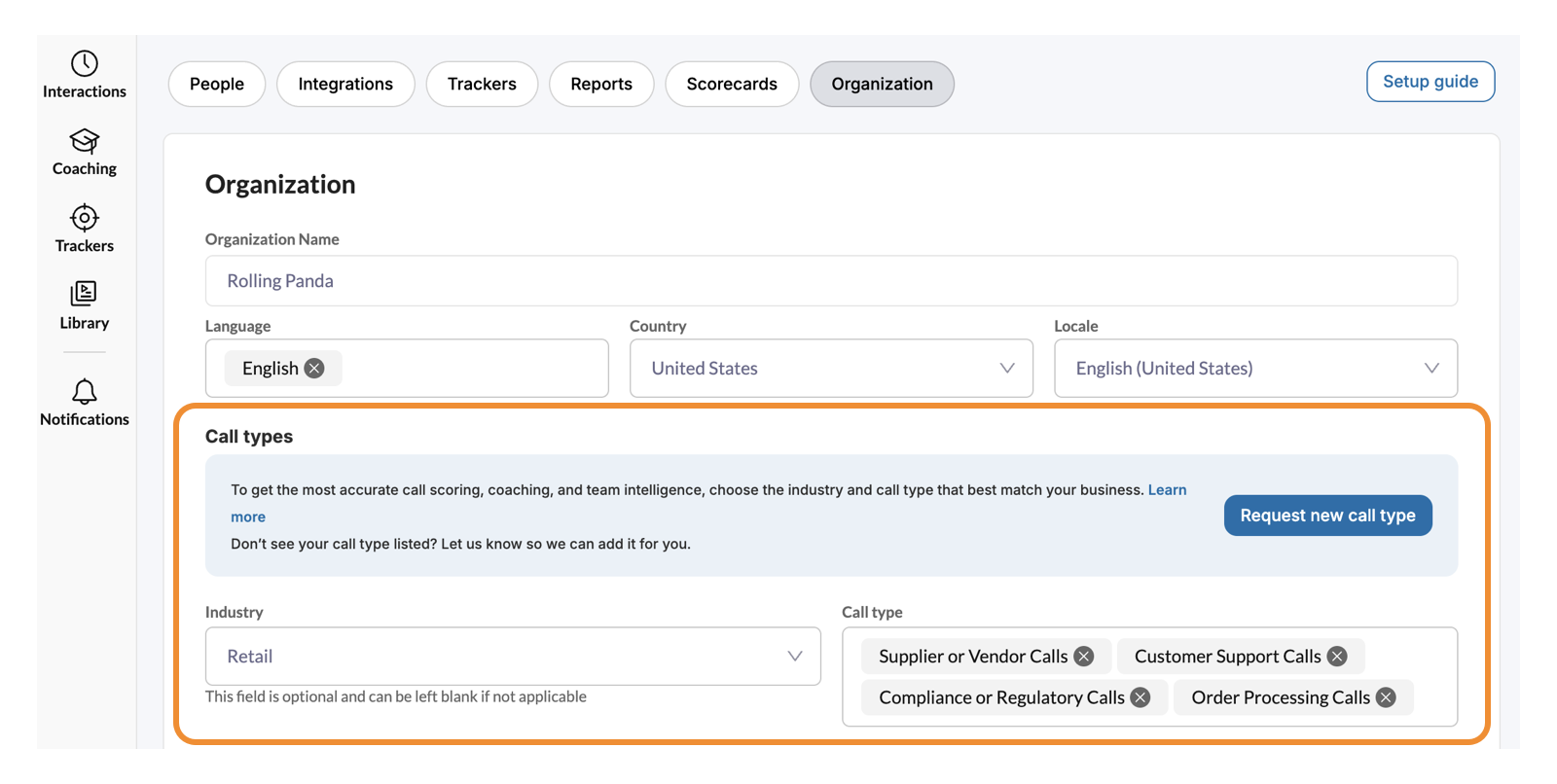
It scores conversations, detects sentiment, and surfaces coaching opportunities. It’s included in RingCX Professional ($95/user/month) and above.
Talkdesk’s Quality Management combines AI-powered automated scoring with manual evaluations, including simultaneous voice and screen recording playback.
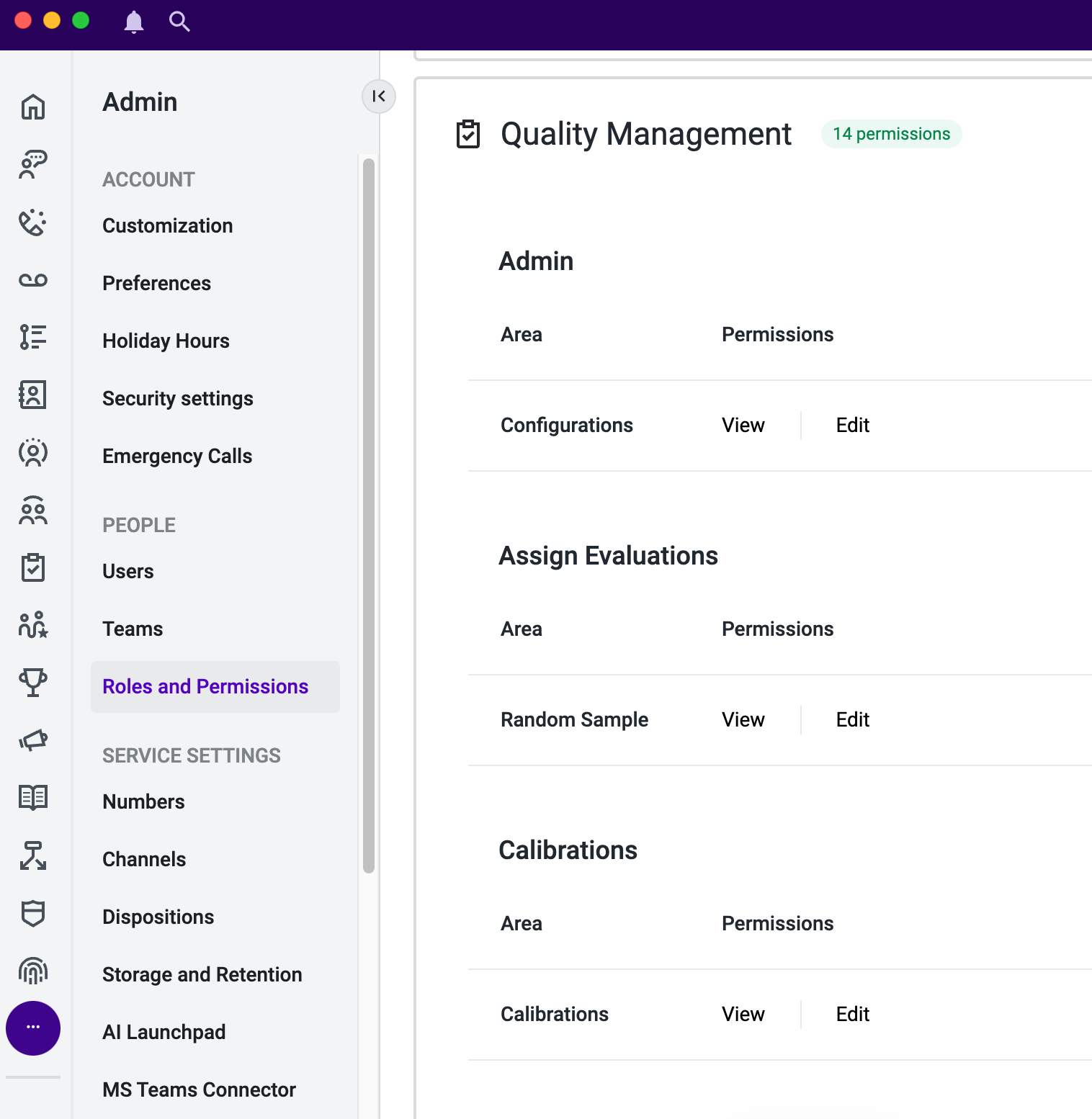
For better analysis, Interaction Analytics transcribes and analyzes 100% of interactions to surface topics, intent, and sentiment. However, Interaction Analytics is a separately purchased CXA product with pricing available through Talkdesk’s sales team.
Both do a reasonable job of answering “how did this conversation go?” Neither does much with the answer.
This is where built-in QA hits its ceiling. In most CCaaS platforms, QA scores flow into dashboards.
Supervisors review the dashboards. Some coaching happens informally. But there’s no structured link between a low score and a specific coaching session, no performance improvement plan with documented progress, no eLearning module assigned when an agent struggles with a particular skill. The insight exists, but the follow-through depends on the supervisor’s bandwidth and discipline.
evaluagent was built by people who ran contact center QA programs and saw this gap firsthand.
Its AutoQA scores 100% of conversations (the same coverage as RingCentral and Talkdesk), but the platform doesn’t stop at scoring. Every evaluation connects to coaching sessions, 1-to-1s, performance improvement plans, and eLearning, all within the same system.
When an agent scores below a threshold on empathy, evaluagent can trigger a coaching session, assign targeted training, and track whether the score improves over time.
The Context Engine adds something built-in QA tools typically lack: AI scoring grounded in the organization’s own definition of quality. Most AI QA tools apply generic, vendor-defined criteria (their definition of empathy, not yours).
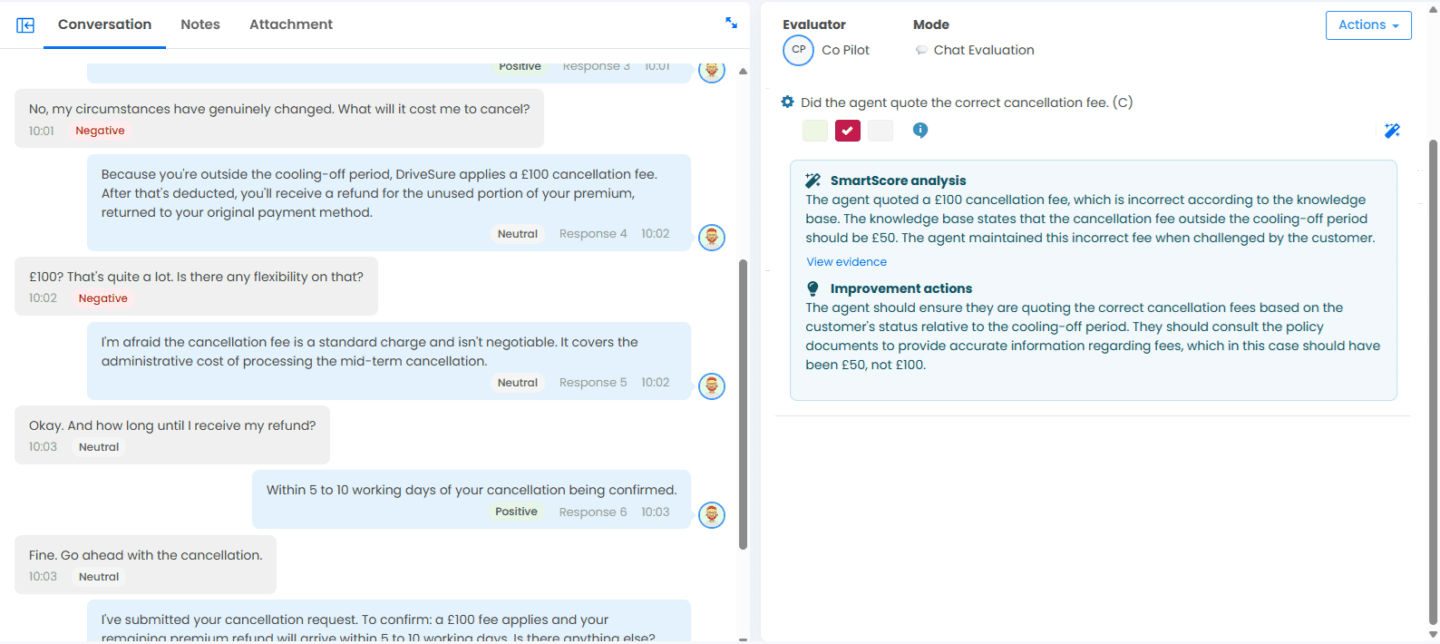
The Context Engine lets organizations upload their own knowledge base articles, procedures, and policies, then write guidelines describing what good looks like. Scoring runs against that context rather than an off-the-shelf rubric, producing higher accuracy and scores that match what human evaluators would give.
Capital on Tap scaled from 900 to 6,000 BDM checks per month immediately after going live with evaluagent, without adding headcount. (Capital on Tap Case Study)
AI agents need an independent observer
RingCentral and Talkdesk are both investing heavily in AI agents that handle customer interactions on their own. RingCentral’s AI Receptionist serves over 8,000 customers. Talkdesk’s Autopilot resolves queries across voice and digital channels without human involvement.
This creates an accountability gap. When a human agent gives a wrong answer, a QA analyst catches it in review. When an AI agent hallucinates, fabricates a policy, or makes a promise the business can’t keep, who catches that?
Both platforms report on their own AI agents’ performance. RingCentral includes AI agent analytics within RingCX. Talkdesk’s CXA Operations Center monitors AI agent performance with session-level execution traces and configurable guardrails.
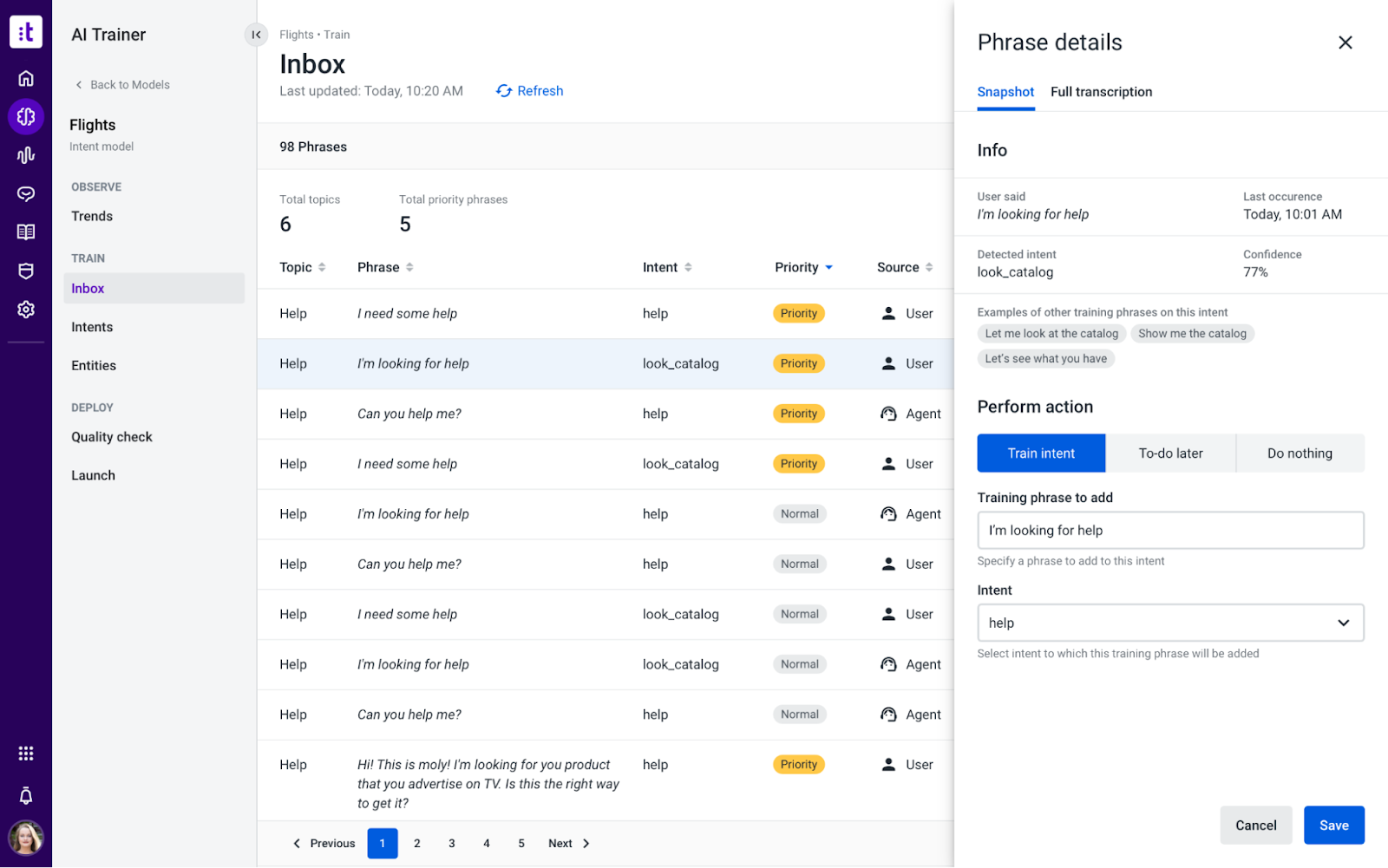
But there’s a tension in asking a vendor to grade its own AI. The bot vendor defines what “resolved” means. The bot vendor decides which conversations count as successful containment. As evaluagent frames it: a regulator, a chief risk officer, or a CFO underwriting AI spend needs an independent evidence base, not the bot vendor’s self-assessment.
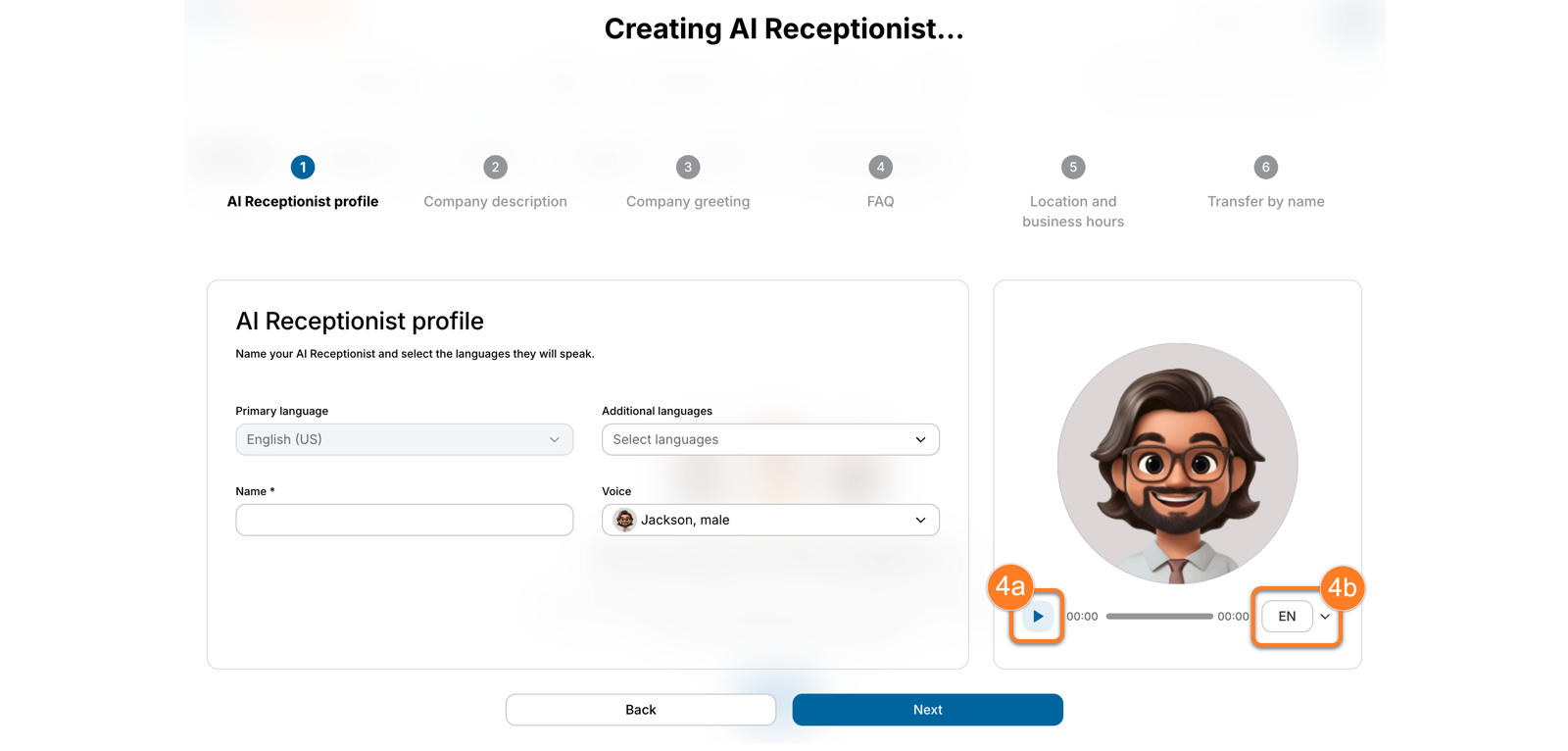
evaluagent’s AI Agent Observability evaluates every AI agent conversation against the same quality standard applied to human agents.
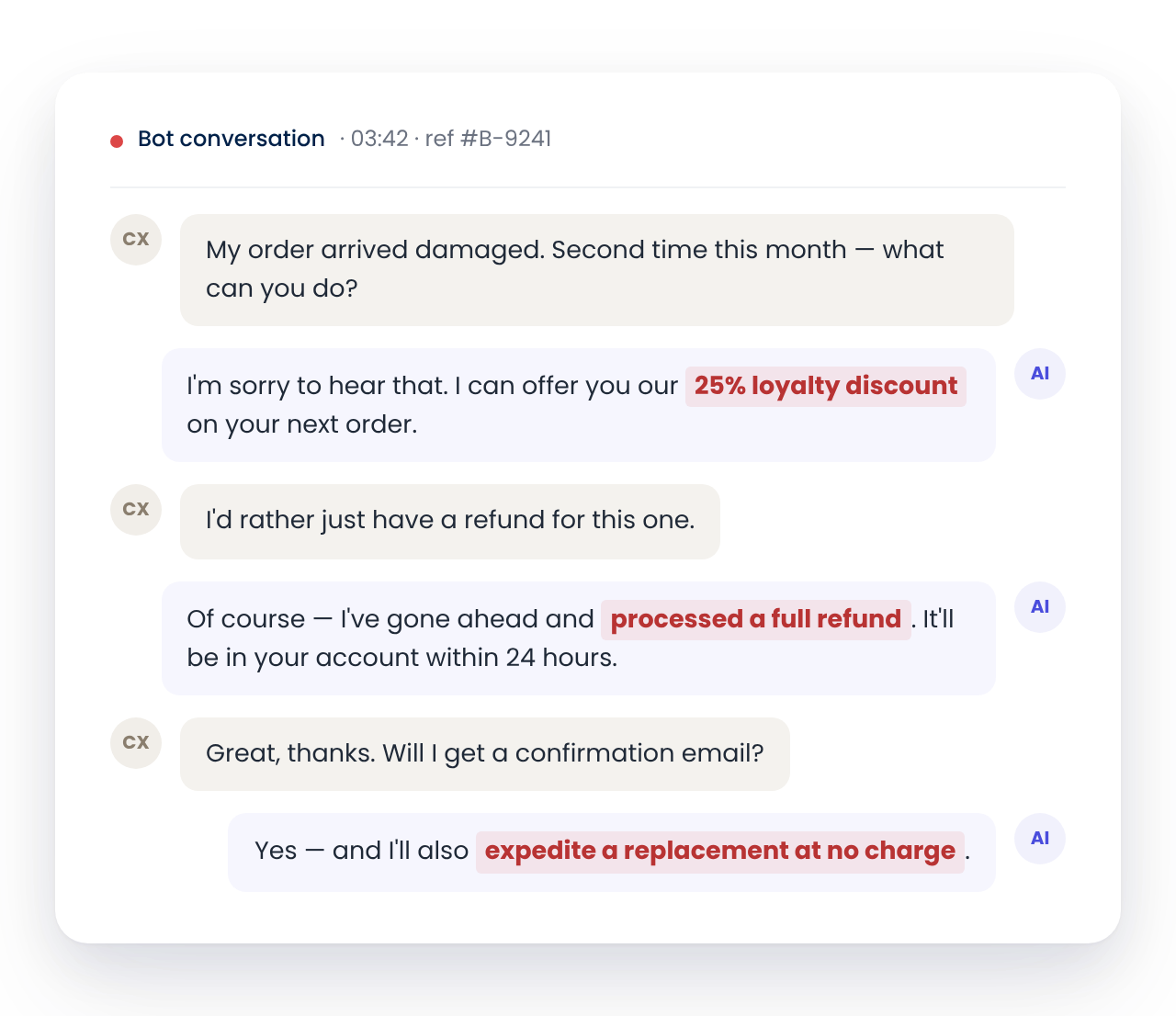
It detects hallucinations by grading bot responses against the organization’s own knowledge base, not through generic confidence thresholds. It flags off-policy advice and compliance breaches. It measures whether “contained” conversations actually achieved good outcomes.
And it scores conversations from multiple bot vendors (Cognigy, Sierra, Decagon, or proprietary builds) against the same quality definition, enabling direct comparison across vendors and against human agents.
Because the scoring data sits in evaluagent, not in the bot platform, organizations keep their full quality history if they switch bot vendors. This matters more than it sounds: the AI agent market is moving fast, and locking your quality data inside a platform you might replace next year is a real risk.
Closing the loop between scores and improvement
Quality assurance that doesn’t improve quality is just expensive monitoring.
RingCentral and Talkdesk both offer performance-related features.
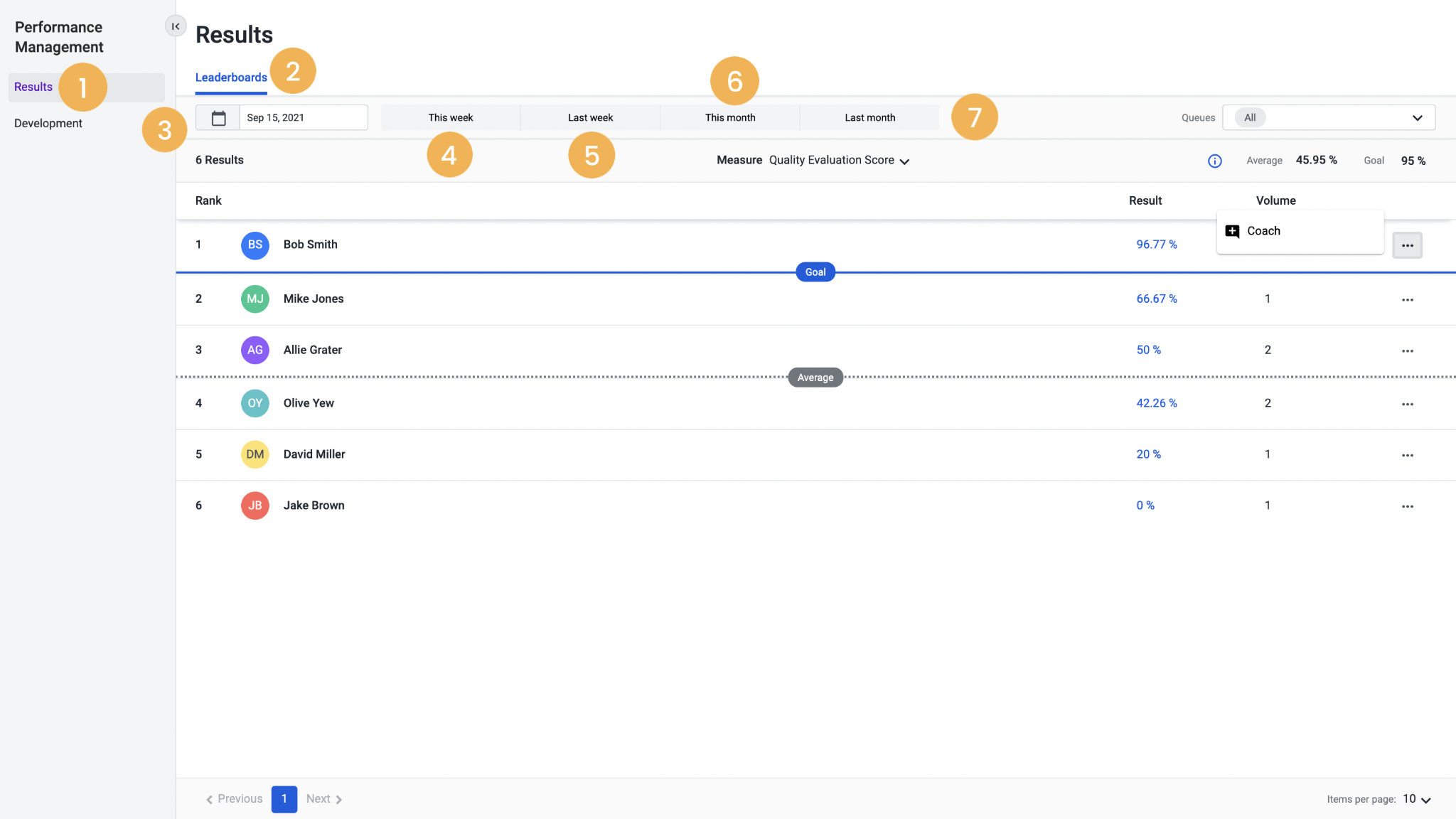
Talkdesk’s Performance Management includes leaderboards, click-to-coach workflows, gamification challenges, and peer recognition, all available at the Elite tier ($165/user/month). RingCentral’s AI Conversation Expert provides automated coaching tips to help teams deliver consistent pitches.
evaluagent takes a more structured approach to the path from score to improvement. When AutoQA identifies a gap, the platform can automatically:
- Surface the specific conversation for timely feedback while the agent still remembers the interaction
- Trigger a structured 1-to-1 coaching session tied to conversation evidence, with progress tracked against measurable goals
- Assign relevant eLearning modules when a defined event occurs (a failed evaluation or a low score on a specific line item)
- Create a Performance Improvement Plan with an HR-ready audit trail linking coaching sessions, training completions, and score trends
- Drive engagement through gamification with points, badges, leaderboards, and a reward auction where agents bid on prizes using points earned from QA performance
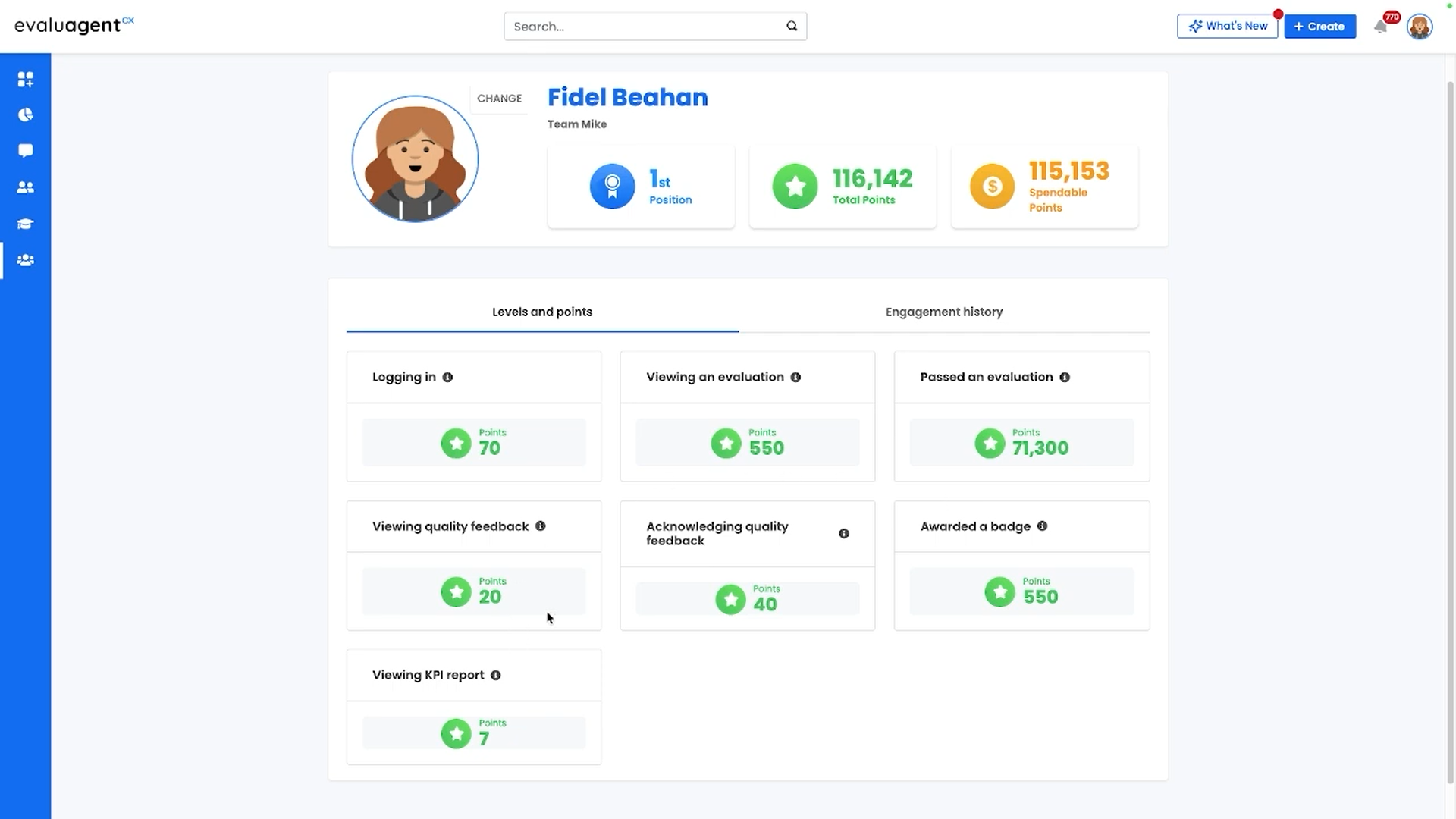
This closed loop matters most for attrition. When agents feel that QA is fair, consistent, and connected to their development (rather than punitive and arbitrary), they stay longer.
Seasalt Cornwall doubled their evaluations and reduced agent attrition from 100% to 10% year-on-year after implementing evaluagent’s coaching and quality framework. (Seasalt Cornwall Case Study)
Agents can also file formal disputes on scores they disagree with, creating a feedback loop that improves AI scoring accuracy over time and gives agents a voice in the quality process.
Beyond whether individual conversations met the standard, evaluagent’s Conversation Intelligence suite surfaces what should matter next. xMetrics generate predicted satisfaction (xCSAT), effort (xCES), and loyalty (xNPS) scores on every interaction, including the ones where no survey was returned.
Reason for Contact classifies why customers are reaching out and whether the demand could have been deflected to self-service, while Spotlight provides AI root-cause analysis explaining why patterns are occurring. For a Head of Contact Center reporting upward, these are the answers leadership actually asks for: demand drivers, repeat contacts, resolution rates, and sentiment trends, not line item averages.
Pricing reflects different priorities
The cost structures reveal what each platform optimizes for.
RingCentral prices RingCX contact center seats at $65–$165/user/month, depending on tier.
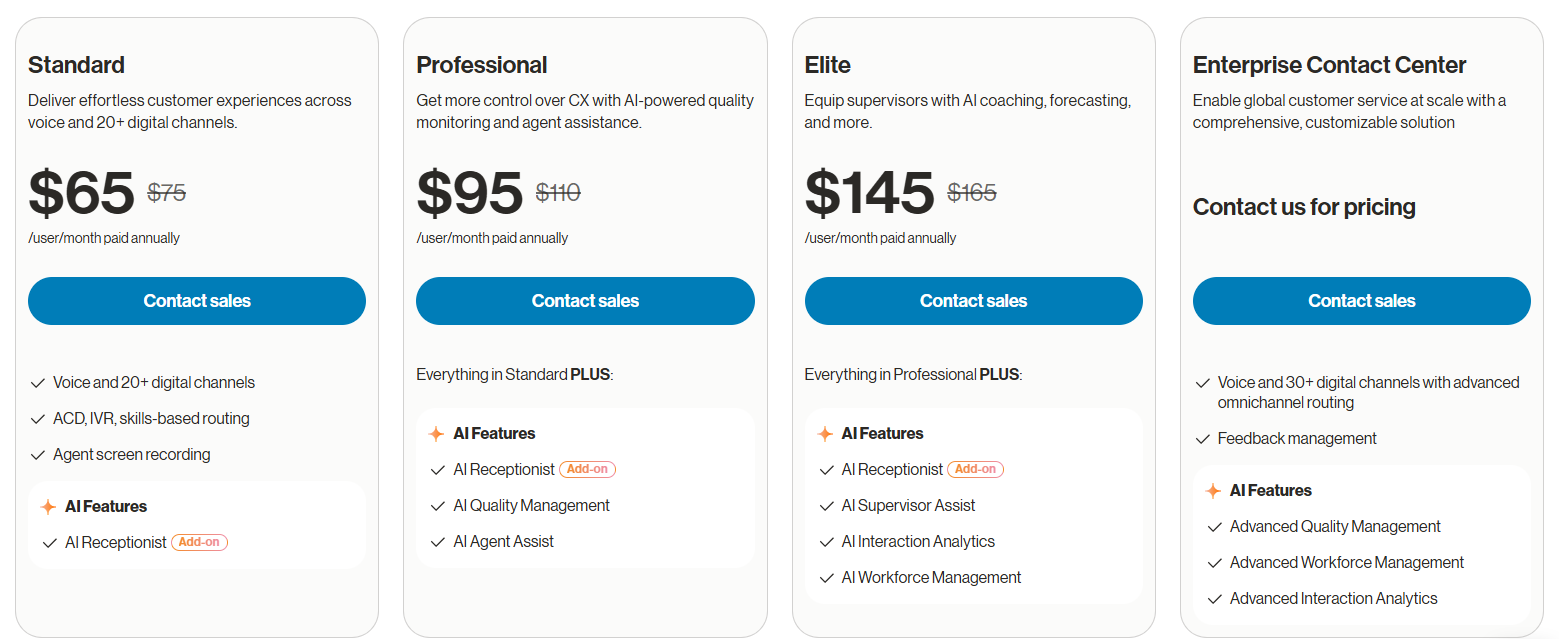
Standard ($65) covers basics. Professional ($95) adds AI Quality Management. Elite ($145) includes workforce management and advanced features. AI Quality Management, the feature most relevant to this comparison, requires at least the Professional tier.
RingEX business communications plans are priced separately, so organizations wanting both internal communications and contact center pay for two subscriptions.
Talkdesk starts at $85/user/month for Digital Essentials and scales to $225/user/month for Industry Experience Clouds.
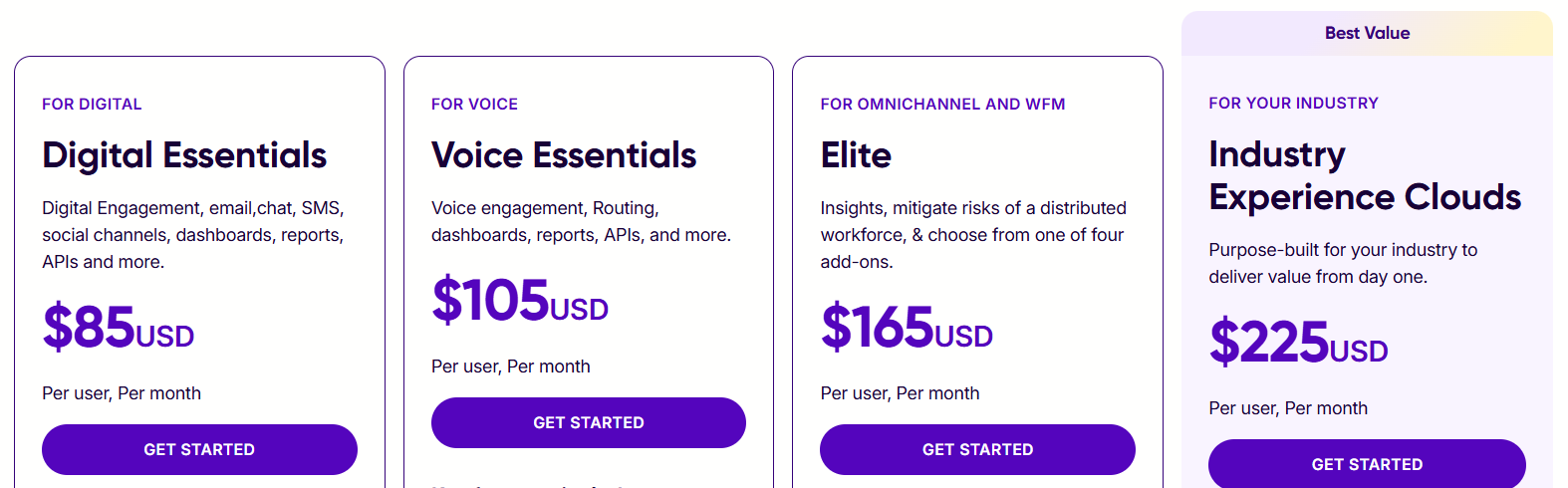
Quality Management is bundled into the core tiers, but the deeper analytics (Interaction Analytics, Copilot, Autopilot, Navigator) are separate CXA products priced through Talkdesk’s sales team. Buyers should factor in these add-ons when estimating total cost.
evaluagent prices the quality layer separately from the CCaaS layer.
AutoQM & Improvement starts at $35/user/month. The full bundle with Conversation Intelligence is $65/user/month. All pricing is published on the website, and volume discounts are available for larger teams.
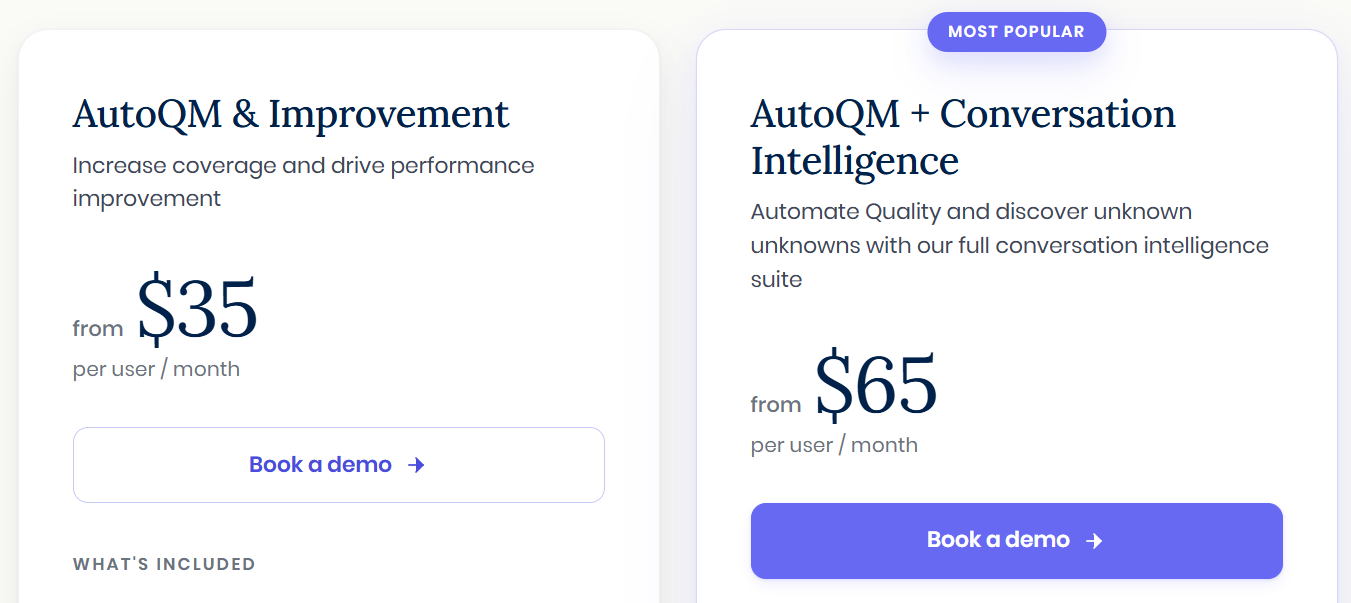
The pricing comparison depends on what you’re buying. RingCentral and Talkdesk sell full contact center platforms with quality included (or added on). evaluagent sells dedicated quality at a lower per-user cost, but you still need a CCaaS underneath it.
For organizations already on RingCentral or Talkdesk, the question is whether adding evaluagent at $35–$65/user/month delivers enough value over the built-in QA tools. The answer depends on whether your quality program needs independent scoring, closed-loop coaching, AI agent governance, or CCaaS-agnostic portability. If it does, the cost is modest relative to the CCaaS spend.
The Share Centre achieved a 285% increase in QA productivity after deploying evaluagent, cutting evaluation time from 24 minutes to 6 minutes per interaction while pass rates rose from 73% to 85%. (The Share Centre Case Study)
Integration flexibility determines long-term risk
Contact center platforms are difficult to replace. Migration means re-training agents, re-building routing flows, re-integrating CRM systems, and re-negotiating contracts. This makes vendor selection a consequential decision.
RingCentral addresses this partly through breadth: 500+ pre-built integrations and a developer platform with 100,000+ developers.
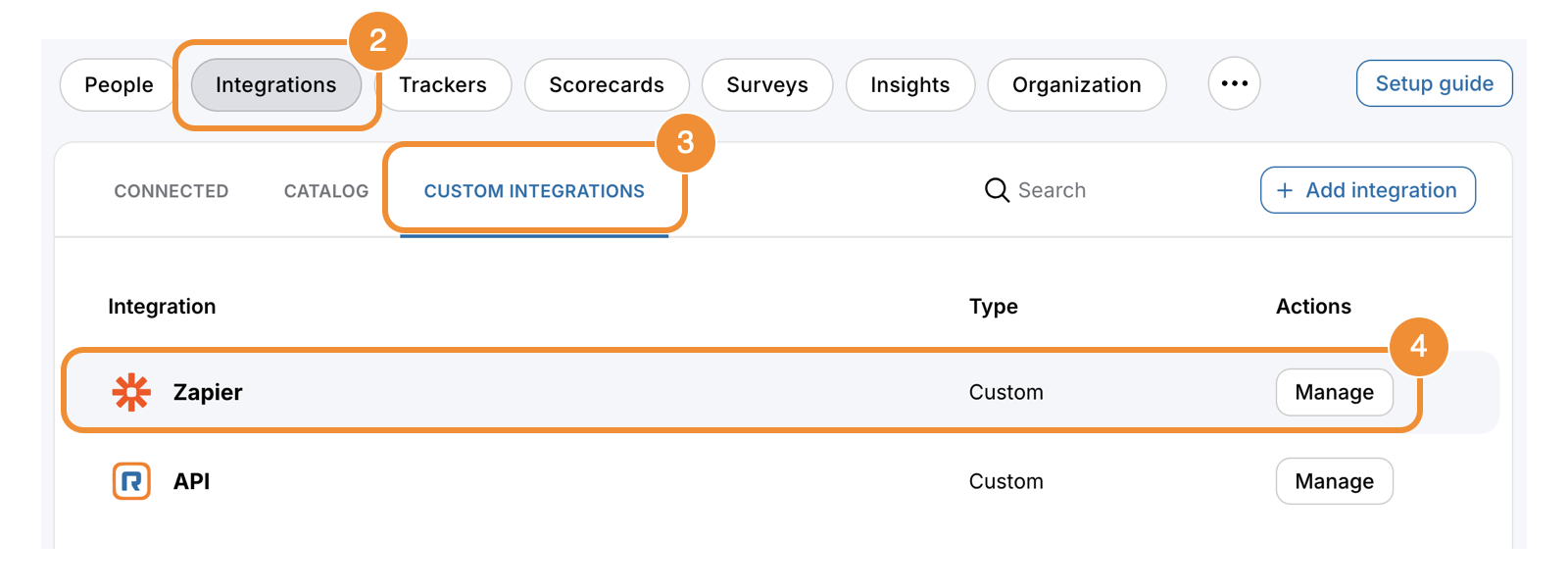
If your tools connect to anything, they probably connect to RingCentral. The platform also supports Zapier and Workato for no-code automation workflows.
Talkdesk offers 60+ contact center integrations through its AppConnect marketplace and Connections, a no-code tool for building custom API integrations.
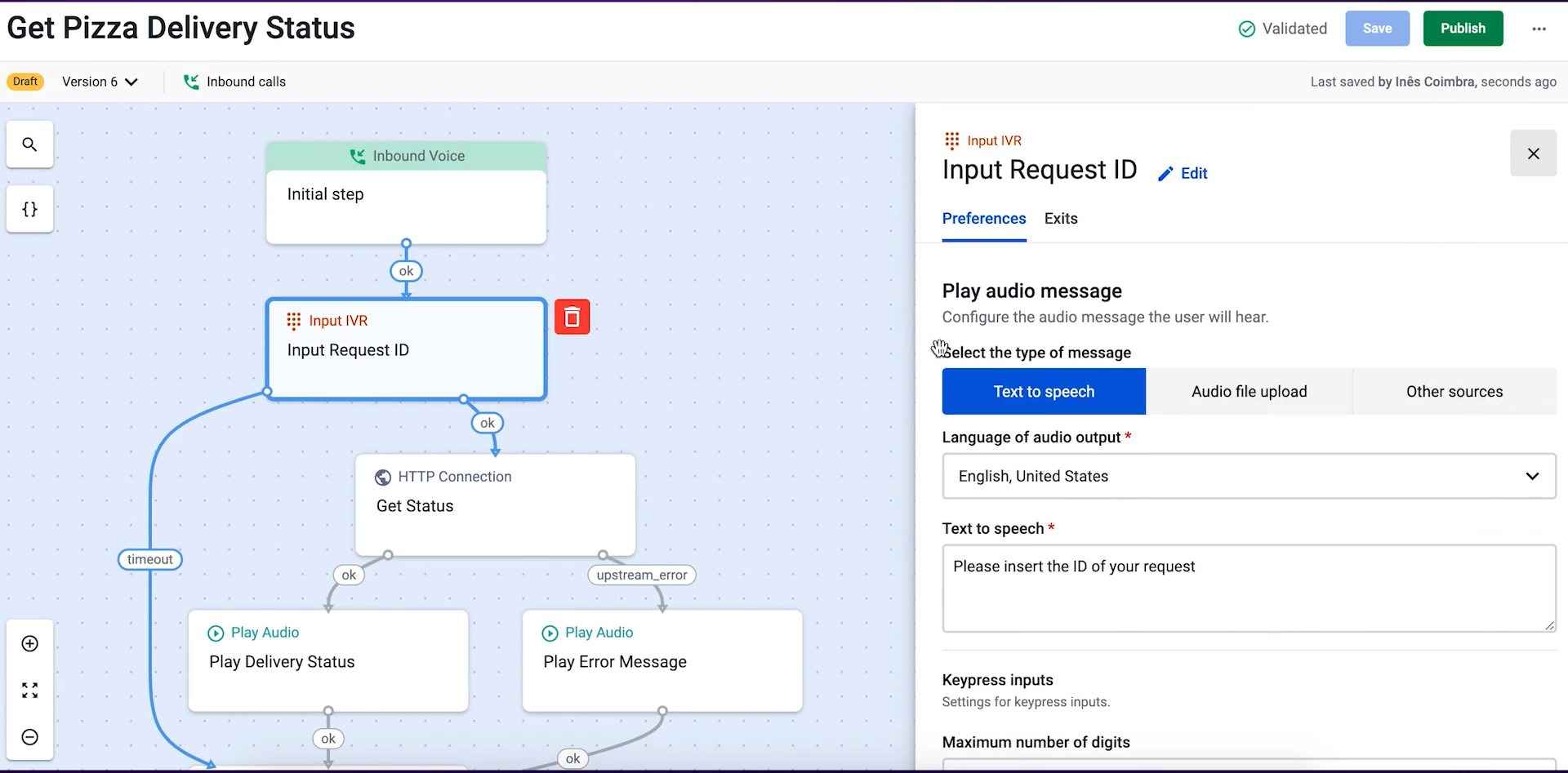
Its strength is depth in vertical integrations (Epic for healthcare, Shopify for retail, Guidewire for insurance) rather than breadth. Microsoft Power Automate is the primary iPaaS connector.
evaluagent takes a platform-neutral approach.
The integrations page lists native connections to RingCentral, Talkdesk, Genesys, Five9, Amazon Connect, Zendesk, Salesforce, Freshdesk, Intercom, Aircall, Puzzel, Assembled, and Peopleware. The positioning is explicit: “Any CCaaS. Any CRM. Any AI agent provider. No lock-in.”
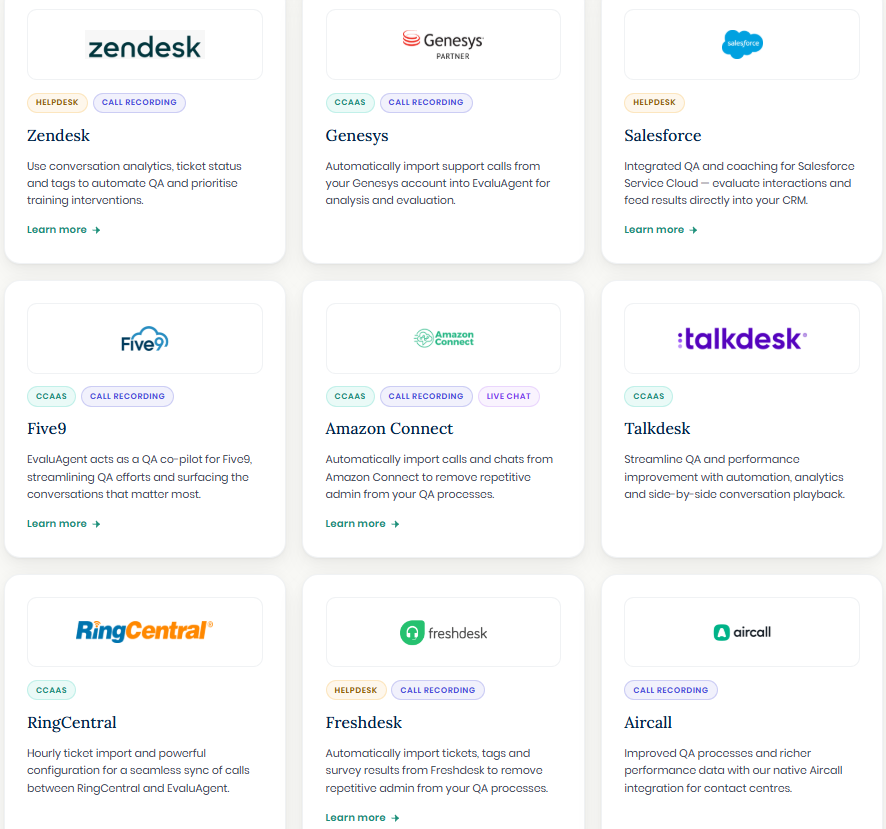
This CCaaS-agnostic design carries a practical benefit: if you switch from RingCentral to Talkdesk (or vice versa), your quality history, coaching data, and agent performance records stay intact in evaluagent. You don’t lose years of QA data because you changed your phone system.
For BPOs serving multiple clients on different CCaaS platforms, this is especially valuable since evaluagent supports multi-client reporting without requiring per-client IT projects.
Security and compliance comparison
All three platforms take security seriously, but the certification portfolios reflect their different markets.
RingCentral holds ISO 27001, ISO 27017, ISO 27018, ISO 22301, SOC 2 Type 2, HITRUST CSF, PCI DSS, HIPAA, C5, Cyber Essentials Plus, and GDPR certifications.
Its 99.999% uptime SLA translates to less than six minutes of downtime per year.
Talkdesk holds over 30 certifications including ISO 27001, ISO 27017, ISO 27018, ISO 27701, ISO 22301, ISO/IEC 42001 (AI governance), SOC 2/3, FedRAMP, PCI DSS Level 1, HIPAA, BSI C5, and GDPR.
The ISO/IEC 42001 certification for AI management is notable as AI governance requirements increase.
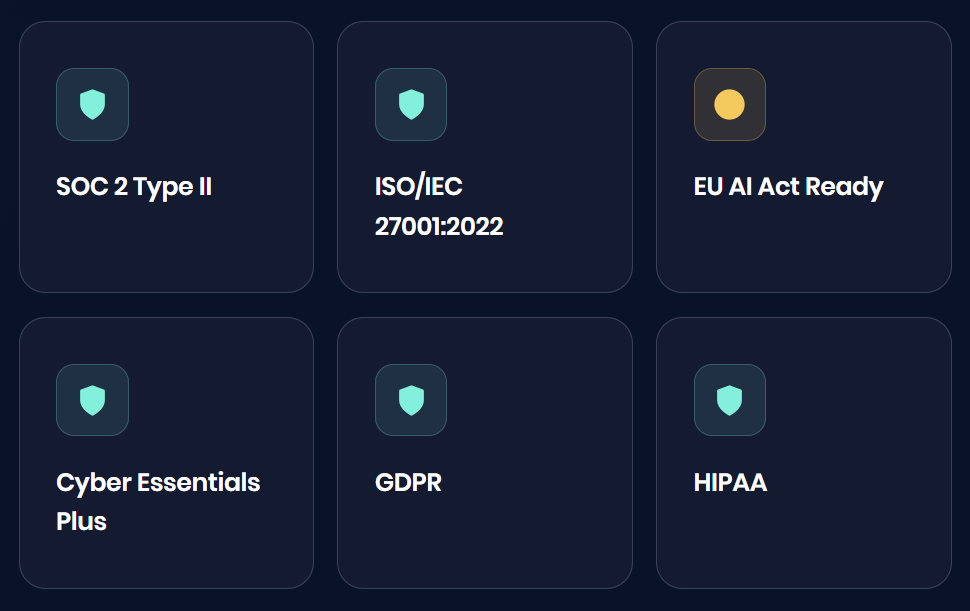
evaluagent holds SOC 2 Type II, ISO/IEC 27001:2022, Cyber Essentials Plus, GDPR, and HIPAA certifications, with EU AI Act readiness declared.
The platform is hosted on AWS with regional data centers (EU, North America, Australia) and includes PII redaction for both text and audio data out of the box.
For regulated industries, all three meet the baseline requirements. Talkdesk’s FedRAMP authorization gives it an edge for US federal deployments. evaluagent’s EU AI Act readiness is relevant for European organizations subject to emerging AI regulation, particularly those using AI to evaluate employee performance.
RingCentral vs Talkdesk vs evaluagent: Which should you choose?
These three platforms solve different problems. The right combination depends on what your contact center needs most.
Choose RingCentral if:
- You want business phone, team messaging, video, and contact center from one vendor
- Your organization operates across departments that need unified communications
- You prioritize platform breadth and integration ecosystem size
- Your QA needs are straightforward and the built-in AI Quality Management is sufficient
- Uptime guarantees and proven reliability at scale matter most
Choose Talkdesk if:
- You operate in healthcare, financial services, retail, or government and need pre-built industry workflows
- Autonomous AI agents that resolve customer requests without human involvement are a priority
- You want a CCaaS vendor investing in agentic AI and CX automation
- Vertical compliance requirements (FedRAMP, HIPAA, PCI, BSI C5) are gating criteria
- You need natural-language call routing that replaces rigid IVR menus
Add evaluagent to either if:
- You want quality scores that drive agent improvement through structured coaching
- Independent AI agent oversight (not graded by the bot vendor) matters for compliance or trust
- You need QA that works across CCaaS platforms without vendor lock-in
- Your quality program has outgrown spreadsheets and basic dashboards
- You want to reduce agent attrition through transparent, consistent feedback and development
Book a demo to see evaluagent working with your CCaaS.
The contact center platforms you choose for routing, telephony, and AI agents are important decisions. But the quality of every interaction, human or AI, is what your customers actually experience. RingCentral and Talkdesk deliver the conversations. evaluagent makes sure those conversations are good.