Level AI sells itself as a complete CX intelligence platform, combining automated quality assurance, real-time agent assistance, voice of the customer analytics, and AI virtual agents under one roof. It runs on proprietary AI models built for contact center data (not general-purpose LLM wrappers) and targets enterprise contact centers that want to move beyond sampled QA and disconnected point solutions.
But a platform that tries to do everything raises a fair question: does it do any one thing well enough?
To write this Level AI review, we analyzed the platform extensively. We believe it’s the right choice if:
- You need a single platform covering QA, coaching, VoC analytics, and AI virtual agents
- You run a large enterprise contact center (200+ agents) with the budget for custom-negotiated pricing
- You want proprietary AI models built for contact center data rather than generic LLM wrappers
- Real-time agent assistance during live calls is a priority
- You need AI virtual agents and automated QA under one vendor
However, Level AI might not be the best choice if:
- You want transparent, published pricing you can evaluate before a sales conversation
- You need a platform that goes live in weeks rather than months
- You prioritize independent AI agent governance and hallucination detection
- You’re a mid-market contact center (50–500 agents) looking for focused QA without buying a full platform
- CCaaS-agnostic flexibility and vendor portability matter to your procurement team
- You want a closed-loop system connecting QA scores directly to coaching, gamification, and performance plans
In this case, you should consider evaluagent: a contact center quality assurance and performance improvement platform that scores 100% of conversations automatically, then closes the loop with structured coaching, gamification, and performance plans, all within a single system built by practitioners who spent their careers running QA programs.
With published pricing starting at $35/user/month, native integrations across every major CCaaS, and a go-live timeline measured in weeks, evaluagent delivers focused QA depth without the complexity of buying an entire CX platform.
We’ve included a detailed look at evaluagent later in this review as the stronger alternative for contact centers that want QA and agent improvement done right. If you’d like to see it in action, you can book a demo here.
What is Level AI?
Level AI was founded in 2018 in Mountain View, California by Ashish Nagar and Sumeet Khullar. Nagar worked on Amazon’s Alexa Prize, which convinced him a wave of NLP breakthroughs was coming that existing contact center vendors couldn’t use.
The company’s first product was a voice assistant for frontline workers like technicians and retail employees. After early customer conversations, the team pivoted toward contact centers, where enterprises already had voice and data streams but lacked modern AI architecture.
The company has raised $73.1 million across four rounds, most recently a $39.4 million Series C led by Adams Street Partners in July 2024. It employs approximately 194–212 people across offices in Mountain View and Delhi, India. Level AI reports serving 100+ businesses and analyzing 10 billion customer interactions per year.
Level AI organizes its product into three pillars: CX Delivery (agent assist, coaching, screen recording, AI virtual agents), CX Strategy (Auto-QA, voice of the customer, analytics, iCSAT), and AI Core (the underlying proprietary models, voice AI, and speech recognition). The platform targets enterprise contact center leaders in financial services, healthcare, insurance, retail, and BPO.
Level AI Pros & Cons
| Pros | Cons |
|---|---|
| Proprietary AI models built for contact center data | No published pricing; requires sales negotiation |
| 100% conversation coverage across voice, chat, and email | 2–6 week implementation timeline |
| Real-time agent assistance during live interactions | AI evaluation accuracy still maturing per user feedback |
| AI virtual agents with sub-500ms voice latency | Limited reporting customization for complex global accounts |
| Enterprise compliance coverage (ISO 27001, SOC 2, HIPAA, PCI) | Smaller ecosystem and integration catalog than market leaders |
| Screen recording integrated into QA workflows | No self-serve trial or free plan |
| iCSAT scoring eliminates survey dependency | Inbound-centric; limited outbound coverage |
Level AI Review: How It Works & Key Features
Auto-QA: Level AI replaces sampled manual QA with AI-powered scoring across 100% of interactions.
Level AI’s Auto-QA is the platform’s quality management engine. It uses a proprietary generative AI model called QA-GPT, trained on contact center data, to score every conversation automatically across calls, chats, and emails.
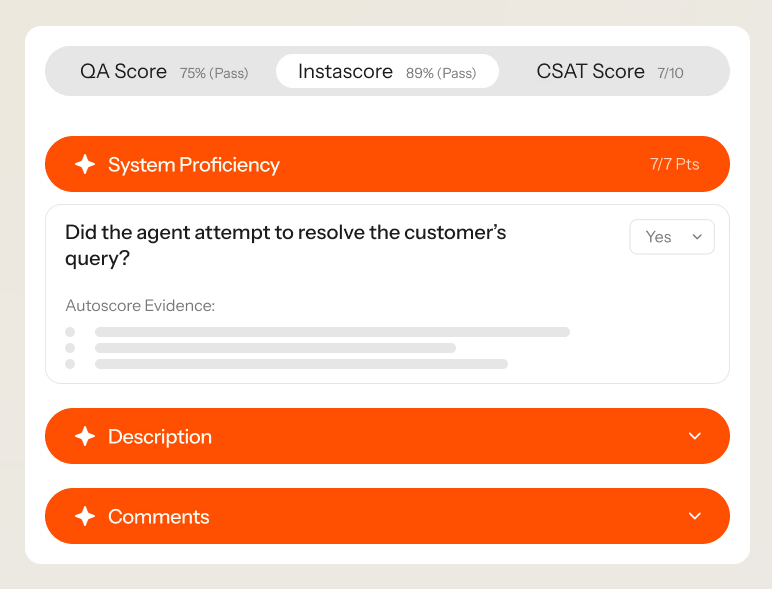
The workflow follows four stages.
First, organizations bring their existing QA scorecard or build one using Level AI’s pre-trained question library and industry-specific rubrics. A sandbox environment lets teams test accuracy before deployment.
Second, QA-GPT scores incoming conversations automatically, evaluating over 90% of the criteria that scorecards typically cover, including subjective measures like tone and empathy that keyword-matching systems miss. Each score comes with supporting evidence and reasoning.
Third, conversations flagged for human attention arrive with labeled timestamps and pre-filled suggestions, making manual reviews faster.
Fourth, agents and managers monitor performance through drill-down dashboards organized by scorecard criterion.
A notable capability is the integration with Agent Screen Recording, which captures what agents do on their desktops during interactions. This lets QA criteria cover agent workflow behavior, not just what was said. For compliance-heavy industries, the system analyzes all interactions for regulatory violations across TCPA, HIPAA, PCI DSS, and other frameworks, with auto-redaction of sensitive data.
Agent Assist & Coaching: Level AI provides real-time guidance during calls and structured coaching afterward.
Agent Assist is Level AI’s real-time co-pilot. During live interactions, it surfaces relevant knowledge base answers, suggested responses, and compliance alerts through AgentGPT, an AI assistant trained on the organization’s own documentation.
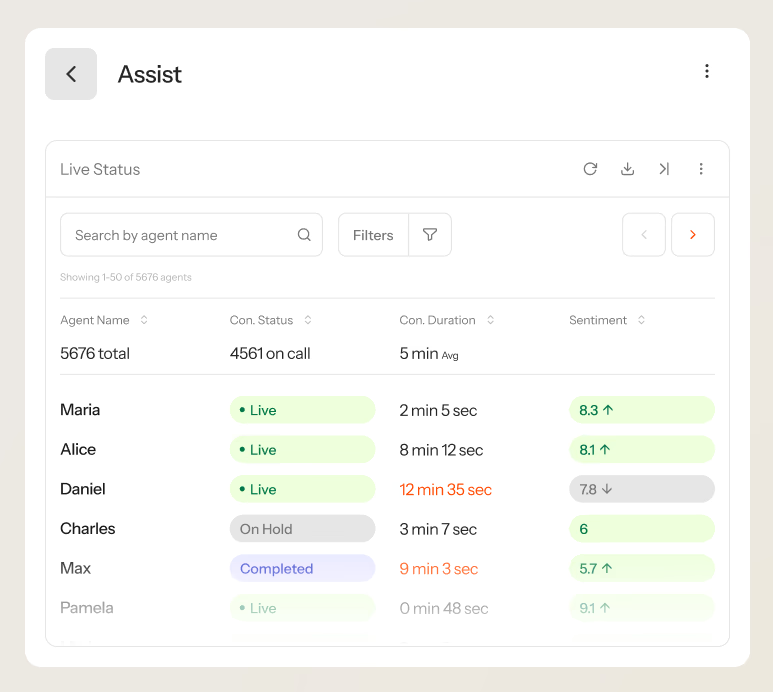
When a customer asks a question, the agent gets a contextual answer without searching manually. After the call, the platform auto-generates summaries and notes, eliminating wrap-up time.
Agent Coaching handles the post-interaction side. Because Auto-QA scores every conversation, the coaching system can surface specific interactions that illustrate performance patterns rather than relying on random samples.
Managers filter by QA score, sentiment, topic, or outcome to find the most instructive moments, then build coaching plans tied to specific conversation evidence. AI Workers can automate this discovery, scanning interactions to identify coaching priorities without manual effort.
The two products share a common data layer, so what gets flagged during a live call feeds directly into the coaching system as documented evidence. Real-time guidance and structured development run on the same data, so agents receive consistent messaging across both.
Voice of the Customer & iCSAT: Level AI infers satisfaction from conversations rather than relying on surveys.
Traditional CSAT programs depend on post-call surveys with response rates well below 20%. Level AI addresses this with iCSAT (Inferred Customer Satisfaction), which analyzes 100% of conversations to produce a satisfaction score for every interaction without requiring customers to fill anything out.
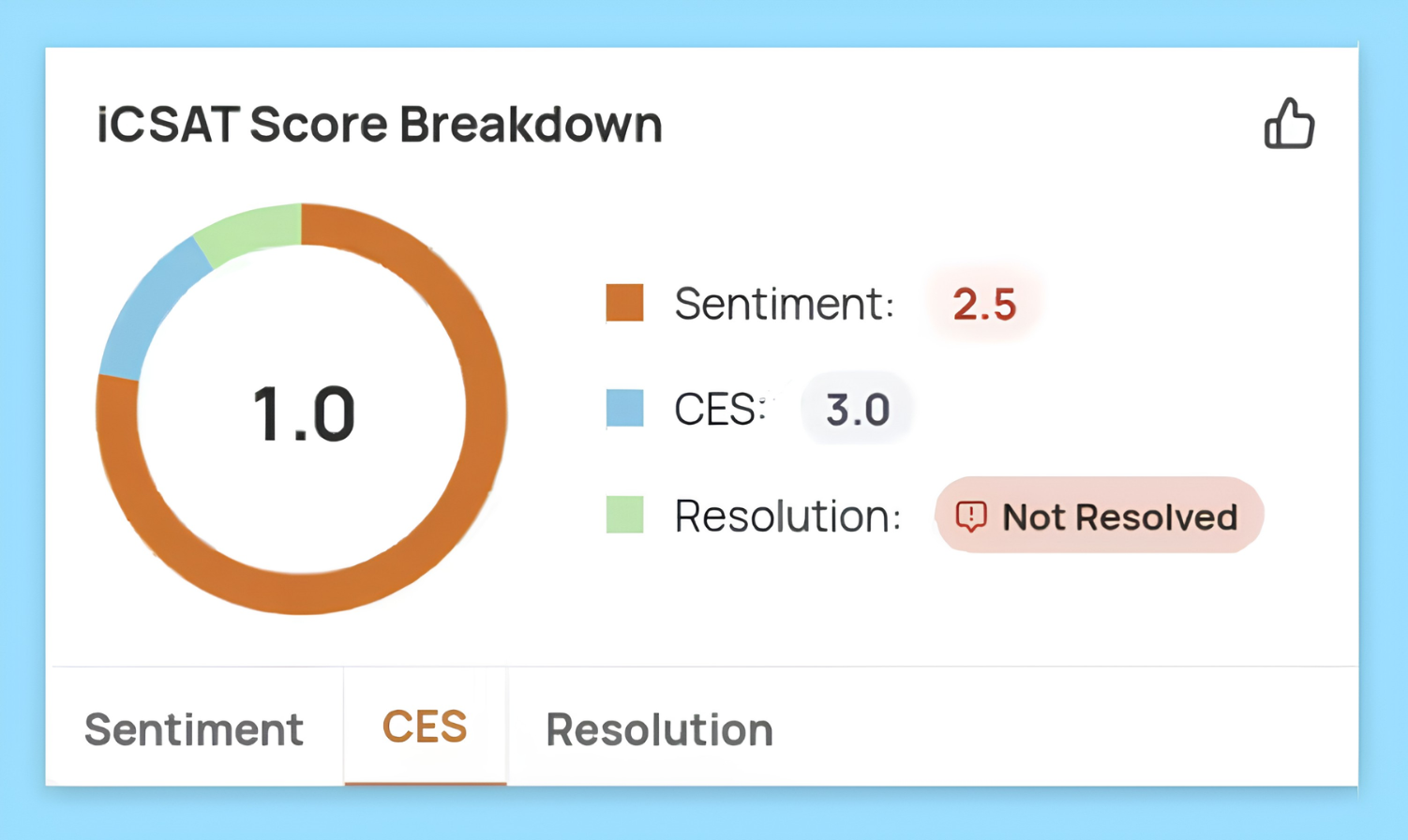
The iCSAT score draws from three components: a sentiment model with temporal weighting (different moments in a conversation carry different significance), customer effort analysis (measuring repetition, transfers, and required customer actions), and resolution tracking (whether the issue was actually resolved).
These three signals combine into a single score with evidence explaining what drove the outcome.
The broader Voice of the Customer module automatically classifies every interaction by topic, intent, and sentiment using Level AI’s Attune NLU model, which the company says delivers 400x the coverage of keyword-based approaches. An Ask AI Analyst feature lets CX leaders query the data conversationally, asking questions like “what is driving low CSAT this week?” and receiving structured answers.
AI Virtual Agent: Level AI offers customer-facing voice and chat automation.
Level AI’s AI Virtual Agent handles inbound interactions across voice and chat in 50+ languages. Unlike rule-based IVR systems, it uses agentic reasoning to handle transactional actions (order modifications, ticket creation, CRM updates) through pre-built connectors for Salesforce, Zendesk, and custom APIs.
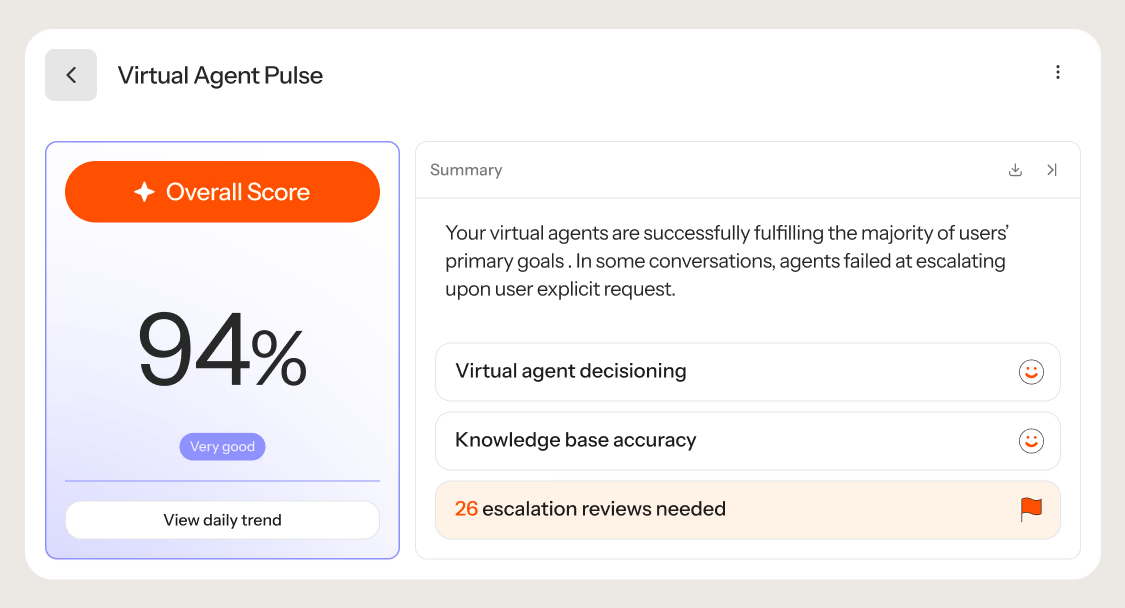
The underlying Voice AI platform runs a sub-500ms speech-to-response pipeline with neural text-to-speech that handles timing, interruptions, and emotional shifts in real time. Level AI reports a 90% accuracy rate and 45%+ resolution rate for its virtual agents.
What makes this notable in the QA context: virtual agent conversations are scored against the same rubrics as human agents, maintaining a single quality standard across the hybrid contact center. An EnlightIQ layer reviews every virtual agent conversation, applies satisfaction scoring, and feeds findings back into the system for continuous improvement.
Proprietary AI Stack: Level AI runs seven domain-specific models on owned GPU infrastructure.
Underneath everything is Level AI Latitude, a proprietary AI architecture running seven specialized models: Orba (speech recognition), Redactor (PII redaction), Attune (intent detection), Crux (summarization), Veridia (satisfaction prediction), Qualix (quality scoring), and Tenor (contact classification).
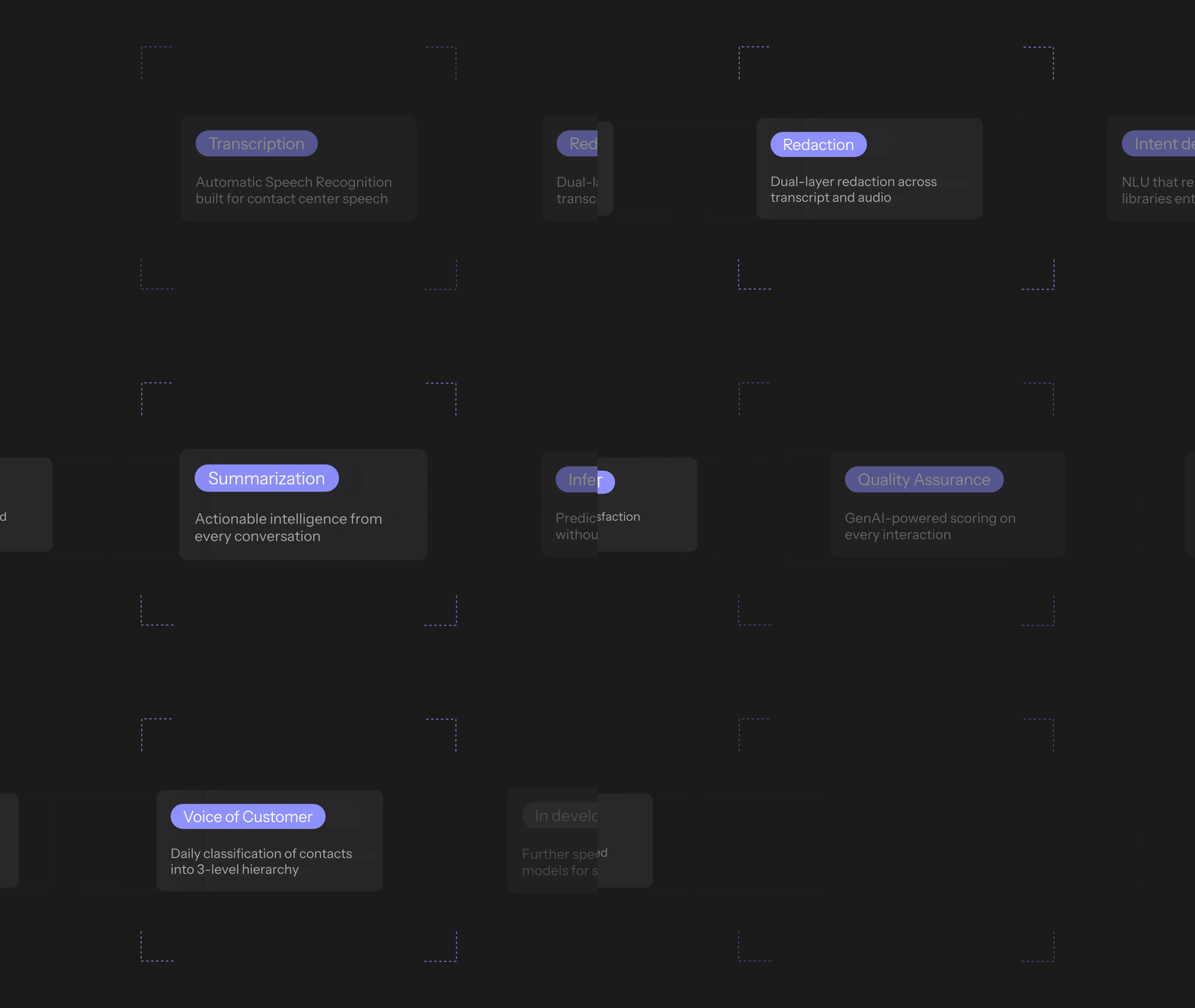
The company processes 4 trillion+ tokens per year across this model fleet and claims 49x cost reduction, 3.5x higher throughput, and 4x lower latency compared to general-purpose LLM approaches.
The speech recognition pipeline deserves specific mention. It runs a seven-stage process covering voice activity detection, acoustic modeling, language modeling, profanity detection, speaker diarization, punctuation, and inverse text normalization.
Each client gets a custom language model trained on their own conversation data, improving accuracy on industry-specific terminology without manual dictionary maintenance. Level AI claims an 8–12 word error rate advantage over industry leaders on contact center audio.
Where Level AI Falls Short
Level AI’s ambition to be a complete CX platform comes with trade-offs that certain buyers should weigh carefully.
No Published Pricing. Level AI does not publish any pricing information. The /pricing URL returns a 404, and all prospective buyers must schedule a sales demo. The EULA classifies pricing as confidential.
For teams evaluating multiple vendors, this adds friction and makes budgeting harder. Minimum seat counts, per-module costs, and implementation fees all remain unknown until you’re deep into a sales cycle.
Implementation Takes Weeks, Not Days. Level AI describes typical implementation timelines of 2–6 weeks depending on integration complexity. That timeline requires real planning investment. Contact centers that need to move quickly or want to test before committing face a slower path to value than platforms designed for rapid deployment.
AI Evaluation Accuracy Is Still Maturing. G2 reviewers note that Level AI’s automated scoring does not always recognize context, tone, or intent with enough nuance. Some users report transcription drift on heavy accents.
These are category-wide challenges, but they matter when the platform scores 100% of conversations and feeds those scores into coaching. Miscalibrated scores at scale can erode agent trust faster than manually sampled QA programs, where human reviewers catch edge cases.
Reporting Customization Has Limits. Several users note that while core conversation intelligence works well, the reporting dashboards need more flexible drill-down options and data extraction, particularly for complex global multi-region accounts. Teams accustomed to BI-grade reporting may find the options thin.
Broad Platform, Thinner Depth in Some Areas. Level AI covers QA, coaching, VoC, agent assist, virtual agents, and AI workers. That breadth means the platform competes in each category against specialists.
The coaching workflows, for example, lack the gamification mechanics (points, badges, leaderboards, reward auctions) and structured performance plan documentation that dedicated QA-to-coaching platforms offer. The AI virtual agent competes against dedicated bot platforms with deeper conversational design tools.
Smaller Ecosystem Than Market Leaders. With approximately 200 employees and $73.1 million in funding, Level AI’s partner network and integration catalog are thinner than enterprise incumbents.
There are no iPaaS connectors (Zapier, Make, Workato), no public API documentation, and no self-serve developer resources. Teams on less common CCaaS platforms or with complex integration requirements may find connectivity limited.
These are not failures. They reflect the natural tension of building a broad platform while still scaling. But they create clear space for platforms that trade breadth for depth, particularly in the QA-to-coaching workflow where precision and speed to value matter most.
Top Level AI Alternative: evaluagent
evaluagent addresses Level AI’s gaps by focusing on what contact centers need most: getting quality assurance right and connecting it directly to agent improvement.
Founded in 2012 by Jaime Scott, Michelle Dinsmore, and Alex Richards (three operators who spent their careers running contact centers), the platform grew from practitioner experience rather than research lab theory.
Backed by a $20 million investment from PeakSpan Capital and reporting nearly 500% revenue growth over three years, evaluagent is a Leader in Contact Center Quality Assurance in G2’s Summer 2026 report and was named to G2’s Top Customer Service Products 2026 (rankings based on verified customer reviews, not analyst briefings).
AutoQA & Context Engine: evaluagent scores 100% of conversations and grounds every score in your own policies.
evaluagent’s AutoQA scores every interaction automatically across voice, chat, and email, replacing the 2% sampling that most manual QA programs rely on.
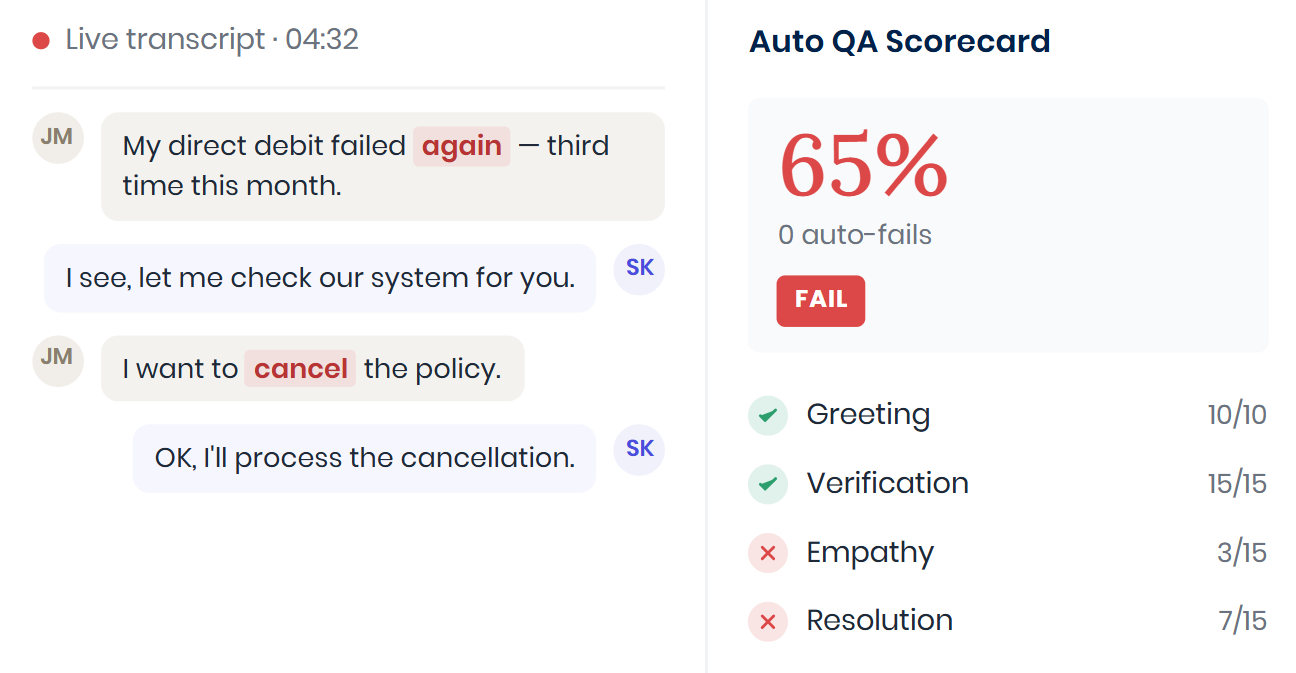
What sets it apart is the Context Engine, launched in April 2026, which grounds AI scoring in each customer’s specific QA policies, tone-of-voice guidelines, compliance rules, and knowledge base content. The AI doesn’t just evaluate whether an agent communicated well; it validates whether they gave the right answer.
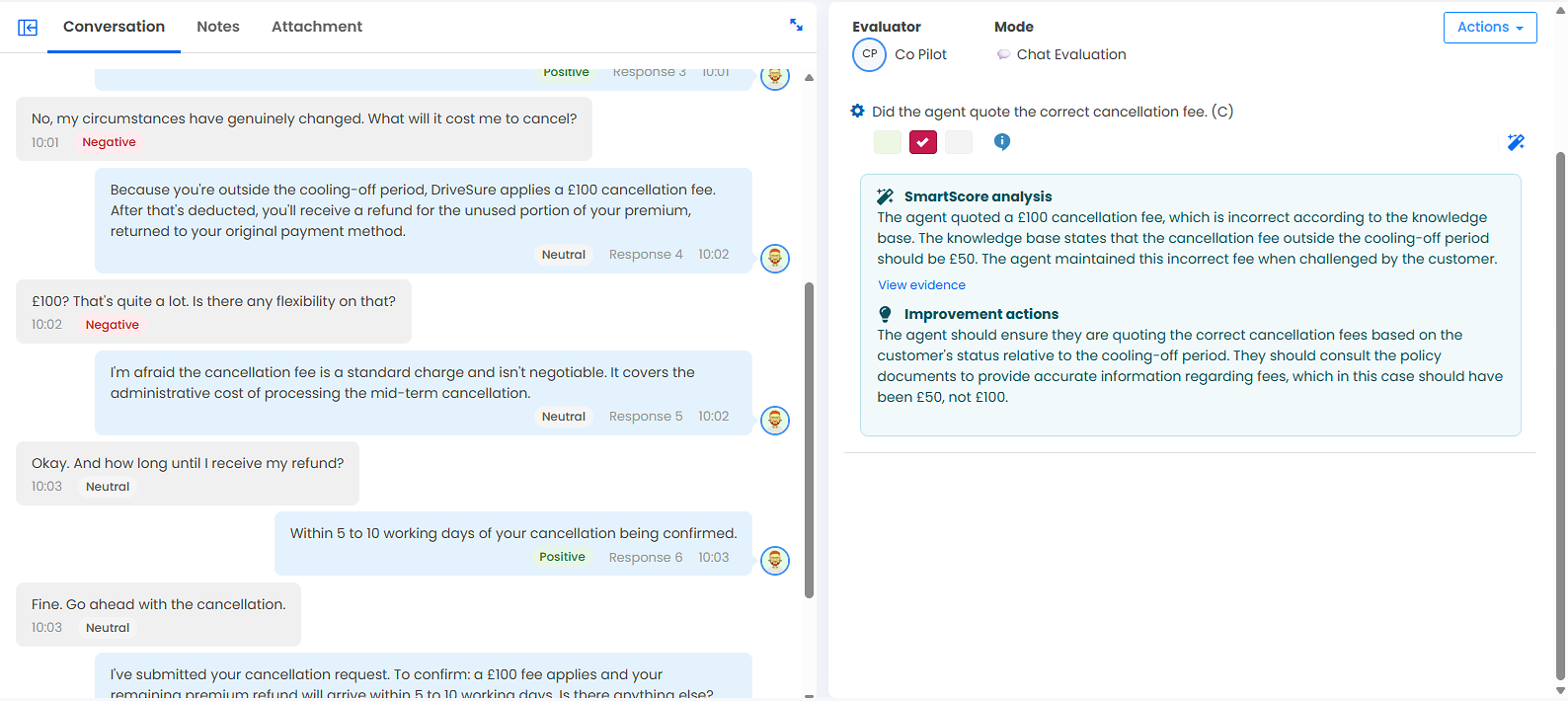
A Testing Console lets QA managers trial any scoring change against real historical conversations before it goes live. Blended Scorecards let AI handle repetitive rule-based checks while human evaluators retain nuanced assessments on the same scorecard. Agent Disputes create a formal appeals mechanism that feeds back into model accuracy.
This calibration infrastructure matters because automated QA is only as useful as agents’ trust in it. When scores are explainable, testable, and disputable, adoption follows. When they aren’t, the system generates numbers nobody acts on.
Full coverage also enables evaluagent’s Conversation Intelligence suite. Once every interaction is scored rather than 2%, the same pass produces xMetrics (predicted satisfaction, effort, and loyalty scores on interactions where no survey was returned) plus Reason for Contact classification and Spotlight root-cause analysis.
These give the QA leader answers to the questions executives actually ask (demand drivers, resolution rates, sentiment trends) without buying a second product.
Capital on Tap scaled from 900 to 6,000 BDM checks per month immediately after go-live without adding headcount. (Capital on Tap Case Study)
Closed-Loop Coaching & Gamification: evaluagent connects scores directly to structured agent development.
Most QA platforms generate scores. evaluagent converts them into action. Coaching & 1-to-1 sessions tie directly to conversation evidence, with progress tracked against specific goals. Performance Plans link coaching sessions, actions, and eLearning courses into HR-ready documentation with a full audit trail. A built-in LMS offers interactive learning paths with auto-enrollment triggered by performance metrics.
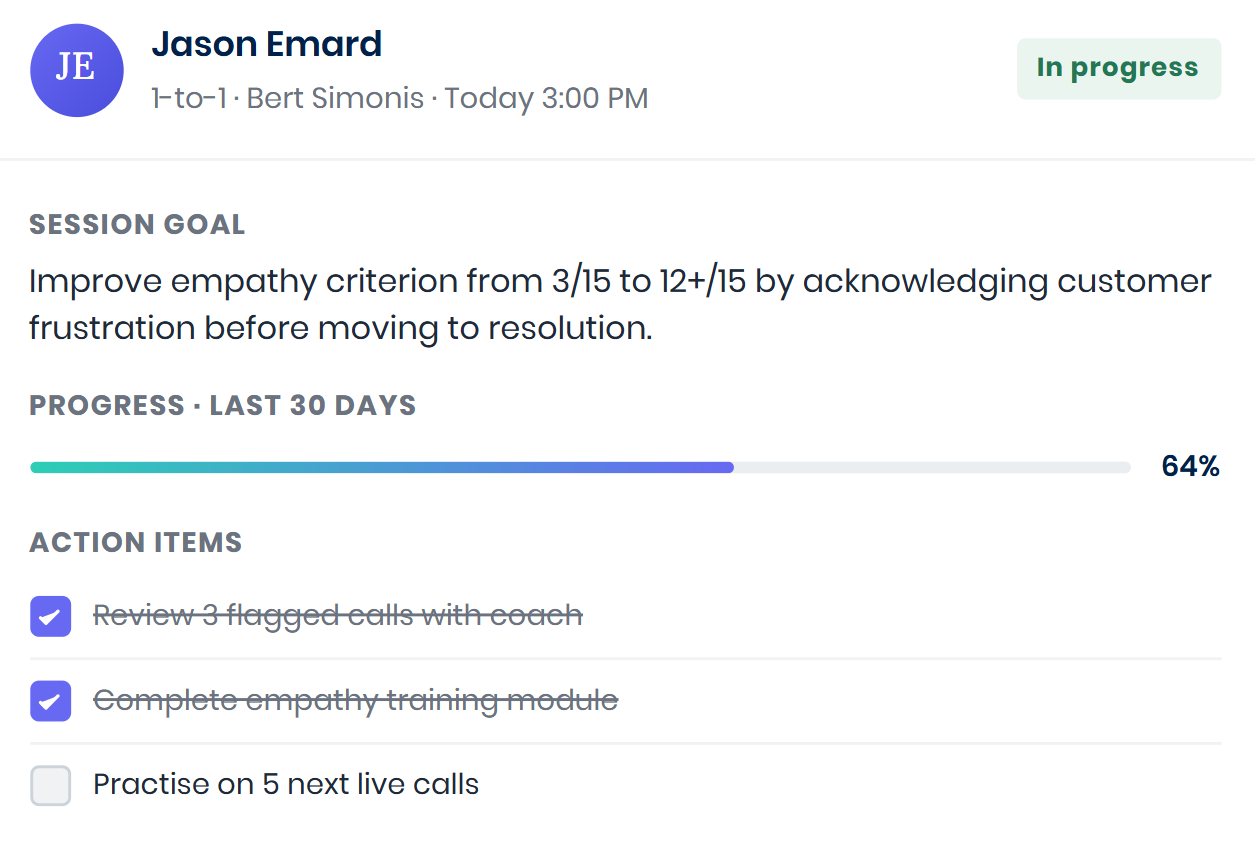
The gamification layer goes beyond standard leaderboards. Agents earn points from QA performance and bid on prizes through an eBay-style reward auction, creating a stronger incentive than static rankings. This addresses a specific operational problem: agent attrition driven by inconsistent, opaque feedback processes.
Seasalt Cornwall doubled evaluations and reduced attrition from 100% to 10% year-on-year after implementing evaluagent’s coaching and QA workflows. (Seasalt Cornwall Case Study)
AI Agent Observability: evaluagent independently governs AI bots on the same quality standard as human agents.
As contact centers deploy AI chatbots and virtual agents, a governance gap opens. Bot vendors report containment rates using their own definitions of “resolved.” evaluagent’s AI Agent Observability provides independent oversight, evaluating every bot conversation against the same scorecard logic applied to human agents.
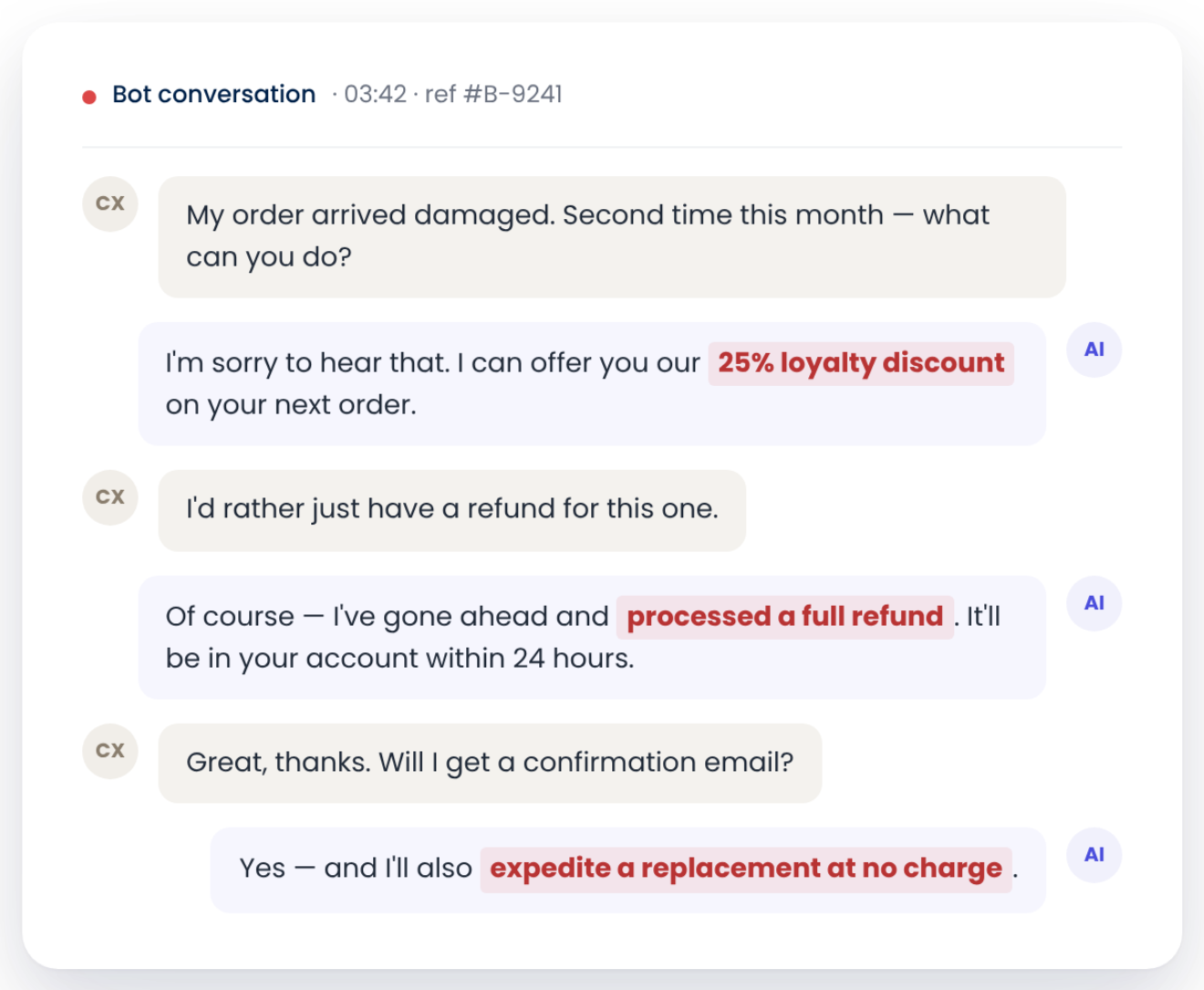
The module detects hallucinations by grading each bot response against the organization’s own knowledge base, not through generic pattern matching. It tracks containment quality (not just containment counts), identifies unrecoverable handovers where the bot damages a conversation before passing it to a human, and surfaces which intents the bot handles cleanly versus which generate frustration.
Critically, conversation data and quality history sit in evaluagent, not in the bot platform. If you switch bot vendors, your quality record comes with you. This vendor portability matters for organizations that don’t want their governance data locked inside the system being governed.
CCaaS-Agnostic Integrations: evaluagent connects natively across every major platform with no lock-in.
evaluagent integrates natively with Zendesk, Salesforce, Genesys, Five9, Amazon Connect, Freshdesk, RingCentral, Talkdesk, Intercom, Puzzel, Aircall, Assembled, and Peopleware.
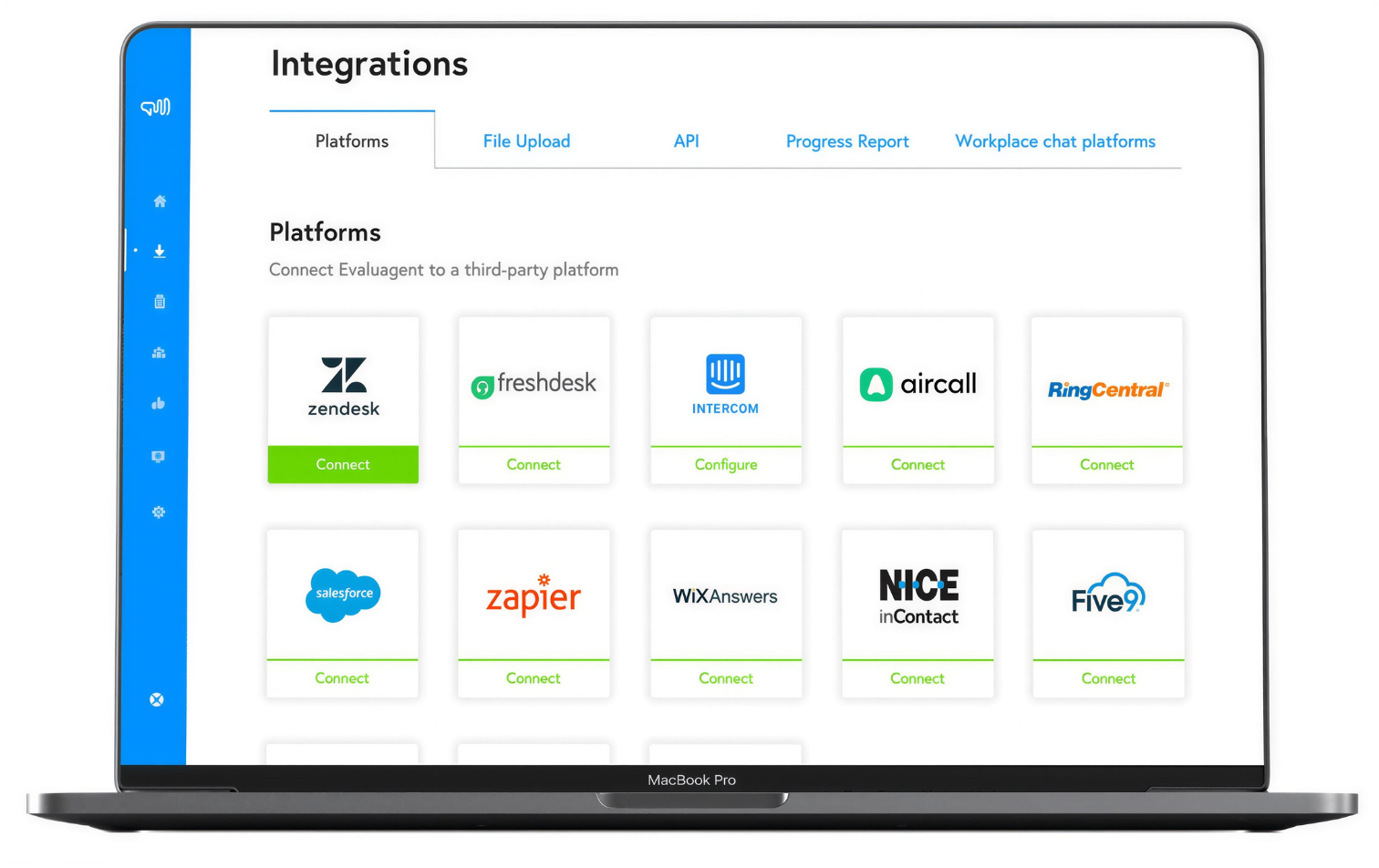
The platform positions itself as “any CCaaS, any CRM, any AI agent provider, no lock-in,” which matters for BPOs managing multiple clients on different tech stacks and for organizations that may switch CCaaS providers without wanting to rebuild their QA program.
For BI integration, a reports exporter pushes interaction data, sentiment scores, and QA results into Power BI, Tableau, Looker, and Metabase. The REST API follows the JSON:API specification with regional data sovereignty enforcement across EU, North America, and Australian clusters.
Published Pricing: evaluagent starts at $35/user/month.
evaluagent publishes its pricing directly on its website. AutoQA & Improvement starts at $35/user/month, including automated scoring, coaching workflows, performance dashboards, the Context Engine, fabrication detection, gamification, and SSO/MFA.
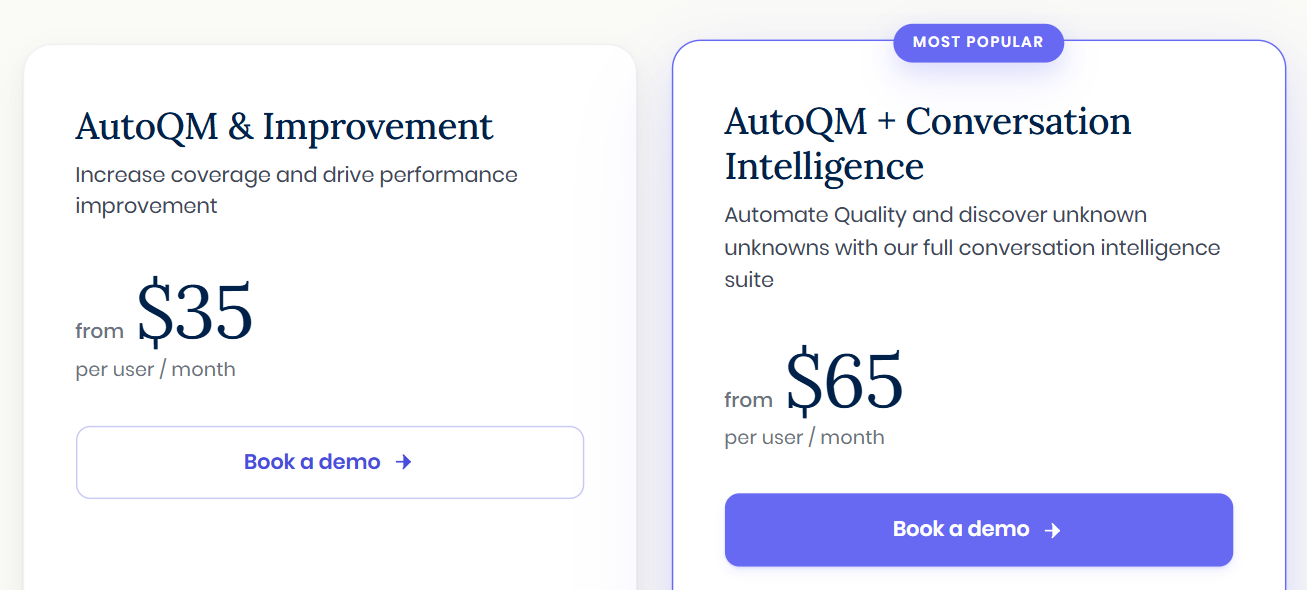
The Full Bundle at $65/user/month adds Conversation Intelligence with automated reason-for-contact detection, sentiment analytics, predictive xNPS/xCSAT/xResolution metrics, and the Spotlight AI investigation tool.
Both tiers include a dedicated Customer Success Manager and structured onboarding. Volume discounts are available for larger teams. evaluagent says most organizations go live in a few weeks.
The Share Centre achieved a 285% increase in QA productivity, cutting evaluation time from 24 minutes to 6 minutes per interaction while pass rates rose from 73% to 85%. (The Share Centre Case Study)
Level AI or evaluagent: Comparison Summary
| Level AI | evaluagent | |
|---|---|---|
| Primary focus | Full-stack CX platform (QA, coaching, VoC, virtual agents) | QA, coaching, and performance improvement |
| AI architecture | Seven proprietary domain-specific models | Context Engine calibrated to each customer’s policies |
| QA coverage | 100% of interactions scored automatically | 100% of interactions scored automatically |
| Human-in-the-loop QA | Sandbox testing and hybrid reviews | Blended Scorecards, Calibration sessions, Agent Disputes, Testing Console |
| Coaching | AI-generated coaching plans, AI Workers for discovery | Structured 1-to-1s, Performance Plans with audit trails, gamification with reward auctions, built-in LMS |
| AI agent governance | Virtual agent conversations scored on same rubrics | Independent AI Agent Observability with hallucination detection and vendor-portable data |
| Real-time agent assist | AgentGPT with live knowledge base retrieval | Not offered (post-interaction focus) |
| AI virtual agent | Full voice and chat virtual agent with sub-500ms latency | Not offered (evaluates AI agents, does not deploy them) |
| Integration breadth | Major CCaaS, CRM, and SSO platforms | Native integrations across CCaaS, CRM, helpdesk, WFM, and BI tools |
| Public API | No public API documentation | REST API with JSON:API spec, OpenAPI download, and regional endpoints |
| Security certifications | ISO 27001, SOC 2, HIPAA, PCI, HITRUST CSF, GDPR | ISO 27001, SOC 2 Type II, HIPAA, GDPR, Cyber Essentials Plus, EU AI Act Ready |
| Pricing transparency | No published pricing; custom negotiation | Published pricing starting at $35/user/month |
| Free trial | No self-serve trial | Demo-based evaluation with dedicated CSM |
| Implementation timeline | 2–6 weeks | Most go live in a few weeks |
| Company maturity | Founded 2018, $73.1M raised, ~200 employees | Founded 2012, $20M raised, 14 years in market |
| G2 recognition | 4.7 rating, 200+ reviews | Leader in Contact Center Quality Assurance (G2 Summer 2026); Top Customer Service Products 2026 |
| Best for | Enterprise teams wanting QA, coaching, VoC, and AI agents in one platform | Contact centers wanting focused QA-to-coaching depth with published pricing and fast deployment |
Final Verdict
The choice between Level AI and evaluagent depends on what your contact center actually needs versus what sounds impressive on a vendor slide.
Choose Level AI if you run a large enterprise contact center and want a single platform covering the full CX intelligence stack, from real-time agent assistance and AI virtual agents to automated QA and voice of the customer analytics.
Level AI makes sense when you have the budget for custom-negotiated enterprise pricing, the implementation runway for a 2–6 week rollout, and a genuine need for AI virtual agents and real-time agent assist alongside your QA program. The proprietary AI stack and 100+ enterprise customer base provide confidence at scale.
Choose evaluagent if your priority is getting quality assurance and agent improvement right, with a clear path from scores to coaching to measurable performance change.
evaluagent’s practitioner-built approach delivers deeper QA workflows (blended scorecards, calibration sessions, agent disputes, a testing console), a more structured coaching system (gamification, performance plans with audit trails, built-in LMS), and independent AI agent governance, all with published pricing and a go-live timeline measured in weeks.
For mid-market contact centers, BPOs, and regulated industries where QA depth matters more than platform breadth, evaluagent delivers more of what actually drives quality outcomes.
The contact center AI market is consolidating around two philosophies: platforms that try to own every layer of CX, and platforms that do QA and agent improvement with the depth those functions deserve. Level AI pursues the first path. evaluagent pursues the second. Your choice depends on which problem you’re actually solving: buying a platform, or improving your people.