If you’re comparing ScorebuddyCX vs Zendesk for contact center quality assurance, the first question isn’t which tool scores conversations better. It’s whether you need a dedicated QA platform at all, or whether a QA module inside your existing service stack is enough.
That distinction shapes everything else. Here’s what you should be asking:
- Do you want QA built into your service platform, or an independent quality layer that works across any platform you use?
- Is scoring 100% of conversations enough, or do you need that scoring to connect directly to coaching, training, and agent development?
- Are you deploying AI agents (chatbots, voice bots) that need independent quality oversight, separate from the bot vendor’s own metrics?
- How important is it that your QA platform stays with you if you switch your CCaaS or helpdesk provider?
- Do you need QA that works across multiple contact center tools, or are you fully committed to a single ecosystem?
In short, here’s what we recommend:
ScorebuddyCX is a dedicated QA and CX intelligence platform built by quality assurance practitioners. It covers AI auto scoring, conversation analytics, coaching, and a built-in learning management system in one place. Its 90%+ AI Auto Scoring accuracy and credit-based consumption model let teams scale coverage without scaling QA headcount. ScorebuddyCX works well for mid-market contact centers moving off spreadsheets, particularly in regulated industries where configurable compliance scorecards and audit trails matter. However, its CCaaS integrations are locked to higher pricing tiers, its Open API requires the most expensive plan, and users report occasional stability issues under heavy load.
Zendesk is a full customer service platform that includes QA as one module in a much larger system. Its AutoQA scores 100% of interactions across human and AI agents, with Spotlight flagging churn risks and escalations in real time. If your contact center already runs on Zendesk, the QA add-on gives you quality scoring without a separate vendor, a separate login, or a separate integration project. The trade-off: Zendesk QA is tightly coupled to the Zendesk ecosystem. If your organization uses multiple contact center platforms, or needs more QA depth than an add-on module provides, you’ll hit its limits.
Both platforms deliver automated quality scoring. But they represent two different philosophies: Zendesk bundles QA into its service platform, while ScorebuddyCX builds QA as the primary product. A third option takes the dedicated QA approach further.
evaluagent is a quality assurance and performance management platform designed for contact centers running hybrid human-and-AI workforces. Its AutoQA scores 100% of conversations across voice, chat, and email, calibrated to each organization’s own QA standards through the Context Engine, which grounds every AI score in company-specific policies, knowledge base content, and compliance rules. Where evaluagent stands apart is in connecting scoring directly to structured coaching, performance improvement plans, gamification, and eLearning, closing the loop from insight to measurable agent development without leaving the platform. Its AI Agent Observability module independently evaluates chatbot and virtual agent conversations for hallucinations, off-policy responses, and compliance breaches using the organization’s own quality standards rather than the bot vendor’s metrics. And because evaluagent integrates natively with Zendesk, Salesforce, Genesys, Five9, Amazon Connect, and more, it works as the independent quality layer across whatever service infrastructure you already have, including Zendesk itself.
If a CCaaS-agnostic QA platform with built-in coaching and AI agent governance sounds like what your team needs, see how evaluagent works.
ScorebuddyCX vs Zendesk QA vs evaluagent at a glance
| ScorebuddyCX | Zendesk QA | evaluagent | |
|---|---|---|---|
| Primary focus | Dedicated QA & CX intelligence platform | QA module inside a service platform | Dedicated QA & performance management platform |
| AI Auto Scoring | 90%+ accuracy, credit-based consumption | 100% coverage with AutoQA, no-code custom categories | 100% coverage with SmartScore, Context Engine calibration |
| Bot/AI agent QA | QA for Bots with hallucination detection | AI Agent QA with human/AI side-by-side scoring | AI Agent Observability with cross-vendor scoring and fabrication detection |
| Coaching | In-platform coaching with GROW/OSKAR/CLEAR frameworks | Targeted coaching assignment (1:1 and group) | Structured 1-to-1s, performance plans, gamification, eLearning |
| Conversation analytics | Cx MOMENTS engine with topic and sentiment analysis | Explore dashboards with Quick Reports | Conversation Intelligence with Spotlight and predictive xNPS |
| Platform independence | Works with 6 CCaaS platforms and standard helpdesks | Zendesk ecosystem only | CCaaS-agnostic with native integrations across major platforms |
| Security certifications | ISO 27001, SOC 2 Type 2 | SOC 2 Type II, ISO 27001, ISO 27018, HIPAA BAA | SOC 2 Type II, ISO/IEC 27001:2022, Cyber Essentials Plus, HIPAA-aligned |
| Free trial | 14-day free trial | 14-day free trial (Suite Professional) | Demo-based; trial available on request |
| Starting price | Custom quote (per seat, tiered) | $50/agent/month add-on (requires Suite plan from $55/agent/month) | From $35/user/month |
| Best for | Mid-market QA teams wanting a dedicated platform with built-in LMS | Teams already on Zendesk wanting QA without a separate vendor | Contact centers needing CCaaS-agnostic QA with closed-loop coaching and AI agent governance |
Dedicated QA platform vs built-in QA module: the fundamental choice
This comparison comes down to an architectural decision that affects everything downstream.
Zendesk QA is a $50/agent/month add-on to the Zendesk Suite. It runs inside the same platform where your agents handle tickets, chats, and calls. That means zero integration work, shared data, and one fewer vendor to manage.
For teams that live entirely inside Zendesk, this convenience is real. Zendesk’s AutoQA scores every interaction using configurable categories described in plain language, and its Spotlight module flags churn risks and stuck conversation loops as they happen, not after.
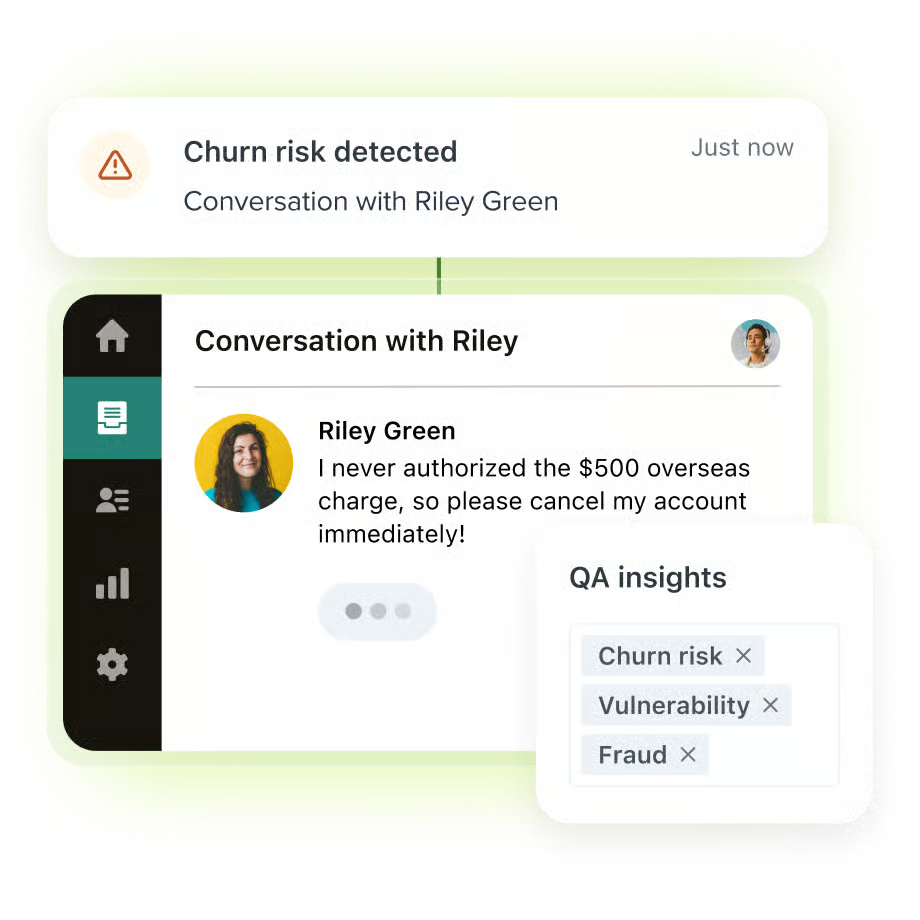
But that tight coupling becomes a constraint.
If your organization uses Genesys for voice and Zendesk for chat, Zendesk QA only sees the Zendesk side. If you switch helpdesks next year, your QA history doesn’t come with you. And if you need more QA depth than an add-on provides (structured performance improvement plans, calibration workflows, built-in eLearning), you’re adding more tools on top of Zendesk anyway.
ScorebuddyCX and evaluagent take the opposite approach: QA is the product, not a feature. They sit above your service infrastructure, pull conversations in from whatever platforms you use, and score them independently.
ScorebuddyCX connects natively to Genesys, Amazon Connect, NICE CXone, Five9, Talkdesk, and Dixa on its Accelerate and Elite tiers, plus helpdesks like Zendesk and Freshdesk on all tiers. evaluagent integrates with Zendesk, Salesforce, Genesys, Five9, Amazon Connect, Freshdesk, RingCentral, Talkdesk, Intercom, Puzzel, Aircall, and more, with no integration features locked behind higher pricing tiers.
The practical difference: if you run a multi-platform contact center, or expect to change your CCaaS provider in the next few years, a dedicated QA platform protects your quality data and scoring history from vendor lock-in. If you’re all-in on Zendesk and plan to stay, Zendesk QA removes a layer of complexity.
AI scoring approaches differ in meaningful ways
All three platforms promise automated scoring across 100% of conversations. The differences lie in how they calibrate that scoring to your organization’s standards.
Zendesk QA uses AutoQA with built-in categories like Empathy and Solution, plus custom categories that admins define by describing what to look for in plain language. No coding or model training required. It’s the fastest path from zero to automated scoring.
The limitation is depth: Zendesk QA works as a quality layer inside a service platform, not as a standalone QA program. Calibration workflows, dispute mechanisms, and granular scorecard logic are less developed than what dedicated QA platforms offer.
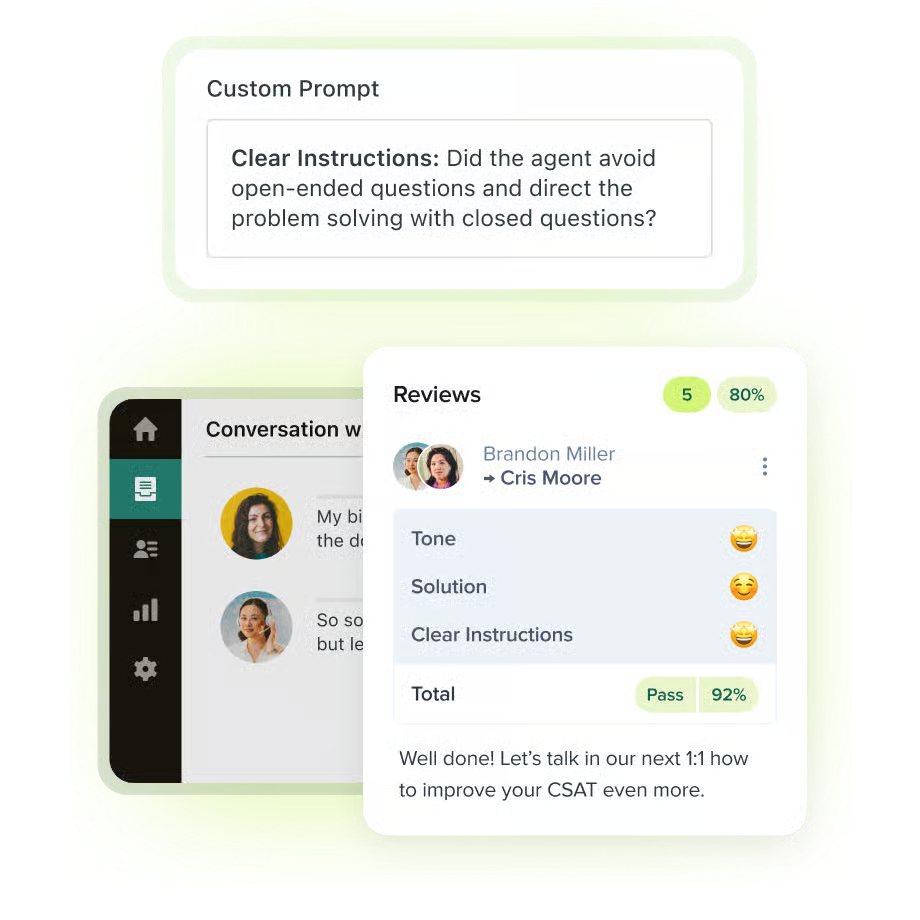
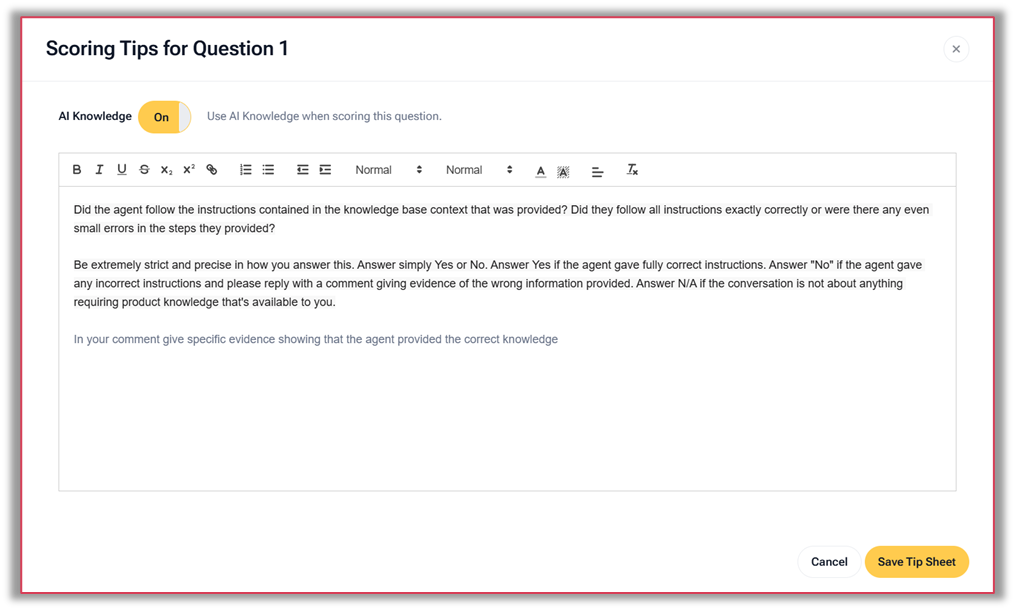
ScorebuddyCX approaches scoring through configurable Scorecards with detailed AI Scorecard Guidelines requiring short title labels, rubric-level guidance for each scoring option, and concrete performance examples.
Its AI Knowledge feature grounds scoring in uploaded knowledge base documents (PDFs up to 50 MB), so the AI evaluates agent answers against actual company policies. AI Auto Scoring runs on a credit-based consumption model, with 500 credits included monthly on Accelerate and 1,000 on Elite. Teams processing high volumes will need to model credit consumption carefully to avoid overage costs.
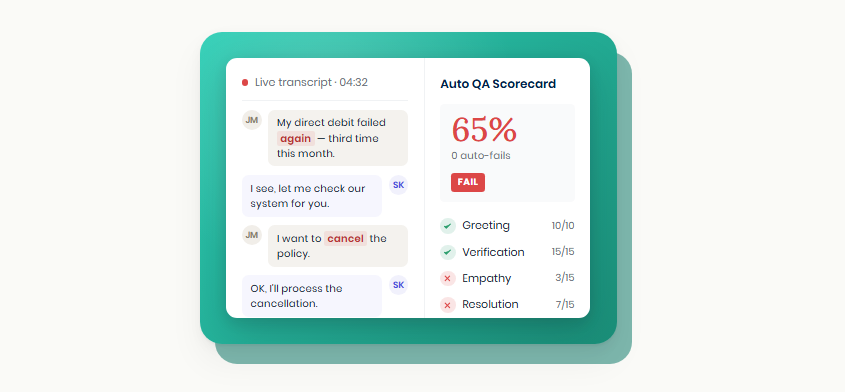
evaluagent takes calibration further with the Context Engine, which ingests QA policies, tone-of-voice guidelines, compliance rules, and knowledge base content in plain language, then lets QA managers validate any scoring change against real historical conversations in a Testing Console before it goes live.
SmartScore provides AI-generated reasoning explaining why each mark was awarded, not just the score itself. Blended Scorecards let teams assign some criteria to AI and reserve others for human evaluators on the same scorecard, and Agent Disputes create a formal feedback loop where agent challenges feed back into model improvement.
Capital on Tap scaled from 900 to 6,000 BDM checks per month immediately after going live with evaluagent’s automated scorecards, without adding QA headcount. (Capital on Tap Case Study)
AI agent governance is the emerging battleground
Contact centers are deploying chatbots and virtual agents faster every year. The question is no longer whether to use AI agents, but how to ensure they give correct, compliant, and on-brand responses. All three platforms now address this, with different levels of depth.
Zendesk QA includes AI Agent QA that scores bot conversations using the same quality standards as human agents, with side-by-side comparison views. The integration is native because Zendesk builds both the AI agents and the QA module.
But this creates a structural question: Zendesk is grading its own AI agents. For organizations that need an independent assessment of bot quality, this self-evaluation model may not satisfy compliance teams or regulators.
ScorebuddyCX offers QA for Bots, a dedicated product that evaluates chatbot conversations for hallucinations, guardrail violations, and off-brand responses.
It uses the same AI Auto Scoring engine as the human QA product, scoring each bot interaction in under five seconds. The AI Knowledge feature checks bot responses against the organization’s uploaded knowledge base to flag fabricated information. Bot and human QA coexist in a single platform, giving teams one view across both interaction types.
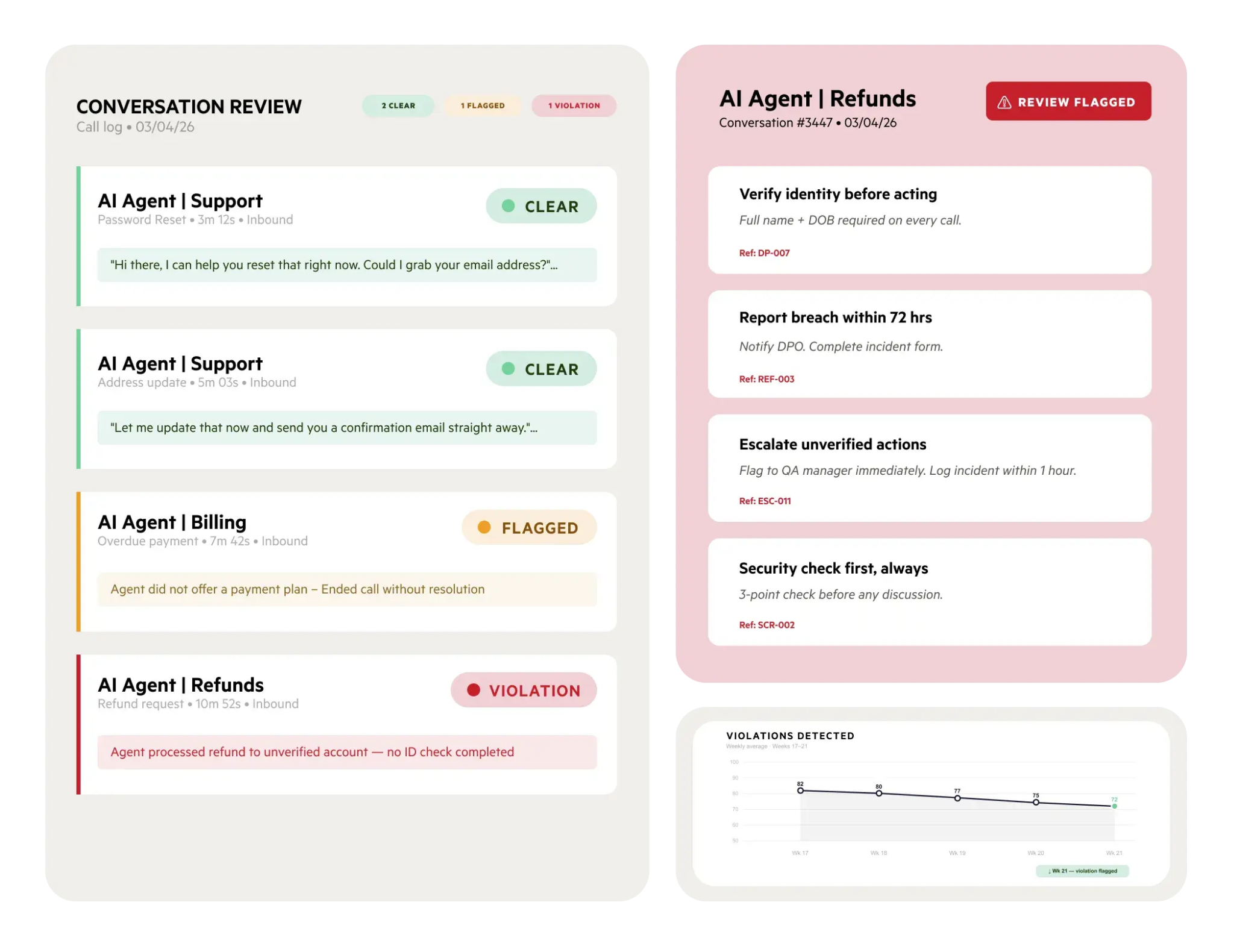
evaluagent positions its AI Agent Observability module as independent from bot vendors.
The module sits above the agent layer, not inside it, and scores conversations from multiple bot platforms (Cognigy, Sierra, Decagon, and proprietary builds) against the same quality definition. Fabrication detection grounds in the organization’s own knowledge base, not generic language model confidence thresholds. evaluagent’s reasoning is direct: a regulator or chief risk officer needs evidence that doesn’t come from the bot vendor itself.
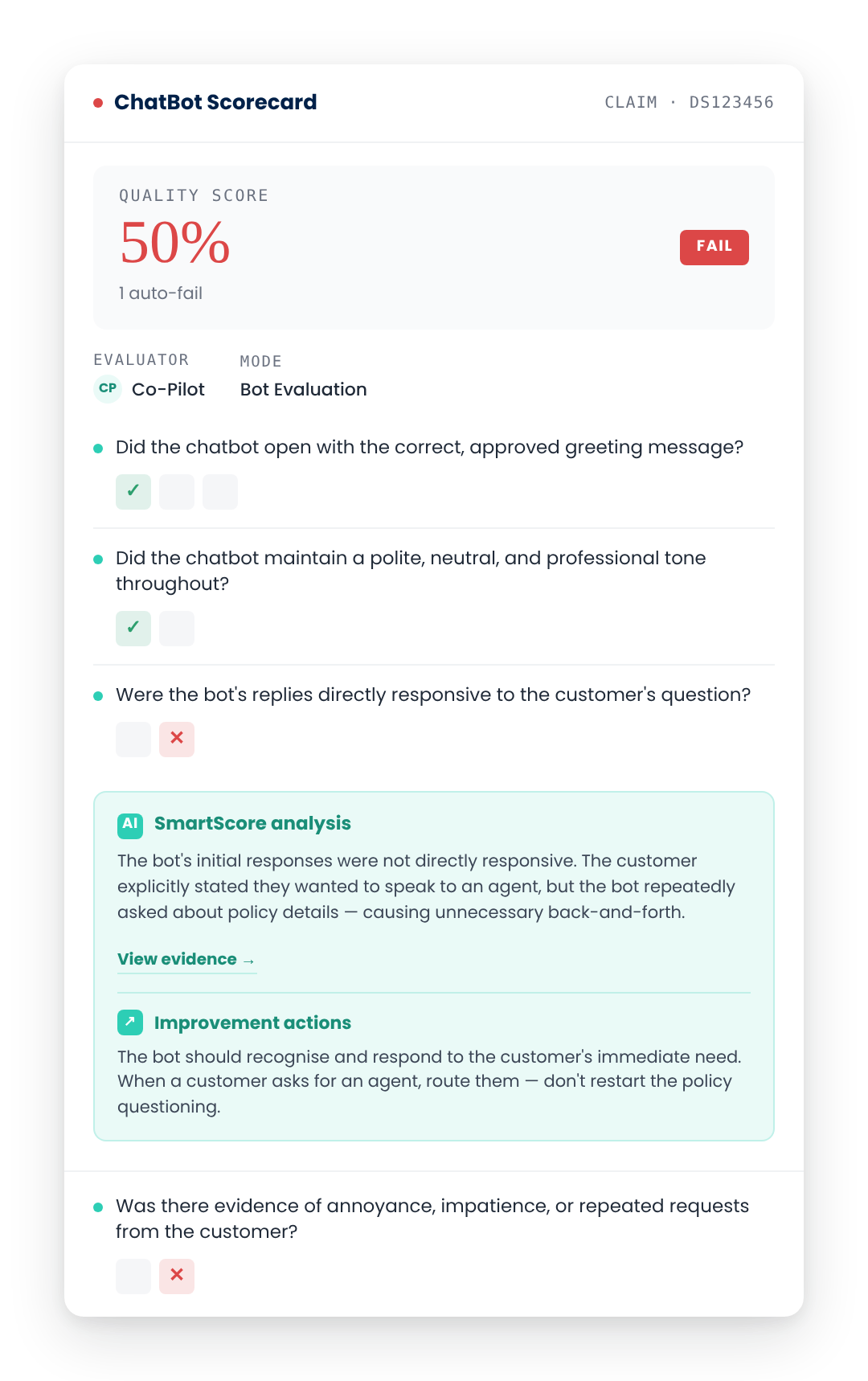
For teams using Zendesk’s own AI agents, Zendesk QA’s built-in scoring is the easiest path. For teams running bots from multiple vendors, or teams in regulated industries where independent oversight matters, evaluagent and ScorebuddyCX offer the vendor-neutral evaluation that an in-house module cannot provide.
Coaching and agent development separate the dedicated platforms
Scoring conversations is half the job. The other half is turning those scores into actual agent improvement. This is where the difference between a QA module and a QA platform becomes most visible.
Zendesk QA provides targeted coaching assignment (1:1 or group sessions) and systematic feedback delivery. It’s functional, but coaching in Zendesk sits alongside dozens of other features competing for attention in a platform built primarily for ticket resolution. Coaching is not the centerpiece of the product.
ScorebuddyCX goes further with a dedicated Coaching module available on Accelerate and Elite plans.
Managers can trigger sessions directly from scorecard evaluations, with built-in discussion templates (GROW, OSKAR, CLEAR) providing structured frameworks. The Coaching Discovery dashboard surfaces which agents and questions need coaching, with a 6-week trend view. Agents can formally acknowledge sessions and add comments, creating a two-way record.
ScorebuddyCX also offers an optional Learning Management System with AI-assisted course authoring (the company reports 90% faster course creation at 10% of conventional cost). The LMS closes the gap from identified skill deficiency to completed training without leaving the platform.
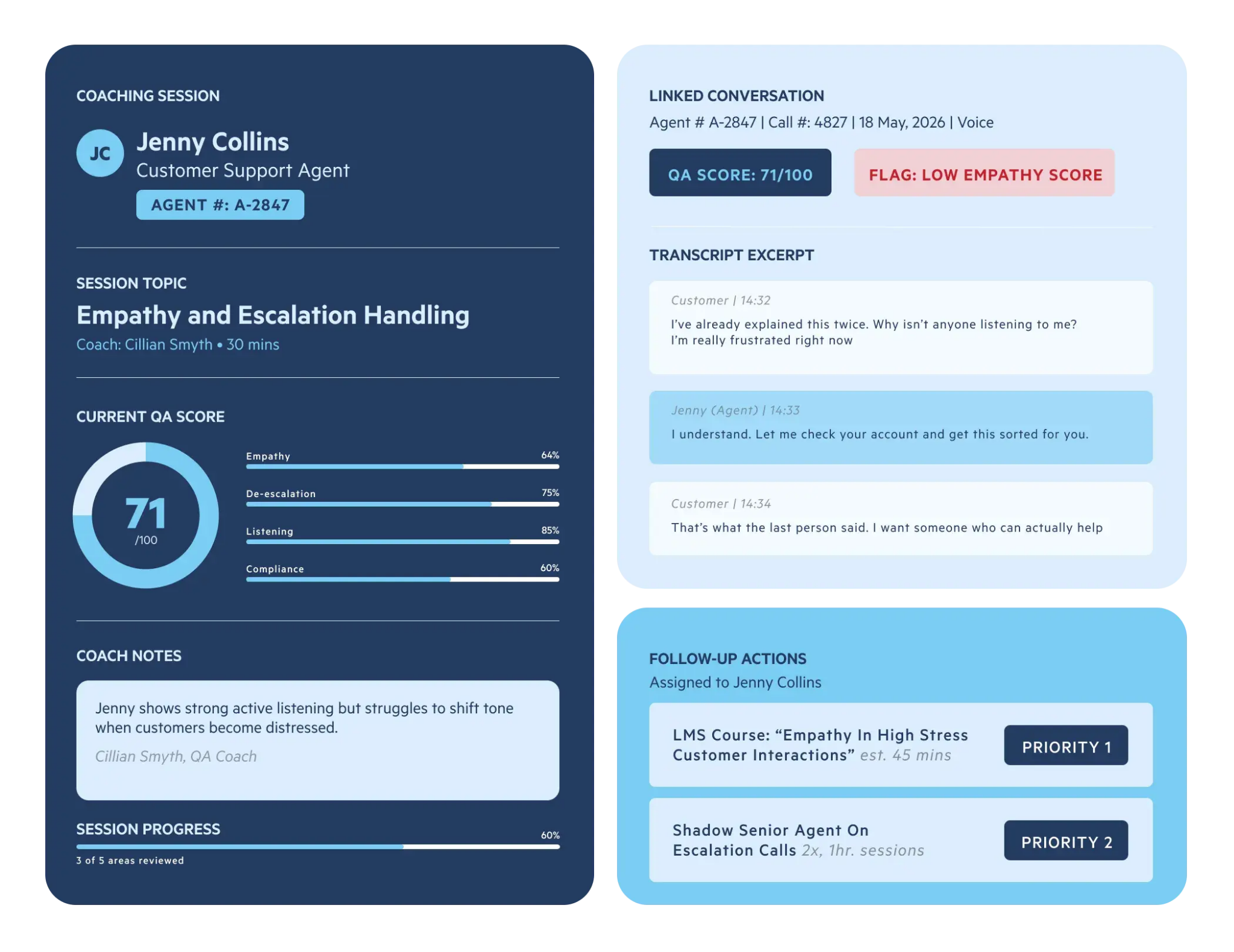
evaluagent treats coaching as a core architectural pillar rather than a feature.
Coaching and 1-to-1 sessions tie directly to conversation evidence, with progress tracked against session-specific goals. Performance Plans link coaching sessions, actions, and eLearning into an HR-ready record with a full audit trail. Automated Actions fire when a score, sentiment shift, or compliance flag meets a configured threshold, triggering coaching sessions or eLearning enrollment without manual intervention.
The built-in LMS includes interactive eLearning with auto-enrollment driven by performance metrics. evaluagent also adds a layer neither competitor matches: gamification with points, badges, leaderboards, and a reward auction where agents bid on prizes using QA-earned points.
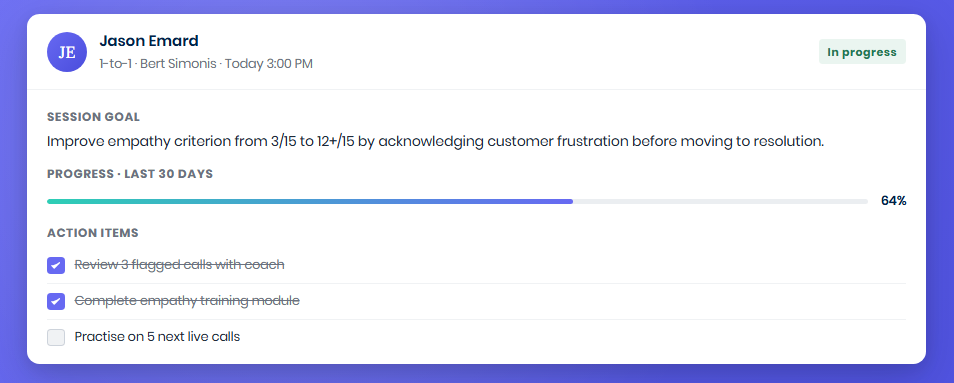
Seasalt Cornwall doubled its evaluations and reduced agent attrition from 100% to 10% year-on-year after implementing evaluagent’s coaching and quality framework. (Seasalt Cornwall Case Study)
Conversation intelligence serves different audiences
All three platforms analyze conversation data. What they do with the analysis, and who they present it to, reflects their different priorities.
Zendesk offers Explore analytics with prebuilt dashboards, custom report building, and Quick Reports where managers describe the insight they need in plain language.
Because Explore sits inside the same platform as ticketing, messaging, and voice, it can correlate QA data with ticket volume, channel mix, CSAT, and agent workload without any data pipeline. The Analyst Copilot (in early access) adds proactive trend spotting. The strength is breadth. The weakness is that QA-specific analytics are one slice of a much larger reporting system, which can make deep QA analysis harder to isolate.
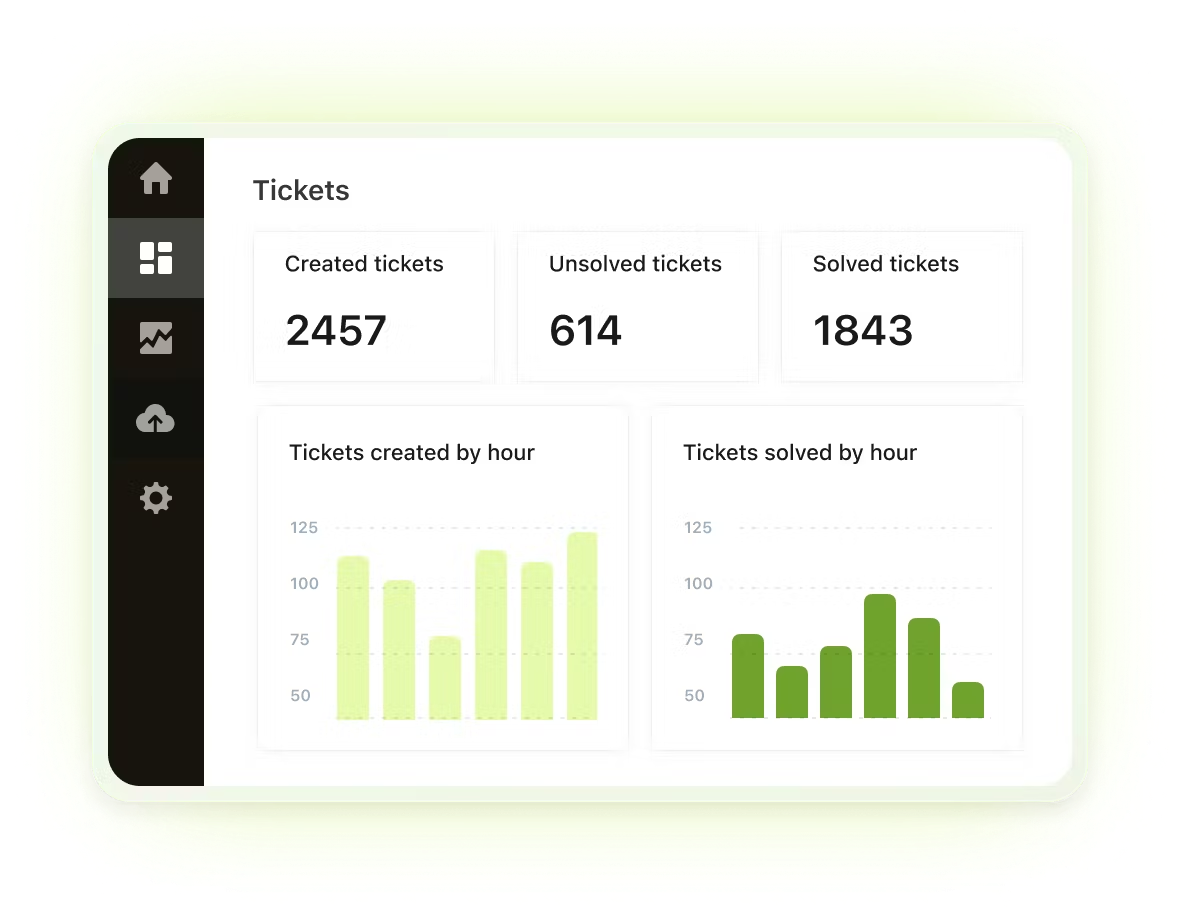
ScorebuddyCX runs its analytics through Cx MOMENTS, a text analytics product it acquired in 2021.
Cx MOMENTS classifies every conversation into topics using keyword combinations, applies sentence-level sentiment scoring on a -100 to +100 scale, and retroactively applies new topic definitions to historical data. The Voice of the Customer solution positions the contact center as a business intelligence source for product, marketing, and operations.
Conversation Analytics is available only on the Elite plan, which limits access for teams on lower tiers. Scorebuddy BI adds customizable dashboards with drill-down to individual scores, available on Accelerate and above.
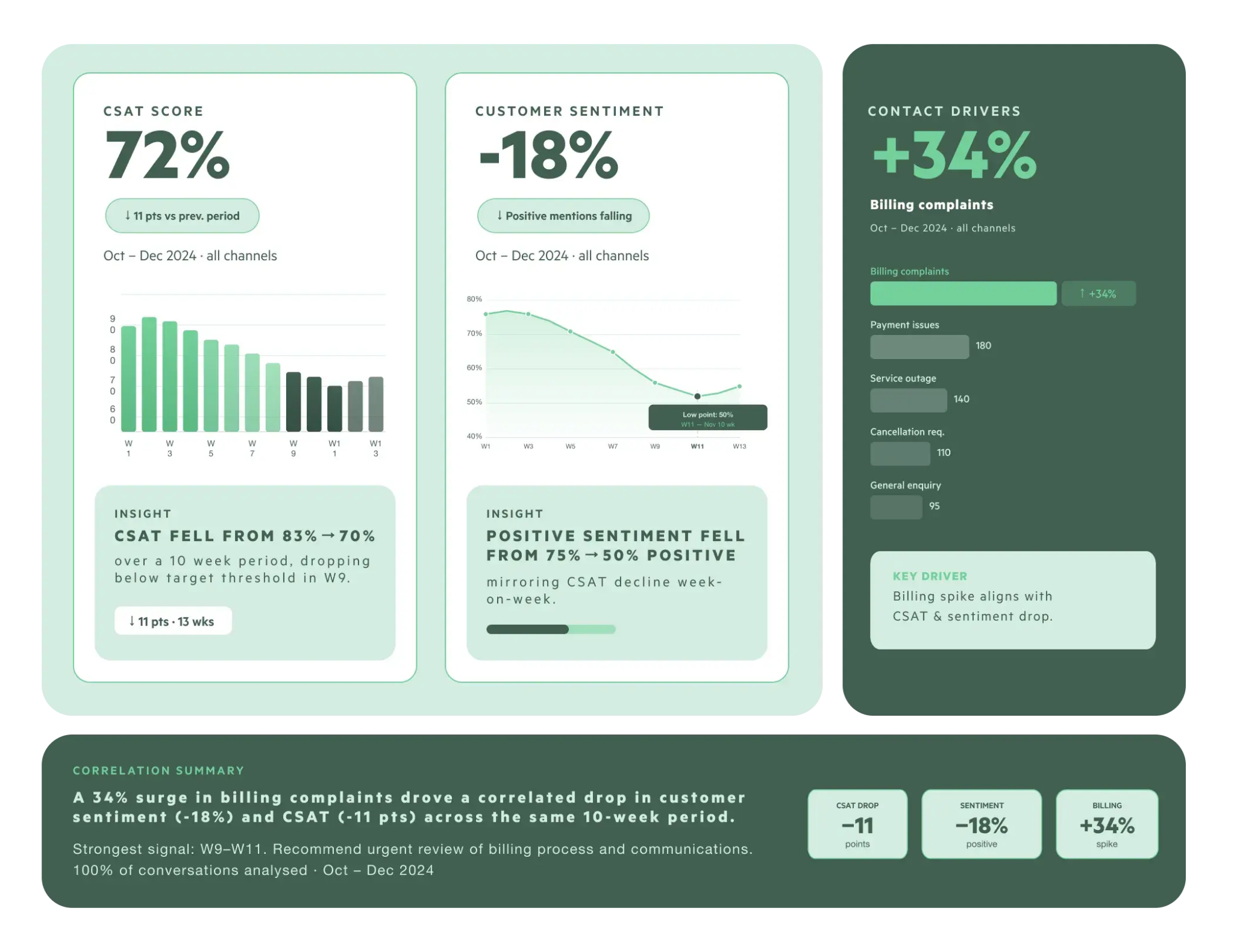
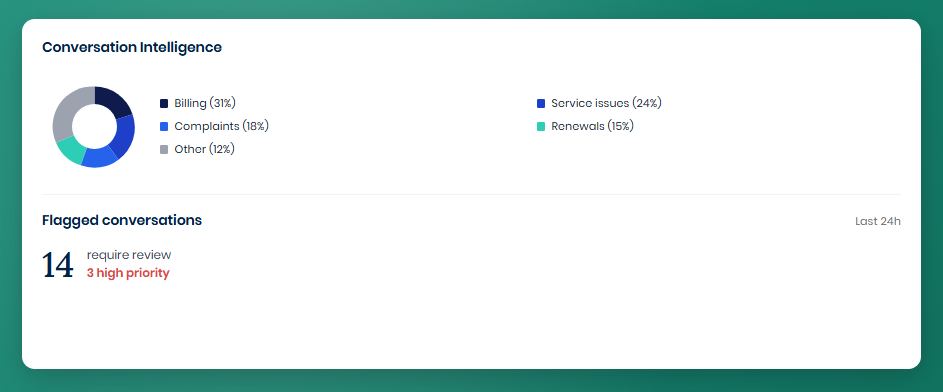
evaluagent built its Conversation Intelligence suite alongside the QA product rather than acquiring it, and bundles it into the $65/user/month Full Bundle tier.
It includes reason for contact detection, sentiment analysis, topic discovery, and predictive customer experience metrics: xNPS, xCSAT, xResolution, and xVulnerability derived from conversation signals rather than post-call survey responses. Spotlight acts as an on-demand AI analyst, reviewing up to 1,000 conversations and returning prioritized findings categorized into Critical Issues, Monitor Closely, and Performing Well.
Every insight traces back to the specific conversation moment that drove it, and evaluagent’s analytics feed directly into the QA and coaching workflows on the same platform.
Pricing structures reflect different business models
The way each platform charges reveals how it thinks about QA’s role in an organization.
Zendesk QA is a $50/agent/month add-on on top of a Zendesk Suite subscription (starting at $55/agent/month for Suite Team).
That means the minimum monthly cost for one agent with QA is $105. Zendesk bundles QA with the Workforce Engagement option at the same $50/agent/month alongside WFM. The advantage is simplicity: one vendor, one invoice.
The disadvantage is that you’re paying for an entire service platform just to access the QA module. For organizations already on Zendesk Suite, the add-on is a natural extension. For organizations using a different helpdesk or CCaaS, the combined Suite and add-on cost may not justify switching service platforms solely for QA.
ScorebuddyCX uses a per-seat, tiered subscription across three plans (Foundation, Accelerate, Elite), but publishes no prices.
Every plan requires a custom quote. AI Auto Scoring runs on a credit-based consumption model with 500 monthly AI scores included on Accelerate and 1,000 on Elite. Additional credit bundles, the LMS, and CCaaS integrations are paid add-ons or require higher tiers. Open API access, Salesforce integration, and SSO are Elite-only.
The lack of published pricing makes it hard to compare total cost of ownership without engaging the sales team. Contracts are annual with automatic renewal, and early termination triggers a charge of 80% of the average monthly fee for every remaining month.
evaluagent publishes its pricing: AutoQA & Improvement starts at $35/user/month, and the AutoQA + Conversation Intelligence full bundle starts at $65/user/month.
Volume discounts are available for large teams. All integrations are accessible at both tiers, with no features locked behind integration paywalls. A dedicated Customer Success Manager and onboarding are included at both pricing tiers, not reserved for enterprise buyers.
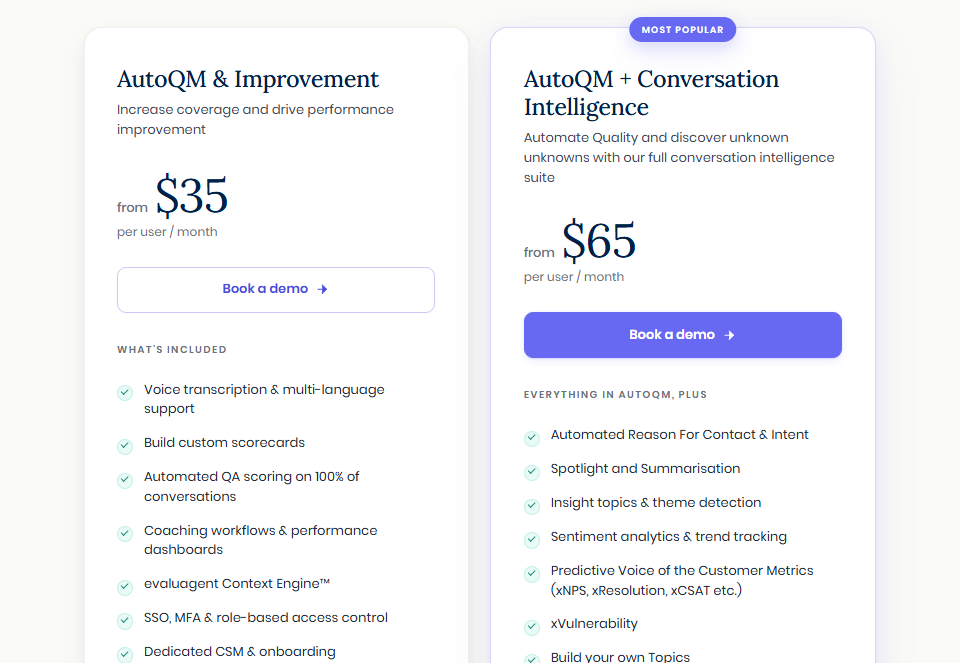
For a 100-agent contact center, the math works roughly like this: evaluagent’s full bundle would start around $6,500/month before volume discounts. Zendesk QA would cost $5,000/month for the add-on alone, plus at minimum $5,500/month for the underlying Suite (assuming Suite Team), totaling $10,500/month or more.
ScorebuddyCX’s cost is unknown without a quote, though the combination of seat fees, AI credit consumption, and add-ons (LMS, additional AI credits) means the total can climb above the published starting point.
Integration flexibility determines long-term value
Contact center technology stacks change. The QA platform that locks you into one ecosystem may save time today but create risk tomorrow.
Zendesk QA works only within Zendesk. If your organization uses Zendesk for everything, this is a strength: no setup, no integration maintenance, shared data. But if you use Genesys for voice, Salesforce for CRM, and Zendesk for chat, the QA module covers only the Zendesk channel. You’d need a separate quality solution for the rest.
ScorebuddyCX offers 20+ native connectors spanning CCaaS (Genesys, Amazon Connect, NICE CXone, Five9, Talkdesk, Dixa), helpdesks (Zendesk, Freshdesk, Intercom, LivePerson), and CRM (Salesforce, HubSpot, Kustomer).
The constraint is tiering: CCaaS integrations require Accelerate, and Open API access plus Salesforce require Elite. Foundation plan users must upload interactions manually via CSV. No iPaaS connectors (Zapier, Make, Workato) are documented.
evaluagent positions itself as CCaaS-agnostic: “Any CCaaS. Any CRM. Any AI agent provider. No lock-in.”
Native integrations span Zendesk, Salesforce, Genesys, Five9, Amazon Connect, Freshdesk, RingCentral, Talkdesk, Intercom, Puzzel, Aircall, Assembled, and Peopleware. All integrations are available at both pricing tiers. The open API supports custom integrations for platforms not natively covered, with regional API clusters (EU, North America, Australia) enforcing data sovereignty.
For BPOs managing multiple clients on different platforms, this vendor-neutral architecture means no requirement for client IT investment to deploy.
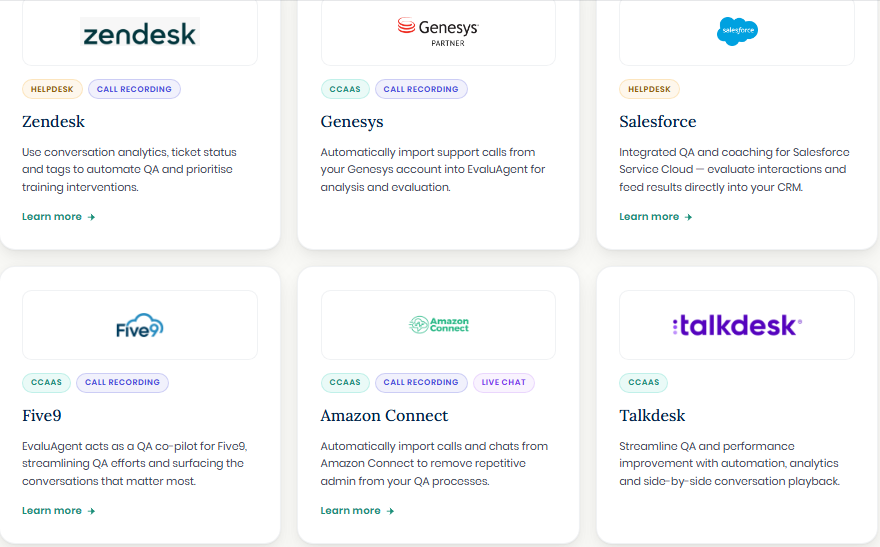
evaluagent’s native Zendesk integration means organizations can use Zendesk as their service platform and evaluagent as their QA layer. This pairing gives teams Zendesk’s ticketing, messaging, and AI agents alongside evaluagent’s deeper QA, coaching, and AI agent governance capabilities, without forcing a choice between the two.
Security and compliance readiness
In regulated industries, security certifications are not differentiators. They are prerequisites.
Zendesk holds SOC 2 Type II, ISO 27001:2022, ISO 27018:2019, and supports HIPAA BAA and GDPR with Binding Corporate Rules. FedRAMP is listed as in process. Its Advanced Data Privacy and Protection (ADPP) add-on provides additional controls for enterprise deployments. As the largest platform of the three, Zendesk’s security infrastructure is the most mature.
ScorebuddyCX holds ISO 27001 and SOC 2 Type 2. Its AI runs on Microsoft Azure AI and Amazon Bedrock within ScorebuddyCX’s own infrastructure, with customer data not shared with other customers or used to train third-party models. SSO is available on the Elite plan only. HIPAA coverage is not addressed in public documentation, which may matter for healthcare contact centers.
evaluagent holds SOC 2 Type II, ISO/IEC 27001:2022, Cyber Essentials Plus, and G-Cloud certification, and is GDPR-compliant and HIPAA-aligned. SSO and MFA are included at both paid tiers, not gated to enterprise. Data residency is selectable across UK/EU, US, and Australia, with in-region processing on AWS and PII redaction built in for text and audio. Customer data is not used to train shared or third-party models.
ScorebuddyCX vs Zendesk QA vs evaluagent: Which should you choose?
The right choice depends on your contact center’s infrastructure, priorities, and where QA fits in your operational strategy.
Choose ScorebuddyCX if:
- You need a dedicated QA platform with a built-in learning management system
- You’re a mid-market QA team moving off spreadsheets and want fast implementation
- Credit-based AI scoring consumption aligns with your volume patterns
- You want structured coaching frameworks (GROW, OSKAR, CLEAR) out of the box
- A 14-day free trial matters for your evaluation process
Choose Zendesk QA if:
- Your contact center runs entirely on Zendesk and you want QA without adding another vendor
- You value native integration with ticketing, messaging, voice, and knowledge base over QA depth
- Real-time QA (scoring during live conversations, not just after) is a priority
- You need QA as part of a broader workforce engagement strategy alongside Zendesk WFM
- You’re comfortable with QA as an add-on module rather than a primary platform
Choose evaluagent if:
- You run a multi-platform contact center and need QA that works across every CCaaS and helpdesk
- Connecting QA scores directly to coaching, performance plans, gamification, and eLearning matters to your team
- You’re deploying AI agents from any vendor and need independent quality oversight with hallucination detection
- Published pricing without integration paywalls fits your procurement process
- You want a dedicated CSM and onboarding included at every tier, not just enterprise
Book a demo to see how evaluagent connects quality to agent improvement.
The Share Centre achieved a 285% increase in QA productivity with evaluagent, cutting evaluation time from 24 minutes to 6 minutes per interaction while pass rates rose from 73% to 85%. (The Share Centre Case Study)
The contact center QA market is splitting into two camps: platforms that treat quality as a feature inside a larger system, and platforms that treat quality as the system itself. Zendesk represents the first camp, and for all-Zendesk organizations, it’s a pragmatic choice. ScorebuddyCX and evaluagent represent the second, with evaluagent’s combination of CCaaS-agnostic integration, closed-loop coaching, AI agent governance, and published pricing making it the strongest option for teams that want quality assurance to drive measurable improvement, not just generate scores.