If you’ve tried Cekura’s credit-based pricing calculator, working out whether 300 free credits will cover your evaluation needs, how many minutes $0.25 per minute buys, and whether the $500/month Startup plan gives you enough concurrent calls to stress-test before launch, you know that AI agent testing pricing can feel like budgeting for a resource you haven’t consumed yet.
Cekura has established itself as the testing and observability layer for voice and chat AI agents, trusted by 70+ conversational AI companies including Five9, PwC, and Deloitte. The platform’s “test, monitor, and self-improve” loop connects pre-production simulation with production call monitoring and automated prompt optimization, giving engineering teams one system for catching failures before and after deployment. But as Cekura has expanded from a voice testing tool into a full lifecycle platform, its credit-based model requires teams to forecast usage across testing minutes, monitored calls, and chat replies, a calculation that grows harder as agent deployments scale.
We’ve analyzed Cekura’s pricing tiers, credit system, and feature access. We believe it’s the right choice if:
- You’re building or deploying AI voice agents on platforms like Vapi, Retell, or ElevenLabs
- Your primary need is pre-production simulation and load testing before agent launches
- You have engineering resources to manage credit consumption and CI/CD integrations
- You need to stress-test voice infrastructure at scale with hundreds of concurrent calls
- Your team wants automated prompt optimization driven by test results
However, Cekura’s pricing might not be a good choice if:
- Your contact center runs both human agents and AI agents and needs unified quality assurance across both
- You need coaching, performance improvement plans, and agent development workflows tied to quality scores
- Your QA program requires structured scorecards, calibration sessions, and compliance audit trails
- You want conversation intelligence (sentiment analysis, reason-for-contact detection, and predictive customer satisfaction scores) across all interactions
- You need a platform-agnostic quality layer that works with any CCaaS, helpdesk, or CRM
In this case, consider evaluagent: a contact center quality assurance and performance management platform that scores 100% of conversations automatically across human and AI agents, connects evaluation findings to coaching and development workflows, and provides conversation intelligence that surfaces operational insights from every interaction.
We’ve included a detailed pricing comparison with evaluagent in this review, as the best choice for contact centers seeking unified quality management. If you’re eager to jump into the evaluagent pricing breakdown, go ahead and do so with this link.
Cekura Pricing Summary
| Cekura | evaluagent | |
|---|---|---|
| Free Plan | • $0/month • 300 free credits (~60 min voice testing) • 10 concurrent calls • 1 project, 1 seat | • No free plan • Demo-based evaluation • Free trial available on request |
| Entry Plan | • Pay As You Go: $0.25/min voice testing • $0.05/monitored call • $0.025/chat reply • Email support | • AutoQM & Improvement: $35/user/month • 100% automated scoring • Coaching & performance plans • Dedicated CSM |
| Mid-Tier | • Startup: $500/month • 10,000 credits included • 50 concurrent calls • 10 seats, 5 projects | • AutoQM + Conversation Intelligence: $65/user/month • Full analytics suite • Predictive xNPS/xCSAT • Spotlight AI analyst |
| Enterprise | • Custom pricing • Annual contracts • VPC/on-prem deployment • Named engineer support | • Custom pricing • Volume discounts • AI Agent add-on from $0.05/conversation • Regional data sovereignty |
| Best For | Engineering teams testing and monitoring AI voice agents before and during production deployment | Contact centers needing unified quality assurance, coaching, and conversation intelligence across human and AI agents |
Cekura Pricing: In-Depth Overview
Cekura runs on a consumption-based pricing model built around credits. All metered usage (voice testing minutes, monitored production calls, and chat replies) draws from a credit balance.
The platform targets engineering teams building AI voice and chat agents, from startups validating their first deployment to enterprises running regulated conversational AI at scale. Beyond base credit allocations, costs scale with concurrent call capacity, seat counts, project limits, and security features that unlock at higher tiers.
Cekura Pay As You Go (Free): $0/month
| Feature | Details |
|---|---|
| Price | $0/month |
| Credits | 300 free credits (~60 minutes of voice testing) |
| Voice Testing | $0.25 per minute after free credits |
| Monitored Calls | $0.05 per production call |
| Chat Replies | $0.025 per reply |
| Concurrent Calls | 10 |
| Projects | 1 |
| Seats | 1 (additional seats $30/month each) |
| Log Retention | 30 days |
The Pay As You Go tier is Cekura’s permanent free entry point; accounts are not auto-upgraded or time-limited. The 300 free credits provide roughly 60 minutes of voice testing, enough to validate basic scenarios against one agent.
After credits run out, every action is billed at the per-unit rates. All plans include production call simulation, alerts, downloadable reports, 10+ standard metrics, unlimited Python custom metrics, API access, MCP server integration, and HIPAA and GDPR compliance.
| Pay As You Go | |
|---|---|
| Pros | Cons |
| – No monthly fee or commitment | – Only 10 concurrent calls |
| – 300 free credits to start | – Single project and single seat |
| – Full API and MCP access included | – 30-day log retention only |
| – HIPAA and GDPR compliance included | – Email support only, best-effort SLA |
Cekura Startup Plan: $500/month
| Feature | Details |
|---|---|
| Price | $500/month |
| Credits Included | 10,000 (~2,000 minutes of voice testing or ~10,000 monitored calls) |
| Concurrent Calls | 50 |
| Seats | 10 included |
| Projects | 5 |
| Log Retention | 90 days |
| Compliance | Signed BAA and DPA |
| Support | Dedicated Slack, 24-hour response SLA |
| Contract | Month-to-month, cancel anytime |
The Startup plan is the first tier with real capacity for production use. The 10,000 credits translate to roughly 2,000 minutes of voice testing or 10,000 monitored production calls (overage rates match Pay As You Go).
The jump to 50 concurrent calls enables proper load testing, and 10 seats cover a mid-size engineering team. The signed BAA and DPA make it viable for healthcare and regulated industries, and dedicated Slack support with a 24-hour response target replaces best-effort email.
| Startup Plan | |
|---|---|
| Pros | Cons |
| – Month-to-month with no long-term commitment | – $500/month is significant for small teams |
| – 10,000 credits covers substantial testing | – Overages billed at standard per-unit rates |
| – Signed BAA/DPA for regulated industries | – No VPC or on-prem deployment |
| – Dedicated Slack support with 24-hour SLA | – No SSO, SCIM, or audit logs |
Cekura Enterprise: Custom Pricing
| Feature | Details |
|---|---|
| Price | Custom (annual contracts) |
| Credits | Volume discounts |
| Concurrent Calls | Custom limits |
| Seats | Custom |
| Log Retention | Custom |
| Deployment | VPC or on-premises |
| Security | SSO, SCIM, SAML, audit logs, IP allowlisting, data residency controls |
| Support | Named engineer, white-glove onboarding, quarterly business reviews |
| AI Program | Forward-Deployed Engineering program |
Enterprise pricing requires a sales conversation and annual contract. This tier unlocks features unavailable at lower plans: VPC and on-premises deployment, enterprise identity management (SSO, SCIM, SAML), audit logs, and IP allowlisting.
The Forward-Deployed Engineering program (covering the self-improvement loop, red teaming, workflow regression suites, and vendor benchmarking) is available only at Enterprise tier. Pilot programs are available for teams evaluating at scale before committing.
| Enterprise Plan | |
|---|---|
| Pros | Cons |
| – Volume discounts on credits | – Requires annual commitment |
| – VPC/on-prem for data sovereignty | – No published pricing |
| – Named engineer and QBRs | – Self-improvement loop requires Enterprise |
| – Full security suite (SSO, SCIM, audit logs) | – Pilot evaluation may be needed before committing |
Cekura Credit System and Hidden Costs
Beyond base subscriptions, Cekura’s full costs depend on how credits are consumed:
Credit Consumption Rates:
- Voice testing: 5 credits per minute
- Chat testing: 0.5 credits per message
- Observability metric evaluation: 0.2 credits per metric
- Pre-defined standard metrics: 10+ included at 0 credits
Additional Costs to Consider:
- Extra seats on Pay As You Go: $30/month each
- Credit overages: billed at standard per-unit rates with no published hard cap
- Credit alerts are configurable to notify before balance runs out
- Sales tax is applied to purchases
- Cekura reserves the right to change prices at any time
Where Cekura Falls Short
Cekura provides solid testing and observability for AI voice agents, but its engineering-first focus creates gaps for contact centers that need to manage quality across their entire operation (human agents, AI agents, and the handoff between them):
No Human Agent Quality Assurance
- Cekura evaluates AI agents only. Contact centers where human agents handle the majority of interactions have no way to score, track, or improve those conversations within the platform
- There is no scorecard builder, no manual evaluation workflow, and no calibration mechanism for human agent QA
- Teams running hybrid operations (AI agents handling tier-one queries and humans handling escalations) cannot manage quality across both in one system
No Coaching or Performance Improvement Workflows
- Cekura identifies what went wrong but provides no structured tools to fix it at the agent level
- There are no 1-to-1 coaching sessions, performance improvement plans, learning management, or gamification features
- The self-improvement loop optimizes prompts, not people. Contact centers that need to develop their human workforce require a separate system
Limited Conversation Intelligence
- Cekura’s observability focuses on technical voice quality signals (latency, gibberish, interruptions) rather than business intelligence
- No reason-for-contact detection, predictive customer satisfaction scoring, or sentiment trend analysis across the full conversation volume
- Teams trying to understand why customers call, what topics drive volume, and where operational improvements are needed will find the analytics incomplete
Voice-First Platform with Chat Gaps
- Cekura’s heritage is voice testing, and chat features trail voice. Feature depth for text-based chat agents remains uneven
- No native integrations with mainstream helpdesk and chat platforms like Intercom, Zendesk, or Salesforce Service Cloud
- Teams running primarily text-based customer service channels face more manual setup
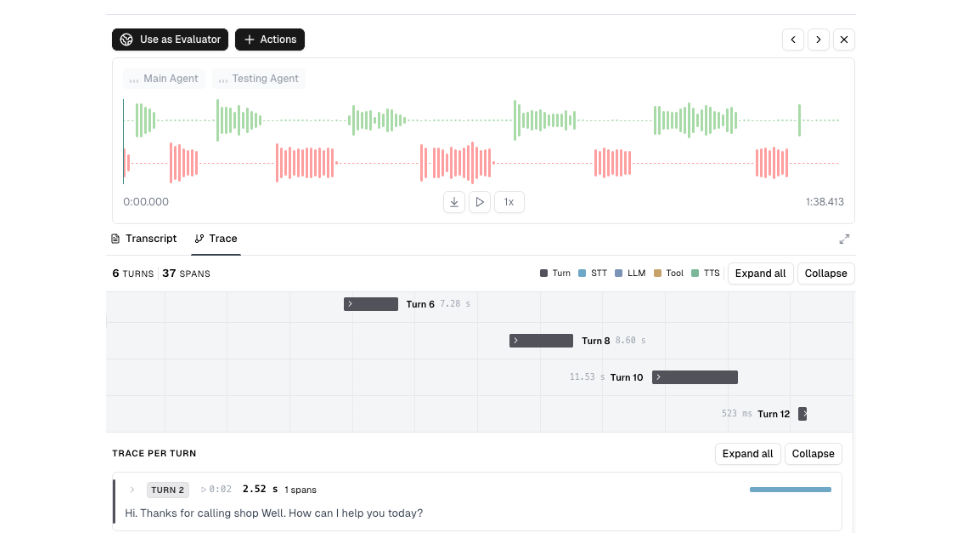
These limitations have led many contact center leaders to explore platforms that manage quality across the full agent workforce (human and AI) with coaching and intelligence built in.
Best Cekura Alternative: evaluagent
evaluagent provides unified quality assurance and performance management across every agent in the contact center, whether human or AI.
For those who find Cekura’s AI-agent-only scope, lack of coaching workflows, and limited conversation intelligence too narrow, evaluagent addresses these gaps with 100% automated conversation scoring, structured coaching and development plans tied to evaluation evidence, and a conversation intelligence suite that surfaces operational insights from every interaction.
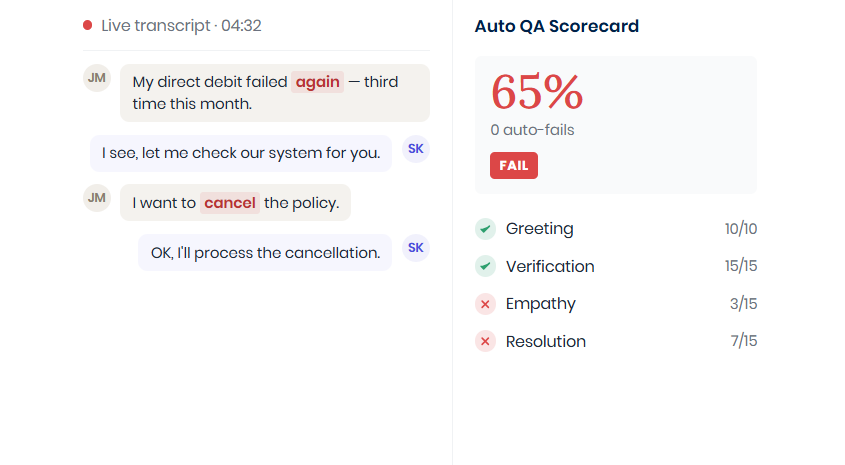
Backed by Peakspan and established over a decade ago, evaluagent serves organizations including Samsung, Jet2, Capital on Tap, and ManyPets.

The platform holds SOC 2 Type II, ISO/IEC 27001:2022, Cyber Essentials Plus, and GDPR certifications with HIPAA-aligned controls and was named to G2’s Top 50 UK Software Companies 2026 (the only contact center software on the list), with Leader recognition in Contact Center Quality Assurance in G2’s Summer 2026 report (rankings drawn from verified customer reviews, not analyst briefings).
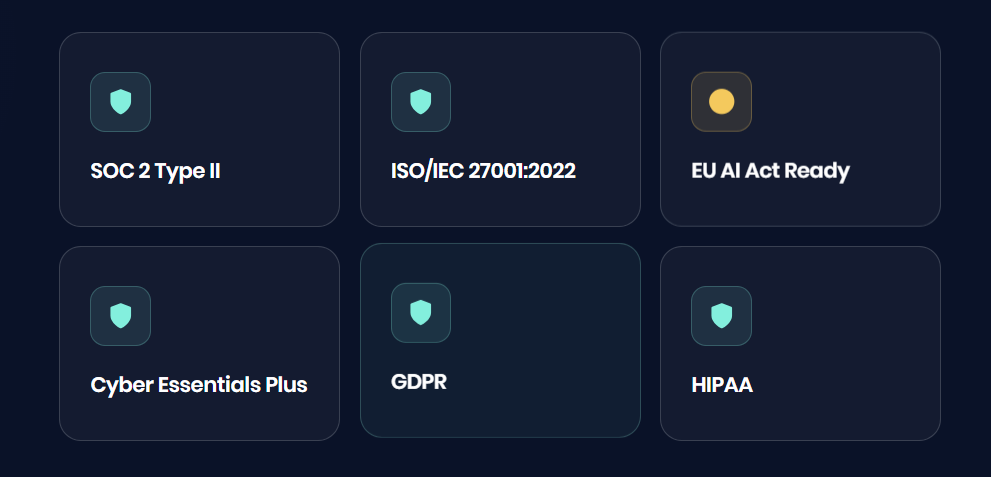
evaluagent excels for mid-market and enterprise contact centers running hybrid human-plus-AI operations, regulated industries needing compliance audit trails, and any organization that wants quality scores to drive agent improvement rather than sit in a dashboard.
evaluagent AutoQM & Improvement: From $35/user/month
| Feature | Details |
|---|---|
| Price | From $35 per user/month |
| Conversation Scoring | 100% automated across voice, chat, and email |
| Scorecard Builder | Drag-and-drop with weighted criteria and auto-fail logic |
| AI Scoring | SmartScore with transparent reasoning |
| Context Engine | Grounded in company policies and knowledge base |
| Coaching | 1-to-1s, performance plans, gamification |
| Compliance | Fabrication detection, auto-fail rules, audit trails |
| Bot QA | Included: scoring, containment analysis, handover tracking |
| Support | Dedicated CSM and structured onboarding |
evaluagent’s AutoQM tier uses published per-user pricing with all core features included. The platform scores every conversation (voice, chat, and email) using AI calibrated to the organization’s own QA standards through the Context Engine, which ingests company policies, procedures, and knowledge base articles. A Testing Console lets QA managers validate any scoring change against real historical conversations before going live.
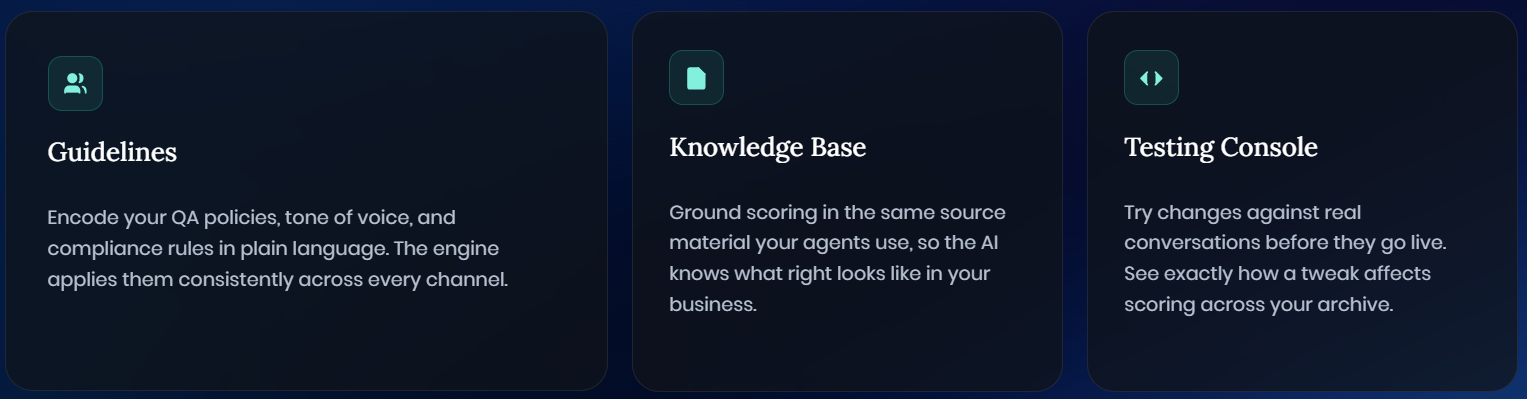
The tier also includes bot QA scoring, containment analysis, and handover tracking for AI agents at no additional per-conversation charge (AI-only conversations are priced separately from $0.05 per conversation).
| AutoQM & Improvement | |
|---|---|
| Pros | Cons |
| – Published per-user pricing with all core features included | – No conversation intelligence features |
| – 100% conversation scoring across all channels | – Volume discounts require negotiation |
| – Coaching, 1-to-1s, and performance plans included | – No free self-serve plan |
| – Bot QA included in the base tier | – Minimum scale needed (20+ agents) |
Capital on Tap scaled from 900 to 6,000 BDM checks per month immediately after go-live without adding headcount. (Capital on Tap Case Study)
evaluagent AutoQM + Conversation Intelligence: From $65/user/month
| Feature | Details |
|---|---|
| Price | From $65 per user/month |
| Everything in AutoQM | Included |
| Reason for Contact | Automated detection across all interactions |
| Sentiment Analysis | Conversation-level scoring and trend tracking |
| Predictive Metrics | xNPS, xCSAT, xResolution across 100% of contacts |
| Vulnerability Detection | xVulnerability for at-risk customer identification |
| Spotlight | On-demand AI analyst for root-cause investigation |
| Custom Topics | No-code topic builder with testing console |
The Full Bundle adds evaluagent’s conversation intelligence suite, turning every interaction into structured business intelligence. Predictive xNPS, xCSAT, and xResolution scores come from conversation signals rather than post-call survey response rates, providing satisfaction metrics across 100% of contacts rather than the fraction who respond to surveys. Spotlight analyzes up to 1,000 filtered conversations and returns prioritized findings (Critical Issues, Monitor Closely, and Performing Well) with supporting evidence.
| AutoQM + Conversation Intelligence | |
|---|---|
| Pros | Cons |
| – Predictive satisfaction metrics on every interaction | – $65/user/month is a significant investment |
| – Automated reason-for-contact detection | – Requires active engagement to deliver full value |
| – Spotlight AI analyst for on-demand investigation | – Annual contract terms are negotiated |
| – Custom topic builder without data science resource | – Enterprise features may require higher tiers |
Seasalt Cornwall doubled evaluations and reduced agent attrition from 100% to 10% year-on-year. (Seasalt Case Study)
evaluagent AI Agent Observability: From $0.05/conversation
| Feature | Details |
|---|---|
| AutoQM for AI Agents | From $0.05 per conversation |
| Full Bundle for AI Agents | From $0.13 per conversation |
| Prerequisite | Requires a seat tier subscription |
| Fabrication Detection | Grounded in organization’s knowledge base |
| Cross-Vendor Scoring | Cognigy, Sierra, Decagon, proprietary bots |
| Handover Tracking | Bot-to-human escalation quality analysis |
| Bot-to-Human Conversations | Covered by seat license at no extra charge |
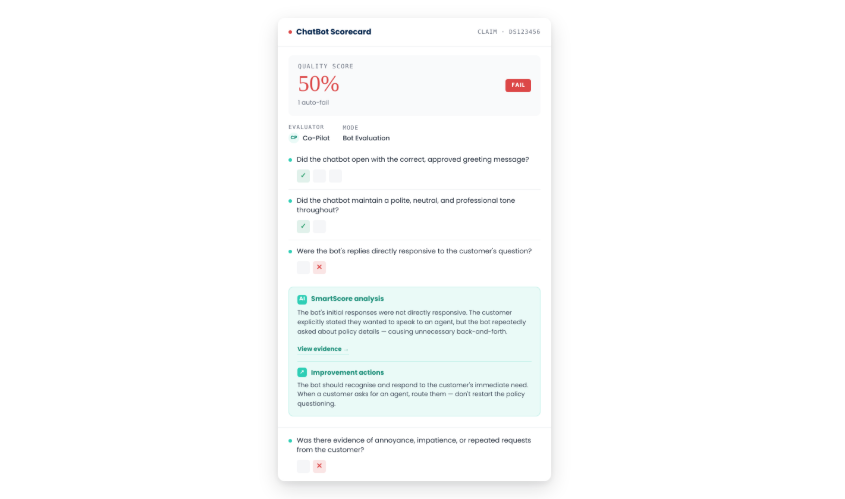
For organizations deploying AI agents alongside human agents, evaluagent’s AI Agent Observability module applies the same quality standard to bot conversations that AutoQM applies to human interactions.
Fabrication detection grades every bot response against the organization’s own knowledge base, not a generic language model. Conversations that start with a bot but end with a human agent are covered under the existing seat license, so the handover moment is always captured.
| AI Agent Observability | |
|---|---|
| Pros | Cons |
| – Same quality standard for human and AI agents | – Requires a seat tier as prerequisite |
| – Knowledge-base-grounded hallucination detection | – Per-conversation pricing adds to seat costs |
| – Cross-vendor scoring across multiple bot platforms | – Cannot be purchased independently |
| – Bot-to-human handovers covered by seat license | – Best suited for contact center deployments |
Cekura Feature Value Breakdown (vs evaluagent)
Quality Evaluation Scope
Cekura’s Approach: Cekura evaluates AI agents only. Its LLM Judge metrics score AI agent conversations across accuracy, conversation quality, customer experience, and speech quality, with pre-defined metrics for hallucination detection, transcription accuracy, sentiment, and gibberish.
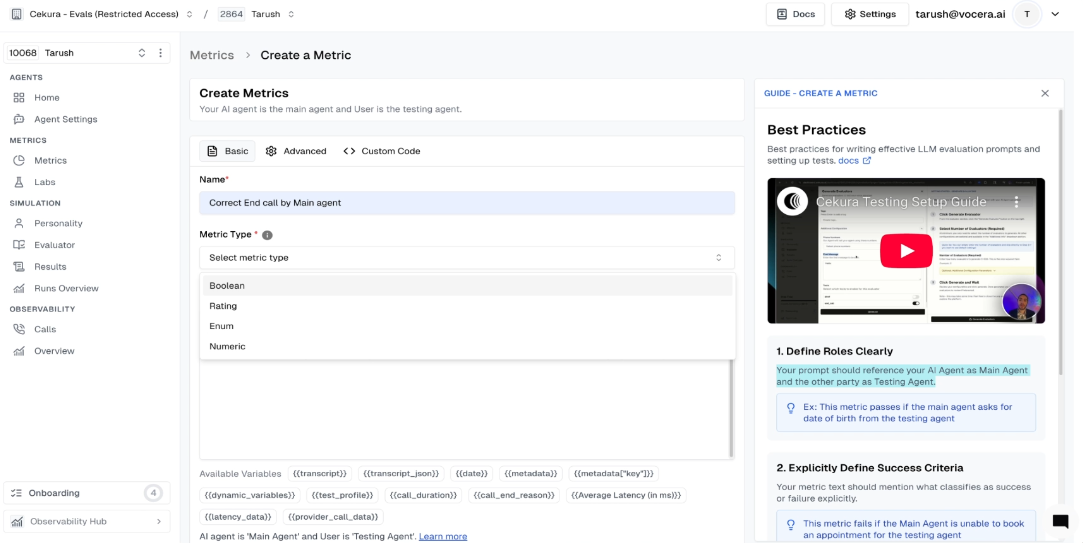
The evaluation framework works well within its scope, but that scope begins and ends with AI agent output. Human agents, hybrid workflows, and the quality of bot-to-human escalations fall outside the platform’s coverage.
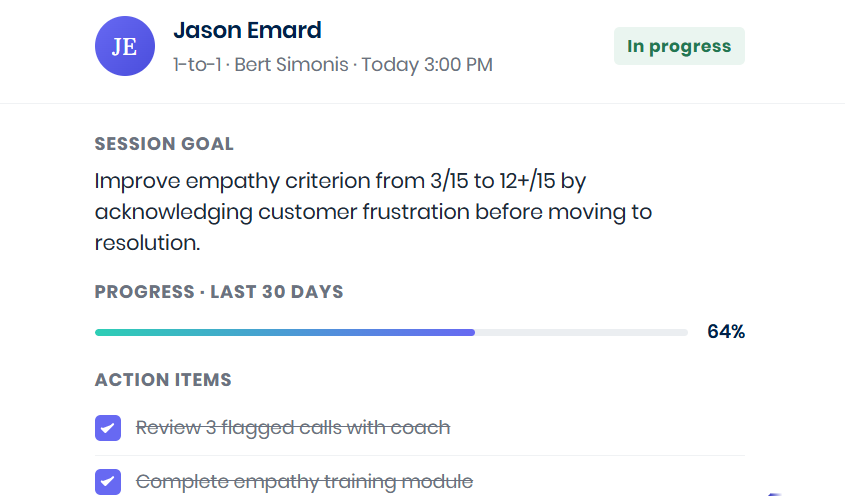
evaluagent’s Approach: evaluagent evaluates every agent, human and AI, against a single quality standard. The Context Engine calibrates AI scoring to each organization’s QA policies, compliance rules, and knowledge base. Blended Scorecards combine AI-automated checks and human evaluator judgments on the same scorecard, and Calibration sessions keep scoring consistent over time. This means an organization can compare AI agent performance against its best human agents using the same definitions of quality.
From Insight to Action
Cekura’s Approach: Cekura’s self-improvement loop is its most distinctive feature. The Optimise Prompt engine diagnoses production failures, proposes prompt changes, tests them against a cloned agent, and repeats until pass rates improve, all without touching production.
This closed loop works well for optimizing AI agent prompts but does not extend to the human side. There is no coaching workflow, no performance plan, and no way to develop the people who handle escalations or work alongside the AI.
evaluagent’s Approach: evaluagent connects evaluation findings to coaching sessions, 1-to-1s, performance improvement plans, automated lesson assignment, and gamification in a single platform. Actions fire automatically when a score, sentiment shift, or compliance flag meets a configured threshold.
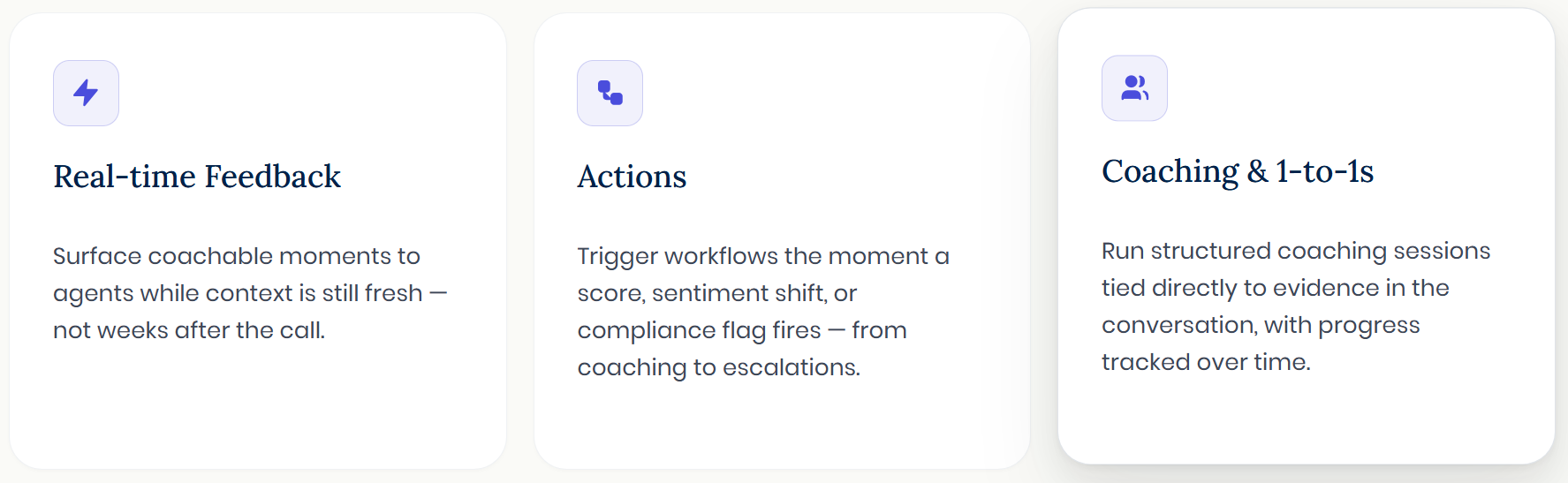
Performance Plans link evaluation evidence to development goals with a full audit trail. The loop runs from AI-scored conversation to human-reviewed coaching to measurable improvement, covering what matters most in a contact center: the people.
Conversation Intelligence
Cekura’s Approach: Cekura’s observability layer tracks technical voice quality signals (gibberish detection, interruption tracking, latency measurement, sentiment analysis, and pitch) with five alert types covering hard failures, gradual drift, threshold violations, new failure categories, and volume spikes.
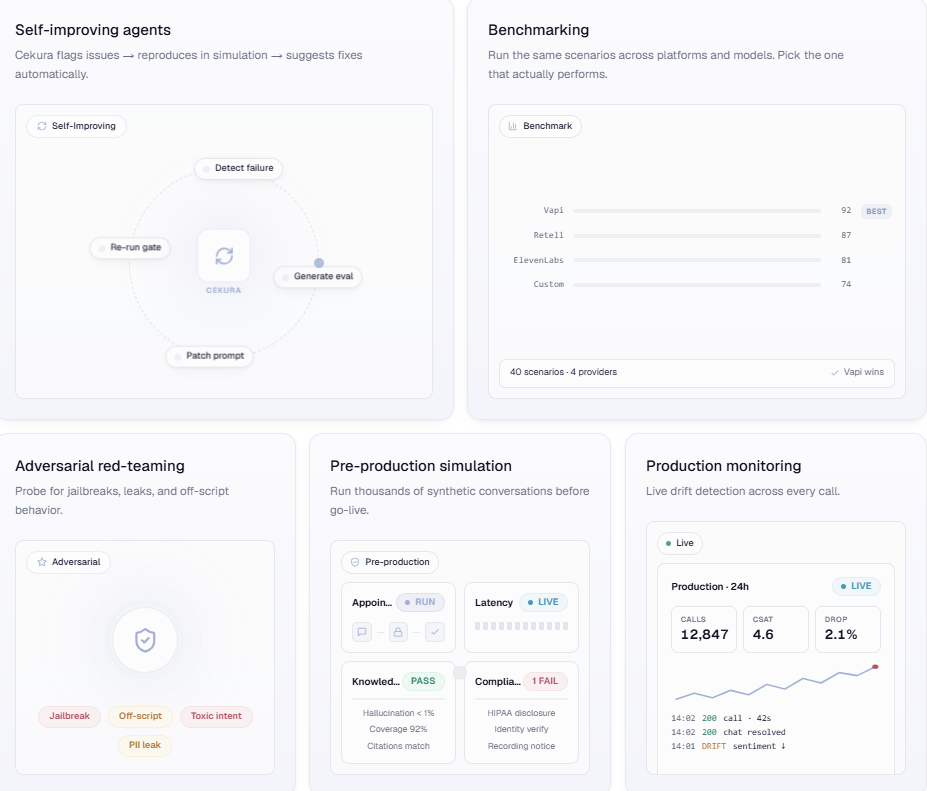
These metrics are built for diagnosing AI agent infrastructure and behavior issues but do not provide business-level conversation intelligence. There is no reason-for-contact detection, no topic clustering, and no predictive customer satisfaction scoring.
evaluagent’s Approach: evaluagent’s Conversation Intelligence module analyzes every interaction for reason-for-contact, sentiment trends, topic themes, and predictive metrics including xNPS, xCSAT, xResolution, and xVulnerability, all derived from conversation signals across 100% of contacts.
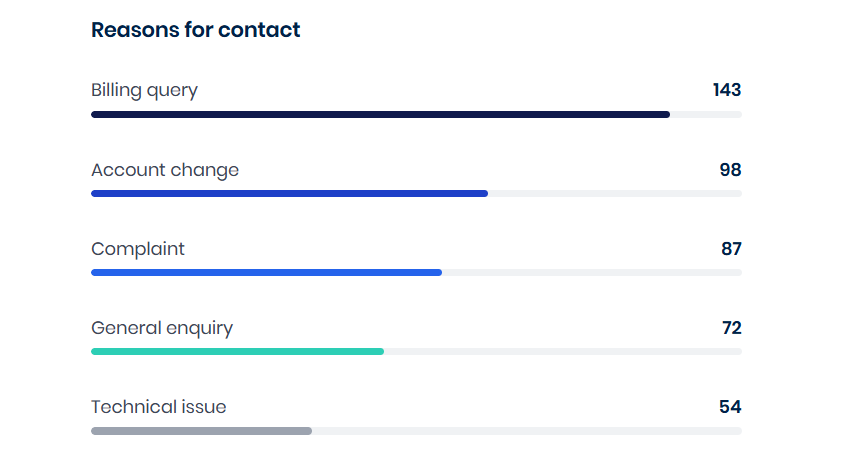
Spotlight runs on-demand investigation across up to 1,000 conversations, returning prioritized findings with evidence. Custom Insight Topics are built through a no-code interface with a testing console, requiring no data science resource.
Integration Ecosystem
Cekura’s Approach: Cekura integrates with the AI voice agent ecosystem (Vapi, Retell, ElevenLabs, LiveKit, Pipecat, Bland AI, Agora, SIP, and WebSocket) plus developer toolchain integrations with GitHub Actions and an MCP server for AI coding assistants. This makes it fast to connect for teams on supported voice platforms.

However, there are no integrations with CCaaS platforms, helpdesks, CRMs, or workforce management systems. Teams using Zendesk, Salesforce, Genesys, or Five9 for their broader contact center operations will find no native connectivity.
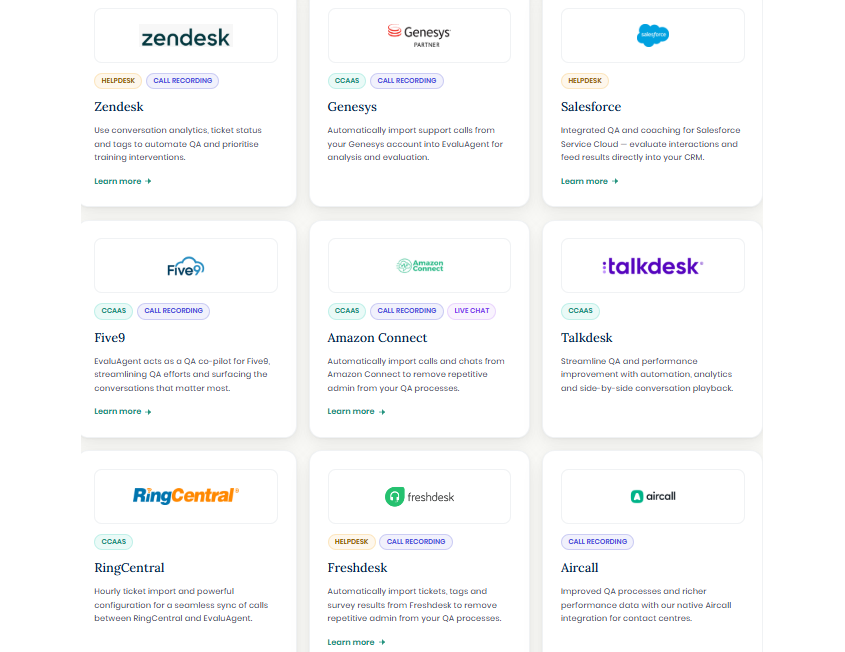
evaluagent’s Approach: evaluagent integrates with Zendesk, Salesforce, Genesys, Five9, Amazon Connect, Freshdesk, RingCentral, Talkdesk, Intercom, Puzzel, Aircall, Assembled, and Peopleware. It positions as CCaaS-agnostic, connecting to whichever contact center platform the organization uses. BI exports push data to Power BI, Tableau, Looker, and Metabase. For unlisted platforms, an open API handles custom integrations.
Final Verdict: Cekura vs evaluagent
The choice between Cekura and evaluagent depends on what you need to evaluate and what you plan to do with the results:
Cekura is an AI agent testing and observability platform for engineering teams who need to validate voice and chat agents before deployment, monitor production call quality with technical metrics, and optimize prompts through automated feedback loops.
With pricing from free to $500/month based on credit consumption, it lets teams simulate thousands of conversational scenarios, load-test voice infrastructure at scale, and catch failures before real customers encounter them. This consumption-based model works best for AI-native companies building voice agents on platforms like Vapi, Retell, or ElevenLabs, engineering teams needing CI/CD-integrated agent testing, and organizations where the primary goal is prompt optimization and infrastructure reliability.
evaluagent is a contact center quality assurance and performance management platform built on the principle that quality scores should drive improvement, not just populate dashboards. By offering AutoQM from $35/user/month with 100% automated conversation scoring across human and AI agents, structured coaching workflows, and conversation intelligence that surfaces operational insights from every interaction, it provides the complete quality-to-improvement loop that contact centers need. This makes it essential for contact centers running hybrid human-plus-AI operations, regulated industries needing compliance audit trails and fabrication detection, and any organization that understands quality assurance only delivers value when it connects to coaching, development, and retention outcomes.
Get started with evaluagent here.
The difference is scope and purpose. Cekura asks “Is our AI agent working correctly?” evaluagent asks “Is every agent (human and AI) delivering the quality our customers and regulators expect, and what are we doing about it when they’re not?”